Connecting AI agents to PostgreSQL databases securely requires more than a simple database connector. MCP (Model Context Protocol) Gateways provide the centralized control plane enterprises need to manage authentication, enforce access policies, maintain audit trails, and enable AI assistants to query databases using natural language, all without exposing credentials or compromising database integrity.
The MCP Gateway market has matured significantly, with options ranging from enterprise managed platforms to open-source solutions. Whether the priority is compliance readiness, developer velocity, or low-latency performance, choosing the right gateway determines how safely and efficiently AI agents interact with PostgreSQL data.
Key Takeaways
- MCP Gateways solve the N×M integration problem where every AI agent would otherwise need separate credentials and policies for every database
- Organizations replacing custom API wrappers with MCP gateways can reduce integration overhead by consolidating many tool connections into a single governed control plane
- Read-only PostgreSQL configuration is non-negotiable, and gateways should support tool-level controls that prevent accidental data modification
- Setup times range from minutes for managed gateways to longer implementation cycles for self-hosted options
- Product teams use MCP gateways for PostgreSQL access to enable more self-service querying while keeping authentication, access control, and auditability centralized
1. MintMCP: From Local MCP to Enterprise Deployment, Fast
MintMCP provides enterprise gateway infrastructure that transforms PostgreSQL integrations from developer utilities into production-ready services with authentication, tool-level access control, credential management, logging, and rule-based policy built in. The platform addresses critical challenges like shadow AI, scattered credentials, and lack of observability that enterprises face when deploying AI agents at scale.
Why MintMCP Fits Enterprise PostgreSQL Integration
MintMCP's one-click deployment for STDIO-based MCP servers reduces manual infrastructure work. The platform supports OAuth brokering for stdio and hosted MCP servers, with SSO and SCIM-driven RBAC helping IT teams deploy governed database access without custom authentication code.
Core Capabilities:
- SOC 2 Type II audited, compliant with HIPAA standards, penetration tested, and complete audit trails for security reviews and compliance requirements
- SSO and SCIM-driven RBAC for governed access across users, groups, and teams
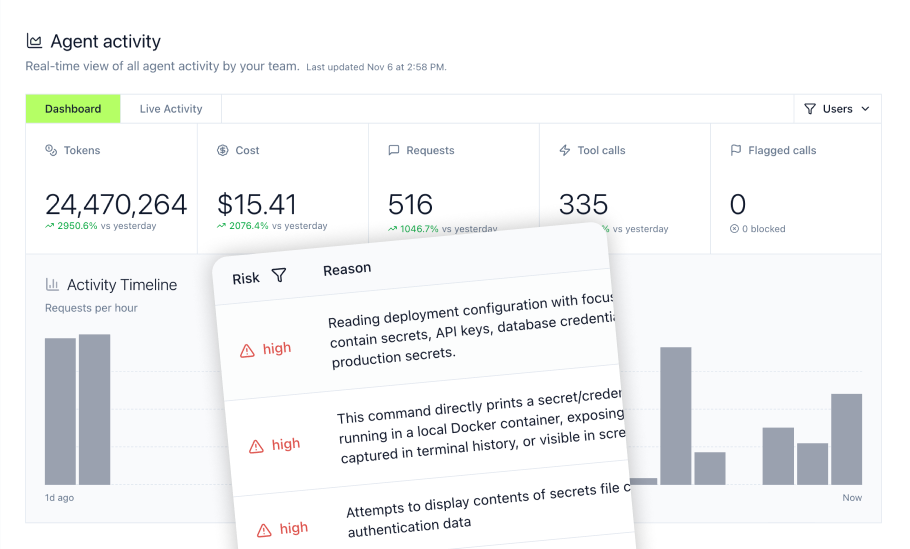
- Centralized observability dashboards tracking tool calls, activity, and access requests
- Tool-level allowlisting and rule-based policy to configure read-only operations while blocking write tools
PostgreSQL-Specific Features:
- Hosted MCP connectors and database connectors covering PostgreSQL and other common enterprise data sources, with gateway-level governance and access controls
- Granular tool access allowing read-only queries while excluding DELETE, DROP, and ALTER operations
- Centralized credential management eliminating scattered API keys across teams
- Virtual MCP Bundles that expose only minimum required database tools per role or use case, with SCIM-driven membership
Enterprise Use Cases:
- Financial services: Trading desk analysts query transaction databases with complete audit trails and centralized access controls
- Executive BI: Generate business intelligence from PostgreSQL without SQL expertise through natural language queries
- Development workflows: Connect AI coding assistants to issue trackers and databases securely via Cursor integration
Healthcare Consideration: Customers handling protected health information can request MintMCP's HIPAA documentation and BAA support during vendor diligence
AI Client Compatibility: Claude Desktop, ChatGPT Custom GPTs, Cursor, Microsoft Copilot, Gemini, Windsurf, and custom MCP-compatible agents
Getting Started: Visit the PostgreSQL integration page to deploy the first PostgreSQL integration
2. Composio
Composio offers 1,000+ app integrations, including Postgres-related integrations such as Neon, Prisma, and Supabase, making it a practical option for teams prioritizing rapid tool adoption. The platform focuses on developer velocity with managed authentication flows across its integration library.
Composio's Primary Focus
Organizations needing to connect AI agents to multiple data sources simultaneously benefit from Composio's breadth. The platform handles OAuth flows and credential management across its integration catalog, reducing setup friction for teams deploying across diverse tool ecosystems.
Primary Capabilities:
- Managed authentication across 1,000+ supported integrations
- Postgres-related connectivity through managed integrations and pre-configured tool definitions
- SOC 2 Type II audited status should be validated during vendor review
- Pricing varies by tier and usage, and should be validated against current vendor pricing
PostgreSQL Integration Features:
- Pre-built database tools for common query patterns
- Credential vault integration for secure storage
- Support details for specific PostgreSQL backends should be validated during vendor review
Team Fit: Composio fits teams that value broad integration coverage and faster setup through a large managed integration library rather than building custom connectors from scratch
Tradeoffs to consider
Composio is developer and AI-engineering oriented, with a strong fit for building customer-facing agentic products. Teams that need IT-led internal employee and internal-agent governance should validate whether their deployment requires SCIM-driven RBAC, per-use-case Virtual MCP Bundles, tool-level rule-based policy, and centralized auditability across Claude, Cursor, ChatGPT, Gemini, and Copilot.
3. TrueFoundry
TrueFoundry targets organizations where low-latency performance is a critical requirement. The platform focuses on performance optimization for AI agent deployments requiring real-time database interactions.
TrueFoundry's Primary Focus
Teams with existing platform engineering capacity who need performant PostgreSQL access may find TrueFoundry's performance characteristics relevant. The platform can be a fit for organizations that want a stronger engineering-led deployment model.
Performance Characteristics:
- Gateway latency optimized for real-time agent interactions
- Support for high-throughput query patterns
- Infrastructure designed for teams with DevOps capacity
Enterprise Considerations:
- Security and governance capabilities should be validated against current deployment requirements
- Best suited for organizations with dedicated platform teams
PostgreSQL Setup: Requires validating SSL configuration, read-only user provisioning, and current deployment steps during implementation
Tradeoffs to consider
TrueFoundry is oriented toward platform engineering and ML platform teams. Organizations prioritizing IT or security ownership should compare its deployment model against MintMCP's managed SaaS-first approach, hosted MCP connectors, SSO and SCIM-driven RBAC, Virtual MCP Bundles, and two-layer Gateway plus Agent Monitor governance.
4. Containerized postgres-mcp
The open-source postgres-mcp project provides a cost-free entry point for teams with DevOps capacity willing to manage security and compliance independently. Container-based deployment works for development environments and proof-of-concept implementations.
Containerized postgres-mcp for Development Teams
Organizations with a $0 gateway budget and existing container infrastructure can deploy PostgreSQL MCP servers locally. This approach requires manual configuration of authentication, audit logging, and access controls.
Open-Source Capabilities:
- Container-based deployment using standard Docker workflows
- Self-hosted option keeping data within internal infrastructure
- Community-supported with GitHub issue tracking
- Setup time varies based on environment, database access, and operator familiarity
Configuration Requirements:
- Manual SSL/TLS certificate management
- Read-only user creation and permission grants required before deployment
- No built-in audit trails, requiring external logging integration
- Linux networking should still be validated, but the current Docker image documentation says localhost remapping is handled automatically
Setup Command:
docker pull crystaldba/postgres-mcp
docker run -i --rm -e DATABASE_URI="postgresql://readonly_user:***@host:5432/db?sslmode=verify-ca" \
crystaldba/postgres-mcp --access-mode=restricted
Tradeoffs to consider
A self-hosted PostgreSQL MCP server can work well for development and proof-of-concept use cases, but teams must operate authentication, audit logging, connector runtime, scaling, credential handling, and policy enforcement themselves. MintMCP addresses those operational gaps with managed SaaS-first deployment, hosted MCP connectors, centralized credential management, audit trails, and tool-level policy.
5. Postgres MCP Pro
Postgres MCP Pro is an open-source PostgreSQL-specific MCP server and a practical alternative to the archived Node.js reference implementation. It provides database-aware tooling with a restricted mode for read-only operations.
Postgres MCP Pro for PostgreSQL-Specific Deployments
Teams needing a PostgreSQL-focused MCP server without broader gateway functionality can use Postgres MCP Pro as a building block. It integrates with Claude Desktop and Cursor via local configuration.
PostgreSQL-Specific Tools:
- Schema introspection and table listing
- Query execution with configurable access modes
- Read-only enforcement blocking destructive operations
- Query analysis and execution tooling for AI-assisted database workflows
Security Considerations:
- The deprecated Node reference server (@modelcontextprotocol/server-postgres) is archived, so avoid this implementation for new production deployments
- Postgres MCP Pro supports a restricted access mode for read-only operations, but it must be configured explicitly
- Requires SSL/TLS configuration at the PostgreSQL level
Integration Steps:
- Add server configuration to
claude_desktop_config.jsonfor Claude Desktop - Create
.cursor/mcp.jsonfor Cursor IDE integration - Configure read-only PostgreSQL user before connecting
Fit: Development and testing environments where enterprise governance features are not required
Tradeoffs to consider
Postgres MCP Pro is PostgreSQL-specific and can be useful as a server component, but it does not replace an enterprise MCP gateway. Teams still need to account for SSO, SCIM-driven RBAC, centralized audit logs, tool-level allowlisting, credential management, tool-update policy, and governance across multiple AI clients.
Securing PostgreSQL for AI Agent Access
Before connecting any MCP gateway to PostgreSQL, proper database security configuration is essential. AI agents should never connect with administrative credentials. According to NIST database security guidelines, implementing least-privilege access controls is fundamental to protecting sensitive data systems.
PostgreSQL Security Setup
Create Read-Only User:
CREATE ROLE readonly_user WITH LOGIN PASSWORD '***';
GRANT SELECT ON ALL TABLES IN SCHEMA public TO readonly_user;
GRANT USAGE ON SCHEMA public TO readonly_user;
Enable SSL/TLS:
- Set
ssl = oninpostgresql.conf - Configure
password_encryption = scram-sha-256 - Update
pg_hba.conf:hostssl all readonly_user 0.0.0.0/0 scram-sha-256
Test Connection:
psql "postgresql://readonly_user@host:5432/db?sslmode=verify-ca"
Common Setup Challenges
- SSL certificate errors: Use
sslmode=requirefor testing; provide CA certificate viasslrootcertfor production - Permission denied: Ensure
GRANT USAGE ON SCHEMA public TO readonly_user;is executed - Docker networking on Linux: Add
--add-host=host.docker.internal:host-gatewayto Docker run commands when the selected Docker image or environment does not handle host remapping automatically
Total Cost of Ownership Considerations
Gateway selection impacts both direct costs and engineering time. Organizations should evaluate the full picture beyond monthly subscription fees.
Direct Cost Comparison
- Open-source (containerized postgres-mcp): $0 gateway cost; substantial equivalent engineering time for OAuth, security, and monitoring implementation
- Managed starter tier: Typically bundles hosted deployment, authentication, and baseline monitoring, with pricing varying by vendor and usage
- Enterprise managed: Typically adds auditability, access controls, support commitments, and governance features, with pricing varying by deployment scope
Hidden Cost Factors
- DIY compliance: Building audit logging and compliance evidence manually can consume substantial security and engineering time each quarter
- Integration maintenance: Each custom API wrapper adds ongoing maintenance, testing, and security-review overhead
- Task-based pricing traps: Platforms charging per tool call can become expensive with high-volume or especially chatty AI agents
Break-Even Analysis
Organizations replacing many custom API wrappers with a managed MCP gateway often reach break-even within roughly 6 to 12 months based on engineering time savings alone.
Why MintMCP for Enterprise PostgreSQL Integration
For organizations requiring production-grade PostgreSQL access for AI agents, MintMCP delivers the security, governance, and deployment speed that enterprises need. The platform can reduce PostgreSQL integration from a multi-week infrastructure project to an initial deployment measured in minutes. One-click STDIO server deployment eliminates custom authentication code and reduces credential management complexity while preserving the need for proper database-side SSL/TLS configuration.
MintMCP is SOC 2 Type II audited, compliant with HIPAA standards, penetration tested, and designed to support enterprise security reviews. Real-time monitoring and observability deliver visibility into agent interactions with databases, including which tools are invoked, what queries are executed, and which users are accessing what data. Tool-level allowlisting and rule-based policy mean administrators can govern which database tools are available to which users, groups, teams, and agents.
The platform bridges the gap between AI assistants and internal PostgreSQL data by handling authentication, permissions, and audit trails transparently. Development teams can deploy governed database access for Claude Desktop, Cursor, ChatGPT, Gemini, Copilot, or custom MCP clients without building custom security infrastructure. Business analysts can query production databases through natural language interfaces with full audit trails. Security teams gain centralized visibility that transforms shadow AI deployments into sanctioned, governed services.
MintMCP eliminates the choice between developer velocity and enterprise governance. Teams deploy AI-powered database access in minutes while maintaining the security controls, compliance documentation, and operational observability that enterprise environments require.
Ready to deploy PostgreSQL integration for AI agents? Book a demo to see MintMCP's deployment in action.
Frequently Asked Questions
What is an MCP Gateway and how does it benefit PostgreSQL integration?
An MCP Gateway serves as a centralized control plane between AI agents and databases. Instead of each agent managing its own PostgreSQL credentials and connections, the gateway handles unified authentication, access control, and audit logging. This solves the N×M integration problem where every AI tool needs separate policies for every data source, reducing complexity while improving security.
How does MintMCP ensure the security of PostgreSQL data when integrated with AI tools?
MintMCP enforces multiple security layers: SSO, SCIM-driven RBAC, role-based access control at the tool level, credential management, rule-based policy, and complete audit trails of every query and access request. The platform supports governed database access through authentication, role-based tool control, and auditability around how database tools are exposed and used.
Can MintMCP support existing PostgreSQL deployments without significant changes?
Yes. MintMCP connects to existing PostgreSQL deployments with minimal configuration. The primary requirement is creating a read-only database user with appropriate permissions. The quickstart guide covers initial deployment in about 5 minutes without modifying database schema or existing applications.
What AI assistants can access PostgreSQL data through an MCP Gateway like MintMCP?
MintMCP supports Claude Desktop, Claude Web, ChatGPT via Custom GPTs, Cursor, Gemini, Microsoft Copilot, Windsurf, and any custom MCP-compatible agent. The platform's client setup docs provide configuration instructions for each supported client.
What are the main challenges an MCP Gateway solves for PostgreSQL in enterprise settings?
MCP Gateways address shadow AI, teams connecting unauthorized tools to databases, scattered credentials across multiple agents, zero telemetry into what AI tools access, and lack of compliance documentation. MintMCP specifically turns shadow AI into sanctioned AI by providing visibility and control without disrupting developer workflows.