Managing multiple LLM providers manually creates operational chaos at enterprise scale. With 40% of enterprise applications expected to incorporate AI agents by end of 2026, organizations need centralized infrastructure that governs which tools agents access, authenticates users through enterprise identity providers, and maintains complete audit trails for compliance. The NIST AI Risk Management Framework emphasizes that governance, transparency, and accountability are foundational to deploying AI systems in production environments.
The right LLM proxy transforms scattered API connections into governed, production-ready infrastructure. It should handle authentication, rate limiting, observability, and access control without requiring weeks of custom development. For enterprises deploying Claude, Cursor, ChatGPT, Gemini, and Copilot across teams, this centralization becomes essential for security, cost management, and regulatory compliance.
Key takeaways
- Enterprise LLM proxies centralize authentication, rate limiting, observability, and access control across multiple model providers and AI clients
- Governed infrastructure requires SSO integration, role-based access control, audit logging, and runtime guardrails for production deployment
- Tool-level authorization and agent identity management are critical for securing autonomous AI systems that access enterprise data
- Cost optimization features include token usage tracking, semantic caching, intelligent routing, and budget controls at team or project levels
- Deployment flexibility spans managed SaaS, self-hosted options, VPC deployment, and on-premises installation depending on data residency requirements
- SOC 2 Type II auditing, HIPAA compliance options, and penetration testing provide baseline security assurance for regulated industries
1. MintMCP: Enterprise MCP and agent governance infrastructure
MintMCP provides enterprise infrastructure for governing AI clients and autonomous agents across the Model Context Protocol ecosystem. The platform addresses a core enterprise challenge: teams adopt Claude, Cursor, ChatGPT, Gemini, and Copilot faster than security and platform teams can govern what those systems access.
MintMCP's data-permissions-first architecture starts with SSO, SCIM-driven RBAC, and governed access to company systems, then extends that foundation to autonomous agents. This approach makes AI systems deployable, governed, measurable, and swappable without rebuilding infrastructure for each new AI client or model.
What makes MintMCP different
The platform solves the fundamental visibility gap that exists when organizations deploy AI agents without centralized control. Security teams cannot see which tools agents use, which files they access, or which actions they take when connections are configured point-to-point across developer laptops.
MintMCP's MCP Gateway provides a single governed entrypoint between AI clients and enterprise tools. The key abstraction is the Virtual MCP (VMCP), which bundles approved connectors and a curated tool surface behind one governed endpoint for a particular team, role, use case, or agent.
Core capabilities
- Virtual MCPs: Create team-specific endpoints that expose only the minimum required tools with SCIM-driven membership and fine-grained role-based access
- Hosted MCP Connectors: MintMCP runs connector instances with auto-scaling and sandboxed execution, reducing infrastructure overhead that typically delays production deployment
- OAuth Brokering: Add enterprise authentication to local and hosted MCP servers, including OAuth 2.x, bearer tokens, and SSO-fronted access without rebuilding each server
- Agent Identities: Give autonomous agents first-class non-human identities with M2M authentication, scoped tools, independent rotation and revocation
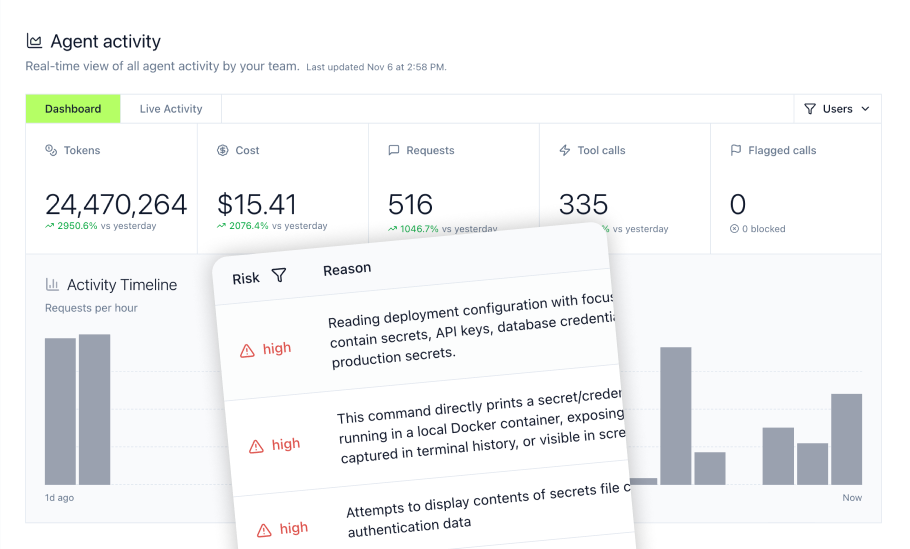
- Real-Time Monitoring: Live dashboards for supported agent activity, including usage, MCP tool calls, file access, commands, and security alerts
- Gateway Middleware: Customer-authored JavaScript running in a sandbox for DLP integrations, external classifiers, and policy enforcement
Security architecture
MintMCP implements defense-in-depth security through centralized governance, SSO enforcement, SCIM-driven RBAC, tool-level policy, credential management, and observability controls. The platform provides visibility into which teams and agents use which tools, when they access data, and how frequently.
Mint Guard delivers managed detection policies for prompt injection, credentials and secrets, PII, and harmful content. Rules enable declarative pattern matching on tool names, argument patterns, or content via regex.
Enterprise integrations
- Snowflake data warehouse access with natural language queries
- GitHub integration for AI-powered development workflows
- Salesforce MCP for CRM data access and automation
- Slack integration for collaborative AI experiences
- Custom MCP server deployment for internal tools and APIs
Compliance
- SOC 2 Type II audited
- Compliant with HIPAA standards (BAA available)
- Penetration tested
- Data encrypted in transit and at rest
Getting started
Visit mintmcp.com for enterprise demonstration and pricing
2. Bifrost
Bifrost is an open-source LLM gateway built in Go that focuses on production-grade performance for enterprise deployments. The platform was publicly released in July 2025 under an Apache 2.0 license.
Primary focus
Bifrost emphasizes raw performance, adding only 11 microseconds of overhead per request at 5,000 requests per second in sustained benchmarks. This makes it effectively transparent in production request pipelines where Python-based alternatives add hundreds of microseconds to milliseconds of latency.
Core features
- Supports 20+ providers through OpenAI-compatible API
- Four-tier hierarchical budget controls spanning Business Unit, Team, Virtual Key, and Provider levels
- Native MCP Gateway with OAuth 2.0 support
- 100% request success rate at sustained high throughput
Deployment options
Self-hosted deployment required; enterprise support options available
3. LiteLLM
LiteLLM is an open-source AI gateway with a Rust core and Python SDK for standardizing calls across 100+ LLM APIs.
Primary focus
LiteLLM supports 100+ LLM APIs through a unified interface. The platform focuses on developer accessibility and ecosystem breadth rather than enterprise governance features.
Core features
- Virtual keys with per-team and per-project budget limits
- Unified OpenAI-compatible API across providers
- Spend tracking and cost optimization features
- MIT license for flexible commercial use
Deployment options
Self-hosted; enterprise features require paid license
4. Portkey (PRISMA AIRS AI Gateway)
Portkey provides a managed AI gateway that was acquired by Palo Alto Networks in May 2026, becoming part of the PRISMA AIRS platform. The service processes over 1 trillion tokens daily for more than 3,000 GenAI teams.
Primary focus
Portkey offers access to 1,600+ LLMs and providers, combined with semantic caching that can reuse responses for semantically similar requests.
Core features
- Built-in guardrails with PII detection
- 99.9% uptime SLA with SOC 2 Type 2, ISO 27001, HIPAA, and GDPR compliance
- Automatic model fallback and load balancing
- Comprehensive LLMOps observability
Pricing
Developer tier free with 10K requests/month; Production at $49/month with 100K requests/month; Enterprise custom pricing
5. Kong AI Gateway
Kong AI Gateway extends Kong's established API gateway platform with AI-specific capabilities.
Primary focus
Kong provides agent-to-agent (A2A) protocol governance through Kong 3.14, making it an option for organizations already standardized on Kong infrastructure who want unified API and AI management.
Core features
- Multi-LLM routing with AI-specific rate limiting
- Agent Gateway with A2A protocol support
- MCP proxy plugin for governance
- Plugin-based architecture for extensibility
- Enterprise authentication including OAuth 2.0, JWT, mTLS, and OIDC
Deployment options
Self-hosted on Kubernetes or managed options; enterprise licensing required for AI features
6. TrueFoundry AI Gateway
TrueFoundry provides an AI infrastructure platform with gateway capabilities, serving enterprises including large food and technology companies. TrueFoundry reports roughly 3-4ms of AI Gateway overhead while handling 350+ requests per second on 1 vCPU.
Primary focus
TrueFoundry offers a complete AI infrastructure stack rather than a standalone gateway, including native model deployment with vLLM, TGI, and Triton backends alongside gateway routing.
Core features
- SOC 2 Type 2 and HIPAA compliance
- Supports VPC, on-premises, hybrid, and air-gapped environments
- MCP integration with OAuth2 and RBAC on tool calls
- Teams report 30-70% cost reduction versus direct provider usage
Deployment options
Enterprise pricing; self-hosted and managed options available
7. Cloudflare AI Gateway
Cloudflare AI Gateway runs on Cloudflare's global network and provides centralized observability and control for model traffic. Unified billing for third-party model usage was introduced in August 2025; Workers AI models routed through AI Gateway follow separate Workers AI pricing.
Primary focus
Cloudflare emphasizes zero infrastructure overhead with edge-native deployment, targeting organizations already using Cloudflare services who want to add AI gateway capabilities without managing additional infrastructure.
Core features
- Edge-native request routing with centralized observability, retries, caching, and rate limiting
- Response caching at the edge
- Unified billing across third-party model providers
- Free core features with low barrier to entry
Pricing
Core AI Gateway features are free; Unified Billing applies a 5% fee to purchased credits, while Workers AI models follow Workers AI pricing
8. Helicone
Helicone started as an observability platform before launching gateway capabilities in 2025. The platform is built in Rust with a focus on lightweight deployment.
Primary focus
Helicone provides developer-first observability through a Rust-based AI gateway designed for low-overhead, lightweight deployment.
Core features
- Proxy-based integration requiring only base URL changes
- Strong observability from platform origins
- Lightweight resource requirements
- Frictionless setup for development teams
Pricing
Free tier available; Pro from $79/month
9. OpenRouter
OpenRouter provides a managed routing service that gives access to over 400 models through a single API. The platform focuses on simplifying multi-model experimentation and unified billing.
Primary focus
OpenRouter emphasizes model selection breadth and experimentation ease, with 400+ models available through a single API.
Core features
- Access to 400+ models through single API
- Automatic model fallback
- Unified billing across providers
- Model comparison interface
Deployment considerations
No self-hosted option available, which may not meet data residency requirements for some enterprises.
Pricing
BYOK is free for the first 1M requests per month, then charged 5% of the equivalent OpenRouter inference cost; purchasing credits carries a 5.5% fee with a $0.80 minimum
10. Zuplo
Zuplo combines API, AI, and MCP gateway capabilities in one programmable platform with multiple deployment models. The platform supports edge, dedicated-cloud, and self-hosted deployment options.
Primary focus
Zuplo provides API and AI gateway capabilities on one programmable platform, with MCP Gateway functionality added through the same project and policy model. The platform emphasizes TypeScript programmability and multi-cloud flexibility, offering GitOps-native deployment with sub-20-second global deployments.
Core features
- MCP Gateway functionality runs within the same Zuplo platform and project model
- TypeScript extensibility with full IDE support
- Multi-cloud deployment options
- SOC 2 Type II audited
Pricing
Free tier available; enterprise pricing custom
Deploy governed MCP and agent infrastructure with MintMCP
Enterprises deploying AI agents across Claude, Cursor, ChatGPT, Gemini, and Copilot need infrastructure that provides visibility, governance, and control without slowing down adoption. MintMCP delivers this through its data-permissions-first architecture, combining MCP Gateway for governed tool connections with Agent Gateway for first-class non-human identities.
The platform's Virtual MCPs bundle approved connectors behind governed endpoints with SCIM-driven membership, while Agent Monitor provides real-time visibility into prompts, commands, file access, and MCP tool calls. Guardrails enable runtime controls through managed detection policies and customer-authored middleware.
For teams evaluating LLM proxy options, MintMCP provides the governance layer that makes AI systems deployable, measurable, and swappable across models, clients, and agent harnesses. Visit mintmcp.com to start a free trial with no sales call required.
Frequently asked questions
What is an LLM proxy and why do enterprise teams need one?
An LLM proxy sits between AI clients and LLM providers, centralizing authentication, rate limiting, observability, and access control. Enterprise teams need this layer because managing multiple providers directly creates scattered credentials, fragmented security policies, zero visibility into agent activity, and duplicated authentication logic. A centralized proxy transforms this complexity into a manageable hub-and-spoke model with unified governance.
How do LLM proxies differ from traditional API gateways?
LLM proxies primarily standardize and govern traffic between applications and model providers, including routing, provider authentication, rate limits, caching, and model-level observability. MCP gateways govern a different path: access from AI clients or agents to MCP servers, tools, and enterprise data. Some platforms combine both categories, but MCP-specific capabilities such as tool authorization and server governance should not be treated as standard LLM-proxy features.
What security features should enterprises prioritize in LLM proxy selection?
Enterprise teams should evaluate SSO and SCIM integration for identity management, role-based access control at the tool level, credential management with rotation capabilities, audit logging for compliance reporting, runtime guardrails for prompt injection and PII detection, and operational controls including kill switches. SOC 2 Type II auditing provides baseline assurance for production deployments.
Can LLM proxies support both human users and autonomous agents?
Leading platforms support both human-operated AI clients and autonomous agents through different authentication mechanisms. Human users typically authenticate through SSO with per-user OAuth flows, while agents require non-human identity management with bearer keys, M2M tokens, or workload identity federation. This distinction matters because agents should not inherit human credentials or use shared API keys that collapse audit attribution.
How do LLM proxies help with AI cost management?
LLM proxies provide token usage tracking by model, user, agent, and session, enabling chargeback-grade visibility into AI spending. Features like semantic caching, intelligent routing that balances cost and quality, and budget controls at team or project levels help organizations manage AI costs. Some platforms report 30-70% cost reduction compared to direct provider usage through these optimizations.