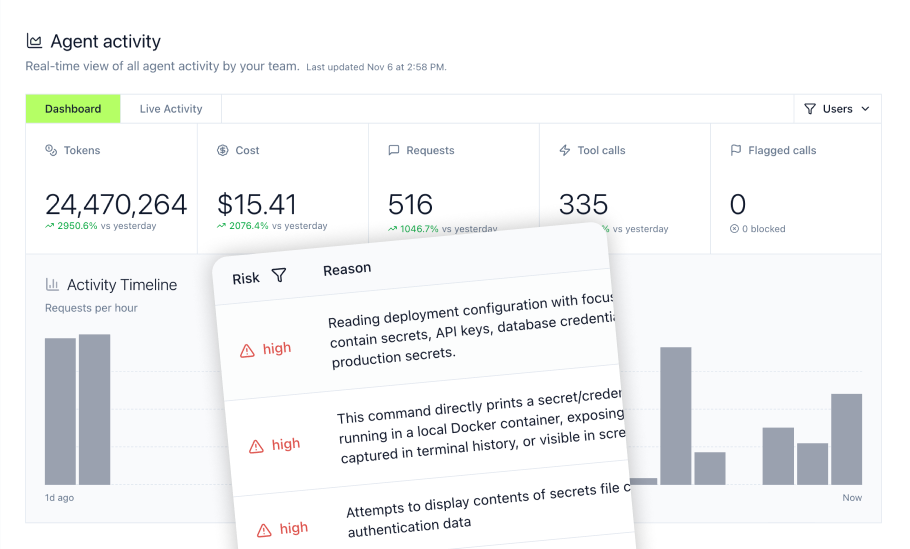
Data-driven insights revealing how organizations gain visibility, governance, and control over AI deployments—and why centralized observability infrastructure separates production-ready enterprises from those stuck in pilot purgatory
Enterprise AI adoption has reached an inflection point. While 88% of global companies actively use AI in at least one business function, most lack the observability infrastructure required to govern these systems at scale. The gap between deploying AI tools and maintaining visibility into their behavior creates substantial security, compliance, and operational risks. MintMCP's MCP Gateway addresses this challenge by providing real-time monitoring, complete audit trails, and centralized governance for AI tool access—transforming shadow AI into sanctioned AI. This comprehensive analysis examines market growth, adoption patterns, security imperatives, operational efficiency gains, and infrastructure requirements shaping enterprise AI observability in 2025 and beyond.
Key takeaways
- Market growth validates observability investments – The AI observability market reached $1.4 billion in 2023 and is projected to grow to $10.7 billion by 2033 at 22.5% CAGR
- Adoption is accelerating rapidly – 90% of IT professionals recognize observability as vital to their business, though only 26% rate their practices as mature
- Security gaps remain critical – 77% of companies experienced AI system breaches in the past year, while only 6% have advanced AI security strategies
- Financial impact is substantial – Organizations excelling in observability release 60% more products and reduce annual downtime costs by 90%
- Infrastructure investment is massive – $47.4 billion spent on compute and storage infrastructure for AI deployments in H1 2024 alone, representing 97% year-over-year growth
- Skills shortage constrains progress – 51% of global technology leaders report critical AI skills shortages
Market growth and adoption statistics
1. The global AI observability market reached $1.4 billion in 2023 and is projected to hit $10.7 billion by 2033
Market research data confirms unprecedented growth in AI-powered observability technology. This near-eightfold expansion reflects mainstream enterprise adoption as organizations recognize that AI systems operating without visibility create unacceptable governance risks. The projection encompasses monitoring platforms, security tools, and compliance infrastructure across industries globally.
2. The AI observability market demonstrates 22.5% compound annual growth through 2033
Industry analysts project sustained 22.5% CAGR growth that validates observability as strategic infrastructure rather than optional tooling. This growth rate substantially exceeds most enterprise software categories, driven by regulatory pressure, security incidents, and proven ROI from organizations with mature observability practices.
3. 88% of global companies actively use AI in at least one business function
McKinsey research confirms AI has moved from experimental to mainstream across industries. This widespread deployment creates urgent demand for observability infrastructure—MintMCP's LLM Proxy tracks every tool call, bash command, and file access from coding agents, providing the visibility organizations require to govern AI at scale.
4. Generative AI is now widely used in day-to-day workflows
Generative AI adoption has reached critical mass, with most organizations embedding AI into daily workflows. Regular use indicates AI has transcended pilot status to become core infrastructure—requiring production-grade monitoring and governance.
5. 90% of IT professionals recognize observability as vital to their business
Despite near-universal recognition of observability's importance, execution lags far behind awareness. This gap between understanding and implementation creates opportunities for platforms that reduce deployment complexity while delivering enterprise-grade capabilities.
6. Only 26% rate their observability practice as mature
Despite 90% recognizing observability as vital, barely a quarter have achieved mature implementations. This execution gap creates competitive advantage for organizations that prioritize observability infrastructure investment.
Security and compliance statistics
7. 51% of respondents at organizations using AI report at least one negative consequence from AI
Security incident data reveals AI systems as high-value attack targets. Without monitoring, organizations cannot detect compromises, assess impact, or demonstrate due diligence to regulators and customers.
8. Only 6% of organizations have advanced AI security strategies
The massive security gap between AI adoption and AI protection creates substantial risk exposure. MintMCP's security guardrails block dangerous commands, restrict file access, and control MCP permissions in real-time—addressing this critical gap.
9. 69% cite ai-powered data leaks as their top security concern
Security priority data confirms data exfiltration as the primary AI security fear. AI agents with broad system access can inadvertently or maliciously expose sensitive information—making monitoring and access controls essential.
10. At least 30% of generative AI projects are expected to be abandoned after proof of concept
Implementation failure data reveals nearly half of AI initiatives stall before delivering value. Many failures stem from inadequate infrastructure, governance gaps, and security concerns that proper observability addresses from the start.
Operational efficiency statistics
11. Organizations excelling in observability release 60% more products or revenue streams
Beyond cost reduction, observability leaders demonstrate superior innovation velocity. The confidence to deploy rapidly comes from knowing AI systems are monitored, governed, and recoverable—enabling aggressive release cycles without unacceptable risk.
12. Advanced deployments reduce downtime costs by 90%, cutting losses to $2.5 million annually
Enterprise implementation data shows organizations with sophisticated observability cut annual downtime losses from tens of millions to single-digit millions. MintMCP's real-time monitoring provides the visibility required to achieve these outcomes.
Infrastructure and investment statistics
13. $47.4 billion spent on compute and storage infrastructure for AI deployments in H1 2024 alone
Infrastructure investment data reveals a 97% year-over-year increase in AI infrastructure spending. This massive investment requires corresponding observability infrastructure to protect and optimize—organizations cannot justify billion-dollar AI investments without visibility into system performance.
14. 44% of organizations cite infrastructure constraints as the top AI barrier
Implementation barrier data identifies infrastructure as the primary AI adoption obstacle. MintMCP's one-click deployment and hosted infrastructure eliminate these constraints—transforming local MCP servers into production-ready services in minutes, not months.
15. 51% of global technology leaders report critical AI skills shortage
The talent gap constrains AI initiatives across industries. Platforms that reduce implementation complexity and operational overhead—like MintMCP's managed infrastructure—address skills shortages by enabling smaller teams to manage enterprise-scale AI deployments.
Market segmentation statistics
16. Cloud-based deployment dominates with 69.1% market share
Deployment preference data confirms cloud as the primary delivery model for AI observability. Cloud deployment enables rapid scaling, reduced operational overhead, and continuous platform improvements—benefits MintMCP delivers through its managed gateway infrastructure.
17. Large enterprises hold 65.7% of the AI observability market
Enterprise segment dominance reflects both the complexity of large-scale AI deployments and the resources available for observability investments. However, platforms like MintMCP extend enterprise-grade capabilities to organizations of all sizes through accessible pricing and simplified deployment.
18. North america leads with 37.4% market share, valued at $520 million
Regional market data shows North American enterprises leading observability adoption, driven by regulatory requirements, security concerns, and competitive pressure. The region's investment validates observability as essential infrastructure for AI-forward organizations.
19. BFSI sector leads adoption with 21.5% market share
Industry vertical data confirms financial services as the leading adopter of AI observability. Stringent regulatory requirements, high operational reliability stakes, and substantial AI investments drive BFSI's observability priority. MintMCP's SOC 2 Type II attestation and HIPAA compliance options meet these rigorous requirements.
Strategic implementation insights
Enterprise AI observability succeeds when organizations prioritize complete visibility over point-solution monitoring. The leaders aren't teams with the most dashboards—they're organizations using unified platforms that track every AI interaction, enforce governance policies, and provide complete audit trails for compliance.
Here's how to maximize results:
- Start with visibility – Deploy monitoring before expanding AI access to understand current tool usage, data access patterns, and security gaps
- Unify your platform – Consolidate observability tools to eliminate data silos and reduce operational overhead
- Enforce governance centrally – Use role-based access controls and policy enforcement through a single gateway rather than distributed point solutions
- Connect to your data sources – Integrate observability with your Elasticsearch, Snowflake, and other enterprise systems for complete context
- Prioritize security from day one – Block risky operations proactively rather than detecting breaches reactively
MintMCP's MCP Gateway delivers this comprehensive approach—centralized authentication, real-time monitoring, complete audit trails, and enterprise-grade security in a single platform. Deploy in minutes, not months, with SOC2 Type II certified infrastructure.
Frequently asked questions
What is AI observability and why is IT crucial for enterprises?
AI observability encompasses the monitoring, logging, and governance of AI systems to ensure visibility into their behavior, performance, and security posture. It's crucial because 77% of companies experienced AI system breaches last year, and organizations with comprehensive observability practices demonstrate superior operational outcomes. Without observability, AI systems operate as black boxes with significant security and compliance risks.
How does MintMCP ensure compliance for enterprise AI deployments?
MintMCP provides complete audit logs for SOC2, HIPAA, and GDPR compliance through its MCP Gateway. The platform tracks every MCP interaction, access request, and configuration change—creating the comprehensive audit trails regulators and security teams require. Data residency controls and OAuth/SAML integration further support compliance requirements.
What specific security measures protect sensitive data and prevent risky AI behavior?
MintMCP's LLM Proxy blocks dangerous commands in real-time, protects sensitive files from access, and provides granular tool access control by role. The platform prevents access to .env files, SSH keys, and credentials while maintaining complete command history for security review.
How can organizations connect AI agents to internal data sources like snowflake or elasticsearch?
MintMCP provides pre-built connectors for enterprise data sources including Snowflake and Elasticsearch. These integrations enable AI agents to query databases, generate reports, and access business data while maintaining governance controls, authentication requirements, and complete audit trails.
What benefits does an AI gateway provide for scaling AI tools across an organization?
An AI gateway centralizes authentication, monitoring, and governance for all AI tool access. Organizations using unified platforms demonstrate superior outcomes including 60% more product releases, reduced tool sprawl, and simplified compliance. MintMCP's gateway transforms local MCP servers into production-ready services with one-click deployment, OAuth protection, and enterprise monitoring.