Enterprise teams deploying AI agents at scale face a fundamental infrastructure decision: which LLM gateway can route model requests while enforcing the authentication, authorization, and audit controls that IT and security teams require? LiteLLM, OpenRouter, and Portkey's technology, now part of Palo Alto Networks' Prisma AIRS AI Gateway, approach this problem differently across self-hosted routing, managed model access, and enterprise AI governance. But for organizations that need to govern both model access and the tools those models can reach, Mintive's LLM Gateway offers a unified approach that combines model routing with MCP tool governance, agent identities, and enterprise compliance in a single platform.
This comparison examines all four options to help CTOs, security architects, and platform engineering teams determine which gateway architecture aligns with their AI infrastructure requirements.
Key Takeaways
- Enterprise LLM gateway evaluations should consider model routing, cost tracking, access control, and audit logging, with additional controls and contractual safeguards for organizations subject to assessments or regulatory obligations
- LiteLLM provides broad provider support with 140+ providers and includes an MCP Gateway, but runs on customer-managed infrastructure requiring DevOps capacity
- OpenRouter offers 500+ models through a managed API without self-hosted infrastructure, with platform fees varying by plan and limited centralized MCP governance
- Portkey, now part of Palo Alto Networks' Prisma AIRS AI Gateway, combines LLM routing, MCP governance, agent-level access controls, and observability across AI workloads
- Mintive combines LLM routing with MCP tool governance, first-class agent identities through Agent Bundles, and hosted connectors in one platform
- Mintive extends shadow AI visibility beyond gateway traffic through Agent Monitor hooks that capture supported local tool calls, bash commands, and off-gateway MCP activity
Understanding the Enterprise Need for LLM API Gateways in 2026
Enterprises are rolling out AI agents faster than they can govern them. Claude Code, Cursor, ChatGPT, GitHub Copilot, and custom agents now access enterprise systems, databases, and internal APIs. Without centralized controls, organizations face scattered credentials on developer laptops, no visibility into which tools agents call, and audit trails that fail compliance requirements.
An LLM gateway sits between AI agents and model providers, routing requests through centralized access controls. But most gateways stop there. They route model calls without governing what those models can access downstream.
The governance gap creates real risk, which the NIST AI Risk Management Framework provides a useful structure for assessing:
- No telemetry: Teams cannot identify which tools their agents are calling or what data they read and wrote
- Scattered credentials: API keys distributed across developer machines create single points of compromise
- Missing audit trails: Organizations cannot produce the evidence required for risk reporting
- Config sprawl: Every developer configures every MCP server locally, creating N installs, N auth flows, and N points of failure
This is why enterprise buyers increasingly look beyond pure LLM routing toward platforms that govern the complete AI stack: models, tools, and agent identities.
Why IT and Security Teams Require Centralized AI Governance
Security teams need visibility and enforcement, not just routing. The NIST Zero Trust Architecture provides a reference for resource-focused access controls. When an agent can call any connected system with no oversight, the blast radius of a compromised credential or prompt injection attack extends across the entire enterprise.
Mintive's approach addresses this by providing a unified gateway that enforces authentication, authorization, audit logging, and security policies on every interaction between AI agents and enterprise systems. The platform routes model requests to supported providers including OpenAI, Anthropic, and Fireworks through its LLM Gateway, while MCP Gateway and Agent Gateway extend governance to enterprise tools and autonomous agent identities.
LLM Gateway Core Functionality: Routing, Observability, and Cost Management
Every LLM gateway handles model routing. The differences emerge in how each platform addresses observability, cost attribution, and the granularity of controls available to platform teams.
Model Routing Capabilities
- LiteLLM provides broad provider catalog support with 140+ providers and 1,892 models through a unified API. The open-source project has processed over 1 billion requests and serves notable enterprises. The Python-based gateway runs on customer-managed infrastructure, so teams are responsible for deployment, scaling, monitoring, and performance tuning.
- OpenRouter offers 500+ models through a managed API without requiring self-hosted infrastructure. The platform removes the need to operate a self-hosted gateway and provides unified billing across providers. The trade-off: platform fees that vary by plan and a managed-cloud architecture rather than customer-operated deployment. Organizations with data residency requirements should evaluate its available regional routing and enterprise controls.
- Portkey provides multi-provider model routing, observability, guardrails, and centralized MCP governance. Its MCP Gateway supports authentication, tool-level access controls, policy enforcement, and agent workflow tracing. Portkey's gateway technology is now part of Palo Alto Networks' Prisma AIRS AI Gateway.
- Mintive supports governed model routing through providers including OpenAI, Anthropic, and Fireworks, with per-policy budgets and model restrictions. The focus is not on maximizing model catalog size but on providing governed model access alongside MCP Gateway tool-access policies and Agent Gateway identity controls.
Comparing Cost Tracking Across Gateways
Cost attribution becomes critical as AI spend scales. Platform teams need to track tokens, requests, and estimated cost broken out by user, session, model, and tool.
Cost tracking capabilities:
- LiteLLM: Virtual keys, per-team budgets, built-in spend tracking, and an Admin UI; customer-operated infrastructure
- OpenRouter: Per-user and per-key spending limits, guardrails, unified billing, and Enterprise workspace budgets
- Portkey: Usage and cost analytics across models, providers, keys, and teams, with enterprise governance options
- Mintive: Cost tracking by user, agent, model, and tool with spend dashboards that rank sessions by cost
Mintive combines estimated model costs with MCP tool usage data, giving teams visibility into inference spending and the tools agents use during operations.
Observability Features: Logs, Metrics, and Traces
Observability requirements vary by buyer. Developers want debugging tools. Security teams want audit trails. Finance wants cost attribution.
- LiteLLM provides logging through community integrations with Langfuse, Helicone, and MLflow. Enterprise features like RBAC and comprehensive audit logs require the paid tier.
- OpenRouter offers basic logging with DataDog, LangSmith, and Langfuse through its Broadcast feature. Deep observability requires additional tooling.
- Portkey provides native observability with detailed logging, tracing, usage analytics, and visibility into LLM and MCP interactions.
- Mintive provides model call logs with latency, tokens, and cost through LLM Gateway monitoring, unified with MCP tool call logs in the same audit trail. SIEM export to Sentinel, Splunk, S3, or any OpenTelemetry collector ensures logs reach existing security infrastructure.
API Management and Governance: Access Control and Security Policies for LLMs
Enterprise AI governance requires more than API keys. Teams need SSO integration, directory-driven access control, and programmable security policies that can inspect, transform, or block requests in real time.
Implementing Granular Access Controls
LiteLLM provides SSO through Okta, Azure AD, and Google Workspace, but limits the free tier to 5 users. RBAC and audit logs require the Enterprise tier. Virtual keys enable per-group access controls and budgets.
OpenRouter supports Workload Identity Federation, organization and workspace controls, and per-user or per-key guardrails for spending, model access, provider selection, and data policies. Its governance model differs from dedicated MCP gateways that manage downstream enterprise tool permissions.
Portkey provides enterprise SSO, RBAC, and content safety guardrails. Its Agent Gateway adds an agent registry, governed endpoints, and access controls scoped by agent, team, and user, alongside MCP authentication and tool-level permissions.
Mintive connects to Okta, Azure AD, Entra ID, Google Workspace, Auth0, JumpCloud, OneLogin, and PingFederate with SCIM provisioning and self-serve group mapping. Directory groups drive both admin roles and tool access through VMCP access policies.
The Role of Programmable Security in LLM Gateways
Security policies must do more than block or allow. Enterprise use cases require transformation, redaction, and integration with existing DLP infrastructure.
Mintive's approach layers three mechanisms:
- Mint Guard: Managed detection policies for prompt injection, credentials and secrets, PII, and harmful content. In enforcing mode, blocks high-confidence threats according to the configured policy.
- Rules: Declarative conditions matching tool names, argument patterns, or content via regex. Actions include flag, block, ask-user, mask, or Slack-notify.
- Gateway Middleware: Customer-authored JavaScript running in a sandbox on every matching call. Integrate external classifiers, call AWS Bedrock Guardrails, GCP DLP, Microsoft Purview, Nightfall, or Skyflow. Transform, redact, or rewrite requests and responses inline.
Gateway Middleware supports custom request inspection, redaction, resource allowlists, and integration with existing DLP systems. For supported local coding-agent environments, Agent Monitor and Rules can also detect or block sensitive file access, including .env file reads.
Learn more about Mintive's guardrails.
Deployment Flexibility: On-Prem, Cloud, and Kubernetes Options for LLM Gateways
Deployment requirements vary by organization. Startups want managed SaaS. Regulated enterprises need VPC or air-gapped options. Platform teams running Kubernetes want native integration.
Evaluating Kubernetes-Native LLM Gateways
LiteLLM provides the most flexible self-hosting options under MIT license. Teams can deploy on any infrastructure with full code transparency. The trade-off is operational burden: managing deployment, scaling, monitoring, and security falls entirely on the customer.
Portkey provides an MIT-licensed open-source gateway alongside enterprise deployment options for customer-managed and hybrid environments. Organizations should confirm supported deployment configurations and availability through Palo Alto Networks' current Prisma AIRS AI Gateway offerings.
OpenRouter operates as cloud-only with no self-hosting option. Organizations with strict data sovereignty requirements cannot deploy OpenRouter in their VPC.
Mintive provides managed SaaS in US and EU regions as the default deployment model. VPC and self-hosted deployments are available on request for enterprises with sovereignty requirements.
Beyond Simple Proxy: The Advantage of Unified AI Agent Infrastructure
LLM gateways primarily manage model access, while some platforms also provide MCP governance and agent-level controls. AI agents also access databases, execute tools, read files, and write to enterprise systems. Organizations must evaluate whether their gateway enforces policies on downstream tool access as well as model requests.
This is the gap Mintive addresses through unified LLM and MCP governance.
Integrating LLM Gateways with Broader AI Agent Ecosystems
Mintive's MCP Gateway provides centralized management for Model Context Protocol servers, with a catalog of thousands of MCP servers and support for hosted, remote, and custom connectors for tools like GitHub, Jira, Salesforce, Snowflake, and internal databases. The same identity and policy layer that governs model access also governs tool access.
The key abstraction is the Virtual MCP (VMCP): many connectors bundled behind one governed endpoint. Users connect once instead of configuring each server. Administrators curate which tools each role can see, inject the right credentials per call, and log everything.
Competitor comparison on MCP support:
- LiteLLM: Includes an MCP Gateway with centralized MCP tool access, authentication, and configuration. Its governance model differs from Mintive's SCIM-driven Virtual MCPs and Agent Bundles.
- OpenRouter: Provides an MCP server for model discovery and access, but does not offer the same centralized enterprise tool-governance model as a dedicated MCP Gateway.
- Portkey: Provides an MCP Gateway with centralized server registration, authentication, tool-level permissions, runtime policies, and observability. Its Agent Gateway also supports agent registration and agent-scoped access controls.
The Unified Governance Model: Bundles vs. Composed Objects
Mintive's Virtual MCP model brings role-based access configuration and tool curation together in a governed endpoint, reducing the need to maintain separate MCP configurations for each employee or AI client:
- SCIM directory groups for membership
- Curated MCP tools with per-tool on/off switches
- Custom security policies
- Audit trails
One Bundle per role can reduce MCP configuration sprawl and simplify enterprise rollouts. Teams at Coursera deployed governed AI to 2,000 employees using Mintive's Virtual MCP architecture.
Compliance in LLM Gateways
Compliance is table stakes for enterprise procurement. Organizations handling protected health information should evaluate applicable safeguards under the HIPAA Security Rule. The depth of compliance implementation varies significantly across platforms.
Meeting Regulatory Requirements for LLM Deployments
Compliance capabilities:
- LiteLLM: Holds attestations; confirm BAA availability and deployment requirements. Request logging with Enterprise administrative audit logs.
- OpenRouter: Holds attestations; no BAA currently offered. Activity logs, exports, and organization controls.
- Portkey: Holds attestations; advertised support with Enterprise options. Confirm BAA terms. Organization audit logs, request traces, and MCP activity logs.
- Mintive: Holds attestations; compliant with standards and BAAs available. Tool-call audit trails and cryptographically verifiable access-grant history.
Mintive's audit implementation goes beyond standard logging. Access-grant history is signed at write time with cryptographic verification, creating records that can be verified offline via published JWKS. These tamper-evident records support compliance evidence collection, access reviews, and incident investigations by making changes to access-grant history verifiable.
Data Privacy and Security in AI Agent Operations
Mintive's security architecture supports enterprise SSO for human users and machine authentication for agents, alongside scoped tool permissions and centralized audit trails. Data encrypts in transit via TLS and at rest. EU and US data residency options address sovereignty requirements.
The platform undergoes continuous Drata monitoring and regular penetration testing. DPA and sub-processor documentation are available on request through the Trust Center.
Shadow AI Detection and Enforcement: A Critical Enterprise Requirement
The most dangerous AI usage is what you cannot see. Developers installing Cursor or Claude Code on their laptops, using local MCP servers, or connecting to models outside approved channels creates shadow AI risk that pure gateway solutions cannot address.
Visibility into Unsanctioned AI Use
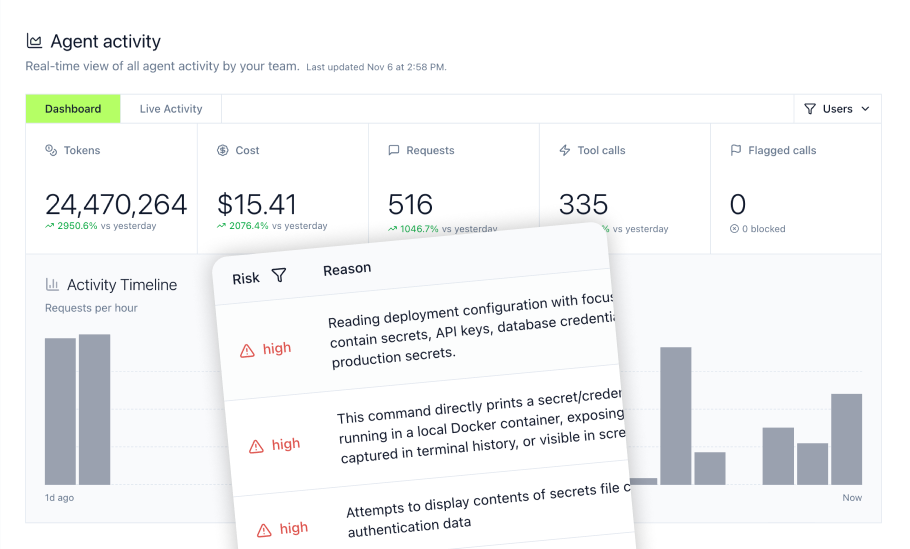
Traditional gateway telemetry primarily captures traffic routed through configured endpoints. Mintive's Agent Monitor adds visibility into supported local coding-agent activity through hooks, helping identify tool usage and MCP connections that bypass the managed gateway:
- File reads (including .env files and SSH keys)
- Bash commands and installations
- Off-gateway MCP server connections
- Prompts and model calls
This cross-platform visibility helps security teams identify supported agent activity beyond governed gateway traffic, including local tool use and off-gateway MCP connections.
Enforcing AI Policy on Developer Workstations
Visibility alone is insufficient. Security teams need mechanisms to act on what they learn.
Mintive supports deploying Agent Monitor configurations through MDM. In supported coding-agent environments, configured Rules can block matching actions before execution when the client and hook integration support enforcement.
Built-in rules detect:
- Secrets and credentials in arguments or results
- Prompt injection attempts
- PII exposure
- Tool permission violations
Custom rules extend detection through tool-argument matching and regex patterns. Actions include flag, block, ask-user, mask, or Slack-notify depending on the integration and enforcement point.
Scaling AI Agent Deployments: Lessons from Enterprise Rollouts
Enterprise deployment velocity matters. The faster teams can roll out governed AI, the faster they realize value while maintaining security posture.
Mintive supports phased enterprise deployments, with implementation time depending on identity integration, connector configuration, policy complexity, and the number of approved tools. A common rollout process includes:
- Connect SSO (Okta, Azure AD, Google) and enable SCIM group sync
- Import or deploy MCP servers from the catalog
- Create Bundles per role, map to directory groups, toggle tools on/off
- Distribute gateway URL to users; paste into Claude Desktop, Cursor, Codex, ChatGPT settings
- Configure middleware policies and DLP integrations
- Export audit logs to SIEM
Building and operating comparable governance infrastructure can require engineering resources for authentication, connectors, policies, and observability. Mintive offers a managed alternative to operating these components independently.
Customer validation:
- Stability AI: "It solved our most immediate MCP problems." Deployed company-wide in under a month.
- Deerfield Group: "The virtual bundles are our number one feature." Setup time cited as the primary adoption driver.
- Modern Treasury: Agents save Technical Account Managers 30 minutes to 4 hours per support case.
Why Mintive Delivers Complete Enterprise Governance
Enterprise AI infrastructure requires more than model routing. Organizations deploying Claude Code, Cursor, ChatGPT, Copilot, and custom agents need to govern what models those agents use, what tools they can access, what identity they operate under, and what actions they take.
Mintive provides this unified governance through a platform that combines:
- LLM Gateway: Governed model access routing with per-team budgets, model restrictions, and cost attribution
- MCP Gateway: Thousands of MCP servers in catalog with Virtual MCPs that bundle tools into role-based endpoints
- Agent Gateway: First-class agent identities with scoped MCP access, independently managed authentication credentials, and agent-owned downstream credentials where needed
- Agent Monitor: Visibility into supported gateway and local agent activity with shadow AI detection, usage tracking, audit trails, and SIEM export
- Mint Guard: Runtime security screening for prompt injection, PII, secrets, and risky commands
- Enterprise Security: SSO, SCIM, attestations, and tamper-evident audit trails
The platform serves as the governance layer that makes AI agents deployable, governed, measurable, and swappable. Enterprises can change AI models, clients, or agent harnesses without rebuilding their identity, permissions, audit, monitoring, or data-governance layer.
For teams evaluating LLM gateways, the question is not just which platform routes the most models. The question is which platform governs your complete AI stack while meeting the security and compliance requirements your organization demands.
Book a demo to see how Mintive unifies governance for enterprise AI.
Frequently Asked Questions
What is the primary difference between a generic API Gateway and an LLM Gateway for enterprise use?
A generic API gateway routes HTTP requests between clients and backend services with rate limiting, authentication, and load balancing. Enterprise LLM gateways apply governance features such as SSO integration, audit logging, and access controls to model-specific workflows, often alongside token accounting, model restrictions, and provider-aware routing. Mintive extends this further by combining LLM routing with MCP tool governance through the same identity and policy layer.
How do LLM Gateways help with cost management and observability for large-scale AI deployments?
LLM gateways track tokens, requests, and estimated cost across every model call, enabling teams to attribute spend by user, session, model, and project. This visibility supports chargeback models, identifies runaway loops or over-provisioned agents, and informs model selection based on cost-performance tradeoffs. Mintive's cost tracking combines estimated inference costs with MCP tool usage data to help teams understand model spending and agent activity.
What security features should an enterprise prioritize when selecting an LLM Gateway?
The gateway should support enterprise SSO for human users, secure machine authentication for agents, scoped authorization, and audit logging that helps organizations demonstrate their security controls and meet applicable compliance obligations. Mintive adds Mint Guard for managed prompt injection and PII detection, plus gateway middleware for custom policy enforcement and DLP integration.
Can LLM Gateways help detect and prevent shadow AI usage within an organization?
Traditional gateway telemetry primarily captures traffic routed through configured endpoints. Mintive's Agent Monitor adds visibility into supported local coding-agent activity through hooks that report local file reads, bash commands, and off-gateway MCP connections into the same audit log as gateway traffic. MDM-pushed configurations enable enforcement on developer machines in supported environments.
What is an Agent Bundle and why is it important for enterprise AI governance?
An Agent Bundle gives an autonomous agent a first-class identity with scoped MCP tool access, independent authentication credentials, and attributable audit records. Agents can authenticate through bearer keys or OAuth M2M tokens. Downstream connector credentials can be shared or configured specifically for the agent when needed. This helps teams manage agent access independently, reduce credential sprawl, and maintain clearer audit trails for governed tool activity.