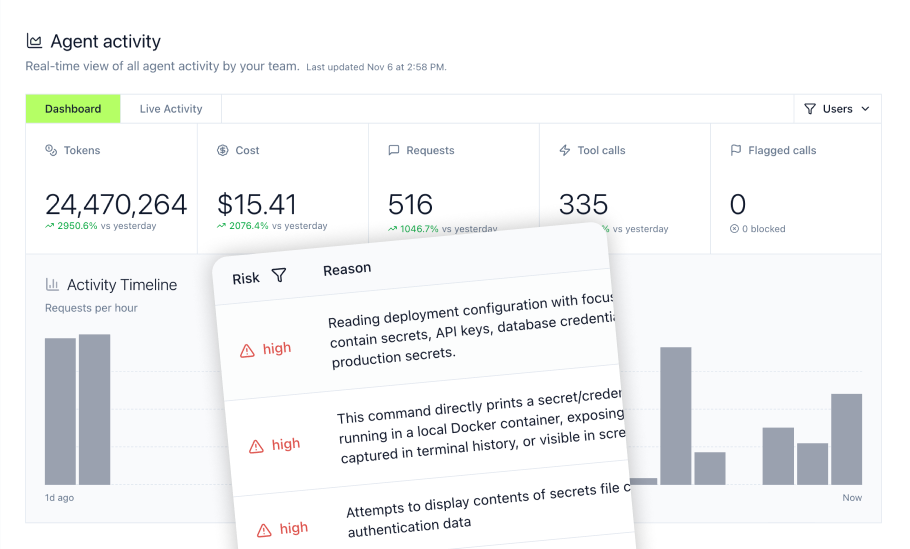
Organizations deploying AI agents across Claude, Cursor, ChatGPT, Gemini, and Copilot face a dual challenge: monitoring what models do at the API layer while governing what tools agents can access. With Helicone acquired by Mintlify in March 2026 and now in maintenance mode, teams need alternatives that address both LLM observability and the emerging governance gap. While Langfuse focuses primarily on observability, TrueFoundry and Portkey also span gateway and governance capabilities. MintMCP separates these functions across Agent Monitor for visibility and MCP Gateway and Agent Gateway for governed tool access, permissions, and agent identity.
This article examines the top Helicone alternatives for LLM observability, explains the key features enterprise teams should evaluate, and outlines how governance platforms complement observability tools to create complete AI infrastructure.
Key Takeaways
- Helicone entered maintenance mode following its March 2026 acquisition, with no major feature releases since then
- LLM observability tools monitor model requests, while MCP governance platforms control tool access, creating two distinct but complementary infrastructure layers
- Langfuse provides an open-source core with self-hosting options, including Docker Compose and Kubernetes deployments
- Bifrost reports approximately 11 microseconds of gateway overhead at 5,000 requests per second in its own benchmark
- Portkey provides broad multi-model routing through a unified API with fallbacks, load balancing, caching, and observability
- Flexera's 2026 State of the Cloud report found that 85% of respondents cite managing cloud spend as a top challenge, reinforcing the need for usage tracking
Understanding LLM Observability: Why it Matters for Enterprise AI
LLM observability refers to the ability to monitor, trace, and analyze large language model interactions across your organization. As AI agents make autonomous decisions about which tools to call, which data to access, and which actions to take, visibility becomes critical for security, compliance, and cost control.
The core problem: Organizations deploying AI systems across multiple clients face limited visibility into agent activity. Security teams cannot see which tools agents use, which files they access, or which actions they take. This creates compliance gaps for SOC 2, HIPAA, and internal risk reporting requirements.
Why traditional monitoring falls short:
- API logs capture request/response pairs but miss the tool calls happening within agent sessions
- Model providers show token consumption without attributing costs to specific projects or teams
- Security teams lack visibility into what happens between the prompt and the final output
LLM observability tools emerged to address these gaps by capturing prompt submissions, model responses, latency metrics, token usage, and cost data. OpenTelemetry's GenAI observability guidance provides a standardized framework for instrumenting these interactions. However, observability tools primarily operate at the LLM API layer, monitoring what models do rather than governing what tools agents can access.
This distinction matters because enterprises increasingly deploy AI agents that connect to internal systems through MCP servers. Observability tells you what happened; governance determines what can happen. Most organizations need both.
Key Features to Look for in LLM Observability Tools
When evaluating Helicone alternatives, enterprise teams should assess capabilities across monitoring, cost management, and security dimensions.
Real-time Monitoring and Alerting
Effective observability requires capturing activity as it happens, not after the fact. Essential capabilities include:
- Trace-level visibility: Span-by-span breakdown of model interactions, including intermediate steps in agent workflows
- Live activity feeds: Real-time streaming of prompts, responses, and tool calls across the organization
- Filtering and search: Ability to slice data by user, model, time window, and tool type
- Alert rules: Configurable notifications for anomalous patterns, error rates, or policy violations
Cost and Usage Tracking
With Flexera's 2026 report finding that 85% of respondents cite managing cloud spend as a top challenge, token spend visibility becomes non-negotiable.
- Token consumption by model: Breakdown of usage across GPT-4, Claude, and other providers
- Attribution to teams and projects: Chargeback-grade data showing which groups generate which costs
- Cache hit rates: Visibility into semantic caching effectiveness for cost optimization
- Budget thresholds: Hard caps or alerts when spending approaches limits
MintMCP's Agent Monitor tracks token spend by model, user, agent, and session, with human-versus-agent attribution and cache-hit visibility for cost analysis and chargeback.
Security and Compliance Capabilities
Enterprise deployments require audit trails and security controls that satisfy regulatory requirements.
- Comprehensive logging: Every request, response, and tool call recorded with timestamps and attribution
- SIEM integration: Export to Splunk, OTLP, or other security information systems
- Role-based access: Control who can view which traces and cost data
- Data residency: Options for EU, US, or self-hosted deployment to meet compliance requirements
Advanced Prompt Management and LLM Observability Solutions
Beyond basic monitoring, mature observability platforms provide tools for managing prompts and enforcing security policies across AI interactions.
Securing Prompts with Guardrails
Prompt injection attacks represent a growing threat as AI agents gain access to sensitive tools and data. Detection capabilities should include:
- Injection detection: Identifying attempts to override agent instructions through malicious input
- Secret scanning: Catching exposed API keys, credentials, or tokens in prompts or responses
- PII detection: Flagging personally identifiable information before it reaches external APIs
- Content moderation: Screening for harmful content that could create legal or reputational risk
MintMCP's Mint Guard provides managed detection policies for these categories with configurable monitoring or enforcement modes. When a high-confidence prompt injection attempt is detected, Mint Guard can block the request before it executes.
Declarative Rules for AI Behavior
Beyond managed detection, teams need the ability to define custom policies matching their specific security posture.
- Tool-name conditions: Allow or block calls to specific MCP tools
- Argument matching: Validate that tool parameters fall within acceptable ranges
- Regex-based patterns: Custom rules for domain-specific compliance requirements
- Configurable actions: Flag, block, ask user for confirmation, mask content, or notify security teams
These declarative rules complement managed detection by addressing organization-specific requirements that generic policies cannot anticipate.
Integrating LLM Observability with AI Gateways and Ecosystems
LLM observability tools increasingly need to integrate with broader AI infrastructure, including gateways, identity systems, and security platforms.
Centralized Gateway for AI Client Connections
Rather than configuring each AI client individually, enterprises benefit from centralized gateways that route all traffic through governed endpoints. The MCP Gateway model provides:
- Virtual MCPs: Multiple connectors bundled behind one endpoint with curated tool surfaces per role or team
- Centralized authentication: SSO integration so users connect once rather than authenticating to each MCP server
- Credential brokering: Secrets injected per-call rather than stored on developer laptops
- Tool-level curation: Admins select which tools each group can access, reducing context window bloat
- Audit logging: Every tool call recorded with user attribution for compliance reporting
Extending Observability to External Systems
Enterprise observability must connect with existing security infrastructure. Key integration points include:
- SIEM export: MintMCP supports OTLP and Splunk export for tool calls, prompt submissions, gateway requests, and access policy changes
- DLP integration: Gateway middleware can call external classifiers from AWS Bedrock Guardrails, Google Cloud Model Armor, or OpenAI moderation
- Identity providers: SSO through Okta, Entra ID, or Google with SCIM-driven access policies
Securing Autonomous Agents: Identity, Permissions, and Audit Trails
As organizations scale from individual AI assistants to fleets of autonomous agents, identity management becomes the central governance question. Who did what? With whose credentials? Under what authority?
Dedicated Identities for AI Agents
Traditional approaches fail because agents inherit human credentials or use shared service accounts. This collapses audit trails and over-privileges agent access. Agent identities solve this by treating autonomous agents as first-class non-human principals:
- Named agent identity: Each agent gets a unique identifier in the same authorization model as humans
- Independent credentials: Bearer keys, M2M tokens, or workload identity federation, separate from employee accounts
- Scoped access: Agent-specific Virtual MCPs with purpose-built toolsets
- Revocable permissions: Rotate or revoke agent credentials independently without affecting human users
Governing Agent Access and Permissions
The governance questions that matter for autonomous agents differ from those for human-operated tools:
- Which agent is acting?
- What credentials does it use?
- What tools can it access?
- What permissions apply to those tools?
- How can access be rotated or revoked?
- How is activity attributed for audit?
MintMCP's Agent Gateway builds on the MCP Gateway foundation by extending governed data and tool access to first-class agent identities, scoped permissions, and attributable audit trails.
Managing Enterprise AI Costs: Usage, Attribution, and Chargeback
Token costs compound quickly across large organizations. Without attribution, finance teams cannot allocate spending, and engineering teams cannot optimize usage.
Tracking LLM Token Consumption
Effective cost management requires granular visibility into consumption patterns:
- By model: Which models consume the most tokens and at what cost per interaction
- By user: Individual usage patterns for capacity planning
- By session: Project-level attribution for chargeback
- By agent: Distinguishing human-driven versus autonomous consumption
Allocating AI Costs Across Teams
Organizations need chargeback-grade data to assign costs appropriately. MintMCP's Agent Monitor tracks token spend by model, user, agent, and session, with human-versus-agent attribution and cache-hit visibility for cost analysis and chargeback.
Observability for Custom Agents and Coworker AI
Enterprise AI increasingly includes custom agents that operate autonomously over extended periods, requiring specialized observability approaches.
Extending Observability to Long-Running Agents
Traditional request/response monitoring misses critical context for agents that:
- Operate through Slack channels or other collaborative interfaces
- Run on schedules or respond to triggers over days or weeks
- Maintain state and memory across sessions
- Open pull requests or make changes to production systems
These agents require observability that captures the full lifecycle of autonomous work, not just individual API calls.
Governing Agent Memory and Workflows
MintMCP's Coworker Agents approach treats agent memory as governed enterprise infrastructure:
- Company-owned memory: Git-backed storage the organization controls
- Scoped access: Private, team, organization, and customer memory silos
- Version history: Full audit trail of memory changes
- Reviewable state: Instructions, memory, and run history accessible as files
This model ensures that agent memory remains inspectable, auditable, and portable rather than locked inside opaque vendor systems.
Choosing the Right LLM Observability Platform: Alternatives to Helicone
With Helicone in maintenance mode, teams evaluating alternatives should match platform capabilities to their specific requirements.
Evaluating Core Differentiators
For open-source observability with self-hosting:
Langfuse provides an open-source core under the MIT license, while its enterprise-only directories are commercially licensed. It supports self-hosting through Docker Compose, Kubernetes, and cloud infrastructure templates, making it an option for teams prioritizing self-hosted observability.
For low gateway overhead:
Bifrost from Maxim AI reports approximately 11 microseconds of gateway overhead at 5,000 requests per second in its own benchmark. Performance-critical applications should benchmark Bifrost under their own workloads.
For broad multi-model coverage:
Portkey provides a unified API across many LLMs and providers, with semantic caching, fallback chains, and load balancing. Teams using multiple model providers may benefit from this breadth.
For enterprise platform with MCP support:
TrueFoundry provides unified LLM and MCP gateway capabilities with VPC deployment, SOC 2 and HIPAA compliance, and publishes benchmark results showing roughly 3-5 ms of added gateway latency under its test conditions.
Comparing Features and Use Cases
| Use Case | Best Option | Why |
|---|---|---|
| Open-source observability | Langfuse | Self-hosted, MIT core, evaluation pipelines |
| Performance-critical gateway | Bifrost | Low overhead, Go-based, semantic caching |
| Multi-model routing | Portkey | Unified API, broad coverage, fallbacks |
| Enterprise LLM platform | TrueFoundry | VPC deployment, MCP support |
| MCP governance and agent identity | MintMCP | Tool access control, agent identities |
The key insight: these platforms overlap across observability, routing, MCP access, and governance rather than fitting into cleanly separate layers. Langfuse is primarily observability-focused, while Portkey, TrueFoundry, and Bifrost also provide gateway capabilities with governance or MCP support. MintMCP differentiates through its data-permissions-first focus on internal MCP and agent governance, including Virtual MCPs, first-class agent identities, Agent Monitor, and runtime guardrails.
Recommended architecture for enterprise teams:
- Cost-conscious: Langfuse (self-hosted) + MintMCP for governance
- Performance-critical: Bifrost for routing + MintMCP for security
- Enterprise-grade: TrueFoundry for unified platform or MintMCP for dedicated governance layer
Explore observability tools compared for detailed feature breakdowns, or review the enterprise teams guide for deployment considerations.
MintMCP's Role in Complete AI Infrastructure
Organizations evaluating Helicone alternatives need to decide whether observability and governance should remain separate layers or work together. MintMCP focuses on the governance side, helping enterprises control how AI agents access internal systems through MCP.
MintMCP combines several governance layers:
- Agent Gateway: Gives autonomous agents first-class identities, scoped permissions, credentials, and attributable audit trails.
- MCP Gateway: Controls access to enterprise tools and data through governed endpoints, credential brokering, and tool-level curation.
- Agent Monitor: Provides visibility into supported agent activity, including tool calls, token usage, and session attribution.
- Mint Guard: Detects risks such as prompt injection, PII, secrets, and harmful content, while declarative Rules handle organization-specific policy conditions and enforcement.
- Coworker Agents: Support long-running autonomous work with governed tools and company-owned, Git-backed memory.
This architecture separates visibility from enforcement. Agent Monitor shows what supported agents are doing, while MCP Gateway and Agent Gateway govern which tools, data sources, and credentials users and agents can access.
For teams standardizing on MCP, Virtual MCPs bundle approved connectors and curated tool surfaces behind governed endpoints. Centralized credential handling reduces secrets stored on developer laptops, while tool-level access policies limit each role or agent to the capabilities it needs.
Organizations that already use observability platforms can add MintMCP as a governance layer without requiring those existing monitoring tools to be replaced.
Frequently Asked Questions
What happened to Helicone and why are teams looking for alternatives?
Helicone was acquired by Mintlify in March 2026 and transitioned to maintenance mode with no major feature releases since the acquisition. Teams relying on Helicone for LLM observability are migrating to actively developed alternatives like Langfuse, Portkey, TrueFoundry, or Bifrost depending on their specific requirements around open-source access, performance, or enterprise features.
Can I use multiple observability tools together, or should I pick one platform?
Many enterprise teams run multiple tools addressing different needs. For example, Langfuse for open-source trace debugging, a gateway like Bifrost for routing performance, and MintMCP for MCP governance and agent identity. The key is ensuring tools integrate cleanly through SIEM export or OpenTelemetry standards rather than creating visibility silos.
How do I migrate existing observability data from Helicone to a new platform?
Helicone supports bulk export of historical request data in CSV, JSON, and JSONL formats. Migration paths vary by destination platform, so teams should verify the target tool's supported import formats rather than assume a direct import. If historical continuity matters, retain the export as an archive and validate the new instrumentation before cutover.
What compliance certifications should I look for in LLM observability tools?
Enterprise deployments should verify SOC 2 Type II audit status as baseline assurance. Healthcare organizations need platforms compliant with HIPAA standards with Business Associate Agreements available. GDPR support matters for EU operations, often requiring self-hosting or EU data residency options. MintMCP is SOC 2 Type II audited and compliant with HIPAA standards, with compliance documentation available through its Trust Center. Customers handling protected health information can request HIPAA documentation, and MintMCP signs BAAs.
How does agent identity management differ from standard API key authentication?
Standard API keys provide authentication but collapse all agent activity into a single identity, making it impossible to distinguish which agent did what. Agent identity management creates first-class non-human principals with individual credentials, scoped permissions, independent rotation schedules, and attributable audit trails. This enables enterprises to treat each autonomous agent as accountable infrastructure rather than an extension of whoever created it.