Moonshot AI released the original Kimi K2 in July 2025 as a 1-trillion-parameter mixture-of-experts model with 32 billion active parameters, a 128K context window, and open weights under a Modified MIT License. It is no longer Moonshot AI's latest model, so enterprises should evaluate it in the context of newer Kimi releases. For enterprise teams already managing Claude, Cursor, ChatGPT, Gemini, and Copilot deployments, evaluating another capable LLM raises familiar questions about security, governance, and controlled access to internal systems. Organizations that have invested in MCP Gateway infrastructure are well-positioned to evaluate Kimi K2 without rebuilding their governance stack from scratch.
This article covers what enterprise IT, security, and AI operations teams need to know about Kimi K2, including architectural considerations, security implications, deployment options, and how to govern Kimi K2 access alongside existing AI tools.
Key Takeaways
- Kimi K2 is a mixture-of-experts model with 1 trillion total parameters, 32 billion activated parameters, a 128K context window, and code and weights released under a Modified MIT License
- Open-weight models offer deployment flexibility but shift security responsibility to enterprises, requiring governed access controls
- Per-agent identity and scoped credentials become critical when deploying agents with access to internal tools and data
- Shadow AI detection matters more as developers experiment with new models outside sanctioned channels
- MCP governance for tool and data access can be reused by Kimi K2-powered applications when their client or agent supports MCP
- Centralized gateways enable consistent authentication, authorization, and audit policies for supported clients and agent applications whose MCP traffic passes through the gateway
Understanding Kimi K2: Architecture and Enterprise Relevance
Kimi K2 is a mixture-of-experts large language model developed by Moonshot AI, a Chinese AI company previously known for the Kimi assistant with its extended context window capabilities. The original Kimi K2 introduced a 1-trillion-parameter MoE architecture with 32 billion parameters activated per token, alongside separate Base and Instruct variants.
What Sets Kimi K2 Apart
Several characteristics make Kimi K2 relevant for enterprise evaluation:
- Open weights: Unlike proprietary models from OpenAI or Anthropic, Kimi K2's weights are available for download, enabling self-hosted deployments
- Mixture-of-experts architecture: MoE models activate only a subset of parameters per inference, improving efficiency at scale
- Extended context processing: K2 supports a 128K context window suitable for document-heavy enterprise workflows
- Modified MIT License: Commercial products exceeding 100 million monthly active users or $20 million in monthly revenue must prominently display "Kimi K2" in the user interface
The Enterprise Adoption Question
For enterprise teams, the question is not whether Kimi K2 is technically capable but whether it fits within existing governance frameworks. Teams running production AI workloads through Claude, ChatGPT, or Cursor already have policies, access controls, and audit requirements in place. Adding Kimi K2 to the mix introduces questions:
- How do you apply consistent authentication and authorization across all LLM tools?
- Where do credentials live, and who can rotate them?
- How do you audit what data Kimi K2 agents accessed?
- What happens when developers start using Kimi K2 outside approved channels?
These questions have answers when organizations treat LLM governance as infrastructure rather than a per-model configuration exercise.
Why Open-Weight Models Demand Stronger Governance
Open-weight models like Kimi K2 offer enterprises something proprietary APIs cannot: complete control over where the model runs and what data it processes. This flexibility comes with shifted responsibility.
The Security Tradeoff
When using OpenAI or Anthropic APIs, the vendor handles model security, uptime, and infrastructure hardening. With open-weight models:
- You own the deployment stack: Container security, network isolation, and access control fall on your infrastructure team
- You own the data flow: No vendor guardrails apply unless you implement them
- You own the audit trail: Logging and compliance documentation are your responsibility
This is not an argument against open-weight models. For some enterprises, particularly those with strict infrastructure-control or data-location requirements, self-hosting may be preferable to a shared managed API. Other organizations may satisfy their requirements through approved regional, dedicated, or private-cloud deployments. But the shift in responsibility demands governance infrastructure that matches.
Where MCP Gateway Fits
The Model Context Protocol provides a standardized way for AI agents to connect to tools and data sources. Rather than building separate tool integrations for each model-powered application, enterprises can expose internal systems as MCP servers and let agent or client applications built around Kimi K2 or other models connect through a governed layer.
MintMCP's MCP Gateway centralizes governed tool and data access, while its Agent Gateway handles agent identities, permissions, memory, and monitoring:
- Authentication normalization: SSO integration applies regardless of which LLM initiates the request
- Tool-level access control: Enable database reads but block writes, allow Salesforce queries but restrict record modifications
- Credential management: Per-agent credentials with independent rotation, not shared service account keys
- Audit logging: MCP requests and tool calls logged with user identity, payload, result, timestamp, and timing, with prompt submissions captured through supported Agent Monitor hooks
When Kimi K2 agents request access to internal tools, the gateway enforces the same policies that apply to Claude or ChatGPT agents. The LLM changes; the governance layer stays consistent.
Security Considerations for Kimi K2 Deployments
Enterprise security teams evaluating Kimi K2 should focus on several areas that differ from proprietary API consumption.
Data Residency and Processing Location
Open-weight models can run anywhere you deploy them, which solves data residency concerns but creates new questions:
- Where will inference occur for production workloads?
- What data will flow to Kimi K2 during processing?
- How do you prevent accidental data exposure through prompts or context?
For organizations with existing data loss prevention capabilities, applying the same policies to Kimi K2 traffic ensures consistent protection. MintMCP's gateway supports inline DLP integration, allowing enterprises to block or mask sensitive data before it reaches any model.
Credential Exposure Risk
Agents powered by any LLM, including Kimi K2, need credentials to access internal systems. The risk model includes:
- Prompt injection: Malicious content in retrieved documents could attempt to extract credentials
- Context window leakage: Long contexts may inadvertently include sensitive tokens from earlier in the conversation
- Agent autonomy: Workflows with tool access can amplify the blast radius of compromised credentials
Per-agent credential scoping limits exposure. Rather than giving all Kimi K2 agents access to the same service account, each agent receives its own credentials with defined scope. If one agent is compromised, rotation affects only that agent's access.
Supply Chain Considerations
Open-weight models introduce software supply chain risks that differ from those associated with proprietary APIs:
- Model weights may be modified between source and deployment
- Quantization or optimization steps can introduce unintended behavior
- Dependencies in the inference stack require security review
Enterprises deploying Kimi K2 should apply the same rigor to model artifacts that they apply to other production software: verified checksums, controlled deployment pipelines, and monitored runtime environments.
Governing Kimi K2 Alongside Existing AI Tools
Most enterprises adopting Kimi K2 will not replace their existing AI stack. They will add Kimi K2 to a portfolio that already includes Claude for long-context analysis, ChatGPT for general tasks, Cursor for development workflows, and Copilot for code completion. Governance must span all of them.
The Multi-Model Governance Challenge
Different LLMs enter the organization through different paths:
- Developer tools: Cursor and Copilot integrate into IDE workflows
- Chat interfaces: Claude and ChatGPT serve knowledge work and analysis
- Custom agents: Kimi K2 may power specialized internal agents built by AI engineering teams
- Embedded AI: Product teams may integrate Kimi K2 into customer-facing features
Without centralized governance, each path develops its own access patterns, credential management, and audit practices. Security teams face fragmented visibility and inconsistent enforcement.
Virtual MCP Bundles for Role-Based Access
Virtual MCPs package tool access, policy enforcement, and audit logging into single governance units per team or role. A customer support bundle might include:
- Read access to Zendesk tickets
- Query access to the customer database
- No access to financial systems or source code repositories
This bundle applies regardless of whether the support team uses Claude, ChatGPT, or a Kimi K2-powered agent. The governance follows the role, not the model.
SCIM Integration for Automatic Membership
Bundles sync with identity providers through SCIM, so access permissions update automatically when team membership changes in Okta or Azure AD. When an employee moves from support to engineering, their AI tool access updates without manual reconfiguration.
Shadow AI Detection: Finding Unsanctioned Kimi K2 Usage
The release of any capable new model triggers experimentation. Developers curious about Kimi K2's coding capabilities may spin up local instances or connect to hosted endpoints outside IT-approved channels. This shadow AI usage creates blind spots.
Why Shadow AI Matters More with Open-Weight Models
Proprietary APIs have natural friction: billing, API keys, and usage dashboards create visibility even for unsanctioned use. Open-weight models can run on personal machines or cloud accounts with no organizational touchpoint.
A developer testing Kimi K2 locally might:
- Feed proprietary code into prompts for debugging help
- Connect to internal databases through personal credentials
- Build and share scripts that bypass security controls
None of this activity appears in enterprise logs unless specifically detected.
Agent Monitor for Off-Gateway Visibility
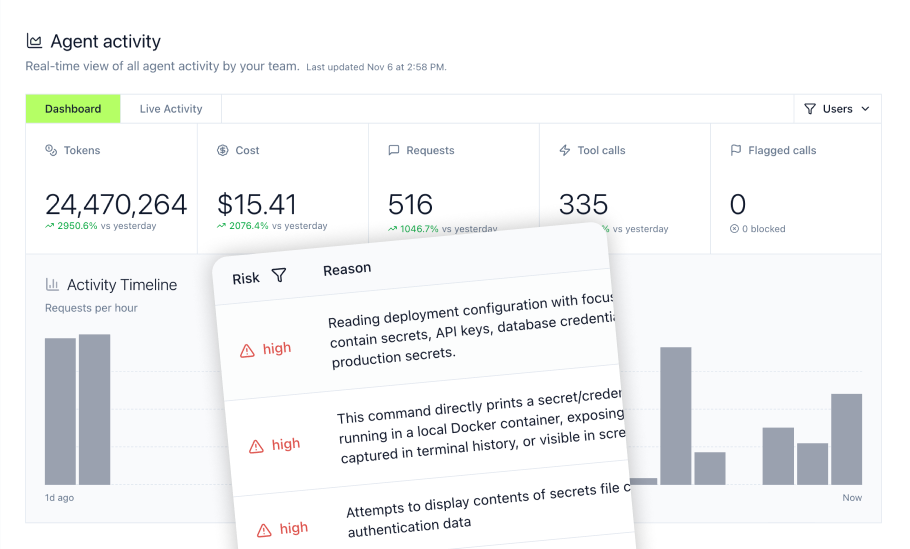
Agent Monitor tracks agent activity beyond the gateway layer. Through hooks in Cursor and Claude Code, Agent Monitor identifies:
- MCP calls made outside the managed gateway
- PII exposure in prompts and responses
- Credential leakage (API keys, tokens)
- Risky bash commands executed by agents
- Prompt injection attempts
This visibility applies when Kimi K2 is used through workflows covered by supported Agent Monitor integrations, such as Cursor or Claude Code. Separate controls may be required for direct local deployments, custom applications, and hosted Kimi endpoints. MDM integration enables push of detect-only or enforce-mode configurations to developer machines for consistent policy application.
Practical Deployment Paths for Kimi K2
Enterprises evaluating Kimi K2 have several deployment options, each with different governance implications.
Option 1: Self-Hosted Deployment
Running Kimi K2 on your own infrastructure provides maximum control but requires:
- Substantial GPU capacity: Moonshot AI's deployment guide lists a 16-GPU H200 or H20 cluster as the smallest FP8 deployment unit for the original Kimi K2 at 128K context
- Model serving infrastructure (vLLM, TGI, or similar)
- Security hardening of the deployment stack
- Integration with existing monitoring and logging
For organizations with existing ML platform teams and GPU capacity, self-hosted deployment may fit naturally. Governance integration happens at the tool-access layer: serve Kimi K2 through the organization's chosen inference stack, then connect the Kimi-powered agent application to governed MCP servers for access to internal tools and data.
Option 2: Managed Inference Providers
Several providers offer hosted Kimi K2 inference, reducing infrastructure burden while maintaining access through standard APIs. This approach:
- Shifts operational complexity to the provider
- May introduce data processing concerns depending on provider location
- Requires API credential management and usage monitoring
MCP gateway integration applies to the agent's tool and data connections. Kimi K2 inference requests remain part of the separate model-serving or model-gateway architecture.
Option 3: Hybrid Approaches
Many enterprises will use different deployment models for different use cases:
- Self-hosted for sensitive workloads with strict data requirements
- Managed inference for development and testing
- Gateway-governed access for production agent deployments
A Kimi K2-powered application can use the same governed MCP bundle whether inference runs on internal infrastructure or through an external provider, although the application still needs a separately configured model endpoint.
Integration with Enterprise Systems
Kimi K2's capabilities become valuable when connected to internal tools and data sources. The integration pattern follows MCP standards.
Database Access
Connecting Kimi K2 agents to databases enables natural language querying, report generation, and data analysis workflows. MintMCP provides pre-configured connectors for PostgreSQL, MySQL, MongoDB, Snowflake, and BigQuery. Each connector supports tool-level access control: enable read queries while blocking schema modifications or bulk exports.
Business Application Integration
Enterprise agents typically need access to multiple business systems including CRM platforms like Salesforce and HubSpot, communication tools like Slack and Zoom, project management systems like Atlassian, and development platforms like GitHub. MintMCP provides prebuilt and hosted connectors with centralized authentication, tool-level access control, credential management, and audit logging.
Custom MCP Servers
Organizations with proprietary systems can build custom MCP servers that expose internal APIs to governed AI agents. MintMCP supports:
- Hosting custom STDIO-based MCP servers from the community ecosystem
- Converting locally-run MCP servers to hosted, production-ready services with OAuth wrapping
- Custom connector development for internal systems
Custom servers benefit from the same governance controls as pre-built connectors: tool-level access control, audit logging, and credential management.
Compliance Considerations
Regulated industries face additional requirements when deploying AI systems. Kimi K2 adoption must fit within existing compliance frameworks.
Audit Requirements
Most compliance frameworks require demonstrable audit trails for systems accessing sensitive data. MintMCP provides:
- Gateway logging for MCP requests and tool calls, including user identity, payload, result, and timing, with prompt submissions available through supported Agent Monitor hooks
- Per-user attribution for every action
- Configurable retention policies
- Export to SIEM platforms including Microsoft Sentinel and Splunk
These capabilities apply to Kimi K2 agents the same way they apply to Claude or ChatGPT, providing consistent audit documentation regardless of which model powers the agent.
Data Protection
For organizations handling protected health information or other regulated data, MintMCP's compliance posture includes:
- SOC 2 Type II audited with continuous monitoring via Drata
- Compliant with HIPAA standards, with BAA available
- Penetration tested infrastructure
- Data encryption in transit and at rest
- Data residency options
Governing Multi-Model AI Infrastructure with MintMCP
As enterprises add Kimi K2 and future models to their AI portfolios, the governance challenge scales. Each new model introduces potential security gaps, credential sprawl, and audit blind spots unless organizations build reusable infrastructure.
MintMCP addresses this by separating concerns across two complementary layers. The MCP Gateway governs tool and data connections, providing standardized access to databases, APIs, and business systems. When an agent needs to query Salesforce, read from PostgreSQL, or send a Slack message, the MCP Gateway enforces authentication, applies tool-level permissions, and logs every action, regardless of which model powers the agent.
The Agent Gateway layer adds identity, memory, and monitoring capabilities for long-running autonomous agents. Per-agent identities with machine-to-machine authentication replace shared service accounts, scoped credentials limit blast radius, and activity monitoring tracks behavior across sessions. This separation allows organizations to deploy Kimi K2-powered agents with the same security posture they apply to Claude or ChatGPT workflows.
MCP adoption expanded across products including Claude, Cursor, ChatGPT, Gemini, Microsoft Copilot, and VS Code. The protocol's transition to Linux Foundation governance through the Agentic AI Foundation provides vendor-neutral stewardship, although enterprises should still verify MCP support in each specific client and integration. Organizations that invest in MCP-based governance today build infrastructure that transfers across future models, reducing the incremental cost of evaluating each new release.
Frequently Asked Questions
How does Kimi K2 compare to other models for enterprise use cases?
Kimi K2's open-weight availability makes it suitable for organizations requiring self-hosted deployment or strict data residency. Moonshot AI's published evaluations reported strong results on several agentic and coding benchmarks, but enterprises should test the exact Kimi variant on their own workloads rather than treating vendor-reported benchmarks as production performance guarantees. The choice depends less on raw capability and more on deployment requirements, cost structure, and integration with existing governance infrastructure. Organizations already governing multiple model-powered applications through MCP gateways can reuse existing tool and data controls for Kimi K2-powered applications, but model serving, evaluation, and infrastructure remain separate workstreams.
Can I use Kimi K2 for customer-facing AI features?
Yes, but deployment model matters. Self-hosted Kimi K2 provides full control over inference and data handling. Managed inference providers may have terms of service implications for customer data. Either way, the governance principles remain: controlled access to backend systems, audit logging of all interactions, and DLP policies to prevent sensitive data exposure in model inputs or outputs. The Modified MIT License requires prominent "Kimi K2" attribution for commercial products exceeding 100 million monthly active users or $20 million in monthly revenue.
What happens if Moonshot AI discontinues Kimi K2 support?
Open-weight models mitigate vendor lock-in risk. Because the weights are downloadable, an organization can generally continue running its deployed copy, subject to the Modified MIT License and its attribution requirement for commercial services exceeding 100 million monthly active users or $20 million in monthly revenue. However, you would lose access to future updates, fine-tunes, or optimizations the vendor might provide. This is the standard tradeoff for open-weight versus proprietary models.
How do I prevent developers from using Kimi K2 without approval?
Shadow AI detection requires visibility into developer tool usage. Agent Monitor hooks in Cursor and Claude Code identify off-gateway MCP activity. MDM integration pushes detect or enforce policies to developer machines. Network-level controls can block connections to known Kimi K2 inference endpoints. The combination of technical controls and clear acceptable use policies addresses most shadow AI scenarios.
Is Kimi K2 suitable for regulated industries like healthcare or finance?
The model itself has no inherent compliance certification. Compliance depends on how you deploy and govern Kimi K2. Self-hosted deployment with appropriate access controls, audit logging, and data protection may help support regulatory requirements, subject to the organization's legal, security, contractual, and compliance review. The governance infrastructure, not the model, determines compliance posture. Organizations using MintMCP for existing AI governance can extend the same controls to Kimi K2 deployments.