Every ungoverned AI agent represents a ticking compliance time bomb - accessing sensitive data, making autonomous decisions, and operating without the audit trails regulators demand. With Gartner predicting that over 40% of agentic AI projects will be canceled by the end of 2027 due to escalating costs, unclear business value, or inadequate risk controls and relatively few enterprises maintaining fully implemented AI governance structures, the gap between AI adoption and compliance readiness creates substantial regulatory and security exposure. The solution isn't slowing AI deployment - it's implementing enterprise-grade infrastructure like an MCP Gateway that delivers centralized governance, complete audit trails, and real-time monitoring from day one.
Key takeaways
- Gartner predicts 40% of agentic AI projects will be canceled by 2027 due to inadequate governance frameworks
- ISO/IEC 42001:2023 provides the first auditable AI management standard - certification timeline varies from months to over a year based on organizational maturity
- Complete audit trails target 99%+ coverage of all agent actions for regulatory compliance
- Organizations implementing continuous monitoring can respond more swiftly to compliance violations
- Enterprise implementations typically achieve break-even within 12-18 months through reduced breaches and operational efficiency
Understanding the imperative for enterprise AI governance in 2025
Your AI agents operate differently than traditional software. Unlike applications that execute predetermined logic, AI agents make autonomous decisions, access vast amounts of sensitive enterprise data, and adapt their behavior over time - all with minimal real-time human oversight.
This fundamental difference creates compliance challenges that legacy IT governance frameworks cannot address.
The rise of enterprise AI agents: Opportunities and risks
Enterprise AI adoption has reached critical mass. Organizations now deploy AI agents across customer service, data analysis, code generation, and internal operations. But this adoption outpaces governance capabilities:
- 79% of organizations report some level of AI agent adoption according to a 2025 PwC survey, yet 53% acknowledge daily access to sensitive information
- 59% lack mature guidelines for responsible AI usage across their organizations
- 57% of IT leaders lack confidence in AI output accuracy and explainability
- 60% don't provide transparency on customer data usage in AI systems
The regulatory stakes are high. GDPR penalties can reach up to €20M or 4% revenue. In 2025, the average cost of a healthcare data breach is about $7.42M and regulatory exposure (including HIPAA) can further compound that impact. Without proper governance, AI tools operate as black boxes with significant security and compliance risks.
Why traditional IT governance falls short for AI
Traditional application security focuses on static controls—firewall rules, access lists, and periodic audits. AI agents require dynamic, behavioral governance that adapts to:
- Autonomous decision-making that evolves based on training data
- Cross-system interactions spanning multiple departments and data sources
- Learning and adaptation that changes agent behavior over time
- Minimal human oversight during routine operations
This is why organizations need purpose-built AI governance solutions rather than retrofitted IT controls.
Establishing a robust AI governance framework for compliance readiness
Effective AI governance starts with a structured framework - not piecemeal controls added after deployment. The Plan-Do-Check-Act model embedded in ISO/IEC 42001 provides the foundation for continuous improvement.
Key pillars of an effective AI governance model
A compliance ready governance framework addresses five critical areas:
1. Documented Policies and Processes
- Clear ownership for AI initiatives across IT, legal, and business units
- Defined approval workflows for new agent deployments
- Escalation paths for high-risk decisions
2. Risk Assessment and Mitigation
- Risk maturity assessment before technology decisions
- Gap analysis between current state and regulatory requirements
- Continuous risk monitoring throughout agent lifecycle
3. Data Protection and Fairness Safeguards
- Data minimization principles limiting collection to necessary information
- Bias detection and fairness audits
- Anonymization and pseudonymization for sensitive data
4. Human Oversight Mechanisms
- Human-in-the-loop requirements for critical decisions
- Explainability requirements for regulatory review
- Override capabilities for agent actions
5. Continuous Monitoring and Improvement
- Real-time compliance monitoring
- Quarterly governance reviews
- Version control for models and configurations
Integrating compliance into your AI development lifecycle
Compliance isn't a post-deployment checkbox. Integrate governance requirements from design through retirement:
- Design Phase: Define compliance requirements, data boundaries, and risk thresholds
- Development Phase: Implement audit logging, access controls, and guardrails
- Testing Phase: Conduct adversarial testing and bias detection
- Deployment Phase: Validate controls before production release
- Operations Phase: Monitor continuously and respond to violations
- Retirement Phase: Document decommissioning and data retention
Organizations adopting ISO/IEC 42001—the world's first auditable AI management standard—report 20% faster compliance audits and clearer accountability structures.
Implementing security & compliance controls for enterprise AI agents
Security controls for AI agents must address both traditional IT security and AI-specific risks. The research shows multi-layered guardrails—policy, runtime, and infrastructure—provide the most effective protection.
Meeting regulatory requirements with AI tools
Different regulations impose specific requirements on AI agent operations:
GDPR Requirements:
- Explicit consent, data minimization, right to explanation
- Penalty risk: €20M or 4% of global revenue
HIPAA Requirements:
- PHI access controls, audit trails, encryption
- Penalty risk: $7.42M average per incident
SOC 2 Requirements:
- Security controls, availability, processing integrity
- Penalty risk: Audit failures and loss of certification
SOX Requirements:
- Tamper-proof records, internal controls
- Penalty risk: Criminal penalties
The MCP Gateway addresses these requirements through built-in OAuth + SSO enforcement, complete audit logs, and SOC 2 Type II certification.
Securing AI agents: Authentication, authorization, and data protection
Identity-first security treats every AI agent as a unique identity requiring granular access controls:
Authentication Requirements:
- Unique identity for each agent (service accounts, certificates)
- Cryptographic attestation with hardware-backed key storage
- Automatic token rotation at 24-72 hour intervals
- Integration with enterprise IdP via SAML/OIDC
- Multi-factor authentication for administrative access
Authorization Models:
- RBAC (Role-Based): Simple, easy to audit—best for defined agent roles
- ABAC (Attribute-Based): Context-aware decisions based on time, location, data sensitivity
- PBAC (Policy-Based): Centralized policy enforcement across all agents
Zero Trust Principles:
- Least privilege - minimum permissions required for each task
- Dynamic policy evaluation with continuous reassessment
- Scoped permissions to specific data domains
Leveraging AI gateways for real-time monitoring and observability
Static controls fail with autonomous agents. Real-time monitoring enables detection and response before compliance violations escalate into regulatory incidents.
Gaining visibility: Why observability is key to AI agent compliance
Without proper monitoring, organizations cannot answer basic compliance questions: What data did the agent access? What decisions did it make? Why did it take specific actions?
Effective observability requires tracking:
- Agent identity and authentication events
- Every action, decision, and reasoning process
- Data accessed and modified
- User interactions and authorization levels
- System integrations and API calls
- Performance metrics and error conditions
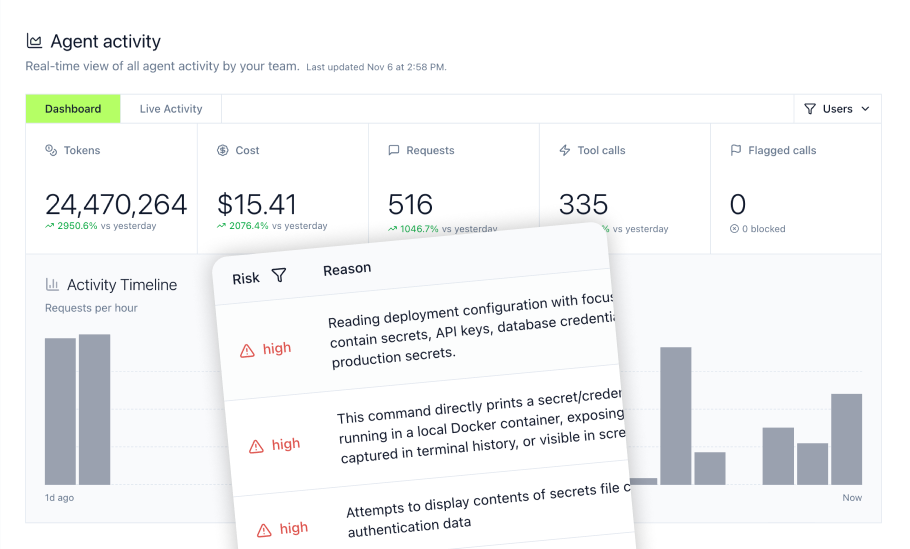
Organizations using continuous compliance monitoring can respond more swiftly to violations compared to periodic audit approaches. The LLM Proxy provides this visibility by tracking every MCP tool invocation, bash command, and file operation across all coding agents.
Transforming shadow AI into sanctioned AI with monitoring tools
Shadow AI—unsanctioned AI tools bypassing security controls—represents a growing compliance risk. Discovery and monitoring tools help organizations:
- Identify all AI agents operating within the environment
- Track usage patterns and data access across teams
- Detect anomalous behavior indicating potential compromise
- Enforce policies without disrupting developer workflows
The goal isn't to block AI adoption—it's to turn shadow AI into sanctioned AI through visibility and governance.
Ensuring data integrity and access controls for enterprise AI agents
Data governance forms the foundation of AI compliance. Poor data quality and inadequate access controls undermine every other governance effort.
Protecting sensitive data: The foundation of AI compliance
Many organizations identify data privacy as their primary AI adoption obstacle. Address this challenge through:
Data Minimization:
- Collect only data necessary for agent function
- Implement automatic data expiration policies
- Remove unnecessary PII before processing
Encryption Standards:
- AES-256 or higher for data at rest
- TLS 1.3+ for data in transit
- Customer-managed keys for sensitive environments
Data Residency:
- Region-specific storage for GDPR compliance
- Multi-region support with data residency controls
- Clear data lineage and provenance tracking
Implementing Role-Based access for AI agent interactions
Granular access controls prevent agents from accessing data beyond their defined scope:
Role-Based Configuration:
- Define tool access by role (e.g., enable read-only operations, exclude write tools)
- Separate development, staging, and production permissions
- Implement time-based access restrictions where appropriate
Sensitive File Protection:
- Block access to .env files, SSH keys, and credentials
- Prevent reading of configuration files containing secrets
- Monitor and alert on attempted access to protected resources
The LLM Proxy implements these protections automatically, blocking dangerous commands and protecting sensitive files without requiring custom configuration.
Bridging the gap: Connecting AI agents to enterprise data with compliance
AI agents deliver value by accessing enterprise data—CRM records, financial systems, knowledge bases. The challenge lies in enabling this access while maintaining compliance.
Securely integrating AI agents with Business-Critical systems
Common integration patterns include:
Database Access:
- Query customer data, generate reports, answer business questions
- Requires encryption, access logging, and query restrictions
- Snowflake and Elasticsearch connectors provide governed access paths
Email and Communication:
- AI assistants accessing CRM data and support tickets
- Requires full security oversight and audit trails
- Gmail and Outlook connectors enable monitored access
Development Workflows:
- Connect coding assistants to repositories and CI/CD systems
- Requires credential protection and command restrictions
- Tool governance ensures safe access to development infrastructure
Contextual AI: Compliance for data access and usage
Each data type requires specific compliance considerations:
Customer PII:
- Compliance requirements: GDPR consent, CCPA access rights
- Recommended controls: Encryption, access logging, retention limits
Financial Records:
- Compliance requirements: SOX auditability, PCI DSS security
- Recommended controls: Tamper-proof logs, separation of duties
Healthcare Data:
- Compliance requirements: HIPAA safeguards, minimum necessary
- Recommended controls: PHI masking, role-based access, encryption
Employee Information:
- Compliance requirements: Privacy regulations, HR policies
- Recommended controls: Purpose limitation, access restrictions
Streamlining adoption: Enterprise-Grade deployment of AI tools
Compliance doesn't require slowing AI deployment. Organizations using pre-configured policies achieve both speed and governance.
Accelerating AI agent deployment while maintaining control
According to industry analyses, organizations implementing governance frameworks can achieve significant reductions in manual audit tasks and 15% increases in deployment speed. The key is building compliance into deployment infrastructure rather than adding it afterward.
One-Click Deployment with Built-in Governance:
- Deploy STDIO-based MCP servers instantly with automatic hosting
- Add OAuth protection automatically during deployment
- Transform local servers into production services with monitoring
Self-Service Access with Policy Enforcement:
- Developers request and receive AI tool access instantly
- Pre-defined policies automatically apply to new deployments
- Centralized credential management eliminates scattered secrets
Frictionless compliance: How to empower developers safely
The goal is governance that enables rather than blocks:
- Pre-approved tool sets: Curate approved MCP servers with pre-configured permissions
- Automatic authentication: OAuth + SSO enforcement without manual configuration
- Real-time guardrails: Block risky operations before they execute
- Transparent audit trails: Complete logging without developer intervention
This approach allows teams to adopt AI tools quickly while maintaining the controls regulators require.
Future-Proofing AI compliance
AI regulations continue evolving. The EU AI Act rolls out in phases—some provisions apply starting Feb 2, 2025, GPAI obligations begin Aug 2, 2025, and the majority of rules (with enforcement) start Aug 2, 2026, with full roll-out by Aug 2, 2027. Organizations must build adaptive compliance programs that respond to regulatory changes.
Staying ahead: Proactive strategies for AI regulatory changes
Monitor Regulatory Developments:
- Track EU AI Act implementation timelines and requirements
- Follow NIST AI RMF updates and emerging standards
- Participate in industry working groups and standard development
Build Adaptable Infrastructure:
- Implement modular architecture allowing policy updates without system changes
- Maintain documentation enabling quick response to new requirements
- Design audit trails capturing data needed for future regulations
Building a sustainable AI compliance program
Sustainable compliance requires ongoing investment:
- Quarterly Governance Reviews: Assess agent performance and compliance posture
- Annual Certification Audits: Maintain ISO 42001, SOC 2, and industry certifications
- Continuous Monitoring: Track controls across technology stack in real-time
- Regular Training: Update team knowledge as regulations and technologies evolve
Organizations report 20% efficiency gains in compliance audits through continuous monitoring compared to periodic assessment approaches.
How MintMCP accelerates enterprise AI compliance
Building compliance infrastructure from scratch requires significant investment—typically $825K-$2.45M for initial implementation plus ongoing operational costs. MintMCP provides this infrastructure as a managed service, reducing implementation time and cost while delivering enterprise-grade governance.
The unified control plane advantage
While point solutions tackle individual compliance requirements, MintMCP Gateway provides centralized governance across all AI tools and agents:
- SOC 2 Type II Certified: Meet audit requirements without building custom compliance infrastructure
- Complete Audit Trails: Capture every AI agent action automatically—no custom logging required
- OAuth + SSO Enforcement: Add enterprise authentication to any MCP server automatically
- Real-Time Monitoring: Live dashboards for server health, usage patterns, and security alerts
- Granular Tool Access Control: Configure tool access by role with read-only and write restrictions
Built-in security controls
The LLM Proxy extends governance to coding agents with:
- Tool Call Tracking: Monitor every MCP tool invocation, bash command, and file operation
- Security Guardrails: Block dangerous commands and protect sensitive files in real-time
- Complete Command History: Audit trail of every operation for security review
- MCP Inventory: Visibility into installed MCPs and their usage across teams
Enterprise data connectors with governance built in
Connect AI agents to enterprise data sources while maintaining compliance:
- Elasticsearch: Query knowledge bases and support tickets with access controls
- Snowflake: Enable financial reporting and analytics with governed data access
- Gmail Integration: AI-driven customer response automation within approved workflows
For organizations serious about deploying AI agents at scale, MintMCP provides the governance infrastructure needed to move from pilot to production—fast.
Frequently asked questions
What is 'shadow AI and how can enterprises mitigate its risks?
Shadow AI refers to unsanctioned AI tools that bypass security controls and governance policies. 79% of organizations report some level of AI agent adoption according to a 2025 PwC survey, but many lack visibility into which tools employees actually use. Mitigate shadow AI through discovery tools that identify all AI agents in your environment, centralized policies that define approved versus prohibited tools, and monitoring infrastructure that tracks usage patterns without disrupting workflows. The goal isn't blocking AI adoption—it's transforming ungoverned tools into sanctioned, monitored deployments.
How long does IT take to achieve AI agent compliance?
Implementation timelines vary based on organizational maturity and regulatory requirements. ISO/IEC 42001 certification can take anywhere from a few months to over a year depending on the organization's maturity. Full enterprise implementations span 7-12 months across five phases: assessment (4-8 weeks), framework setup (8-16 weeks), security controls (12-20 weeks), testing (6-10 weeks), and ongoing operations. Organizations using managed platforms like MintMCP can accelerate timelines by 40-60% compared to building custom solutions.
What audit trail requirements do regulations mandate for AI agents?
Regulatory frameworks require comprehensive logging of AI agent activities. Audit trails must capture 99%+ coverage of all agent actions, including timestamps, agent identity, user context, actions taken, data accessed, decision reasoning, and authorization decisions. Logs must be immutable (cryptographically signed), separately stored from production systems, encrypted, and retained per regulatory requirements—typically 3-7 years. Tamper-evident storage and role-based access controls for log viewing are essential for compliance.
Can I integrate compliance controls with existing identity management systems?
Yes. Modern AI governance platforms integrate with enterprise identity providers through SAML and OIDC protocols. This enables single sign-on, centralized user provisioning, and consistent access policies across AI tools and existing applications. Look for platforms supporting OAuth + SSO enforcement that automatically wrap MCP endpoints with enterprise authentication without requiring custom integration work.
How does MintMCP simplify deploying compliant AI agents across different teams?
MintMCP provides pre-configured governance policies that apply automatically during deployment. Teams can deploy MCP servers with one click while inheriting organization-wide security controls, authentication requirements, and audit logging. Role-based access controls allow administrators to define which tools each team can access, and real-time monitoring provides visibility across all deployments. This approach enables self-service AI tool access while maintaining the centralized governance enterprises require.