Every unsecured AI agent connection to your enterprise data creates a potential breach point—and 66% of MCP servers operate with poor security practices that leave sensitive information exposed. With the AI agents market projected to grow from $5.1 billion in 2024 to $47.1 billion by 2030, organizations face an urgent challenge: AI agents need data access to deliver value, but that access creates significant security, compliance, and operational risks. The solution isn't blocking AI adoption—it's deploying an MCP Gateway that transforms ungoverned AI interactions into controlled, secure, and compliant operations.
Key takeaways
- 43% of MCP servers contain command injection vulnerabilities that enable arbitrary code execution on enterprise systems
- MCP gateways act as a single "pinch point" where all AI agent traffic flows through centralized authentication, authorization, and audit logging
- Enterprise SSO integration eliminates fragmented authentication—agents use existing identity infrastructure instead of scattered credentials
- Organizations deploying hosted gateways avoid $500K-$2M costs plus 20-30% ongoing engineering overhead
- Complete audit trails enable SOC 2, HIPAA, and GDPR compliance with immutable records of every AI interaction
- Real-time monitoring detects anomalies and blocks risky operations before they execute—protecting .env files, SSH keys, and production credentials
- Deployment timelines shrink from 3-6 months for custom builds to days or weeks with hosted solutions
Understanding the security imperative for AI agent data access
The root cause of enterprise AI security failures isn't lack of awareness—it's architectural gaps that allow AI agents to operate as black boxes with uncontrolled access to sensitive systems.
Research into MCP server security reveals six major vulnerability classes threatening enterprise data:
- Command injection (43% of servers): Arbitrary code execution through unsanitized inputs
- Unrestricted network access (33% of MCP tools): Data exfiltration to unauthorized external destinations
- File system exposure (22% of servers): Access to directories and files outside intended scope
- Tool poisoning (5.5% of servers): Malicious tool descriptions that manipulate AI agent behavior
- Secret exposure (66% poor practices): Credentials stored insecurely in environment variables
Without proper governance, AI tools create significant security risks through zero telemetry, no request history, and uncontrolled data access. Shadow AI—unauthorized AI deployments that bypass IT governance—continues to accelerate, compounding these risks across departments that adopt AI tools without security review.
The business impact extends beyond data breaches. Compliance failures trigger regulatory penalties, customer trust erodes, and engineering teams spend cycles firefighting instead of building. Organizations need an architectural solution that makes secure AI deployment the default—not an afterthought.
What are MCP gateways and how do they function for AI agents?
An MCP gateway sits between AI agents (MCP clients) and enterprise tools or data sources (MCP servers), acting as the central control point where all AI interactions are authenticated, authorized, logged, and governed. Think of it as a security layer that transforms scattered, ungoverned AI connections into a single managed infrastructure.
The role of MCP gateways in bridging AI and internal systems
MCP gateways solve three specific problems: tool organization, protocol translation, and security control. Instead of each AI agent maintaining direct connections to dozens of enterprise systems—each with its own authentication method, API format, and access patterns—all traffic flows through one governed endpoint.
This architectural pattern delivers immediate benefits:
- Single point of control: Consistent security policies apply to every AI interaction
- Centralized authentication: Enterprise SSO handles identity instead of scattered API keys
- Unified audit logging: Every tool call, data access, and agent action recorded in one place
- Policy enforcement: Block unauthorized operations before they reach backend systems
- Tool discovery: AI agents see only approved tools for their role and current task
Core components of an enterprise MCP gateway
Production-grade MCP gateways include several interconnected components that work together to secure AI agent access:
- Authentication layer: Integrates with existing identity providers (Okta, Azure AD, Cognito) using OAuth 2.0, SAML, or OIDC
- Authorization engine: Enforces role-based access control at the tool and resource level
- MCP server registry: Central catalog of available tools with configuration and permission metadata
- Traffic proxy: Routes requests between AI clients and MCP servers while applying policies
- Audit system: Immutable logging of all interactions for compliance and security review
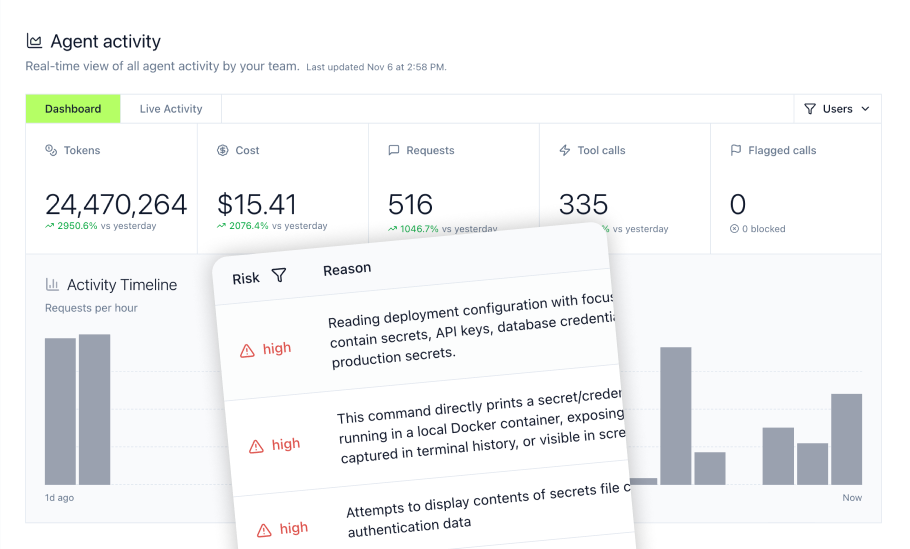
- Monitoring dashboard: Real-time visibility into usage patterns, performance, and anomalies
The gateway handles complexity that would otherwise require custom engineering—OAuth flows, credential management, session handling, and protocol translation—so AI agents can access enterprise data through a standardized, secure interface.
For a deeper understanding of gateway architecture, review the MCP Gateways infrastructure overview.
Implementing robust authentication for AI agents with enterprise SSO
MCP specification's native OAuth approach conflicts with enterprise practices. The spec assumes anonymous dynamic client registration and authorization code flows—patterns that enterprise security teams reject because they bypass established identity governance.
Enterprise MCP gateways solve this by integrating with existing identity infrastructure rather than implementing the spec's OAuth approach directly.
Centralized identity management for AI agent credentials
Instead of each MCP server handling its own authentication—creating token sprawl and making access revocation nearly impossible—the gateway manages all identity operations:
- SSO integration: Users authenticate once through enterprise IdP; gateway handles downstream connections
- Agent identity: AI agents receive cryptographic identities tied to their operator's permissions
- Token exchange: Gateway converts enterprise tokens (JWT, SAML assertions) into MCP-compatible credentials
- Centralized revocation: Disable agent access instantly from one control point
This approach means no changes to workflows. Users authenticate the same way they access other enterprise applications, and security teams maintain visibility through existing identity management tools.
Securing access with OAuth protection
MCP gateways add OAuth protection automatically to any MCP server—including STDIO-based servers that have no native authentication. The gateway:
- Wraps unauthenticated servers with enterprise-grade OAuth 2.0 or SAML
- Manages token lifecycle (issuance, refresh, expiration) without manual intervention
- Supports both shared service accounts and per-user authentication flows
- Integrates with secrets management systems (HashiCorp Vault, AWS Secrets Manager) for credential storage
The result: AI agents operate with enterprise authentication standards regardless of how individual MCP servers were originally built. Learn more about authentication models for MCP deployments.
Granular access control and authorization for AI agent tool usage
Authentication confirms identity—authorization determines what that identity can do. MCP gateways provide fine-grained control over AI agent capabilities that would be impossible to implement at the individual server level.
Controlling AI agent capabilities at a granular level
Role-based access control (RBAC) in MCP gateways operates at multiple levels:
- User/agent level: Which identities can access the gateway at all
- Server level: Which MCP servers (tools) each identity can reach
- Tool level: Which specific operations within a server are permitted
- Resource level: Which data entities (databases, files, accounts) agents can access
- Action level: Read-only versus read-write permissions per tool
For example, a customer support AI agent might have access to:
- CRM data (read-only)
- Support ticket system (read-write)
- Email drafting (write, but send requires human approval)
- Financial systems (blocked entirely)
This granular control follows the principle of least privilege—agents access only what they need for their current task, nothing more.
Preventing unauthorized operations
Beyond static permissions, MCP gateways enforce dynamic policies that adapt to context:
- Tool filtering: Limit which tools appear in agent discovery based on task type
- Rate limiting: Prevent runaway agents from overwhelming backend systems
- Resource quotas: Cap data volume that agents can access in a given timeframe
- Time-based restrictions: Limit certain operations to business hours
- Approval workflows: Require human confirmation for high-risk actions
Virtual MCPs—curated tool sets exposed through the gateway—expose minimum required tools, not entire MCP servers. This prevents tool proliferation that overwhelms agents and creates unnecessary attack surface.
For detailed guidance on tool governance, see the tool governance documentation.
Ensuring compliance and auditability for AI agent interactions
Regulated industries—finance, healthcare, government—require complete audit trails of data access. Without centralized logging, proving compliance across dozens of AI agents and hundreds of tool interactions becomes impossible.
Maintaining a comprehensive audit trail of AI agent activity
MCP gateways create immutable records of every interaction:
- Who: User identity and agent identifier
- What: Tool called, parameters passed, data accessed
- When: Precise timestamps for every operation
- Where: Source IP, gateway endpoint, destination server
- Why: Context from the agent session (optional, configurable)
- Result: Success/failure, response data, error messages
These logs feed into existing SIEM systems, compliance dashboards, and incident response workflows. Security teams gain visibility they never had with direct agent-to-server connections.
Meeting Industry-Specific compliance standards
Audit capabilities map directly to regulatory requirements:
SOC 2 Type II:
- Change management logging for gateway configuration
- Access control documentation through RBAC policies
- Availability monitoring via health dashboards
HIPAA:
- Minimum necessary enforcement through granular permissions
- PHI access logging with user attribution
- Business Associate Agreement support from enterprise vendors
GDPR:
- Data processing records through interaction logs
- Right-to-erasure support via centralized access controls
- Data minimization through tool filtering
Organizations with formal AI governance report significantly higher success rates than those without structured approaches. The gateway architecture makes governance operationally feasible—not just a policy aspiration.
Review the security and compliance overview for detailed compliance mapping.
Real-time monitoring and observability for AI agent environments
Audit logs capture history—monitoring captures the present. MCP gateways provide observability infrastructure that transforms AI agents from black boxes into transparent, measurable systems.
Tracking AI agent usage and performance
Real-time dashboards surface critical metrics:
- Usage patterns: Which tools agents use most, peak activity times, user adoption curves
- Performance metrics: Response latency, error rates, throughput by server
- Cost analytics: Token consumption, API call volume, resource utilization by team or project
- Security indicators: Failed authentication attempts, policy violations, anomalous access patterns
Detecting and responding to anomalies in real-time
Beyond passive monitoring, gateways enable active threat detection:
- Anomaly alerts: Automatic notification when agent behavior deviates from baseline
- Rate limiting triggers: Automatic throttling when agents exceed normal usage
- Kill switches: Emergency revocation of agent access during security incidents
- Integration hooks: Feed alerts to Slack, PagerDuty, or security orchestration platforms
The LLM Proxy extends this observability to coding agents specifically—tracking every tool invocation, bash command, and file operation from AI coding assistants like Cursor or Claude Code.
Securing specific enterprise data sources with MCP connectors
Generic security policies matter, but enterprise deployments require connectors optimized for specific data sources—databases, search engines, email systems, and business applications.
Connecting AI agents to your data warehouse with confidence
Data warehouses contain some of the most sensitive business information—customer analytics, financial metrics, operational data. MCP connectors for these systems include purpose-built security features:
- Natural language to SQL conversion with Cortex Analyst
- Semantic search against configured Cortex Search services
- Query execution with DML/DDL operation support
- Granular access to specific databases, schemas, and tables
- Query DSL search for flexible document retrieval
- ES|QL execution for advanced analytics
- Index-level access control through gateway policies
- Shard health monitoring for operational visibility
These connectors enable use cases like:
- Product analytics and metrics tracking through natural language queries
- Financial reporting automation with governed data access
- Executive business intelligence without SQL expertise
Integrating AI with your email systems securely
Email represents high-risk territory for AI agents—access to communications, contacts, and calendar data requires careful governance.
- Advanced search with labels and filters
- Email retrieval including metadata and attachments
- Draft creation with Markdown formatting
- Reply threading with integrity preservation
- Send operations through controlled workflows
Use cases include AI-driven customer response automation, product feedback aggregation, and communication analysis—all within approved workflows and full security oversight.
Protecting against malicious or unintended AI agent actions
Coding agents and development tools operate with extensive system access—reading files, executing commands, accessing production systems through MCP tools. Without guardrails, these capabilities create significant risk.
Blocking dangerous commands and file access
The LLM Proxy provides security guardrails specific to coding agent scenarios:
- Command blocking: Prevent dangerous bash commands in real-time
- File access restriction: Block access to .env files, SSH keys, and credential stores
- MCP inventory: Complete visibility into installed MCPs and their permissions
- Tool call tracking: Monitor every MCP tool invocation across all coding agents
These controls address the reality that coding agents have system access—they can read files, execute commands, and interact with production systems. The proxy provides essential visibility and control over agent behavior that doesn't exist with direct tool access.
Controlling coding agent behaviors
Beyond blocking specific actions, the LLM Proxy enables policy-based governance:
- Environment protection: Prevent reading environment variables containing secrets
- Network restrictions: Block unauthorized external API calls
- Filesystem sandboxing: Limit file operations to approved directories
- Command auditing: Complete history of every bash command for security review
Organizations gain the productivity benefits of AI coding assistants without accepting the security risks of unmonitored system access.
Choosing the right MCP gateway for your enterprise AI strategy
Not all MCP gateways serve the same use cases. Selection criteria depend on your security requirements, compliance obligations, and operational preferences.
Key evaluation criteria
When assessing MCP gateway options, prioritize:
Security Certifications:
- SOC 2 Type II for infrastructure security
- HIPAA compliance options for healthcare deployments
- GDPR compliance with data residency controls
Authentication Capabilities:
- Enterprise SSO integration (OAuth 2.0, SAML, OIDC)
- Per-user authentication versus shared keys
- Centralized credential management
Deployment Flexibility:
- Cloud-hosted with SLA guarantees
- Private VPC options for data isolation
- Self-hosted/on-premises for air-gapped environments
Observability Features:
- Real-time monitoring dashboards
- Comprehensive audit logging
- Integration with existing security tools
Integration Breadth:
- Pre-built connectors for common tools
- Custom server support
- API bridging capabilities
Decision framework
Choose hosted MCP gateways if:
- You want production deployment in days or weeks
- Engineering resources are better spent on core product
- Predictable costs matter more than maximum customization
- Compliance certifications are required
Consider custom builds only if:
- Unique requirements that no vendor can meet
- Unlimited engineering capacity (5-10+ engineers)
- 6+ month timeline is acceptable
- Budget supports $500K-$2M initial plus ongoing maintenance
For most enterprise deployments, hosted solutions deliver faster time to value with lower total cost of ownership than custom alternatives.
Why MintMCP delivers Enterprise-Grade MCP security
MintMCP provides the deployment, monitoring, and governance infrastructure that transforms MCP from developer utility to production-ready AI tool access.
From local MCP to enterprise Deployment—Fast
MintMCP addresses the core enterprise challenge: most MCP servers are STDIO-based and difficult to deploy securely. The platform provides:
- One-click deployment: Host STDIO-based MCP servers with automatic containerization
- OAuth protection: Add enterprise authentication to any server automatically
- Enterprise monitoring: Transform local servers into production services with logging and compliance
Production-Grade security and compliance
MintMCP is SOC 2 Type II compliant. The platform delivers:
- Complete audit logs: Every MCP interaction, access request, and configuration change recorded
- Real-time monitoring: Live dashboards for server health, usage patterns, and security alerts
- Granular tool access control: Configure access by role—enable read-only operations, exclude write tools
- High availability: Enterprise SLAs with automatic failover and multi-region support
Centralized governance without workflow disruption
The MCP Gateway provides unified authentication, audit logging, and rate control for all MCP connections—without changing how developers or end users work with AI tools.
- Works with existing deployments: Claude, ChatGPT, Cursor, Copilot, and custom MCP-compatible agents
- Centralized credentials: Manage all AI tool API keys and tokens in one place
- Self-service access: Developers request and receive AI tool access instantly through approval workflows
For organizations ready to turn shadow AI into sanctioned AI, MintMCP provides the infrastructure to deploy secure AI agent access at scale. Book a demo to see MintMCP in action.
Frequently asked questions
What is an MCP gateway and why is IT essential for enterprise AI?
An MCP gateway is infrastructure that sits between AI agents and enterprise data sources, acting as the single control point where all interactions are authenticated, authorized, and logged. It's essential because 66% of MCP servers have poor security practices without this governance layer. The gateway makes secure AI deployment architecturally possible by ensuring every agent interaction flows through centralized security policies, enterprise SSO, and comprehensive audit logging.
How does an MCP gateway ensure compliance for AI agent data access?
MCP gateways create immutable audit trails of every AI interaction—who accessed what data, when, through which tool, and what the outcome was. This logging maps directly to compliance requirements: SOC 2 needs change management and access control documentation, HIPAA requires minimum necessary enforcement and PHI access logging, and GDPR demands data processing records with user attribution.
Can MCP gateways prevent AI agents from accessing sensitive files or executing dangerous commands?
Yes. MCP gateways—particularly solutions like the LLM Proxy—include security guardrails that block dangerous operations in real-time. This includes preventing access to .env files, SSH keys, and credential stores; blocking risky bash commands before execution; restricting file operations to approved directories; and monitoring every tool call for anomalous behavior.
What types of enterprise data sources can MCP gateways secure for AI agents?
MCP gateways secure virtually any enterprise data source through pre-built and custom connectors. Common integrations include data warehouses (Snowflake), search platforms (Elasticsearch), email systems (Gmail), databases (PostgreSQL, MySQL, MongoDB), CRM platforms, project management tools (Jira, Linear), and custom REST APIs. The gateway applies consistent authentication, authorization, and audit policies regardless of the underlying data source—so security teams can govern AI access across diverse systems through a single control point.
How much does IT cost to implement an MCP gateway versus building custom security?
Custom MCP gateway builds typically cost $500K-$2M for initial development plus 20-30% of engineering effort annually for maintenance. Hosted solutions offer subscription-based pricing with deployment in days or weeks instead of 3-6 months. For most organizations, hosted platforms deliver better total cost of ownership—the avoided build costs alone justify the subscription before accounting for faster time to market, automatic security updates, and pre-built integrations. Custom builds only make sense when unique requirements genuinely cannot be met by existing vendors.