As enterprises deploy AI agents across Claude, Cursor, ChatGPT, and custom agent harnesses, traditional network firewalls cannot see, understand, or control AI-specific traffic. While 77% of organizations are rethinking security for AI systems, only 26% have the architecture to enforce it. This gap creates urgent demand for a new security category: the AI firewall.
Traditional perimeter security inspects network packets but cannot parse the semantic content of prompts, tool calls, or agent reasoning loops. AI firewalls address this blind spot by applying security controls at the AI interaction layer, whether that means inspecting prompts and responses, governing agent-to-tool connections, or enforcing runtime policy on autonomous agent actions. For enterprises deploying autonomous agents, an MCP gateway with built-in guardrails provides the governed infrastructure that traditional perimeter security cannot deliver.
Key takeaways
- MintMCP provides enterprise AI governance through MCP Gateway, Agent Gateway, and Guardrails with Virtual MCPs, per-agent identities, runtime policy enforcement, and centralized auditability
- Check Point AI Network Firewall extends existing NGFW infrastructure with AI traffic inspection at the network layer
- Akamai Firewall for AI is offered in limited availability, with edge or REST API deployment for AI application protection
- NeuralTrust combines AI gateway and runtime security with Gartner and KuppingerCole analyst recognition
- Pipelock offers an open-source agent firewall with an Apache 2.0-licensed core, ELv2-licensed paid multi-agent features, and 11-layer content inspection
- APERION Smartflow focuses on on-premises deployment for regulated industries requiring data sovereignty
- Linx Security unifies identity governance with MCP gateway capabilities for human and AI agent principals
- Aim Security integrates AI firewall capabilities into Cato Networks SASE platform
- Lakera Guard provides AI-native runtime guardrails now backed by Check Point
- Lasso Security specializes in shadow AI discovery and GenAI-first security
- Zenity applies intent-aware detection correlating tool calls, memory, and workflow context
- F5 AI Guardrails and F5 AI Red Team combine runtime protection with adversarial security testing
- Tigera Lynx delivers Kubernetes-native AI agent security with eBPF-powered enforcement
What is an AI firewall?
An AI firewall is a security layer that inspects, filters, or enforces policy on AI interactions. Depending on the product, that can include prompts and responses, model/API traffic, tool calls, or agent-to-tool communications. Some products analyze semantic content for prompt injection, jailbreaks, and data leakage, while agent-focused controls may govern identity, tool access, or runtime actions. For enterprises deploying autonomous agents, an MCP gateway with built-in guardrails can provide governed agent-to-tool infrastructure that complements traditional perimeter security.
Unlike traditional firewalls that monitor network packets at the transport layer, AI firewalls operate at the application and semantic layers. They can detect when an agent attempts to exfiltrate credentials through a prompt, enforce policies on which tools specific agent identities may invoke, and maintain audit trails that distinguish autonomous agent actions from human activity. This capability becomes essential as organizations scale AI deployments beyond pilot projects into production systems with access to sensitive data and critical infrastructure.
1. MintMCP: Enterprise AI governance with data-permissions-first architecture
MintMCP provides enterprise infrastructure for governing AI clients and autonomous agents across the Model Context Protocol ecosystem. The platform addresses a core enterprise problem: teams adopt Claude, Cursor, ChatGPT, Gemini, and Copilot faster than security teams can govern what those systems access, whose credentials they use, and what actions they take.
What makes MintMCP the enterprise choice
MintMCP's data-permissions-first architecture starts with governed access to company systems rather than granting broad access and restricting afterward. This foundation supports both human-operated AI clients and autonomous agents through connected product areas for governed tool access, agent identity, monitoring, and runtime policy enforcement. In this context, MintMCP is best understood as an agent-governance control layer rather than a traditional network or prompt-response firewall.
Core capabilities
MCP Gateway
The MCP Gateway provides governed data and tool connections through a single entrypoint between AI clients and enterprise systems:
- Virtual MCPs bundle approved connectors behind one governed endpoint for specific teams, roles, or use cases
- SSO and SCIM-driven membership through directory groups eliminates per-user configuration
- Credential injection ensures connectors never hold long-lived secrets
- Tool curation controls which capabilities each role can access
- Audit logging captures every tool call with full context
Agent Gateway
The Agent Gateway treats autonomous agents as first-class non-human principals:
- Each agent receives its own identity, scoped permissions, and credentials
- Bearer keys, M2M tokens, and workload identity federation support multiple authentication models
- Independent credential rotation and revocation per agent
- Attributable audit trails distinguish agent actions from human activity
Agent Monitor
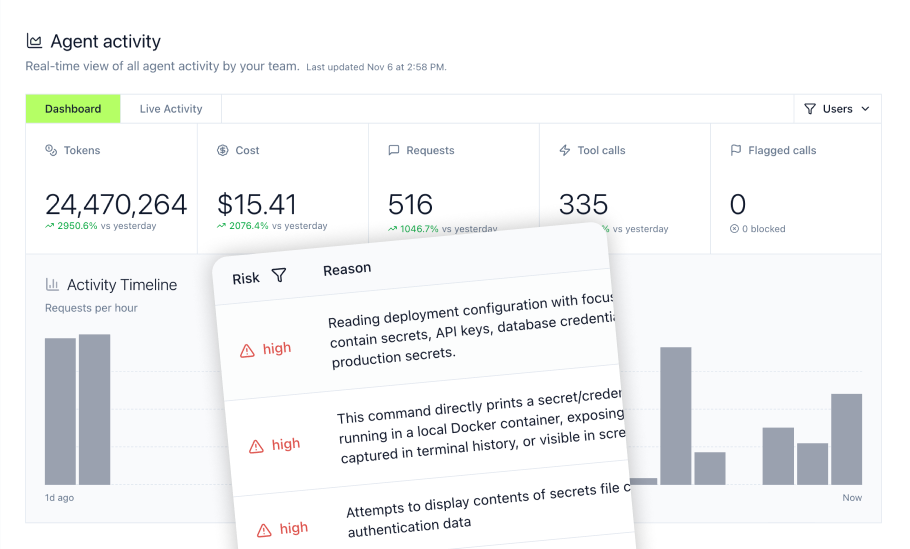
Agent Monitor provides visibility into supported AI agent activity:
- Captures prompts, file access, commands, and MCP tool calls
- Live activity feed filtered by user, agent, tool, or time
- Usage and cost tracking by model, user, and session
- SIEM export via OTLP or Splunk HEC
Guardrails
MintMCP's guardrail architecture applies runtime controls at the agent-tool interaction layer:
- Mint Guard provides managed detection for prompt injection, secrets, PII, and harmful content
- Rules enable declarative matching on tools, arguments, or content patterns
- Gateway Middleware runs customer-authored JavaScript for DLP integration and custom policy enforcement
Security and compliance
- SOC 2 Type II audited
- Compliant with HIPAA standards
- Penetration tested
- Data encrypted in transit and at rest
Getting started
Visit mintmcp.com for enterprise demonstration and pricing.
2. Check Point AI Network Firewall
Check Point extends its next-generation firewall platform with AI traffic inspection capabilities, allowing organizations to see and control AI traffic at the network layer without deploying new hardware.
Where Check Point fits
Check Point's AI Network Firewall operates as part of the AI Defense Plane:
- Network-level AI traffic inspection covering employees, autonomous agents, and AI applications
- MCP server discovery and policy enforcement
- Part of unified AI Defense Plane for discovery, protection, and governance
- Integration with existing NGFW infrastructure
Recognition
Check Point holds a Leader position in the 2025 Gartner Magic Quadrant for Hybrid Mesh Firewalls.
3. Akamai Firewall for AI
Akamai brings its global edge network expertise to AI security with a firewall designed for LLM-based applications, delivering low-latency protection through edge computing.
Where Akamai fits
Akamai Firewall for AI provides real-time prompt injection detection and AI response filtering through flexible deployment options:
- Real-time prompt injection detection and blocking
- AI response filtering for toxic and biased content
- Model-agnostic design supporting any LLM-based application
- Data exfiltration and AI model theft prevention
- Compliance support for AI TRiSM and OWASP Top 10 for LLMs
- Currently offered in limited availability
4. NeuralTrust
NeuralTrust provides an AI agent security platform with recognition in multiple Gartner Market Guides, combining gateway capabilities with runtime agent protection.
Where NeuralTrust fits
NeuralTrust addresses large enterprises with strict security requirements through TrustGate (AI Gateway) and TrustGuard (Agent Runtime Security):
- TrustGate for centralized security and observability
- TrustGuard monitors agent reasoning loops
- Split-plane architecture supporting data sovereignty
- Full lifecycle coverage including red teaming, runtime protection, and posture monitoring
Recognition
NeuralTrust was recognized as a Representative Vendor in Gartner's 2025 Market Guide for AI Gateways and 2026 Market Guide for Guardian Agents, plus as a Leader in the 2025 KuppingerCole Leadership Compass for Generative AI Defense.
5. Pipelock (open source)
Pipelock provides an open-source agent firewall with an Apache 2.0-licensed core; paid multi-agent features are licensed separately under Elastic License 2.0.
Where Pipelock fits
Pipelock addresses security teams requiring transparent, self-hosted agent egress controls:
- 11-layer scanner pipeline for comprehensive threat coverage
- Mediation for HTTP, WebSocket, MCP, and A2A traffic, with CONNECT content inspection when TLS interception is enabled
- Enforced capability separation architecture
- Single Go binary deployment
- OWASP MCP Top 10 and Agentic AI Top 10 coverage
Licensing
The open-source core is Apache 2.0; paid multi-agent features use Elastic License 2.0.
6. APERION Smartflow
APERION provides an enterprise AI gateway and firewall focused on on-premises deployment for organizations in regulated industries.
Where APERION fits
APERION targets regulated industries with on-premises or private-cloud deployment:
- Inline inspection of prompts and responses
- MCP and agent-to-agent (A2A) protocol governance
- On-premise deployment ensuring data never leaves the network
- HIPAA, SEC, and EU AI Act compliance support
- OWASP LLM01-09 coverage including prompt injection and data disclosure
Industry data
A January 2026 CovertLabs scan found security misconfigurations exposing sensitive data in 196 of 198 iOS AI applications examined. Separately, the Chat & Ask AI incident exposed approximately 406 million records.
7. Linx Security
Linx Security combines AI-native identity governance with MCP gateway capabilities, unifying human, non-human, and AI agent identities in a single platform.
Where Linx fits
Linx addresses enterprises deploying AI agents at scale:
- Linx Identity Graph covering human, non-human, and AI agent identities
- MCP Gateway with inline enforcement
- Just-in-time access provisioning for agents and tools
- Per-tool, per-identity, per-tenant policy enforcement
- Credential brokering where models never touch secrets directly
Industry data
According to Cloud Security Alliance research, 68% of organizations cannot distinguish AI agent activity from human activity, making unified identity governance essential.
8. Aim Security (Cato Networks)
Aim Security delivers AI firewall capabilities through the Cato Networks SASE platform, providing converged network and AI security.
Where Aim fits
Aim serves organizations seeking AI security bundled with SASE infrastructure:
- AI-Firewall for runtime protection
- AI-Security Posture Management (AI-SPM)
- Prompt injection, data leakage, and adversarial attack protection
- Support for third-party AI tools and custom agents
- Delivery through Cato SASE fabric
9. Lakera Guard
Lakera Guard provides AI-native runtime guardrails with low-latency detection, now backed by Check Point following its 2025 acquisition of Lakera.
Where Lakera fits
Lakera addresses organizations requiring real-time runtime protection:
- Real-time runtime guardrails with low-latency detection
- Lakera Red continuous adversarial testing
- Gandalf project adversarial research data
- Prompt injection, jailbreak, and data leakage detection
- API-based deployment with on-premises options
10. Lasso Security
Lasso Security provides a GenAI security platform with particular strength in shadow AI discovery and end-to-end workflow monitoring.
Where Lasso fits
Lasso serves organizations deploying internal or customer-facing GenAI requiring visibility into both sanctioned and unsanctioned AI usage:
- Secured gateway intercepting LLM API calls
- Shadow AI discovery and monitoring
- Real-time detection, logging, and masking
- End-to-end workflow monitoring across browser and application integrations
- GenAI-first design principles
For organizations seeking MCP gateway integration alongside dedicated security tools, complementary deployment options exist.
11. Zenity
Zenity delivers AI agent runtime protection with intent-aware detection that correlates tool calls, memory, and workflow context rather than relying on isolated pattern matching.
Where Zenity fits
Zenity serves enterprise security teams managing AI agents:
- Intent-aware runtime detection correlating tool calls, memory, and flow
- Secure-by-design policies applied before deployment
- Step-level execution monitoring
- Discovery and ownership attribution across platforms
- OWASP and MITRE ATLAS framework mapping
Funding
Zenity announced a $125 million Series C in August 2026, bringing its reported total funding to roughly $185 million.
12. F5 AI Guardrails and F5 AI Red Team (formerly CalypsoAI)
F5 now delivers the former CalypsoAI capabilities as F5 AI Guardrails for runtime protection and F5 AI Red Team for adversarial security testing.
Where F5 fits
F5 addresses enterprises scaling generative AI across teams:
- Agentic red-teaming for continuous security testing
- Real-time defense at inference time
- Model-agnostic support for any LLM or AI system
- SIEM and SOAR integration
- Protection against prompt injection, jailbreaks, data leakage, and adversarial attacks
13. Tigera Lynx
Tigera Lynx delivers Kubernetes-native AI agent security with eBPF-powered enforcement, designed specifically for cloud-native AI deployments.
Where Tigera fits
Tigera serves enterprises running AI agents in Kubernetes environments:
- Kubernetes-native design for cloud-native AI deployments
- eBPF and LSM enforcement monitoring every syscall
- Cryptographic identity integration with EntraID, Okta, and SPIFFE/SPIRE
- Cedar policy language for unified LLM, MCP, and agent access control
- Guardian Agent for anomalous behavior detection and quarantine
- GDPR, HIPAA, SOC 2, and financial services compliance support
Why MintMCP is the right choice for enterprise AI governance
As enterprises scale AI agent deployments, the gap between traditional security architectures and AI-specific threats continues to widen. MintMCP addresses this challenge through comprehensive capabilities across four connected product areas:
- MCP Gateway centralizes tool connections with Virtual MCPs, SSO-driven membership, and credential injection so connectors never hold long-lived secrets
- Agent Gateway gives every autonomous agent a first-class identity with scoped permissions, independent credential rotation, and attributable audit trails
- Agent Monitor delivers visibility into what agents actually do, capturing prompts, file access, commands, and MCP tool calls with SIEM export for security teams
- Guardrails enforce runtime policy to stop risky actions before they execute, combining managed detection with customer-authored middleware for DLP integration
For organizations deploying Claude, Cursor, ChatGPT, Gemini, Copilot, or custom agents, MintMCP provides the infrastructure to make those systems deployable, governed, measurable, and swappable. MintMCP is SOC 2 Type II audited and compliant with HIPAA standards, supporting enterprise security and governance requirements without slowing AI adoption.
Visit mintmcp.com to get started.
Frequently asked questions
How does an AI firewall help prevent shadow AI in the enterprise?
AI firewalls and governance layers can reduce shadow AI risk by combining approved access paths with discovery and monitoring. In MintMCP, MCP Gateway catalogs approved MCP servers, enforces role-based access controls, and maintains tool-call audit trails, while Agent Monitor can detect supported local and off-gateway agent activity. Organizations gain visibility into which tools teams use, when they access data, and how frequently.
Can an AI firewall manage access for both human-operated AI tools and autonomous agents?
Yes. Enterprise AI firewalls distinguish between human-operated AI clients and autonomous agents through separate governance mechanisms. MCP Gateway governs connections for human users with SSO and per-user OAuth, while Agent Gateway provides autonomous agents with their own non-human identities, scoped permissions, and independent credentials. This separation ensures proper attribution and enables different policy enforcement for each principal type.
What kind of activity can an AI firewall monitor for autonomous agents?
In supported agent environments, Agent Monitor can capture prompts, file access, commands, MCP tool calls, usage, and token costs through lightweight local hooks, with rules that can block supported risky actions in real time. Coverage varies by client, agent, and hook phase.
Is an AI firewall a replacement for API security gateways?
AI firewalls complement rather than replace API gateways. Traditional API gateways handle HTTP/REST traffic routing and standard authentication, while AI firewalls address protocol-specific requirements like MCP tool authorization, agent identity management, prompt inspection, and context state across multi-step agent workflows. Some organizations deploy both, using API gateways for general traffic and AI firewalls specifically for AI agent communications and MCP server governance.
What compliance standards are relevant for AI firewall solutions?
Relevant compliance frameworks include SOC 2 Type II for security controls and audit, HIPAA for protected health information handling, GDPR for personal data protection, EU AI Act for AI system governance, and industry-specific regulations like SEC requirements for financial services. AI firewalls support compliance through audit trails, SIEM export capabilities, access controls aligned with compliance requirements, and tamper-evident logging for regulatory reporting.