Enterprises are deploying AI agents faster than they can govern them. Teams across organizations now use Claude, Cursor, ChatGPT, Gemini, Copilot, and custom agents to access enterprise systems, but security and platform teams struggle to answer fundamental questions: Which agents exist? What credentials do they use? What actions have they taken? How can they be restricted or shut down?
The MCP Gateway provides the governed data and tool connections that form the foundation for answering these questions. The Mintive (formerly MintMCP) Agent Gateway builds on that foundation with first-class agent identities, scoped permissions, credentials, memory, and monitoring.
This article outlines the five pillars of the AI Agent Governance Stack, providing CIOs and CISOs with a concrete architecture for making AI systems deployable, governed, measurable, and swappable in 2026.
Key Takeaways
- Identity is foundational: Autonomous agents should operate as first-class non-human principals with their own credentials, scoped permissions, and independent audit trails rather than borrowing human accounts or shared service keys
- Virtual MCPs centralize governance: Bundling approved connectors and curated tool surfaces behind single governed endpoints enables consistent access policies driven by directory groups via SCIM
- Visibility before enforcement: Monitoring real AI activity before tightening policies helps security teams understand actual usage patterns and assess the impact of enforcement
- Runtime guardrails require multiple layers: Effective AI security combines managed detection policies for prompt injection and PII, declarative rules for tool-level controls, and custom middleware for DLP integrations
- Company-owned memory matters: Persistent agents need memory that is scoped, versioned, reviewable, auditable, and portable rather than hidden inside opaque vendor systems
- Auditability supports enterprise compliance: AI governance should provide attributable activity records, access and credential history, and SIEM export. Mintive supports gateway and Agent Monitor logs, credential lifecycle events, access-policy history, and tamper-evident access-grant records
- Cost visibility supports optimization: Centralized usage telemetry helps organizations attribute token consumption and estimated spend by model, user, agent, and session so teams can identify opportunities to optimize AI costs
Building a Robust AI Governance Framework for 2026
The Evolving Need for Enterprise AI Governance
The core enterprise problem is straightforward: teams are adopting AI clients and autonomous agents faster than security teams can govern what those systems access, whose credentials they use, what actions they take, and how those actions are attributed.
Without governance infrastructure, organizations face:
- No telemetry: Security teams cannot see which tools agents call or what data they read and write
- Scattered credentials: API keys end up on developer laptops, creating single points of failure
- Missing access controls: Agents reach any connected system with no oversight or permission boundaries
- Absent audit trails: Compliance cannot produce documentation for SOC 2, HIPAA, or internal risk reporting
- Configuration sprawl: Every developer configures every MCP server locally, creating N installs, N auth flows, and N points of failure
The AI Agent Governance Stack addresses these challenges through five interconnected pillars: Identity, Access, Memory, Monitoring, and Audit.
Mintive's Vision for AI Governance
Mintive's approach starts from a data-permissions-first architecture. Rather than granting autonomous agents broad access and restricting afterward, governance begins with permissions and governed access to company systems. This foundation supports both human-operated AI clients and autonomous agents operating independently.
Mintive governs both tool calls and model calls for AI clients, coding agents, and Coworker Agents. Its MCP gateway and LLM gateway share groups, identities, and an audit trail, so teams can manage tool access and model usage together as their AI systems change.
Establishing AI Agent Identity and Access Management
Why Dedicated Agent Identities Matter
When autonomous agents operate through human credentials or generic service accounts, organizations lose the ability to answer critical governance questions:
- Which agent performed this action?
- What permissions does this specific agent have?
- How do we rotate this agent's credentials without affecting others?
- How do we revoke access for a compromised agent?
The Agent Gateway treats autonomous agents as first-class non-human principals. Each agent receives its own identity, scoped permissions, credentials, MCP access, and audit trail. This separation ensures that an autonomous agent does not operate through whichever employee credential or shared API key happens to be available.
Securely Authenticating Autonomous Agents
Agent authentication ranges from simple to highly secure depending on organizational requirements:
- Bearer keys: Static credentials on every request with named identities, configurable expiration, and individual revocation
- M2M tokens: OAuth client-credentials exchange producing short-lived tokens that keep secrets out of the request path
- Workload identity federation: Available on request, this lets an agent's infrastructure, such as a Kubernetes service account, cloud role, or CI job identity, mint short-lived OIDC tokens without requiring a Mintive-issued agent secret
This progression allows organizations to start with simpler authentication during pilots and move toward agent authentication that does not require a Mintive-issued agent secret as deployments mature.
Governing AI Client and Agent Access with Virtual MCPs
The Power of the Virtual MCP Abstraction
The Virtual MCP is the key abstraction for governing tool access. A Virtual MCP bundles approved connectors and a curated tool surface behind one governed endpoint for a particular team, role, use case, or agent.
Each Virtual MCP serves as the unit of:
- Deployment
- Access control
- Tool curation
- Audit
- Administration
This approach eliminates scattered local MCP configurations. Instead of every developer configuring each MCP server separately, users connect once to a VMCP and receive access to all approved tools through SSO authentication. Read-only versus read-write access becomes a matter of creating two VMCPs over the same connector with different tool curation.
Streamlining Access Control with Directory Integration
Directory groups drive VMCP membership through SCIM integration. When a user joins the "Engineering" group in Okta or Entra ID, they automatically gain access to the Engineering VMCP. Disabling or unassigning a user in the IdP deactivates them in Mintive automatically; existing authenticated sessions may remain valid until their tokens expire or are revoked.
Role-based access operates at two independent layers:
- Org-level roles: Member, admin, or custom roles for administrative reach
- VMCP access policies: Tool-level permissions for what agents and users can actually access
This two-layer model enables least-privilege access to fall out of role design rather than requiring manual per-user configuration.
Monitoring AI Agent Activity and Costs for Security
Gaining Visibility into Shadow AI
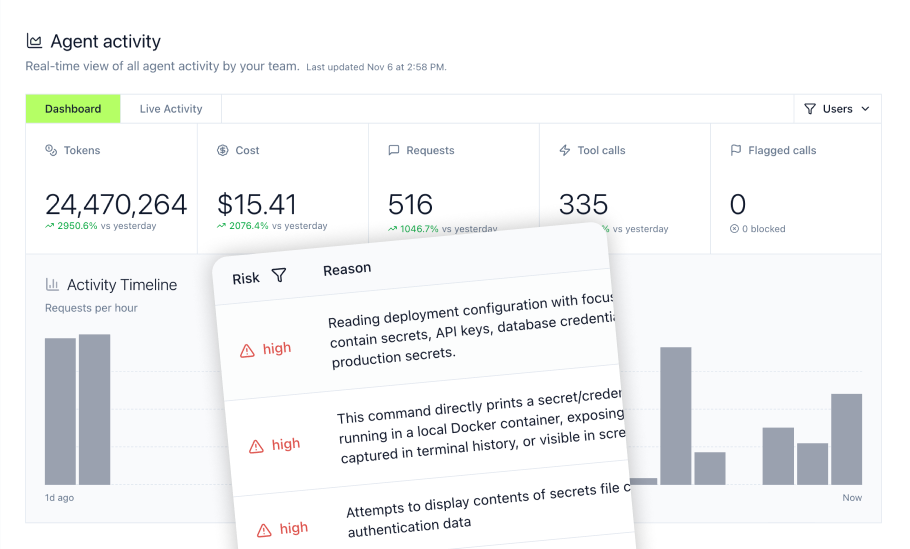
Agent Monitor provides organizational visibility into supported activity from AI coding agents and related agent environments.
Activity captured includes:
- Prompt submissions
- File access (including
.envfiles and SSH keys) - Commands (bash, installations, git operations)
- MCP tool calls
- Usage metrics
- Model and token costs
The live activity feed shows captured activity from configured monitored agents in real time, with filtering across supported activity dimensions. This visibility can extend beyond gateway traffic to supported local and agent activity.
Tracking Agent Usage and Spend
Cost attribution becomes critical as AI usage scales. Agent Monitor provides token and estimated-cost visibility by model, user, agent, and session, distinguishes human versus agent activity, and tracks cache-hit rates for visibility and chargeback analysis.
Agent Monitor tracks cached versus fresh input tokens where monitored agents report that telemetry, helping teams understand how model-provider caching affects estimated spend. Usage dashboards can also surface expensive models, users, agents, and sessions for further optimization.
Implementing Advanced AI Runtime Guardrails and Security Controls
Preventing Malicious and Unintended Agent Actions
Visibility alone is insufficient. Guardrails determine whether an action should be allowed, applying runtime controls at the agent-tool interaction layer through three complementary mechanisms:
Mint Guard provides managed detection policies for:
- Prompt injection (blocking at high confidence)
- Credentials and secrets
- PII
- Harmful content
Mint Guard operates in Off, Monitoring, or Enforcing modes, requiring no custom policy authoring for organizations seeking immediate protection.
Rules provide declarative conditions evaluating:
- Tool names
- Argument patterns
- Content via regex matching
Supported actions include flagging, blocking, asking for user confirmation, masking sensitive content, or sending Slack notifications.
Customizing Security with Gateway Middleware
Gateway Middleware enables customer-authored JavaScript logic for complex requirements. Running in a JS sandbox, middleware can:
- Transform or redact content
- Call external classifiers
- Integrate with DLP tools including AWS Bedrock Guardrails, Google Cloud Model Armor, and OpenAI moderation
- Enforce resource allowlists
- Apply custom policy enforcement
Middleware operates fail-closed for policy-critical checks, ensuring security failures default to denial rather than silent permission.
Managing Company-Owned Memory for Persistent AI Agents
Ensuring Enterprise Memory Ownership and Auditability
Coworker Agents, currently in beta and available on Enterprise and Teams plans, extend governance from connectivity into governed autonomous work. These long-running agents work alongside employees through Slack, schedules, or manual triggers while maintaining company-owned memory.
Enterprise agent memory should follow Git-like principles:
- Scoped: Private, team, organization, and customer memory contexts
- Versioned: Full history of memory changes
- Reviewable: Instructions, memory, and run history stored as reviewable files
- Auditable: Complete trail of what agents accessed and when
- Portable: Organizations can export and move memory rather than facing vendor lock-in
This approach contrasts with memory systems that are opaque, difficult to review, difficult to audit, or difficult to move. An enterprise should be able to understand, inspect, govern, and move the memory its agents rely on.
Enabling Long-Term Autonomous Workflows
Coworker Agents operate with:
- Repository-as-memory (instructions, progress, and inbound tasks as files)
- Slack mentions, cron schedules, or manual triggers
- VMCP-scoped tool allowlists (real allowlists, not advisory)
- Sandboxed execution with restricted egress
- Secret brokering where runs see only placeholders
This infrastructure enables non-technical domain experts to run agents safely, with governance built in by default rather than added as an afterthought.
Ensuring Comprehensive Auditability and Enterprise Security for AI
Establishing a System of Record for Your Agent Workforce
The long-term requirement for enterprise AI governance is a system of record for the agent workforce that can answer:
- Which agents exist?
- Who owns or operates them?
- Which systems can they access?
- What credentials and permissions do they use?
- What actions have they taken?
- What memory do they retain?
- Which security policies apply?
- How much usage or cost do they generate?
- How can they be restricted or shut down?
Security and Enterprise controls provide the foundation: SSO/SCIM integration, RBAC, audit trails, and operational controls including an org-wide kill switch for suspected credential compromise or runaway activity.
Integrating AI Governance with Existing Enterprise Security
Every tool call, credential lifecycle event, and access-policy change requires logging. Tamper-evident access-grant history signed at write time enables offline verification via published JWKS.
SIEM export via OTLP or Splunk HEC delivers:
- Tool call records
- Prompt submissions
- Gateway requests
- Access-policy changes
Mintive is SOC 2 Type II audited and compliant with HIPAA standards, is penetration tested, and encrypts data in transit and at rest. These controls and assurances can support organizations' own security and compliance programs without automatically making a customer deployment compliant with a particular framework.
Zero Trust Security for AI Agent Access
Applying Zero Trust Principles to Autonomous Agents
Zero Trust principles translate directly to AI agent governance:
- Least privilege: Agents receive only the permissions required for their specific function
- Continuous verification: Every tool call validates identity and authorization
- Explicit verification: No implicit trust based on network location or previous authentication
- Micro-segmentation: Virtual MCPs create boundaries around tool access
- Dynamic access policies: Directory-driven membership updates access in real time
Why Permissions-First is the Foundation for AI Security
The permissions-first architecture ensures governance begins with what agents can access rather than attempting to restrict broad access after deployment. This approach scales from 10 to 100+ agents because every new agent inherits the same identity, permission, and audit infrastructure.
Agent bundles provide per-agent identities with scoped tools, M2M authentication, independent credentials, and attributable audit trails. Combined with Virtual MCPs for governed tool access, organizations establish Zero Trust AI governance without custom development.
Understanding the MCP data risk helps organizations assess which tools require stricter controls and where governance investments deliver the highest security return.
Why Mintive for AI Agent Governance
Mintive brings the core layers of AI agent governance into one platform:
- MCP Gateway for governed data and tool access
- LLM gateway for per-group budgets and allowed-model lists, with usage, cost, and latency per model call so teams can retain visibility and controls when switching providers
- Agent Gateway for first-class agent identities, scoped permissions, and credentials
- Agent Monitor for visibility into agent activity, usage, and costs
- Guardrails for runtime policy enforcement
- Coworker Agents for persistent autonomous work with company-owned memory
Organizations can centralize infrastructure that would otherwise require separate systems or custom development, including:
- SSO and SCIM-driven access
- Workload identity federation
- Virtual MCPs and tool-level permissions
- Declarative rules and custom middleware
- Tamper-evident audit history
- SIEM export
Mintive's permissions-first architecture helps enterprises move from AI pilots toward governed agent deployments while centralizing identity, credentials, permissions, activity, memory, and cost visibility.
Its vendor-neutral approach supports governance across Claude, Cursor, ChatGPT, Gemini, and Copilot, helping organizations change AI models and clients without rebuilding the core governance layer. The longer-term position is a system of record for the enterprise agent workforce.
Frequently Asked Questions
How long does it typically take to deploy an AI governance platform?
Deployment time varies with the organization's identity setup, connector environment, access policies, and rollout scope. Teams can begin with governed gateway access and Monitoring mode, review real traffic and detections, then move to stricter enforcement once they understand the impact.
Can AI governance platforms integrate with existing DLP and security tools?
Gateway Middleware enables integration with external DLP systems, classifiers, and security tools. Templates exist for AWS Bedrock Guardrails, Google Cloud Model Armor, OpenAI moderation, and enterprise DLP platforms. Custom JavaScript logic can call any HTTP endpoint for classification or policy decisions.
What happens when an agent's credentials are potentially compromised?
Operational controls include an org-wide kill switch that immediately disables all Mintive gateway traffic for the organization. Per-agent credentials can be rotated or revoked independently without affecting other agents. Workload identity federation can remove the Mintive-issued agent secret from the authentication path, while downstream connector credentials remain governed separately.
How do governance platforms handle multiple AI clients (Claude, Cursor, ChatGPT)?
The gateway provides governed MCP endpoints for supported AI clients such as Claude, Cursor, ChatGPT, Gemini, and Copilot. Users connect supported clients to a Virtual MCP and receive the tools permitted by its access policy, helping organizations keep a consistent governance layer as their AI stack changes.
What visibility exists into AI usage that bypasses the governance gateway?
Agent Monitor uses lightweight local hooks to capture supported endpoint activity, including MCP usage that may not route through Mintive's gateway. This can improve visibility into off-gateway and shadow AI activity, with coverage depending on the monitored client, agent, configuration, and available hook phases.