AI agents have moved beyond experimental pilots to become integral members of enterprise teams. These autonomous systems now handle data analysis, customer support, development workflows, and compliance reporting with less direct human involvement than traditional AI tools. Yet the shift from AI tools to AI teammates introduces new challenges around governance, credential management, memory ownership, and audit accountability that most organizations are unprepared to address.
Digital coworkers are not just chatbots with longer context windows. They are long-running agents that can live in Slack, hold memory, continue work across days, and operate alongside employees. With MCP now moving under Linux Foundation governance through the Agentic AI Foundation, the infrastructure for deploying AI agents at scale is becoming more standardized. Organizations that establish proper agent governance now can improve productivity while maintaining security and compliance controls.
This article explains what AI agents are, how they function as digital coworkers across industries, and what infrastructure organizations need to deploy them securely at enterprise scale. It also explains why the next layer of enterprise agent infrastructure is the Agent Gateway: a control layer for agent identities, permissions, memory, and monitoring that builds on the MCP Gateway foundation for governed data and tool access.
Key Takeaways
- AI agents differ from AI tools through autonomy: Unlike chatbots that respond to single prompts, agents maintain context across sessions, chain multiple tool calls together, and execute multi-step workflows independently
- Digital coworkers are long-running agents: The emerging pattern is a Slack-native agent that holds memory, continues work across days, and operates alongside employees
- Enterprise deployments require per-agent identity: Each AI agent needs its own credentials and permission scope independent of its creator's access level to enable proper audit attribution and credential rotation
- Enterprise memory needs governance: Private, team, organization, and customer memory scopes should be company-owned, versioned, reviewable, auditable, and portable
- The "last mile problem" blocks most enterprise AI adoption: Connecting agents to internal systems and data sources requires authentication, access controls, and audit logging that standard AI tools lack
- Shadow AI creates unmanaged security exposure: AI coding assistants and automation agents operating outside governed channels bypass security controls and create audit blind spots
- Model Context Protocol standardizes agent-to-tool connections: MCP provides a universal interface for AI agents to access databases, APIs, and internal systems through authenticated, logged connections
- Governed access determines enterprise value: AI agents deliver the most reliable productivity gains when they can reach approved internal systems through scoped, logged, and policy-controlled connections
- Virtual MCP Bundles reduce configuration complexity by packaging tool access, policy enforcement, and audit logging into single governance units per team, role, use case, or agent identity
What Are AI Agents? Understanding the Foundation of Your New Digital Workforce
AI agents represent a fundamental shift from reactive AI tools to proactive autonomous systems. Where traditional AI tools like chatbots respond to individual prompts and forget context between interactions, AI agents maintain persistent state, plan multi-step workflows, and execute tasks with minimal human intervention. The NIST AI Risk Management Framework gives organizations a structure for managing AI risks through governance, mapping, measurement, and management practices.
For enterprise teams, the most useful digital coworkers are persistent agents that operate like governed teammates rather than disconnected automations. They need a durable identity, scoped permissions, reviewable memory, and monitored actions. MintMCP frames this as two connected layers: MCP Gateway for governed data and tool connections, and Agent Gateway for agent identities, permissions, memory, and monitoring.
The Evolution from AI Tools to Autonomous Agents
The distinction matters for enterprise deployment. A standard large language model receives a prompt, generates a response, and terminates the interaction. An AI agent receives a goal, breaks it into subtasks, selects appropriate tools for each step, executes the workflow, and adapts based on intermediate results.
Core components that define an AI agent include:
- Context windows: Memory systems that retain information across interactions, enabling agents to reference previous conversations and accumulated knowledge
- Governed memory: Private, team, organization, and customer memory scopes that are company-owned, versioned, reviewable, auditable, and portable
- Tool-use capabilities: The ability to invoke external APIs, databases, file systems, and applications to gather information and execute actions
- Autonomous planning: Logic that decomposes complex goals into executable steps without requiring human guidance at each stage
- Feedback loops: Mechanisms that evaluate results, detect errors, and adjust subsequent actions accordingly
- Governed identity: Agent-specific credentials, permissions, and audit trails that separate the agent's actions from the creator's personal access
Defining Agentic AI Capabilities
Agentic AI refers to systems designed with agency: the capacity to make decisions, take actions, and pursue objectives within defined boundaries. This stands apart from generative AI, which produces content in response to prompts but lacks autonomous decision-making.
For enterprises, the agentic capability enables AI systems to function as digital coworkers rather than sophisticated search tools. An agentic system can monitor a project management board, identify blockers, draft status updates, notify relevant stakeholders, and escalate unresolved issues to human managers.
The Model Context Protocol emerged as the standard interface connecting these capable agents to enterprise data sources. MCP standardizes how agents discover and call tools, while gateway layers add the authentication, access policy, and audit logging required for production deployments. Organizations leveraging platforms like the MCP Gateway gain centralized control over agent-to-system connections. MintMCP's Agent Gateway builds on that MCP Gateway foundation by adding the agent-specific controls required for long-running digital coworkers: identity, permissions, memory, and monitoring.
Exploring Real-World AI Agents: Practical Examples Across Industries
AI agents now operate across every major enterprise function, though use case maturity varies significantly by industry, risk level, and task complexity.
AI Agents in Software Development
Development workflow agents represent one of the more mature categories, with tools like Claude Code, Cursor, and GitHub Copilot deployed across engineering teams. These agents connect to version control systems, CI/CD pipelines, issue trackers, and documentation repositories to accelerate coding tasks.
Common development agent workflows include:
- Analyzing codebases to suggest refactoring opportunities
- Generating unit tests based on function signatures and existing test patterns
- Creating pull request descriptions from commit histories
- Debugging errors by correlating logs, stack traces, and code changes
- Drafting documentation from code comments and API signatures
Organizations using governed agent deployments with GitHub integration and Linear integration can accelerate development cycles when agents have authenticated access to project management and repository data.
Transforming Customer Service with AI
Customer support agents handle ticket triage, response drafting, and escalation routing by connecting to CRM systems, knowledge bases, and communication platforms. These agents reduce response times for routine inquiries while routing complex issues to human specialists.
Enterprise support agent configurations typically include:
- Salesforce integration for customer history
- Zendesk integration for ticket management
- Slack integration for internal escalation
- Knowledge base connections for policy lookups
For support use cases, memory governance matters as much as retrieval quality. Customer memory should be scoped separately from private, team, and organization memory so agents can maintain continuity without overexposing unrelated internal context.
Data-Driven Insights with Agentic AI
Data analysis agents query databases, generate reports, and surface anomalies without requiring SQL expertise from business users. These agents connect to data warehouses like Snowflake, BigQuery, and Elasticsearch to transform natural language questions into structured queries.
When each agent has its own credentials and scope, organizations can focus on building new capabilities rather than worrying about security risks. Proper credential scoping ensures agents access only the data necessary for their specific roles.
Navigating the New AI Workplace: Benefits and Challenges of Digital Coworkers
Deploying AI agents as permanent team members introduces both productivity gains and organizational challenges that extend beyond technical implementation.
A digital coworker should be treated as a governed teammate: it needs a durable identity, defined decision rights, scoped tool access, memory that can be reviewed, and monitoring that shows what it did across time. This is where Agent Gateway infrastructure becomes important. MCP Gateway governs the tools and data an agent can reach, while Agent Gateway governs the agent as an operating entity.
Boosting Productivity with AI Automation Tools
Organizations implementing governed AI agent access to internal systems see productivity improvements concentrated in high-volume, repetitive workflows where agents can execute standard processes faster than human workers.
Productivity improvements cluster in specific task categories:
- Data entry and validation across multiple systems
- Report generation from structured data sources
- Calendar coordination and meeting scheduling
- Document drafting from templates and prior examples
- Status monitoring and exception alerting
Virtual MCP abstraction reduces configuration complexity for teams by packaging tool access, policy enforcement, and audit logging into single governance units, enabling broader adoption without requiring custom integrations.
Addressing the "Last Mile Problem" with AI Agents
The "last mile problem" in enterprise AI refers to the gap between capable AI models and productive enterprise deployment. Models can generate excellent outputs in isolation, but enterprise value requires authenticated connections to internal systems, proper authorization for sensitive operations, and audit trails for compliance.
Most organizations discover this gap when initial AI pilots succeed in sandboxed environments but stall during production deployment. The security team requires audit logging. The compliance team requires access controls. The operations team requires credential management. Each requirement adds integration work that can delay deployment by months.
MCP Gateway solutions address this last mile by providing pre-built authentication, logging, and policy enforcement that security teams can approve once and apply across agent deployments. For long-running agents, Agent Gateway adds the next layer: agent identity, scoped permissions, memory governance, and monitoring across on-gateway and off-gateway activity.
Preparing Your Team for AI Integration
Human-AI collaboration requires clear role definitions. Teams need explicit guidance on which tasks agents handle autonomously, which require human approval, and which remain human-only responsibilities.
Effective change management for AI agent deployment includes:
- Documenting decision rights between human workers and AI agents
- Establishing escalation paths for agent errors or edge cases
- Training staff on prompt engineering and agent supervision
- Creating feedback channels for reporting agent quality issues
- Defining metrics for evaluating agent performance over time
- Reviewing memory changes for high-impact customer, policy, or operational context
Securing Your Digital Coworkers: Governance and Control for AI Agents
Security concerns represent the primary barrier to enterprise AI agent adoption. Agents with access to production databases, customer data, and internal systems create attack surface that traditional security controls were not designed to address.
The Imperative of AI Agent Security
AI agents inherit the permissions of their tool connections. An agent with database read access can query any data those credentials permit. An agent with API write access can modify records across the system. Without granular access controls, agents operate with excessive permissions that violate least-privilege principles.
Key agent security risks include:
- Credential exposure: Agents may inadvertently include API keys, tokens, or passwords in outputs
- Data exfiltration: Agents can extract sensitive information through tool calls without explicit user awareness
- Prompt injection: Malicious inputs can manipulate agent behavior to bypass intended restrictions
- Permission creep: Agents accumulate tool access over time without corresponding review
- Memory leakage: Agents may retrieve or reuse context from the wrong private, team, organization, or customer scope if memory boundaries are not enforced
Organizations handling sensitive data should review the MCP data risk framework before deployment.
Mitigating Risks in AI Coding Assistants
AI coding assistants present particular security challenges because they operate with developer-level system access. Tools like Claude Code and Cursor can read files, execute commands, and modify code across repositories.
Agent Monitor capabilities address these risks through:
- Real-time tracking of agent activity across the organization
- Detection of PII exposure and credential leakage in agent outputs
- Identification of risky bash commands and file operations
- Custom guardrail policies with block, flag, and alert actions
- Shadow AI detection for agent activity outside governed channels
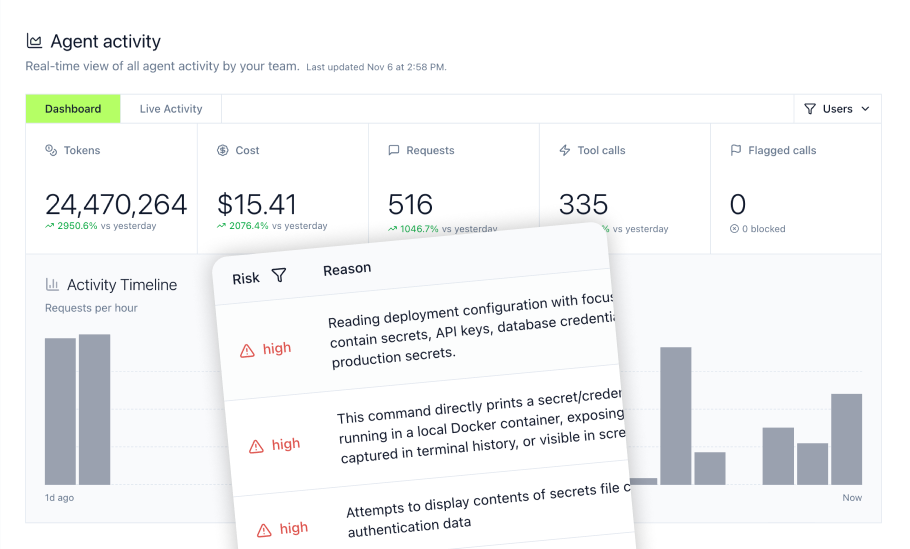
Together, MCP Gateway and Agent Monitor create a two-layer governance model. The gateway governs MCP traffic and approved tool access, while Agent Monitor extends visibility to local non-MCP agent activity such as file reads, shell commands, and prompt submissions.
Establishing Trust with Robust Audit Trails
Compliance requirements mandate complete audit trails for data access and modifications. AI agents must generate the same audit documentation as human employees performing equivalent actions.
Enterprise audit requirements for AI agents include:
- Per-user and per-agent attribution of agent actions
- Conversation-level logging capturing prompts, tool calls, and responses
- Configurable retention policies matching data governance requirements
- Export capabilities for SIEM platforms like Splunk and Microsoft Sentinel
- Immutable records for compliance investigations
- Memory history showing what changed, who approved it, and which agent used it
MintMCP provides full conversation-level logging with per-user attribution and SIEM export capabilities for organizations requiring integration with existing security operations infrastructure.
Automating with Intelligence: AI Automation Tools for Enterprise
Enterprise automation through AI agents differs from traditional workflow automation in flexibility and contextual awareness. Rule-based automation executes predefined sequences; AI agents adapt their approach based on input variability and intermediate results.
Streamlining Operations with Intelligent Automation
AI agents excel at semi-structured tasks with variable inputs. Invoice processing, contract review, and support ticket routing all involve pattern recognition within defined categories combined with exception handling for edge cases.
Characteristics of tasks suited for AI agent automation:
- High volume with predictable variation
- Clear success criteria that agents can evaluate
- Tolerance for occasional errors with human review
- Available training examples from historical execution
- Defined escalation paths for uncertain cases
Building Bespoke AI Workflows
Custom agent workflows connect multiple tools in sequences tailored to specific business processes. A sales workflow agent might query the CRM for recent opportunities, draft follow-up emails, check calendar availability, and schedule calls without human intervention between steps.
Platforms supporting 50+ pre-configured connectors enable rapid workflow assembly. Common enterprise connectors include:
- Productivity: Notion, Asana, ClickUp, Monday
- Communication: Gmail, Outlook, Slack
- Development: GitHub, Jira, Linear
- Data: BigQuery, Snowflake, PostgreSQL
The Power of Pre-Built AI Connectors
Pre-built connectors reduce integration time from weeks to minutes for standard applications. Organizations avoid custom API development for common SaaS tools while maintaining centralized security controls.
The MintMCP server catalog includes managed MCP servers for common enterprise systems, enabling one-click activation without infrastructure management overhead.
Choosing Your Digital Teammate: Types of AI Agents and Virtual Assistants
AI agents vary significantly in autonomy, specialization, and interaction patterns. Understanding these distinctions helps organizations select appropriate solutions for specific use cases.
Distinguishing Between Agent Types
By autonomy level:
- Assistive agents: Require human approval for each action; function as intelligent helpers
- Supervised agents: Execute autonomously within boundaries; escalate exceptions to humans
- Autonomous agents: Operate independently on defined objectives; report outcomes after completion
By specialization:
- General-purpose agents: Handle diverse tasks with broad knowledge bases
- Domain-specific agents: Optimize for particular functions like coding, support, or analysis
- Task-specific agents: Focus on narrow workflows with deep process knowledge
By workplace pattern:
- Chat assistants: Respond to individual prompts and usually depend on the user to drive each step
- Workflow agents: Execute a defined process across multiple tools and escalate exceptions
- Digital coworkers: Long-running, Slack-native agents that hold memory, continue work across days, and operate alongside employees
Selecting the Right AI Assistant for Your Needs
Selection criteria should match agent capabilities to organizational requirements:
| Requirement | Agent Type | Key Consideration |
|---|---|---|
| Broad task coverage | General-purpose | May require more supervision for specialized tasks |
| Deep domain expertise | Domain-specific | Limited flexibility outside trained areas |
| Process compliance | Task-specific | Requires clear workflow documentation |
| Data sensitivity | Governed agents | Needs proper access controls and audit logging |
| Long-running team support | Digital coworkers | Requires agent identity, governed memory, monitoring, and Slack-native invocation |
Organizations deploying agents across Claude, Cursor, ChatGPT, Gemini, and Copilot benefit from centralized governance that applies consistent policies regardless of which AI platform individual teams prefer.
The Technology Powering Digital Coworkers: Understanding AI Agent Infrastructure
Enterprise AI agent deployment requires infrastructure components beyond the models themselves. Authentication, transport protocols, runtime environments, memory governance, and policy enforcement all contribute to production-ready deployments.
The Role of the Model Context Protocol
MCP provides the standard interface between AI agents and external tools. The protocol specifies how agents discover available tools, authenticate to services, invoke operations, and receive responses.
MCP technical specifications include:
- JSON-RPC 2.0 message encoding over UTF-8
- Support for stdio and Streamable HTTP transport methods, with legacy HTTP+SSE compatibility where needed
- OAuth-based authorization patterns and gateway-layer identity controls
- Standardized tool discovery and capability declaration
The protocol transitioned to Linux Foundation's Agentic AI Foundation governance in December 2025, signaling industry standardization. Anthropic donated MCP to the Agentic AI Foundation, with broader industry participation around MCP-related support, projects, and contributions.
Building Robust Agentic AI Platforms
Production agent platforms require components beyond MCP connectivity:
- Credential management: Secure storage and rotation for API keys, OAuth tokens, and service accounts
- Rate limiting: Protection against runaway agent loops and API cost overruns
- Sandboxed execution: Isolation for untrusted or custom MCP server code
- Provenance tracking: Attribution across multi-step agent workflows
- Agent identity governance: Per-agent credentials, policy scope, and audit attribution
- Memory governance: Private, team, organization, and customer scopes with reviewable, auditable, portable memory history
The MintMCP architecture addresses these requirements through Bundle abstraction that packages tool access, policy enforcement, and audit logging into single governance units per team, role, use case, or agent identity.
Integrating AI Agents into Existing IT Ecosystems
Enterprise integration requires compatibility with existing identity providers, security tools, and operational workflows:
- Identity integration: SSO through Okta, Azure AD, and Google Workspace with SCIM-based group synchronization
- DLP integration: Middleware hooks for Bedrock Guardrails, GCP DLP, Microsoft Purview, Nightfall, and Skyflow
- SIEM integration: Log export to Microsoft Sentinel, Splunk, and S3 for security operations
- CI/CD integration: REST APIs and SDKs for infrastructure-as-code workflows
- Tool-update policy: Admin review workflows for new upstream tools to prevent silent capability expansion
Organizations with existing security tool investments can review security documentation for integration patterns.
Unlocking Potential: The Value Proposition of Enterprise AI Agents
The business case for AI agents extends beyond task automation to strategic capabilities that reshape how organizations operate. Gartner has separately projected rapid growth in task-specific AI agents inside enterprise applications, making governance and measurement increasingly important as deployments move beyond pilots.
Beyond Automation: Strategic AI Impact
AI agents enable capabilities previously impractical at scale:
- Continuous monitoring: Agents observe systems, markets, and processes around the clock without fatigue
- Parallel execution: Multiple agents handle simultaneous tasks across time zones and workstreams
- Institutional memory: Agents accumulate organizational knowledge that persists across employee turnover
- Consistent execution: Agents apply standard processes uniformly without variation from individual judgment
Institutional memory is only useful when teams can trust it. Enterprise memory should follow Git-like principles: company-owned, versioned, reviewable, auditable, portable, and scoped by private, team, organization, or customer context. This avoids treating memory as an opaque vendor-controlled blob that is difficult for security, compliance, or operations teams to inspect.
Measuring the Success of Your AI Agent Deployments
Effective measurement requires metrics beyond task completion:
- Time savings: Hours reclaimed from automated tasks
- Error rates: Accuracy of agent outputs compared to human baselines
- Throughput: Volume of tasks processed per time period
- Escalation rates: Frequency of agent handoffs to human workers
- User satisfaction: Feedback from employees interacting with agents
- Compliance adherence: Audit pass rates and policy violation incidents
- Memory quality: Accuracy, freshness, review status, and reuse of agent memory over time
Organizations managing multiple AI deployments benefit from unified platforms that consolidate metrics across all agent activity.
Why MintMCP for Enterprise AI Agent Governance
Deploying AI agents at enterprise scale requires more than connecting models to tools. Organizations need governance infrastructure that satisfies security, compliance, and operational requirements while enabling teams to move quickly.
MintMCP provides two connected layers for enterprise AI agent governance. Its MCP Gateway governs data and tool connections for the AI systems users already run, including Claude, Cursor, ChatGPT, Gemini, and Copilot. Its Agent Gateway builds on that foundation with controls for agent identities, permissions, memory, and monitoring. Together, they address the critical gaps that block many organizations from moving AI agents beyond pilot phase:
- Data-permissions-first architecture starts with SSO, SCIM-driven RBAC, IdP groups, Virtual MCP Bundles, tool-level policy, and audit, then enables agents on top. This ensures an agent's access is a subset of an already-governed permission model.
- Centralized credential management eliminates the security risk of agents operating with developer-level permissions. Each agent receives its own scoped credentials, enabling proper audit attribution and credential rotation independent of the employees who created them. This per-agent identity model supports zero-trust requirements while enabling autonomous operation.
- Virtual MCP Bundles package tool access, policy enforcement, and audit logging into per-use-case endpoints with SCIM-driven membership. Security teams define approved tool combinations once, then teams across the organization deploy agents within those boundaries without custom integration work. This abstraction reduces configuration complexity compared to managing individual MCP server connections one by one.
- Agent Bundles give each agent a persistent identity with scoped tools, M2M authentication, and an "act as agent" flow for connectors that require per-agent OAuth. This helps teams avoid shared service-account keys and inherited human permissions.
- Agent Monitor provides visibility into agent activity across Claude, Cursor, ChatGPT, Gemini, and Copilot. Detect shadow AI operating outside governed channels. Identify credential leakage and PII exposure before they create incidents. Configure custom guardrails with block, flag, and alert actions tailored to your risk tolerance.
- Managed MCP server hosting eliminates infrastructure overhead for approved MCP servers in the MintMCP catalog. Activate pre-built connectors to Salesforce, GitHub, Snowflake, BigQuery, and 50+ other enterprise systems with one-click deployment. Runtime security, version management, and availability monitoring are handled by the platform.
- Managed Agents platform supports long-running digital coworkers with their own identity, memory, scoped tool access through Virtual MCP Bundles, and Slack-native invocation.
MintMCP is SOC 2 Type II audited, with continuous compliance monitoring via Drata. Enterprise SSO, complete audit trails, PII detection, and role-based access control are built into every layer of the platform. Customers handling protected health information can request HIPAA documentation. MintMCP signs BAAs. Security teams can review the full security posture in the MintMCP Trust Center.
Organizations can evaluate fit through a free trial or schedule a demo to review specific deployment requirements with the MintMCP team.
Frequently Asked Questions
How do AI agents differ from traditional automation scripts?
Traditional automation scripts execute predefined sequences of steps in fixed order. They handle expected inputs and fail on edge cases requiring judgment. AI agents understand context, adapt to input variation, and make decisions within defined boundaries. An automation script that encounters an unexpected invoice format will fail; an AI agent will attempt to interpret the document, flag uncertainty, and proceed or escalate based on confidence levels. This flexibility makes agents suitable for semi-structured tasks with variable inputs that would require prohibitive rule-writing for traditional automation.
What is an Agent Gateway?
An Agent Gateway is a control layer for agents that work alongside users. It governs agent identities, permissions, memory, and monitoring so long-running agents can operate safely across enterprise systems. In MintMCP's model, Agent Gateway builds on MCP Gateway: the MCP Gateway governs data and tool connections, while the Agent Gateway governs the agent as an operating identity with scoped access, memory, and visibility.
What happens when an AI agent makes a mistake with production data?
Agent errors require the same incident response as human errors: identifying scope, reverting changes where possible, and documenting root cause. Proper governance prevents most catastrophic errors through permission scoping, approval workflows for destructive operations, and staged rollouts. Organizations should implement database transaction logging, API call audit trails, and rollback capabilities before granting agents write access to production systems. Testing agents in staging environments with realistic data helps identify failure modes before production deployment.
Can AI agents access systems that require multi-factor authentication?
AI agents cannot complete interactive MFA challenges in real time. Enterprise deployments use machine-to-machine authentication patterns: OAuth 2.0 client credentials, API keys with IP allowlisting, or service accounts with certificate-based authentication. Platforms like MintMCP provide per-agent identity with dedicated credentials that can be rotated independently of human user accounts. This approach supports zero-trust requirements while enabling autonomous agent operation.
How do enterprises prevent AI agents from accessing data beyond their intended scope?
Effective data governance for AI agents requires tool-level access controls rather than broad service accounts. The Bundle architecture packages specific tool permissions with team, role, use-case, or agent membership, ensuring agents only access tools explicitly granted. Additional protections include read-only permissions for analysis agents, field-level masking for sensitive columns, query result limits, and inline DLP scanning of agent outputs. Regular access reviews should audit agent permissions just as organizations review human access rights.