Sales teams deploying AI agents face a critical limitation: stateless chatbots that forget customer context between sessions. Long-term memory transforms these tools into intelligent coworkers that remember customer preferences, past interactions, and procedural workflows across weeks or months of engagement. With enterprises managing complex B2B sales cycles spanning multiple stakeholders and extended timelines, implementing persistent memory through a governed MCP gateway becomes essential for delivering personalized experiences without forcing reps to re-read months of conversation history before every call.
For enterprise sales teams, memory is not just a retrieval feature. It is governed infrastructure: scoped across private, team, organization, and customer contexts; owned by the company; versioned; reviewable; auditable; and portable where practical. MintMCP frames this as two connected layers: MCP Gateway for governed data and tool connections, and Agent Gateway for the identities, permissions, memory, and monitoring needed to run AI sales coworkers safely.
This article outlines actionable strategies for implementing AI sales coworkers with long-term memory, covering memory architecture decisions, CRM integration, security governance, and ongoing workforce management to ensure compliance and operational success.
Key Takeaways
- Long-term memory enables AI agents to store and retrieve customer context across sessions, transforming stateless chatbots into intelligent coworkers that maintain continuity throughout extended B2B sales cycles
- AI sales coworkers are long-running agents that can live in Slack, hold memory, continue work across days, and operate alongside sales teams
- Memory architectures combining vector databases with graph storage can reduce repeated full-context prompting, lowering token usage and latency in memory-heavy workflows
- Enterprise sales teams can use AI to reduce research, call review, drafting, and admin work, with 2-5 hours each week as a practical planning range and heavier users saving around 10 hours
- Governance frameworks must be established before scaling, including memory taxonomy definitions, data retention policies, and compliance rules approved by sales, legal, and security stakeholders
- Sales memory should be scoped across private, team, organization, and customer contexts, with version history, review workflows, audit trails, and portability
- Each AI agent requires its own persistent identity with scoped credentials that can be rotated independently, enabling audit attribution and credential hygiene at enterprise scale
- Agent Gateway extends MCP Gateway by governing the agent itself, including identity, permissions, memory, and monitoring
Bridging the Sales Gap with AI Automation: What Customers Need to Know
Traditional sales automation handles repetitive tasks like email sequencing and data entry. AI coworkers with long-term memory represent a fundamental shift: they learn from interactions, remember customer preferences, and provide contextually relevant support across the entire customer journey.
What long-term memory enables
- Semantic memory stores facts: "Customer prefers email over calls," "Budget authority: Yes," "Tech stack: Python, AWS"
- Episodic memory records events: "Demo completed," "Objection: pricing too high," "Next step: send case study"
- Procedural memory learns patterns: "Always cc legal on contracts," "Follow up quickly after procurement questions"
These memory types work together to create agents that understand not just what customers said, but how they prefer to interact and what steps typically move deals forward. For enterprise sales teams, those memories should follow Git-like principles: company-owned, scoped, versioned, reviewable, auditable, and portable rather than hidden inside an opaque memory store.
The business problem this solves
Sales reps waste significant time re-reading prior interactions before each touchpoint. In long B2B sales cycles, an account executive might forget a CFO's budget constraint from an earlier conversation when preparing a later proposal. Memory-enabled AI surfaces: "Remember: CFO prefers OpEx model. Frame as subscription." The result: reps can personalize follow-up with the right context instead of relying on memory or manual CRM review.
How AI Sales Tools Revolutionize Prospecting and Customer Retention
AI sales tools with persistent memory enable hyper-personalization at scale. Rather than sending generic nurture sequences, memory-enabled agents tailor outreach based on documented preferences, past content engagement, and interaction history.
Prospecting improvements
- Lead scoring informed by historical behavior patterns
- Personalized outreach based on documented buyer intent signals
- Automatic surfacing of relevant case studies matching a prospect's industry and pain points
Customer retention applications
- Proactive identification of churn signals based on interaction patterns
- Cross-sell recommendations grounded in actual purchase history
- Support interactions that reference prior issues without requiring customers to repeat themselves
In practice, memory-enabled personalization works best when AI agents retrieve persona data, past content engagement, and documented preferences before generating outreach. Teams should measure lift against their own baseline open rates, reply rates, and pipeline contribution rather than assuming one benchmark applies across every sales motion.
For retention use cases, customer memory should be scoped separately from private, team, and organization memory. This lets agents maintain continuity across the customer relationship without overexposing internal sales strategy, manager notes, or unrelated account context.
Implementing Scalable AI Coworkers for Enterprise Sales Teams
Deploying memory-enabled AI coworkers requires careful infrastructure planning. For sales teams, the core architecture typically combines semantic retrieval, structured customer records, governance controls, agent identity, memory scope, and CRM integration.
Implementation sequence
- Audit CRM data quality: Run a data audit on Salesforce or HubSpot records. Define completeness thresholds for core fields including name, company, role, and last interaction.
- Define memory taxonomy: Create governance documentation listing what to remember, how long to retain it, who owns the data, and which memory scope applies. Get approval from Sales, Legal, and Security.
- Set up memory infrastructure: Provision memory storage and retrieval infrastructure. Configure embedding, indexing, access controls, CRM API connections, and version history for high-impact memories.
- Build extraction pipeline: Create prompt templates for LLM extraction. Validate outputs against test transcripts before using extracted memories in production.
- Implement retrieval logic: When AI agents start conversations, embed the user query, search relevant memory candidates, rank by relevance and recency, and inject the most useful results into the prompt.
- Add governance controls: Assign unique identity to each AI agent, set least-privilege access, define memory scopes, and log all memory queries to an audit trail.
- Pilot with a small cohort: Deploy to a limited sales group, monitor for hallucinations, and track time saved versus manual note-taking.
Implementation scope depends on CRM readiness, memory design, integration complexity, and governance requirements, so teams should validate costs and timelines during pilot planning rather than relying on generic estimates.
MintMCP Gateway enables organizations to deploy AI agents with centralized security, authentication, and observability. The platform's MCP Bundles package tool access, policy enforcement, and audit logging into single governance units per team, role, use case, or agent identity, simplifying the infrastructure complexity described above. MintMCP's Agent Gateway builds on that foundation by governing the long-running sales agent itself: identity, permissions, memory, and monitoring.
Maintaining Data Security and Compliance in AI-Powered Sales
Sales teams handle sensitive customer data including contact information, budget details, and competitive intelligence. Memory systems storing this information require robust security controls.
Data security requirements
- Encryption: Encrypt sensitive sales data in transit and at rest
- Access controls: RBAC plus SSO integration with identity providers such as Okta or Azure AD
- Memory governance: Define private, team, organization, and customer memory scopes with ownership, version history, review workflows, audit trails, and portability
- Data handling: Document storage location, retention rules, transfer controls, and customer contract requirements before storing sales memories
- Backup policy: Define backup, retention, deletion, and recovery rules before production rollout
Enterprises should treat every AI agent as a security principal with least-privilege access, monitoring for intent drift, and documented retirement plans for decommissioning agents and deleting their memories.
Compliance considerations
- GDPR programs require right-to-deletion workflows and data portability planning
- Healthcare use cases should confirm HIPAA documentation and BAA requirements before storing protected health information
- Regulated workflows should define where human-in-the-loop validation is required before AI-generated actions affect customers
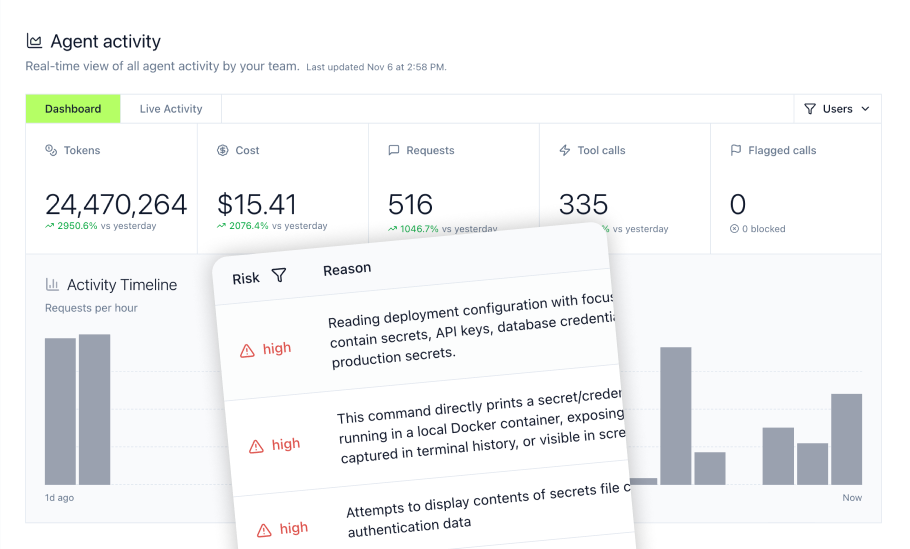
MintMCP Gateway offers custom policy code execution in a JS sandbox on every tool call, enabling inline DLP integration with AWS Bedrock Guardrails, Google Cloud DLP, Microsoft Purview, Nightfall, and Skyflow. The Agent Monitor detects PII exposure and credential leakage using built-in rules, providing real-time visibility into agent activity.
Together, MCP Gateway and Agent Monitor provide two-layer governance: the gateway governs approved MCP traffic and tool access, while Agent Monitor extends visibility to local non-MCP agent activity such as file reads, shell commands, and prompt submissions.
Optimizing Sales Productivity with AI Assistant Software
Memory-enabled AI coworkers deliver measurable productivity gains by automating research, context retrieval, and follow-up coordination.
Documented time savings
Sales teams implementing memory-enabled AI workflows can reduce research, call review, drafting, and admin work, with 2-5 hours each week as a practical planning range and heavier users saving around 10 hours.
Additional productivity improvements include:
- Fewer forgotten follow-ups through automated next-best-action surfacing
- Reduced duplicate customer questions when prior issues, preferences, and next steps are retrieved before outreach
Cost efficiency gains
Memory architectures reduce LLM costs by avoiding full-context prompting. Rather than feeding long conversation histories into every API call, retrieval systems inject only the most relevant memories. This can lower token usage in memory-heavy workflows, turning full-history prompting into a targeted retrieval pattern where only the most relevant memories are included.
Workflow automation examples
- Automatic CRM field updates after customer interactions
- Meeting prep summaries pulling relevant memories and recent activity
- Email drafts personalized based on documented communication preferences
- Report generation incorporating customer-specific context
Monitoring and Managing AI Agents for Peak Sales Performance
Ongoing management requires visibility into agent activity, usage patterns, and compliance adherence. Establishing both posture controls before deployment and runtime controls during production helps keep AI sales workflows aligned with security expectations.
Key monitoring metrics
- Agent activity logs with full audit attribution
- Usage patterns by team, tool, and time period
- Latency monitoring for retrieval operations
- Error tracking for extraction and retrieval failures
- Memory quality metrics, including accuracy, freshness, review status, and reuse over time
Risk detection requirements
- PII exposure in agent outputs
- Credential leakage including API keys and tokens
- Prompt injection attempts
- Intent drift where agent behavior deviates from approved workflows
- Memory leakage where an agent retrieves context from the wrong private, team, organization, or customer scope
MintMCP's Agent Monitor tracks agent activity in real time across the organization, including MCP calls made outside the gateway through hooks in Cursor and Claude Code. The platform supports custom guardrail policies with block, flag, and alert actions, plus MDM integration for pushing configurations to developer machines.
Understanding the data risks in MCP helps security teams establish appropriate controls before deployment.
The Role of Long-Term Memory in Effective AI Sales Strategies
Long-term memory creates competitive advantage by enabling AI agents to maintain context across extended sales cycles. Unlike temporary context windows limited to single conversations, persistent memory systems support multi-stakeholder deals spanning months.
Memory retrieval mechanics
When an AI agent starts a new conversation, the system:
- Embeds the user query as a vector
- Searches relevant memory candidates using approximate nearest neighbor algorithms
- Ranks results by relevance and recency
- Injects the most useful memories into the prompt
This approach can reduce latency and token usage compared to repeated full-context prompting, especially in memory-heavy workflows where only a small subset of prior context is relevant.
Multi-stakeholder deal support
Enterprise B2B sales involve multiple stakeholders with different priorities. Memory systems can store and retrieve:
- CFO budget constraints and approval authority
- Technical lead integration requirements
- End-user pain points and feature requests
- Procurement timeline expectations
Graph memory architectures enable multi-hop queries: "Which customers who bought Product X also complained about Integration Y?" This capability requires hybrid vector plus graph storage and should be evaluated against each team's CRM data model, retrieval needs, and governance requirements.
Building a Robust Ecosystem for AI-Powered Sales: Integrations and Customization
Effective AI sales coworkers require seamless integration with existing technology stacks. CRM integration patterns should account for authentication, sync direction, error handling, field mapping, and audit requirements before AI agents write to customer systems.
Essential integrations
| Platform | Integration Type | Primary Use Case |
|---|---|---|
| Salesforce | REST API plus OAuth | CRM field mapping, opportunity tracking |
| HubSpot | Webhooks plus API key | Deal updates, contact management |
| Gong/Chorus | API for call transcripts | Conversational memory extraction |
| Slack | Webhook triggers | Real-time notifications, agent interaction |
Integration considerations
- Sync type: Real-time for memory writes, scheduled for consolidation
- Direction: Two-way sync between CRM and memory store
- Volume limits: Confirm CRM, webhook, memory-store, and gateway limits against expected write volume
- Webhook support: Trigger on deal stage changes, send memory to notification channels
- Memory ownership: Define whether each memory belongs to a private rep context, team context, organization context, or customer context
MintMCP Gateway supports hundreds of prebuilt connectors, including Salesforce, HubSpot, Slack, and GitHub. The platform's REST APIs and SDKs enable programmatic management for CI/CD integration and infrastructure-as-code workflows.
Achieving Enterprise Governance for AI Sales Deployments
Enterprise-scale deployment requires governance frameworks that balance productivity with security and compliance. The Bundle model provides the administrative primitive for managing AI agent access at scale.
Governance architecture components
- Access controls: Role-based permissions synced with identity providers via SCIM
- Credential rotation: Per-agent credentials that rotate independently of human users
- Memory governance: Scoped, company-owned, versioned, reviewable, auditable, and portable memory for sales workflows
- Admin approval workflows: New tool additions require explicit authorization
- Policy cascades: Organization-level policies cascade to team and agent levels
Agent identity management
Each deployed AI agent receives its own persistent identity with scoped credentials. This enables:
- Audit attribution showing exactly which agent performed which action
- Credential hygiene through independent rotation schedules
- Permission scoping that limits agent access to specific tools and data sources
- Memory scoping that limits retrieval to approved private, team, organization, or customer contexts
This addresses a core enterprise requirement: agent actions need their own identities, scopes, and audit trails instead of inheriting broad human or shared service-account access.
MintMCP's Agent Bundles extend the governance model to non-human principals, giving each deployed agent its own rotatable credentials, scoped tools, M2M authentication, and "act as agent" flow for connectors that require per-agent OAuth.
Why MintMCP Fits Memory-Enabled AI Sales Coworkers
MintMCP Gateway delivers the enterprise governance infrastructure that helps make memory-enabled AI sales coworkers viable at scale. Instead of treating memory storage, tool access, security monitoring, and audit logging as separate projects, MintMCP provides a central control layer for governing AI agent access and activity.
MintMCP provides two connected layers for AI sales coworkers. Its MCP Gateway governs data and tool connections for the AI systems users already run, including Claude, Cursor, ChatGPT, Gemini, and Copilot. Its Agent Gateway builds on that foundation with controls for agent identities, permissions, memory, and monitoring.
MintMCP's data-permissions-first architecture starts with SSO, SCIM-driven RBAC, IdP groups, Virtual MCP Bundles, tool-level policy, and audit, then enables agents on top. This ensures an agent's access is a subset of an already-governed permission model.
MintMCP is SOC 2 Type II audited, with continuous compliance monitoring via Drata. Enterprise SSO, complete audit trails, PII detection, and role-based access control are built into every layer of the platform. Customers handling protected health information can request HIPAA documentation, and MintMCP signs BAAs.
MintMCP's Agent Bundles solve the credential hygiene problem that blocks enterprise AI deployment. Each agent receives its own identity, rotatable credentials, least-privilege tool access, and scoped memory boundaries, all managed through a single administrative interface. Security teams gain audit attribution without forcing sales ops teams to navigate complex IAM policies.
The platform's real-time monitoring through Agent Monitor tracks agent activity across the organization, including off-gateway usage in developer tools. Custom guardrail policies enable inline DLP integration with enterprise data protection platforms, while MDM integration pushes compliance configurations to team devices for consistent policy application.
For sales leaders building memory-enabled AI strategies, MintMCP reduces the infrastructure complexity that can delay time-to-value. Hundreds of prebuilt connectors including Salesforce, HubSpot, and Slack enable CRM and collaboration workflows. REST APIs and SDKs support CI/CD workflows for teams managing AI infrastructure as code.
Organizations implementing AI sales coworkers need more than memory storage. They need governance frameworks, security controls, compliance documentation, operational visibility, and memory that follows Git-like principles: company-owned, scoped, versioned, reviewable, auditable, and portable. MintMCP's pricing page provides the next step for reviewing evaluation options and platform packaging before enterprise commitment.
Frequently Asked Questions
What is "shadow AI" and how can sales teams detect it?
Shadow AI refers to AI agents and tools that employees use outside sanctioned channels, bypassing security controls and audit logging. In sales teams, this might include reps using personal ChatGPT accounts to draft customer emails or analyze deal data. Detection requires monitoring capabilities that extend beyond managed platforms to identify off-gateway MCP usage in developer tools. MDM integration enables pushing detection configurations to team devices for consistent policy application.
What is an Agent Gateway for AI sales coworkers?
An Agent Gateway is the control layer for agents that work alongside users. It governs agent identities, permissions, memory, and monitoring so long-running sales agents can operate safely across CRM, communication, and revenue systems. In MintMCP's model, Agent Gateway builds on MCP Gateway: the MCP Gateway governs data and tool connections, while the Agent Gateway governs the agent as an operating identity with scoped access, governed memory, and visibility across time.
How long does implementation typically take for memory-enabled AI sales coworkers?
Implementation scope depends on CRM readiness, memory design, integration complexity, and governance requirements. Organizations with clean CRM data and existing AI infrastructure can move faster, while those requiring extensive data cleanup, custom integration development, or new governance frameworks need longer timelines. Teams should validate costs and timelines during pilot planning rather than relying on generic estimates.
What happens when AI agents extract incorrect information from sales conversations?
Memory extraction hallucinations occur when LLMs generate facts not present in source transcripts. Mitigation requires validation steps that check whether a claim is directly supported by the source conversation. Organizations should use human-in-loop review early in deployment, flag low-confidence results for manual verification, and run recurring accuracy audits against CRM and call-transcript sources.
Can memory-enabled AI agents comply with GDPR right-to-deletion requirements?
Yes, compliant implementations require right-to-deletion APIs that remove all memories associated with a specific customer upon request. This includes vector embeddings, graph relationships, and any derived insights stored in the memory system. Data portability requirements also mandate the ability to export stored memories in machine-readable formats. Organizations should implement anonymization by storing user IDs instead of names and encrypting sensitive fields.