Every enterprise deploying Claude Managed Agents faces the same challenge: getting autonomous AI agents to securely access internal systems without building months of custom infrastructure. With Anthropic's Managed Agents platform now processing enterprise workloads and the Model Context Protocol reaching widespread adoption, the solution isn't building from scratch. It's using an MCP Gateway that handles authentication, access controls, and audit logging so your team can deploy governed AI agents without building the governance layer from scratch.
Key Takeaways
- Claude Managed Agents charge $0.08 per session-hour for session runtime, metered only while sessions are running
- Anthropic positions Managed Agents as a way to move from prototype to launch in days rather than months, while full enterprise rollout timing depends on governance, integrations, and security review
- Novo Nordisk achieved 90% reduction in report generation time using Claude agents with governed data access
- MCP currently defines two standard transport mechanisms: stdio and Streamable HTTP, while SSE remains a legacy transport for older implementations
- Per-agent identity with scoped credentials eliminates shared service account risks in multi-agent deployments
Understanding AI Agents and the Model Context Protocol
AI agents represent a fundamental shift from static API calls to dynamic, autonomous systems that plan, execute, and iterate on complex tasks. Claude Managed Agents, launched April 8, 2026, provides managed infrastructure for running autonomous agents without building custom agent loops, sandboxing, or runtime management from scratch.
The Model Context Protocol serves as the connective tissue between AI agents and enterprise data sources. Rather than hardcoding integrations for each tool, MCP provides a standardized interface that lets agents discover available tools, resources, and prompts from connected servers.
What Makes Claude Managed Agents Different
Unlike standard Claude API calls, Managed Agents provide:
- Autonomous execution: Agents plan, execute tools, observe results, and iterate until tasks complete
- Managed infrastructure: Anthropic handles sandboxed containers, session persistence, and error recovery
- Long-running sessions: Sessions can operate for hours with persistent state
- Built-in tools: Native access to bash execution, file operations, web search, and MCP server integrations
- Multi-agent coordination: Lead agents can delegate sub-tasks to specialist agents working in parallel
The Role of MCP in Enterprise AI
MCP transforms how agents connect to business systems. Instead of building point-to-point integrations, your team deploys MCP servers that expose standardized tool interfaces. Agents then discover available capabilities dynamically through the protocol.
This architecture means adding a new data source doesn't require agent code changes. You deploy an MCP server, configure access policies, and agents can immediately use the new capabilities within their permission scope.
Addressing Enterprise Challenges with AI Agent Integration
The gap between AI capability and enterprise deployment remains significant. While Claude can execute complex reasoning and tool use, most organizations struggle with getting agents secure, governed access to internal systems without extensive engineering overhead for each integration.
Common Hurdles in Deploying Enterprise AI Agents
Enterprise teams encounter predictable obstacles when connecting Claude agents to production systems:
- Credential management complexity: Each MCP server requires credentials, rotation policies, and secure storage
- Access control gaps: Standard MCP provides no built-in RBAC or permission scoping
- Audit trail fragmentation: Agent actions spread across multiple systems with no unified logging
- Shadow AI risk: Developers install community MCP servers without security review
- Compliance documentation: Regulated industries need demonstrable controls for AI data access
Centralized governance helps reduce the credential management burden that appears when teams connect multiple agents to multiple MCP servers across different systems.
The Need for Centralized Control and Visibility
Without centralized governance, enterprises face compounding risks. Ungoverned Claude agent deployments can increase credential exposure risk when teams connect agents directly to internal tools without scoped credentials, approval workflows, and centralized audit logs.
The solution requires a governance layer that sits between your AI agents and MCP servers, handling authentication, authorization, and audit without slowing down agent execution. This is where MCP Gateway architecture becomes essential.
Setting Up Basic MCP Connectivity for Claude Agents
Connecting Claude Managed Agents to MCP requires understanding both the agent configuration and the MCP server deployment model. The official quickstart outlines the basic flow, but enterprise deployments need additional governance layers.
Choosing Your MCP Server Deployment Model
Organizations typically choose between three deployment approaches:
Pre-configured Connectors: Platforms like MintMCP offer one-click activation for 50+ enterprise applications including Salesforce, GitHub, Slack, and Snowflake. This approach eliminates connector development and maintenance overhead.
Custom MCP Servers: Teams with proprietary systems can use MCP deployment guidance to build and deploy custom servers. These require hosting infrastructure, credential management, and ongoing maintenance.
Hybrid Deployment: Most enterprises combine pre-built connectors for common SaaS applications with custom servers for internal systems.
Initial Configuration for Claude Access
The basic setup sequence for connecting Claude agents to MCP servers:
Step 1: Create Agent Definition
Use the Anthropic Console or CLI to define your agent with model selection, system prompt, and tool configuration:
{

  "name": "Enterprise Data Analyst",

  "model": "claude-sonnet-4-6",

  "system": "You are an enterprise data analyst. Access internal databases via approved MCP servers.",

  "tools": [{"type": "agent_toolset_20260401"}]

}
Step 2: Configure MCP Server Access
For each MCP server your agent needs, you must configure:
- Server endpoint URL or stdio command
- Authentication credentials, such as OAuth, bearer token, or API key
- Tool-level permissions for which operations the agent can invoke
- Rate limiting and usage quotas
Step 3: Test Connectivity
Create a test session and verify the agent can discover and invoke tools from your MCP servers. The Anthropic documentation recommends testing with read-only operations before enabling write access.
For teams wanting to skip manual configuration, MintMCP's hosted connectors handle server hosting, credential management, and OAuth brokering automatically.
Implementing Secure Authentication and Access Controls for Claude Agents
Authentication represents the critical control point for enterprise MCP deployments. Without proper identity management, you cannot enforce least-privilege access or attribute agent actions to specific users or purposes.
Securing Agent Identities
Claude Managed Agents support multiple identity models, but enterprise deployments should implement:
SSO Integration: Configure SAML 2.0 or OIDC with your identity provider, such as Okta, Azure AD, or Google Workspace, to ensure Claude access flows through corporate authentication.
Domain Capture: Enable domain capture to prevent employees from using personal Claude accounts with company data. This eliminates a primary shadow AI vector.
Per-Agent Credentials: Each deployed agent should have its own credential set, not shared service accounts. This enables independent rotation and revocation without affecting other agents.
For Claude Managed Agents, these controls are configured through agent definitions, environment settings, session updates, vaults, and MCP server configuration. For local Claude Code or endpoint governance, managed settings can also constrain which MCP servers are allowed.
Controlling Tool Access
Granular tool-level access control prevents agents from exceeding their intended scope. Enterprise configurations should:
- Whitelist specific tools: Enable only the tools required for each agent's purpose
- Separate read and write permissions: Allow database queries but block writes until explicitly approved
- Implement approval workflows: Require human approval for sensitive operations
- Set rate limits: Prevent runaway agents from overwhelming backend systems
MintMCP's Bundle model packages tool access, policy enforcement, and audit logging into single governance units per team or role. Each Bundle ties SCIM group membership to a curated MCP server list with custom policy rules.
Ensuring Data Governance and Compliance with Managed AI Tools
Regulated industries require demonstrable controls over AI data access. Claude Managed Agents provide baseline security, but enterprise compliance demands additional governance layers.
Real-Time Data Loss Prevention
Effective DLP for AI agents requires inline inspection of every tool call and response. Key capabilities include:
- PII detection: Automatically flag or block responses containing personal identifiable information
- Credential scanning: Detect API keys, tokens, and secrets in agent inputs or outputs
- Content classification: Apply organization-specific rules for sensitive data categories
- Masking and redaction: Transform sensitive data before it reaches the agent or leaves the system
MCP gateways can integrate with existing DLP infrastructure. MintMCP supports connections to AWS Bedrock Guardrails, Google Cloud DLP, Microsoft Purview, Nightfall, and Skyflow for organizations with established data protection investments.
Audit Trails and Compliance Reporting
Every agent action should generate a centralized audit record capturing:
- User attribution: Who initiated the agent session
- Tool invocations: Which MCP tools were called with what parameters
- Data flow: What information passed between the agent and connected systems
- Timestamps: When each action occurred
- Decisions: Why the agent chose specific actions for explainability
Full conversation-level logging with configurable retention enables compliance teams to reconstruct any agent interaction. Export capabilities to SIEM platforms like Splunk or Microsoft Sentinel support integration with existing security operations workflows.
For organizations subject to HIPAA, Anthropic says BAAs are available for customers using HIPAA-eligible services, subject to configuration requirements and feature limitations.
Monitoring and Observing Claude Agent Activity Across Your Organization
Visibility into agent behavior extends beyond gateway traffic. Modern enterprise deployments require observability across all agent touchpoints, including local development environments.
Detecting Unauthorized Agent Use
Shadow AI represents a growing security concern. Developers installing community MCP servers or using personal Claude accounts bypass corporate governance entirely. Effective detection requires:
- Network monitoring: Identify Claude API calls from corporate networks that don't route through approved gateways
- Endpoint hooks: Deploy Claude Code integrations that report local MCP usage to central systems
- MDM enforcement: Push managed settings via mobile device management to ensure consistent policy application
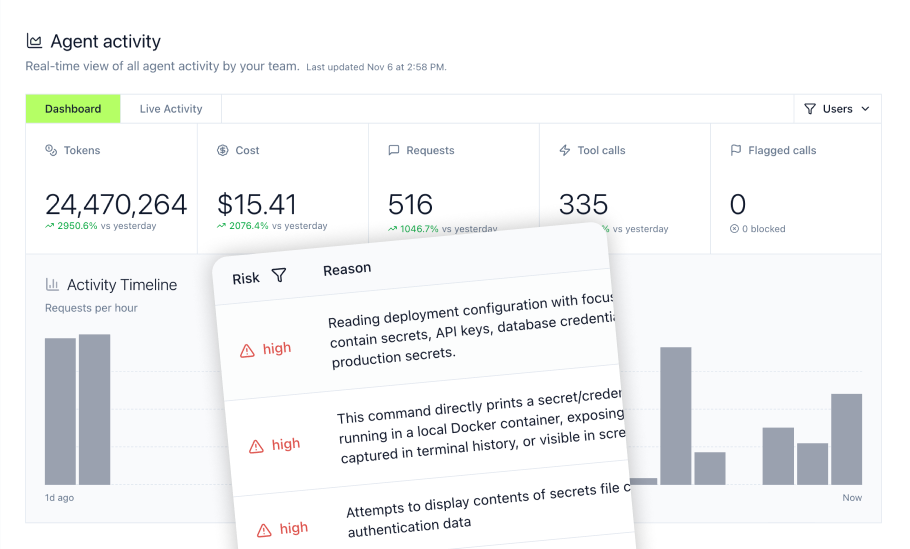
Agent Monitor tracks real-time agent activity including MCP calls made outside the gateway. This addresses a gap in standard MCP implementations that provide no visibility into off-gateway usage patterns.
Optimizing Agent Performance
Beyond security, observability enables performance optimization:
- Latency tracking: Identify slow MCP servers affecting agent response times
- Error monitoring: Detect failing tool calls before they impact business processes
- Usage analytics: Understand which tools and servers see heaviest use
- Cost attribution: Track token and runtime costs by team, agent, or use case
Rakuten reported a 79% reduction in time to market, from 24 days to 5 days, and deployed Claude Managed Agents across product, sales, marketing, and finance within one week.
Optimizing Workflows with Virtual MCPs and Bundles for Claude
As deployments scale beyond initial pilots, manual configuration becomes unsustainable. Virtual MCPs and Bundles provide abstraction layers that simplify management while maintaining governance.
Simplifying Complex Agent Configurations
Virtual MCPs aggregate multiple MCP servers behind a single endpoint tailored to specific use cases. Instead of configuring agent access to 15 individual servers, you create a Virtual MCP that bundles:
- Relevant servers for the use case, such as CRM, email, and calendar for sales agents
- Tool-level permissions appropriate to the role
- Custom policy rules for the business context
- Isolated audit trails for compliance
Virtual MCP abstraction reduces configuration complexity by giving each role or use case one governed endpoint instead of requiring teams to manage every MCP server connection separately.
Scaling Agent Deployments Securely
Agent Bundles extend the governance model to non-human principals. Each deployed agent receives:
- Independent identity: Unique credentials separate from human user accounts
- Scoped permissions: Access limited to tools required for the agent's specific purpose
- Rotatable credentials: Ability to rotate or revoke agent credentials without affecting users or other agents
- M2M authentication: OAuth 2.0 client-credentials flow for agent-to-system communication
This model makes each agent independently governable, so security teams can rotate, revoke, and audit agent access without relying on shared service accounts.
Integrating Claude Agents with Your Existing Enterprise Ecosystem
Production deployments require integration with existing infrastructure, workflows, and tooling. Claude Managed Agents and MCP gateways support multiple integration patterns.
Automating Agent Deployment Pipelines
Infrastructure-as-code approaches enable version-controlled, peer-reviewed agent configurations:
- REST APIs: Programmatically manage agent definitions, MCP server configurations, and access policies
- SDKs: Native libraries for Python, TypeScript, and other languages
- CI/CD integration: Deploy agent configurations through existing pipelines with staging and production environments
- Terraform providers: Manage MCP gateway resources alongside other cloud infrastructure
Teams treating agent, MCP server, and policy configuration like infrastructure-as-code can reduce misconfigurations and speed up incident response when issues arise.
Connecting Agents to Core Business Systems
Enterprise value comes from connecting Claude agents to systems of record:
Development Tools: GitHub, Jira, Linear for code review, issue triage, and project management automation
Customer Systems: Salesforce, HubSpot, Zendesk for CRM queries and support automation
Data Platforms: Snowflake, BigQuery, Databricks for analytics and reporting
Productivity: Slack, Gmail, Google Calendar for communication and scheduling
Each integration requires credential configuration, permission scoping, and audit setup. Pre-built connectors through an MCP gateway eliminate the per-connector engineering burden.
Why MintMCP Makes Enterprise Claude Deployments Faster and Safer
Deploying Claude Managed Agents with proper governance typically requires building authentication layers, credential vaults, access control systems, audit infrastructure, and observability tooling. MintMCP collapses this complexity into a managed platform that helps teams move governed MCP access into production faster.
MintMCP's approach differs from point solutions by treating governance as the foundation rather than an afterthought. Data permissions come first; agents are enabled on top of an already-governed permission model. This architecture eliminates the common pattern of deploying agents first and scrambling to add security controls later.
The platform provides a centralized MCP Gateway that routes Claude agent MCP traffic through a single governance layer with SSO, SCIM-driven RBAC, and tool-level access controls. One configuration point governs Claude, Cursor, ChatGPT, Gemini, and Copilot across your organization.
Instead of building and hosting connectors, teams get access to 10,000+ MCP servers with hosted connectors where available. MintMCP handles hosting, OAuth brokering, credential management, and sandboxed execution for supported connectors. This eliminates the per-connector engineering burden that typically delays enterprise AI deployments.
Agent Bundles give each deployed agent its own rotatable credentials and scoped permissions. No shared service accounts, no credential sprawl across agents. Custom policy code execution on every tool call integrates with existing DLP investments, letting teams block, flag, or transform requests based on content, user, or context.
Agent Monitor extends visibility beyond the gateway by hooking into Claude Code and Cursor at the endpoint level. When developers use MCP servers that don't route through the gateway, Agent Monitor detects and reports this activity. MDM integration enables consistent policy enforcement across developer machines, addressing shadow AI risks that standard MCP implementations cannot detect.
MintMCP is SOC 2 Type II audited, with continuous compliance monitoring via Drata. Enterprise SSO, complete audit trails, PII detection, and role-based access control are built into every layer of the platform. Customers handling protected health information can request HIPAA documentation. MintMCP signs BAAs. Visit the Trust Center or contact security@mintmcp.com for compliance documentation.
For teams evaluating MCP governance platforms, explore the MCP data risk framework to understand security considerations, or review Claude skills tips for optimizing agent behavior within governed environments.
Frequently Asked Questions
What is the Model Context Protocol and why is it important for Claude agents?
MCP provides a standardized interface for AI agents to connect with external tools and data sources. Instead of building custom integrations for each system, agents use MCP to discover available capabilities dynamically. For Claude Managed Agents, this means you can add new data sources without modifying agent code. The current protocol defines stdio for local processes and Streamable HTTP for remote servers, while SSE remains a legacy transport for older implementations. Enterprise deployments typically route MCP traffic through a central gateway that handles authentication and access control.
How does MintMCP help manage security and compliance for Claude agent deployments?
MintMCP sits between your Claude agents and MCP servers, enforcing security policies on every tool call. The platform provides SSO integration with identity providers like Okta and Azure AD, ensuring all agent access flows through corporate authentication. Per-agent credentials enable independent rotation and revocation. The Bundle model packages tool access, policy rules, and audit logging into single governance units tied to SCIM group membership. Full conversation-level logging captures prompts, tool calls, and responses with user attribution. The platform exports audit data to SIEM platforms and integrates with DLP tools like AWS Bedrock Guardrails and Microsoft Purview.
Can MintMCP detect when Claude agents are used outside of the central gateway?
Yes. Agent Monitor provides visibility beyond gateway traffic by hooking into Claude Code and Cursor at the endpoint level. When developers use MCP servers that don't route through the gateway, Agent Monitor detects and reports this activity. The platform supports MDM integration to push configurations to developer machines, ensuring consistent policy application even for local agent usage.
What is a Bundle in MintMCP and how does it simplify managing Claude agents?
A Bundle packages tool access, policy enforcement, and audit logging for a specific team or role. Instead of configuring individual access rules for each user and each MCP server, you create a Bundle that defines which servers are accessible, which tools are enabled, what policy rules apply, and which IdP groups have access. Bundles sync automatically with identity provider group changes. Agent Bundles extend this model to non-human principals, giving each deployed agent its own identity with scoped permissions.
How does MintMCP integrate with existing enterprise tools and identity providers?
MintMCP integrates at multiple layers. For identity, the platform supports SAML 2.0 and OIDC with providers like Okta, Azure AD, and Google Workspace, with SCIM for automated user provisioning. For security operations, audit logs export to SIEM platforms including Microsoft Sentinel and Splunk. For data protection, middleware hooks connect to DLP vendors like Nightfall, Skyflow, and cloud-native tools. REST APIs and SDKs enable CI/CD integration. The hosted connector catalog provides pre-built integrations with 50+ enterprise applications.