Claude Enterprise represents Anthropic's highest-tier AI platform, bundling foundation models with SSO, SCIM provisioning, custom data retention, audit logging, and compliance controls required by regulated industries. Yet deploying Claude at scale introduces governance gaps that native controls alone cannot address. Organizations connecting Claude agents to internal databases, CRM systems, and code repositories need centralized oversight across every tool call and data access request. An MCP Gateway provides that control layer, managing authentication, tool-level permissions, and audit logging for every agent interaction with enterprise systems. MintMCP's Agent Gateway builds on this foundation by adding persistent agent identities, scoped permissions, governed memory, and monitoring for agents operating alongside employees.
This guide covers the security architecture, governance frameworks, deployment strategies, compliance requirements, and operational considerations for enterprises deploying Claude alongside governed MCP infrastructure.
Key Takeaways
- Claude Team standard seats cost $20/user/month when billed annually or $25/user/month when billed monthly, with support for teams of 2 to 150 users; Enterprise offers self-serve purchasing at $20 per seat plus usage at API rates
- Deployment timing depends on purchasing path; self-serve Enterprise customers can begin without sales engagement, while sales-assisted procurement may require additional time for legal and security reviews
- Anthropic announced 28 Compliance API integrations across DLP, SIEM, identity, security operations, eDiscovery, and AI observability categories. Cowork activity is not captured in the Compliance API, and its locally stored conversation history cannot be centrally exported, although supported operational events can be streamed through OpenTelemetry
- Native Claude controls govern approved connectors and tools within Claude-managed environments; cross-platform governance for Claude, Cursor, ChatGPT, Gemini, and Copilot requires an external gateway layer
- Claude Enterprise provides native controls and telemetry for managed Claude products, but cross-platform shadow AI detection for Cursor and other unmanaged AI clients may require additional endpoint or gateway controls
AI Security Architecture for Claude Enterprise Deployments
Claude Enterprise delivers encryption in transit (TLS) and at rest (AES-256), SSO through SAML 2.0 and OIDC, SCIM-based user provisioning, IP allowlisting, and role-based access control across capabilities including Claude Code and Cowork. Custom data-retention controls are available on Enterprise plans. Zero Data Retention may be available under specific contractual terms, and organizations should confirm product, model, safety-review, and logging exceptions with Anthropic.
Core security controls:
- Authentication: SSO (SAML 2.0, OIDC), domain-verified workspaces, tenant restrictions
- Authorization: RBAC with connector-level and per-tool permissions, custom roles on Enterprise tier
- Data handling: Configurable retention, ZDR option under contract, workspace isolation
- Network: IP allowlisting, domain capture for unauthorized account prevention
Mitigating Prompt Injection and Credential Leakage
AI coding agents introduce code injection, data exfiltration, credential exposure in context, prompt injection via malicious files, supply chain poisoning through dependencies, and excessive permissions risks. Claude Code operating with broad file system access can inadvertently expose API keys, tokens, and credentials present in codebases.
Claude provides native connector and per-tool controls for approved integrations. Enterprises that need programmable inline DLP, custom middleware, or consistent policies across multiple AI clients can add gateway-level enforcement. MintMCP's security governance includes custom middleware that executes on every tool call, enabling integration with AWS Bedrock Guardrails, GCP DLP, Microsoft Purview, Nightfall, and Skyflow for PII detection, credential masking, and content filtering before data reaches the model.
Key protections to implement:
- Tool-level access controls (enable database reads, block writes)
- Inline DLP scanning for credential patterns
- Prompt injection detection using built-in rules or custom policies
- Rate limiting per user and team to prevent abuse
Establishing AI Governance Frameworks for Claude Enterprise
Effective Claude governance requires more than SSO and audit logs. Organizations need to define who can access which tools, what data those tools can touch, and how to attribute every action to a specific user or agent identity.
Defining Access Policies with Role-Based Controls
Claude Enterprise provides toggleable capabilities at the organization level and custom role creation for granular permission assignment. These controls can govern approved connectors and individual connector tools within Claude. However, they remain limited to Claude-managed environments and do not provide one policy and audit layer across Claude, Cursor, ChatGPT, Gemini, and Copilot.
MintMCP's Bundle model addresses this gap by packaging tool access, policy enforcement, and audit logging into single governance units per team or role. Each Bundle ties SCIM group membership to a curated MCP server list, custom policy rules, and isolated audit trails. When a user's IdP group membership changes, their MCP access updates automatically.
Governance model comparison:
| Scope | Claude Enterprise Native | MCP Gateway Layer |
|---|---|---|
| User authentication | SSO, SCIM, domain verification | Inherited from IdP via gateway |
| Tool access | Connector-level and per-tool permissions within Claude | Per-tool policy across governed MCP clients and Bundles |
| Policy enforcement | Organization system prompt | Custom middleware on every call |
| Audit attribution | Per-user Compliance API | Per-user and per-agent logging |
Implementing Accountable Audit Trails
Claude Enterprise's Compliance API provides programmatic access to usage data, chat content, file uploads, and audit telemetry. Organizations can export these logs to SIEM platforms for centralized monitoring.
Cowork activity is not captured in the Compliance API, and its locally stored conversation history cannot be centrally managed or exported. However, Team and Enterprise administrators can stream supported Cowork events through OpenTelemetry, which Anthropic notes does not replace compliance audit logging.
For workflows involving regulated data, this creates an audit gap. MintMCP logs MCP requests, tool calls, responses, and user or agent attribution for traffic routed through the gateway. Agent Monitor separately provides visibility into supported local agent activity such as prompt submissions, Bash commands, and file access.
Deployment Strategies for Claude and Enterprise AI Agents
Enterprise Procurement Timeline
Claude Enterprise deployment timing varies by purchasing path and organizational requirements:
- Plan and purchasing path: Choose self-serve or sales-assisted Enterprise
- Legal and security review: Complete any required DPA, security, and contract reviews
- Identity and network setup: Configure SSO, SCIM, domain controls, and network policies
- Admin configuration: Set permissions, retention, connector controls, and monitoring
- Pilot and rollout: Test with a limited group before broader deployment
Common delays and fixes:
- DPA review bottleneck: Legal reviews cause most timeline extensions. Involve legal early; use standardized DPA review templates
- SSO misconfiguration: SCIM setup frequently requires iteration. Test with a single user before broad rollout
- Missing system prompt: Teams often skip this step. Organization instructions can help Claude follow company context, terminology, and operational constraints more consistently
Accelerating Deployment with Pre-Configured Connectors
MCP server deployment adds complexity beyond Claude Enterprise setup. Organizations connecting Claude to Salesforce, GitHub, Slack, databases, and internal APIs need hosted runtimes, OAuth configuration, and credential management for each integration.
MintMCP's MCP Gateway offers one-click activation for hundreds of prebuilt connectors. For custom integrations, STDIO server support automatically converts locally-run MCP servers to hosted, production-ready services with OAuth wrapping. The customer does not manage Kubernetes pods, runtimes, or scaling for the connector layer.
Achieving AI Compliance and Auditability
Meeting Regulatory Requirements
Claude Enterprise offers security, privacy, and compliance capabilities relevant to regulated deployments:
- SOC 2 Type II: Independent attestation report available through Anthropic's Trust Center
- ISO/IEC 27001:2022: Information security management system certification
- ISO/IEC 42001:2023: AI management system certification that may support broader AI governance programs
- GDPR: Data processing terms and transfer mechanisms should be reviewed under Anthropic's current commercial agreement and DPA
- HIPAA: HIPAA-ready Enterprise offering available. Organizations should confirm BAA eligibility, supported products, retention settings, and Cowork coverage with Anthropic before processing protected health information
MintMCP is SOC 2 Type II audited with continuous compliance monitoring via Drata. Customers handling protected health information can request HIPAA documentation, and MintMCP is compliant with HIPAA standards with signed BAAs.
SIEM Integration for Unified Threat Detection
Claude's Compliance API enables export to SIEM platforms, and Anthropic announced 28 Compliance API integrations across categories including DLP, SIEM, identity, security operations, eDiscovery, and AI observability. These integrations capture Claude-specific activity but not MCP tool calls to external systems.
MintMCP's gateway captures the governed MCP interaction chain, including tool requests, responses from external systems, and user or agent attribution. This unified log stream exports to the same SIEM platforms, providing end-to-end visibility that Claude's native logging cannot achieve alone.
MintMCP Agent Gateway for Claude Agents Across the Enterprise
Simplifying Credential Management with Agent Identities
When AI agents access enterprise systems, the fundamental question is: whose credentials are they using? Shared service accounts create attribution problems. User-delegated tokens create over-permissioning risks.
MintMCP's Agent Identities give each deployed agent its own persistent identity with scoped credentials that can be rotated independently. Agent Bundles extend the governance model to non-human principals, applying Virtual MCP Bundles so an agent's permissions are explicitly scoped rather than inherited from a human user's access level.
Agent identity model:
- Bearer API keys plus OAuth 2.0 client-credentials per agent
- Rotation and revocation independent of human users
- "Act as agent" admin flow for connectors requiring per-agent OAuth
- Attribution in audit logs tied to specific agent identities
Enterprise-Wide Visibility into AI Agent Activity
Claude Enterprise provides analytics, managed settings, connector controls, and telemetry for supported Claude products, including Claude Code. It does not provide one unified governance view across Cursor, ChatGPT, Gemini, Copilot, and other third-party AI clients.
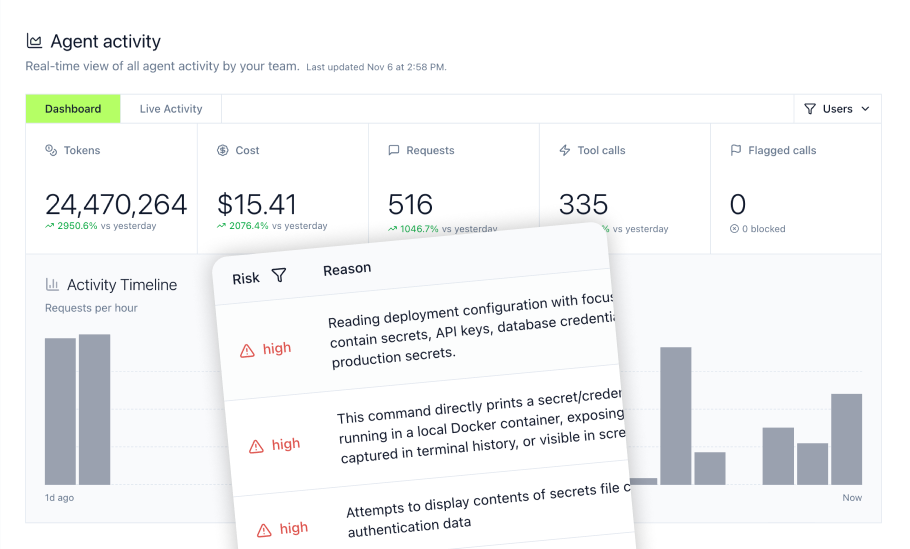
MintMCP's Agent Monitor provides visibility into supported local non-MCP agent activity, including Bash commands, file reads and writes, and prompt submissions through Claude Code and Cursor hooks. The platform detects PII exposure, credential leakage (API keys, tokens), risky bash commands, and prompt injection attempts using built-in rules with block, flag, or alert actions.
Addressing Shadow AI Risks in Developer Tools
Detecting Unmanaged AI Workflows
Developers using Claude Code, Cursor, and other AI coding assistants may connect to MCP servers outside IT-approved channels. This shadow AI creates compliance gaps, credential sprawl, and audit blind spots that Claude Enterprise cannot address because it only governs Claude-branded products.
MintMCP combines gateway enforcement for governed MCP traffic with Agent Monitor visibility into supported local agent activity. This provides organizations with detection capabilities for off-gateway usage patterns while maintaining governance for approved workflows.
Enforcing AI Usage Policies Across Endpoints
Claude Enterprise's tenant restrictions can prevent personal Claude account usage, but they do not prevent employees from using Cursor with unmanaged MCP servers or connecting ChatGPT to internal APIs. Cross-platform governance requires a control layer that operates independently of any single AI vendor.
MintMCP's gateway provides that layer, managing authentication and authorization for Claude, Cursor, ChatGPT, Gemini, and Copilot through a single policy engine. The same Bundles, rules, and audit streams apply regardless of which AI client initiates the MCP connection.
Governing AI Agents at Enterprise Scale with MintMCP
Deploying Claude Enterprise provides organizations with powerful AI capabilities and native security controls for Claude-managed environments. Yet achieving comprehensive governance across the full AI agent lifecycle - from authentication and tool access to memory management and audit attribution - requires purpose-built infrastructure that extends beyond any single AI vendor's control plane.
MintMCP addresses this gap through three integrated layers. The MCP Gateway provides governed data and tool connections with hundreds of prebuilt connectors, inline DLP integration, and policy enforcement across Claude, Cursor, ChatGPT, Gemini, and Copilot. The Agent Gateway adds persistent identities, scoped permissions, and governed memory for agents operating alongside employees. Agent Monitor extends visibility to local agent activity through Claude Code and Cursor hooks, detecting credential leakage, PII exposure, and prompt injection attempts in real time.
This layered approach enables enterprises to deploy Claude at scale while maintaining the centralized oversight, audit attribution, and cross-platform policy consistency required by regulated industries. Organizations gain the flexibility to govern what Claude agents can access, how agent identities are managed, and where shadow AI patterns emerge - all through a single control plane that works regardless of which AI client initiates the connection.
Frequently Asked Questions
What is the difference between Claude Team and Claude Enterprise pricing?
Claude Team standard seats cost $20/user/month when billed annually or $25/user/month when billed monthly and support teams of 2 to 150 users. Claude Enterprise uses a $20-per-seat base price plus usage at API rates and adds capabilities such as fine-grained role-based access, SCIM, audit logs, the Compliance API, custom data retention, network controls, and a HIPAA-ready offering. Anthropic provides both self-serve and sales-assisted Enterprise purchasing paths.
Does Claude Enterprise support EU data residency?
Data residency and inference location vary by Claude product, deployment route, model, and contract. Organizations with EU residency requirements should confirm native Claude Enterprise terms with Anthropic and evaluate supported regional deployment options through services such as AWS Bedrock or Google Vertex AI where appropriate.
How do I prevent employees from using personal Claude accounts for work?
Claude Enterprise offers tenant restrictions that route domain-verified users to your Enterprise workspace. However, this only governs Claude-branded products. Employees can still use Cursor, ChatGPT, or other AI tools with personal accounts. Broader shadow AI governance may require additional endpoint monitoring or gateway controls beyond Claude Enterprise.
What happens to Claude Cowork activity in audit logs?
Claude Cowork activity is not captured in the Compliance API, and its locally stored conversation history cannot be centrally managed or exported. Supported operational events can be streamed through OpenTelemetry, but Anthropic notes that this does not replace compliance audit logging. Routing sensitive tool access through governed MCP connections can capture MCP requests, tool calls, responses, and attribution, but it does not make Cowork's local conversation history centrally exportable.
Can I use Claude Enterprise with existing DLP investments?
Yes. Claude's Compliance API integrates with SIEM platforms, and MintMCP's gateway middleware supports inline DLP integration with AWS Bedrock Guardrails, GCP DLP, Microsoft Purview, Nightfall, and Skyflow. Custom middleware hooks enable integration with additional DLP vendors, allowing organizations to apply existing content policies to AI agent interactions.