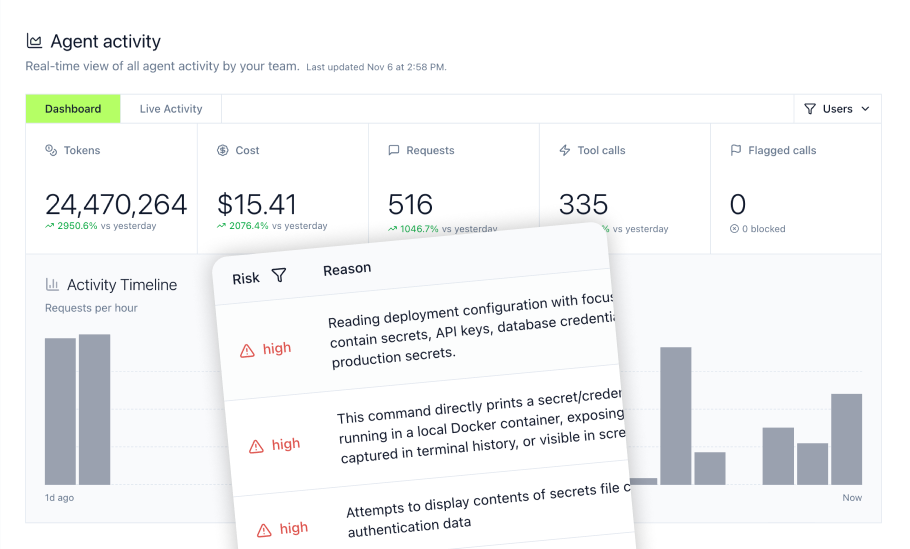
Every day your security team operates without visibility into AI agent activity, shadow AI spreads deeper into your infrastructure—exposing proprietary code, customer data, and compliance gaps that cost enterprises an average of $4.4 million per breach. With 78% of knowledge workers bringing their own AI tools into enterprise environments, the solution isn't blocking all AI adoption—it's implementing systematic auditing through platforms like MintMCP's MCP Gateway that transform shadow AI into governed, production-ready infrastructure.
Key Takeaways
- 75% of knowledge workers use generative AI at work, and 78% of those users bring their own AI tools into enterprise environments
- Data breaches cost an average of $4.4 million, with unsecured AI agents increasingly identified as root causes
- Comprehensive auditing platforms deliver measurable reductions in compliance audit costs and significant efficiency improvements
- Discovery-to-enforcement implementation often takes several weeks with proper planning and a phased rollout
- Organizations with formal AI governance frameworks achieve significantly better outcomes than those with ad-hoc approaches
Understanding the Rise of Shadow AI Agents and Their Risks
Shadow AI represents any artificial intelligence tool, agent, or MCP server deployed without explicit IT approval or security review. Unlike traditional shadow IT—where employees might use unauthorized SaaS apps—shadow AI introduces unique risks because these agents actively access, process, and transmit sensitive data while making autonomous decisions.
Defining Shadow AI in the Enterprise
Shadow AI encompasses several categories of unauthorized deployment:
- Coding assistants — GitHub Copilot, Cursor, Claude Code, and similar tools accessing source code repositories
- Browser extensions — AI-powered productivity tools with access to email, documents, and internal systems
- MCP servers — Local or remote Model Context Protocol servers connecting AI clients to enterprise data
- Custom agents — Developer-built AI tools deployed without security review or governance controls
- SaaS AI features — AI capabilities embedded in approved tools but activated without IT knowledge
The scope of unauthorized AI usage continues expanding, with reports finding 73% of security professionals admit to using SaaS apps not provided by their company’s IT team, and AI tools compound this problem by operating with extensive system access that traditional applications never required.
The Unseen Dangers of Unsanctioned Agents
Unauthorized AI agents create compounding security risks that traditional security tools cannot detect:
Data Leakage — Coding assistants transmit proprietary source code to external LLM providers. Customer data flows through AI summarization tools without encryption or access controls. Sensitive documents get processed by AI agents with no audit trail.
Compliance Gaps — Regulatory frameworks including GDPR, HIPAA, and SOC 2 require documented evidence of data handling. Shadow AI operates outside these controls, creating audit failures and potential penalties.
System Vulnerabilities — AI agents with file system access can read credentials, SSH keys, and environment variables. Without monitoring, security teams cannot detect or prevent credential exfiltration.
Operational Inefficiencies — Duplicate AI tools across teams waste resources. Inconsistent configurations create unpredictable behavior. No central inventory makes troubleshooting impossible.
Establishing an AI Governance Framework: From Policy to Practice
Effective AI auditing requires a governance framework before deploying detection tools. Organizations with formal AI governance frameworks achieve significantly better project outcomes than those using ad-hoc approaches.
Key Components of a Robust AI Governance Policy
A production-ready AI governance policy addresses five core areas:
Classification Standards — Define what constitutes authorized versus unauthorized AI usage. Establish criteria for evaluating new AI tools before deployment. Create clear escalation paths for policy exceptions.
Data Access Rules — Specify which data categories AI agents can access. Require data classification before AI processing. Mandate encryption for sensitive data in transit and at rest.
Authentication Requirements — Enforce SSO and OAuth for all AI tool access. Require multi-factor authentication for agents accessing sensitive systems. Prohibit shared credentials or service accounts without audit trails.
Audit and Retention — Define logging requirements for all AI agent activity. Establish retention periods aligned with compliance requirements (90-365 days depending on regulations). Require immutable, tamper-evident audit logs.
Incident Response — Create playbooks for unauthorized AI detection. Define escalation procedures and remediation timelines. Establish communication protocols for security incidents involving AI agents.
Integrating AI Governance into Existing IT Frameworks
AI governance operates within existing security architecture—not as a parallel system. Integration points include:
- Identity providers — Okta, Azure AD, Google Workspace for centralized authentication
- SIEM platforms — Splunk, Datadog, Microsoft Sentinel for security event correlation
- Endpoint management — MDM and GPO for enforcing agent policies on developer workstations
- Cloud security — CASB and CSPM tools for monitoring cloud-based AI deployments
For detailed guidance on authentication models, enterprise teams should establish OAuth and SAML integration patterns before rolling out AI agent monitoring.
Identifying Unauthorized AI: Detection Strategies and Tools
Detection forms the foundation of AI agent auditing. Without comprehensive visibility into what agents exist and how they operate, enforcement remains impossible.
Leveraging Existing IT Infrastructure for Detection
Your current security stack provides starting points for shadow AI discovery:
Network Traffic Analysis — Monitor outbound connections to known LLM API endpoints (OpenAI, Anthropic, Google). Flag unusual data volumes to AI service domains. Identify MCP server communications on non-standard ports.
Endpoint Detection — Scan developer workstations for AI tool installations. Monitor process execution for coding assistant activity. Track file access patterns indicating AI agent operation.
Log Analysis — Review cloud provider logs for unauthorized AI service usage. Analyze API gateway logs for AI-related requests. Correlate authentication logs with AI tool access patterns.
SaaS Audit Logs — Check Microsoft 365 audit logs for Copilot activation. Review Salesforce logs for Agentforce deployments. Monitor Google Workspace for AI feature usage.
Proactive vs. Reactive Discovery Methods
Proactive Discovery operates continuously, scanning environments before incidents occur:
- Automated agent inventory scans running daily or weekly
- Real-time monitoring of new tool installations
- API-based polling of SaaS platforms for AI feature activation
- Network inspection for AI service communication patterns
Reactive Discovery responds to indicators of compromise or policy violations:
- Incident investigation following data exfiltration alerts
- Compliance audit findings revealing undocumented AI usage
- User reports of unauthorized tool activity
- Security team detection during routine reviews
Enterprise deployments require both approaches. Proactive discovery prevents shadow AI accumulation, while reactive capabilities ensure rapid response when unauthorized agents bypass initial controls.
The LLM Proxy provides immediate visibility into every MCP tool invocation and file operation from coding agents—identifying unauthorized API usage that network-level detection misses.
Implementing Effective AI Governance Tools and Controls
Detection without enforcement creates visibility without security. Governance tools transform discovery findings into actionable controls that block unauthorized agents while enabling sanctioned AI usage.
Centralized Control for Distributed AI Agents
Enterprise AI environments span multiple platforms, cloud providers, and deployment models. Centralized governance provides:
- Unified authentication — Single OAuth/SSO integration for all MCP connections
- Policy enforcement — Consistent rules applied across SaaS, cloud, and on-premise agents
- Real-time blocking — Automatic termination of unauthorized agent actions
- Rate limiting — Control agent API usage to prevent abuse or runaway costs
- Data masking — Redact sensitive information before AI processing
Setting Granular Access Policies
Effective policies operate at multiple levels:
Agent-Level Controls
- Whitelist approved AI tools by name and version
- Block known unauthorized agents automatically
- Quarantine unknown agents pending security review
Data-Level Controls
- Restrict access to specific databases, file paths, or API endpoints
- Require data classification tags before AI processing
- Enforce read-only access for analytical agents
Action-Level Controls
- Permit query operations while blocking write/delete
- Allow file reading but prevent execution
- Enable API calls while restricting parameter values
The MCP Gateway offers centralized governance with unified authentication, audit logging, and rate control for all MCP connections—transforming shadow AI into sanctioned, production-grade infrastructure.
For teams requiring curated tool access, Virtual MCP concepts enable administrators to expose only minimum required capabilities rather than entire MCP servers.
Ensuring AI Security: Protecting Sensitive Data and Systems
Security controls protect against both external threats and internal misuse. AI agents require specialized security measures beyond traditional application controls.
Guarding Against Data Exfiltration by AI Agents
AI agents pose unique exfiltration risks because they legitimately require data access to function. Security measures must distinguish authorized processing from unauthorized extraction:
Sensitive File Protection — Block access to .env files, SSH keys, credentials, and configuration files containing secrets. Monitor access patterns for anomalous file requests.
Output Monitoring — Inspect agent responses for sensitive data before transmission. Flag outputs containing PII, credentials, or proprietary information.
Context Boundaries — Limit agent memory and context windows to prevent accumulation of sensitive information. Clear agent state between sessions.
Network Segmentation — Isolate AI agents from production databases without explicit authorization. Require VPN or private network access for sensitive system connections.
The LLM Proxy prevents access to sensitive files like .env and SSH keys, blocking dangerous commands in real-time before execution completes.
Building a Proactive AI Security Posture
Reactive security responds to incidents. Proactive security prevents them:
Threat Modeling — Identify AI-specific attack vectors including prompt injection, data poisoning, and model manipulation. Design controls addressing each threat category.
Vulnerability Management — Track CVEs affecting AI frameworks and tools. Patch agent dependencies promptly. Monitor for emerging AI security vulnerabilities.
Penetration Testing — Include AI agents in regular security assessments. Test prompt injection resistance. Verify access control enforcement under adversarial conditions.
Security Training — Educate developers on AI security risks. Train security teams on AI-specific monitoring techniques. Update incident response procedures for AI-related events.
For comprehensive security documentation, enterprise teams should review authentication, access control, and monitoring requirements before deployment.
Achieving AI Compliance: Audit Trails and Certifications
Regulatory compliance requires documented evidence of AI agent activity. Without comprehensive audit trails, organizations fail audits regardless of actual security posture.
Meeting Regulatory Demands with Comprehensive Logging
Compliance frameworks impose specific logging requirements:
SOC 2 Type II — Requires evidence of security controls operating effectively over time. Audit logs must demonstrate continuous monitoring, access control enforcement, and incident response capabilities.
HIPAA — When AI agents may touch regulated health data, teams require detailed logging of access and transformations. MintMCP is HIPAA compliant, providing the controls healthcare organizations need.
GDPR — Requires documentation of data processing activities including AI-based processing. Audit trails must support data subject access requests and demonstrate lawful processing basis.
ISO 27001 — Demands documented information security management including AI systems. Audit logs provide evidence for certification audits.
Preparing for AI Compliance Audits
Audit preparation begins before auditors arrive:
Log Retention — Configure retention periods meeting regulatory requirements. SOC 2 audit evidence often benefits from 90+ days of retained logs; regulated industries may require longer retention based on policy and legal guidance
Log Integrity — Implement cryptographic signatures preventing log tampering. Store logs in immutable storage systems resistant to modification.
Report Generation — Build automated reports showing agent inventory, access patterns, policy enforcement, and incident response. Pre-generate reports covering common audit requests.
Evidence Organization — Structure documentation for efficient auditor review. Create indexes mapping compliance requirements to supporting evidence.
The MCP Gateway provides complete audit logs for every MCP interaction, access request, and configuration change—essential documentation for SOC 2 and GDPR-aligned compliance workflows.
For audit and observability implementation details, security teams can access comprehensive logging configuration guidance.
Centralized Monitoring and Observability for AI Operations
Monitoring transforms audit logs into actionable intelligence. Real-time visibility enables rapid response to security events while providing operational insights for optimization.
Gaining Full Visibility into AI Agent Activity
Comprehensive monitoring covers all agent interaction types:
- Tool calls — Every MCP tool invocation with parameters and results
- Bash commands — All shell commands executed by coding agents
- File operations — Read, write, and delete operations with paths and content summaries
- Memory updates — Changes to agent context and long-term memory
- RAG queries — Retrieval-augmented generation requests with sources accessed
- User interactions — Conversations and instructions triggering agent actions
Analyzing Usage and Performance for Optimization
Beyond security, monitoring data enables operational improvements:
Cost Analytics — Track spending per team, project, and tool. Identify optimization opportunities in high-cost agent deployments. Budget AI infrastructure based on actual usage patterns.
Performance Metrics — Measure response times, error rates, and throughput. Identify bottlenecks affecting agent performance. Optimize configurations based on measured results.
Usage Patterns — Understand how teams use AI tools. Identify training needs based on usage gaps. Plan capacity based on growth trends.
Anomaly Detection — Establish baseline behavior patterns. Alert on deviations indicating security issues or operational problems. Automate response to common anomalies.
Streamlining AI Deployment and Management for Enterprise
Auditing unauthorized agents addresses immediate risk. Sustainable governance requires streamlined deployment of sanctioned AI that removes incentives for shadow AI adoption.
From Developer Utility to Production-Grade Infrastructure
Developers adopt shadow AI because sanctioned alternatives are unavailable, slow to provision, or lack required capabilities. Addressing root causes reduces shadow AI demand:
Self-Service Access — Enable developers to request AI tool access through automated workflows. Eliminate multi-week approval processes that drive shadow adoption.
One-Click Deployment — Deploy STDIO-based MCP servers instantly with built-in hosting. Remove infrastructure complexity that prevents sanctioned tool usage.
Pre-Configured Policies — Ship AI tools with security policies already applied. Reduce configuration burden on developers while ensuring compliance.
Production Monitoring — Transform local servers into production services with automatic monitoring, logging, and alerting. Provide visibility without requiring developer effort.
Empowering Teams with Governed AI Access
Governed AI access balances security requirements with developer productivity:
- Curated tool sets — Expose only approved capabilities through Virtual MCPs
- Role-based permissions — Match tool access to job responsibilities
- Centralized credentials — Manage all API keys and tokens in one secure location
- Cross-tool integration — Connect AI agents to databases, APIs, and services through governed pathways
For tool governance implementation, security teams can configure granular access controls aligned with organizational policies.
Transform Shadow AI into Governed Infrastructure with MintMCP
For organizations serious about auditing unauthorized AI agents while enabling productive AI adoption, MintMCP provides enterprise-grade infrastructure that transforms shadow AI into sanctioned, production-ready deployments without disrupting developer workflows.
The MCP Gateway centralizes control and visibility across your entire AI infrastructure. Deploy STDIO-based MCP servers instantly with managed hosting, eliminating the infrastructure complexity that drives shadow adoption. Automatic OAuth and SSO enforcement ensures every connection meets security requirements without manual configuration. Complete audit trails capture every interaction, providing the documented evidence required for SOC 2, HIPAA, and GDPR compliance audits. Real-time monitoring of server health, usage patterns, and security alerts enables rapid response to emerging threats. Granular role-based permissions let you control exactly which tools each team member can access, matching capabilities to responsibilities.
The LLM Proxy delivers essential visibility into coding agent behavior that network-level monitoring cannot capture. Track every tool invocation, bash command, and file operation across all coding assistants. Automatically block access to sensitive files including .env files, SSH keys, and credential stores before data exfiltration occurs. Maintain comprehensive audit histories for security investigations and compliance reviews. Monitor which MCP servers are installed and how teams use them across your organization.
MintMCP works seamlessly with your existing AI tools—Claude, ChatGPT, Cursor, Copilot, and any MCP-compatible agent. The platform supports both STDIO servers deployed through managed hosting and remote or self-hosted servers you already operate. SOC 2 Type II compliant, with security controls that can support HIPAA-oriented requirements and GDPR-aligned data handling, MintMCP delivers enterprise-grade security without sacrificing developer productivity.
Deployment takes minutes rather than months. Enterprise authentication works out of the box through existing identity providers. The monitoring infrastructure that MCP servers need for production use comes built-in, eliminating custom development overhead.
Learn more about MCP Gateway capabilities or explore understanding MCP gateways for AI infrastructure implementation strategies.
Frequently Asked Questions
What is 'shadow AI' and why is it concerning?
Shadow AI refers to AI tools and agents deployed without IT approval. Unlike traditional shadow IT, shadow AI actively processes sensitive data and makes autonomous decisions—accessing source code, customer records, and internal documents without governance controls. Data breaches cost an average of $4.4 million, with unsecured AI agents increasingly appearing as root causes. Without auditing, organizations cannot detect what data agents access or whether they comply with regulatory requirements.
How does AI governance help mitigate risks?
AI governance frameworks establish classification standards, data access rules, authentication requirements, and audit policies before deploying detection tools. Organizations with formal governance achieve significantly better outcomes than those using ad-hoc approaches. Frameworks define authorized usage, specify which data agents can access, require SSO/OAuth for all connections, and mandate logging aligned with compliance requirements. Integration with existing identity providers and SIEM platforms creates unified enforcement.
What should enterprises look for in auditing tools?
Enterprise auditing tools must provide automated discovery across SaaS, cloud, and endpoint environments. Essential capabilities include behavioral monitoring tracking every tool call and file operation, real-time policy enforcement blocking unauthorized agents, and immutable audit logs for compliance evidence. Integration with existing security stacks including SIEM, IAM, and SOAR systems ensures comprehensive visibility.
Can MintMCP integrate with existing infrastructure?
MintMCP integrates with enterprise identity providers including Okta, Azure AD, and Google Workspace through SAML and OIDC protocols. The platform supports AI clients including Claude, ChatGPT, Cursor, and custom MCP-compatible agents without requiring workflow changes. Audit logs export to SIEM platforms for correlation with security events. The MCP Gateway provides automatic OAuth and SSO enforcement for all connected servers.
How does MintMCP ensure compliance?
MintMCP is SOC 2 Type II compliant with GDPR-aligned controls; healthcare teams can evaluate HIPAA-oriented requirements based on their policies and legal guidance. The MCP Gateway generates complete audit trails capturing every interaction, access request, and configuration change—providing documented evidence for regulatory audits. Configurable retention periods (90-365 days) with immutable storage prevent tampering. Pre-built compliance reporting templates streamline audit preparation.
What are the benefits of sanctioned AI?
Converting shadow AI to governed deployments delivers measurable business value. Sanctioned AI provides productivity benefits—developers keep using AI tools—while security teams gain visibility and control. Centralized credential management eliminates scattered API keys. Consistent policies prevent configuration drift. Self-service access removes multi-week approval delays that drive shadow adoption. Production monitoring transforms local utilities into enterprise-grade infrastructure with automatic alerting and compliance documentation.