The OWASP Top 10 for Agentic Applications is an emerging, globally peer-reviewed framework and developed with input from 100+ industry security experts from AWS, Microsoft, Palo Alto Networks, and leading security researchers. This framework addresses what happens when AI systems can plan, decide, and execute actions across enterprise infrastructure—not just respond to prompts. As organizations increasingly deploy autonomous AI agents with tool access and decision-making authority, robust MCP gateway infrastructure becomes essential to govern these systems before deployment scales beyond control. According to IBM's 2024 research, the average cost of a data breach reached $4.45 million, making preventive security frameworks critical for AI deployments.
This guide provides actionable strategies for implementing OWASP's agentic security framework, covering risk categories, real-world attack examples, and platform selection to ensure your AI agents operate securely at enterprise scale.
Key Takeaways
- The OWASP Agentic AI Top 10 identifies 10 critical risk categories spanning goal hijacking, tool misuse, identity abuse, and supply chain vulnerabilities—each requiring distinct mitigation approaches
- Real attacks are occurring: Claude Desktop RCEs, malicious MCP servers exfiltrating emails, and PromptPwnd exposing CI/CD secrets demonstrate immediate threats
- Machine identities outnumber humans 82:1 in enterprise environments, creating massive attack surfaces that traditional IAM cannot address
- Supply chain risks dominate, with compromised runtime dependencies representing primary security challenges
- Organizations need behavioral monitoring, kill switches, and granular access controls specifically designed for autonomous agent operations
Understanding the Agentic AI Paradigm
What Defines Agentic AI?
Agentic AI systems differ fundamentally from traditional generative AI. While generative AI responds to prompts and produces outputs, agentic AI operates with autonomy across steps—planning actions, using tools, accessing databases, communicating with other agents, and making decisions that directly affect business operations.
Key characteristics creating security challenges:
- Dynamic composition: Tools, plugins, and MCP servers assembled at runtime rather than compile time
- Natural language attack surface: Malicious instructions hide in any text content agents process—emails, PDFs, web pages, calendar invites
- Persistent memory: Context and state carry across sessions, enabling long-term behavioral manipulation
- Tool use autonomy: Agents invoke external APIs, execute code, and modify data without per-action human approval
The Operational Shift
Traditional application security assumes fixed code paths and predictable behavior. Agentic systems violate these assumptions entirely. A coding assistant with CI/CD access operates with fundamentally different risk characteristics than a chatbot answering customer questions. This shift requires new security governance approaches treating agents as non-human identities requiring lifecycle management, behavioral monitoring, and granular access controls.
The OWASP Framework
The framework categorizes risks by business impact and attack methodology. Understanding these categories enables systematic risk assessment and prioritized mitigation.
Common priority grouping:
- ASI01 - Agent Goal Hijack: Attackers redirect agent objectives through malicious content
- ASI02 - Tool Misuse: Legitimate tools used harmfully without privilege escalation
- ASI03 - Identity Abuse: Credential theft and privilege escalation through agent sessions
Additional high-priority categories:
- ASI04 - Supply Chain Vulnerabilities: Compromised dependencies loaded at runtime
- ASI05 - Unexpected Code Execution: RCE through agent-generated commands
- ASI06 - Memory Poisoning: Long-term behavioral manipulation through context injection
- ASI08 - Cascading Failures: System-wide outages from single-point failures
- ASI10 - Rogue Agents: Misaligned autonomous behavior and self-replication
Other frequently prioritized categories:
- ASI07 - Insecure Inter-Agent Communication: Message tampering and impersonation
- ASI09 - Human-Agent Trust Exploitation: Social engineering via AI-generated content
Agent Goal Hijack
Agent goal hijacking represents the most direct attack path. Adversaries inject malicious instructions into any content agents process—and agents cannot reliably distinguish instructions from data.
Documented attacks:
- EchoLeak: Crafted emails triggered Microsoft 365 Copilot to silently exfiltrate confidential files without user interaction
- RAG Poisoning: Indirect prompt injection (including RAG poisoning): Malicious content in retrieved sources can smuggle instructions that cause tool-enabled assistants to take unsafe actions or leak sensitive data
Mitigation Strategies
- Treat all natural language input as untrusted data
- Apply prompt injection filtering at every input boundary
- Lock system prompts and require human approval for goal-changing actions
- Implement behavioral monitoring to detect unexpected objective drift
- Sanitize all external data sources before agent processing
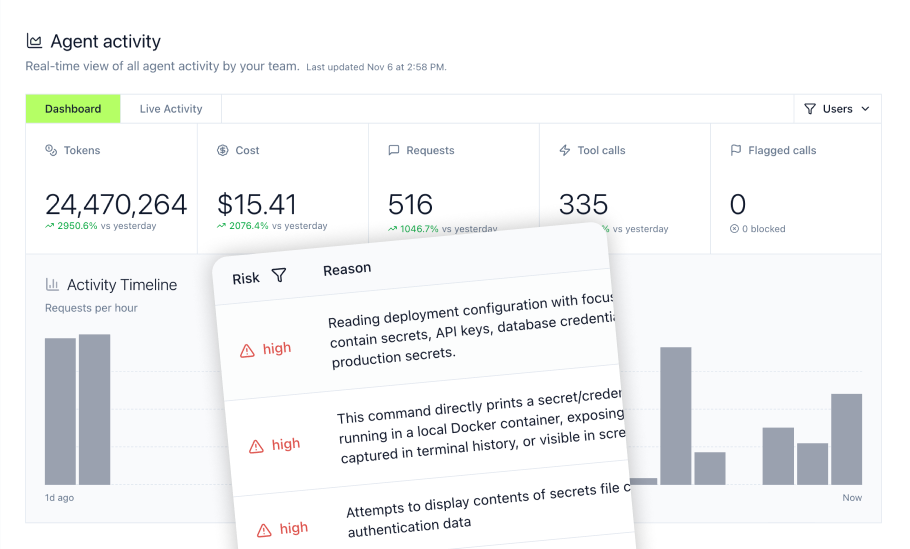
MintMCP's LLM Proxy provides real-time monitoring of agent actions, detecting unexpected behavior patterns before exfiltration occurs.
Insecure Tool Usage
Tool misuse attacks exploit legitimate, authorized capabilities—agents don't need to escalate privileges when they already have broad tool access. The PromptPwnd attack demonstrated this: untrusted GitHub issue content injected into CI/CD workflow prompts exposed secrets through write-capable tokens.
Additional documented incidents:
- Amazon Q Compromise: Poisoned pull requests directed coding assistants to delete AWS resources using legitimate CLI tools
- DNS Exfiltration: Coding agents with ping tool access repeatedly contacted remote servers, exfiltrating data via DNS queries
- Typosquatting: Agents called malicious tools with names similar to legitimate ones
Implementation Requirements
- Strict tool permission scoping based on least privilege
- Sandboxed execution environments for code generation
- Argument validation before every invocation
- Human approval gates for destructive operations
- Rate limits and adaptive budgeting
- Ephemeral, just-in-time credentials
Platforms offering tool governance features enable role-based MCP endpoints where different user groups receive different tool sets.
Identity and Privilege Abuse
Agents inherit high-privilege credentials, session tokens, and delegated access that persist across interactions. Traditional identity management designed for human users fails when applied to autonomous systems operating at 82:1 machine-to-human ratios.
Attack Patterns Observed
- Cached Credentials: IT agents reusing SSH credentials from earlier sessions for unauthorized actions
- Confused Deputy: Low-privilege agents relaying instructions to high-privilege agents that trust internal requests
- Cross-Agent Delegation: Worker agents inheriting full database rights from manager agents without scoping
Required Controls
- Task-scoped, short-lived permissions
- Session isolation with strict memory wiping between tasks
- Authorization checks per action step
- Unique cryptographic identity per agent
- Just-in-time privileged access with immediate credential expiration
MintMCP Gateway provides enterprise authentication features with OAuth 2.0 and SSO integration, enabling centralized credential management with role-based access controls.
Supply Chain Vulnerabilities
Agents dynamically load tools, plugins, MCP servers, and prompt templates at runtime. Any compromised component can alter agent behavior. Security researchers have documented malicious MCP servers impersonating email services and secretly copying every agent-sent email.
Additional Supply Chain Incidents
- Backdoored MCP Package: Examples include a malicious “postmark-mcp” package that covertly exfiltrated emails, and an “mcp-runcommand-server” package reported with remote-shell/backdoor behavior
- PhantomRaven: A campaign reported as 126 malicious npm packages used for credential and secret theft
- NPM Gaslighting: Packages including text designed to confuse AI security scanners
Mitigation Requirements
- Signed manifests and integrity checks for runtime-loaded components
- Curated registries with vetted, approved tools
- Dependency pinning preventing auto-updates without review
- Sandbox untrusted tools before granting workflow access
- Kill switches for rapid disabling of compromised components
- Continuous monitoring of MCP servers and plugin sources
Establishing a curated MCP registry through centralized governance transforms shadow AI into sanctioned AI.
Logging and Monitoring
Without comprehensive logging, rogue agent incidents can persist undetected for extended periods. Agent operations generate fundamentally different telemetry than traditional applications—multi-step reasoning chains, tool invocations, inter-agent messages, and memory mutations all require capture and analysis.
Required Observability Capabilities
- Complete audit trails for every MCP interaction and tool call
- Real-time dashboards for server health and usage patterns
- Anomaly detection based on behavioral baselines
- Tamper-evident logs supporting forensic investigation
- Compliance reporting for SOC 2 and GDPR requirements
The LLM Proxy monitors every MCP tool invocation, bash command, and file operation, providing complete audit observability into agent tool usage.
Implementation Roadmap
Phase 1: Assessment (Days 1-30)
- Catalog existing and planned agentic deployments
- Identify all AI agents, MCP servers, and plugins
- Map agent authorities, tool access, and data permissions
- Identify high-risk agents with financial authorization or PII access
- Establish baseline metrics for behavior patterns
Phase 2: Foundation (Days 31-60)
- Implement centralized agent identity management
- Deploy monitoring infrastructure for agent operations
- Establish incident response procedures
- Configure basic sandboxing for code execution
- Set up curated tool and MCP registry
Phase 3: Advanced Controls (Days 61-90)
- Roll out MCP server authorization frameworks
- Implement behavioral analytics and anomaly detection
- Deploy kill switches for critical agents
- Configure memory segmentation and validation
- Implement human-in-the-loop for high-impact actions
Implementing OWASP Controls with MintMCP
Organizations need infrastructure purpose-built for agentic AI security. MintMCP provides a comprehensive platform addressing all ten OWASP risk categories through centralized governance, real-time monitoring, and granular access controls.
MintMCP Gateway serves as the central control plane for your agentic AI infrastructure. It supports both STDIO servers deployable on our managed service and other deployable or remote servers you might operate. The gateway provides SOC 2 Type II compliant security with complete audit trails meeting compliance requirements for regulated industries.
Key security capabilities:
- Centralized Authentication: OAuth 2.0 and SSO integration ensures all MCP server access flows through enterprise identity systems, eliminating credential sprawl across autonomous agents
- Granular Tool Governance: Role-based virtual endpoints allow different user groups to access different tool sets—read-only operations for analysts, full capabilities for administrators
- Real-Time Behavioral Monitoring: The LLM Proxy tracks every tool invocation, command execution, and file operation, establishing behavioral baselines that detect anomalies indicating compromise
- Curated MCP Registry: Centralized server management transforms shadow AI into sanctioned AI by ensuring only vetted, approved MCP servers can connect to your infrastructure
- Complete Audit Trails: Immutable logging captures every interaction with tamper-evident records supporting forensic investigation and regulatory compliance
Organizations implementing comprehensive controls report maintaining high developer productivity while significantly reducing security incidents. The platform's centralized governance model enables security teams to establish guardrails without blocking legitimate agent workflows.
Understanding AI governance trends enables organizations to build compliant agent workflows from deployment rather than retrofitting controls after incidents occur.
Frequently Asked Questions
How does this differ from OWASP LLM Top 10?
The LLM Top 10 focuses on single-model interactions—prompt injection into individual queries, training data poisoning, model theft. The Agentic framework addresses autonomous systems with multi-step planning, tool use, inter-agent communication, and persistent memory. Organizations need both frameworks, but agentic risks require different controls including non-human identity management and behavioral monitoring.
What indicates agent compromise?
Early indicators include unexpected tool invocations outside normal patterns, changes in processing speed or resource consumption, agent outputs referencing instructions not in original prompts, unusual inter-agent message volumes, and memory entries without legitimate sources. Organizations without behavioral baselines cannot detect these anomalies—establish 2-4 weeks of monitoring before enforcement.
Can we maintain development velocity?
Yes, with proper sequencing. Begin with monitoring-only deployment that collects data without blocking operations. After 2-4 weeks, gradually enable guardrails starting with highest-risk agents. Organizations report high productivity retention when controls are introduced incrementally with developer involvement.
What about limited budgets?
The OWASP framework itself is free. Start with manual inventory of agents and MCP servers, implement basic logging through existing systems, and establish human approval workflows for high-risk operations. These manual controls address highest-severity risks without platform investment. As deployment scales beyond 10-15 systems, platforms typically provide ROI through incident prevention.
How do we handle external communications?
External-facing agents require additional controls: message signing for outbound communications, rate limiting, content filtering on outbound data, and sandbox environments isolated from production systems. Consider dedicated external agents with minimal permissions rather than granting external communication to agents with broad internal access.