With AI Act enforcement underway since August 2, 2026, organizations need policies, processes, and security governance infrastructure that translate principles into enforceable controls across their AI systems. High-risk AI obligations now phase in later, with Annex III rules applying from December 2, 2027 and Annex I product-embedded rules from August 2, 2028. AI adoption is widespread, while comprehensive governance remains uncommon. Enterprises face a widening gap between AI deployment velocity and the controls needed to manage risk.
This article defines AI governance, outlines foundational principles and frameworks, and details the tooling required to govern AI clients and autonomous agents effectively in an enterprise context.
Key takeaways
- AI governance is a structured framework of policies, processes, and controls that ensures AI systems are developed, deployed, and monitored responsibly across their entire lifecycle, distinct from AI ethics or compliance
- The governance gap creates material enterprise risk: widespread AI adoption is outpacing comprehensive governance controls, increasing exposure to security, compliance, and operational failures
- Shadow AI creates major governance blind spots. IBM's 2025 breach research found organizations with high shadow AI had average breach costs $670,000 higher than those with low or no shadow AI
- EU AI Act enforcement began August 2, 2026, while high-risk rules apply December 2, 2027 for Annex III systems and August 2, 2028 for Annex I product-embedded systems. The Act's highest penalty tier reaches €35 million or 7% of worldwide annual turnover for prohibited practices
- Agentic AI governance is the critical 2026 challenge: Gartner predicts 40% of enterprise applications will include task-specific AI agents by end of 2026, up from less than 5% in 2025
- PwC's 2025 Responsible AI survey found 58% of executives said responsible AI initiatives improve ROI and organizational efficiency, while 55% said they enhance customer experience and drive innovation
The core of AI governance: Defining the new frontier of responsible AI
AI governance represents a fundamental shift from aspirational principles to enforceable operational controls. Unlike AI ethics, which defines values, or AI compliance, which focuses on meeting specific regulations, governance is the practical framework that translates principles into repeatable processes, assigns clear accountability, and maintains audit trails across the entire AI lifecycle.
This distinction matters because enterprises need more than policy documents. They need platforms that embed governance into daily workflows with automated controls, continuous monitoring, and real-time policy enforcement.
Why AI governance is crucial for enterprise AI adoption
The business case for AI governance extends beyond compliance. PwC's 2025 Responsible AI survey found that 58% of executives said responsible AI initiatives improve return on investment and organizational efficiency, while 55% said they enhance customer experience and drive innovation.
Strong AI and data governance can support business performance by reducing uncertainty around approvals, accountability, and risk controls, but the impact varies by organization and implementation.
Key pillars of a robust AI governance strategy
Six foundational principles anchor effective AI governance regardless of industry or jurisdiction:
- Transparency and explainability: Making AI decisions interpretable to stakeholders
- Accountability: Clear ownership of outcomes with defined RACI matrices
- Fairness and non-discrimination: Preventing biased outputs through continuous monitoring
- Privacy and data protection: Safeguarding sensitive information throughout the AI lifecycle
- Security and robustness: Protecting against adversarial attacks and system failures
- Human oversight: Maintaining meaningful human control over high-risk decisions
Establishing an AI governance framework: Blueprint for trustworthy AI
An AI governance framework provides the structural foundation for translating principles into operational reality. The NIST AI Risk Management Framework organizes governance around four functions: Govern, Map, Measure, and Manage. Risk management identifies problems; governance determines who has authority to act, what remediation timelines apply, whether affected parties must be notified, and how leadership learns about incidents.
Developing a tailored AI governance framework for your organization
Framework development requires clear accountability structures. Typical governance committees include:
- Executive sponsor: CTO, CIO, or Chief AI Officer with budget authority
- Security lead: CISO responsible for threat modeling and vulnerability management
- Data governance lead: CDAO overseeing data quality and model practices
- Compliance lead: CCO coordinating regulatory alignment
- Business representatives: Domain experts validating use-case appropriateness
Implementation timelines and budgets vary with organizational scope, regulatory exposure, AI inventory size, and the maturity of existing security, risk, and compliance controls.
Integrating AI governance into existing enterprise structures
MintMCP's enterprise SSO and SCIM integration enable governance frameworks to leverage existing identity infrastructure. Directory groups can drive both administrative roles and tool access, ensuring governance policies align with organizational structures already in place.
Navigating AI regulations: Understanding artificial intelligence laws and regulations
The regulatory landscape has shifted from voluntary guidance to binding enforcement. Three critical frameworks converge in 2026:
EU AI Act: Prohibited AI practices and AI-literacy obligations began applying in February 2025, and enforcement powers expanded on August 2, 2026. Following the 2026 AI Omnibus, high-risk rules apply from December 2, 2027 for Annex III systems and August 2, 2028 for Annex I product-embedded systems. The Act also applies in specified cross-border circumstances involving providers, deployers, and AI-system outputs connected to the EU.
NIST AI Risk Management Framework: A voluntary U.S. framework organized around Govern, Map, Measure, and Manage. NIST released the Generative AI Profile in July 2024 as a companion resource for managing generative AI risks.
ISO/IEC 42001:2023: The first international AI management system standard designed for certifiable management systems. Its management-system structure can be integrated with existing ISO standards such as ISO/IEC 27001, but implementation time varies by organization.
Global perspectives on AI regulation: A comparative analysis
Regulatory approaches vary significantly by region:
- Europe: Risk-based, legally binding obligations under the EU AI Act, with substantial penalties for non-compliance
- United States: A mix of voluntary federal frameworks, sector-specific requirements, and state-level AI laws
- Asia-Pacific: Approaches vary widely, including voluntary governance frameworks in Singapore and mandatory requirements in China
- Sector-Specific: Financial services and healthcare can face additional requirements from existing sector regulators and legal frameworks
Preparing your organization for emerging AI compliance mandates
MintMCP's audit and observability capabilities support compliance with emerging regulations by providing tamper-evident access history, complete audit trails across tool calls and access changes, and SIEM export for integration with existing security operations.
Mitigating AI risk: Implementing an AI risk management framework
AI risk management spans the entire system lifecycle, from development through retirement. Key risk categories include:
- Bias and fairness risks: Discriminatory outputs affecting protected groups
- Security vulnerabilities: Prompt injection, data poisoning, model extraction
- Operational risks: Model drift, accuracy degradation, system failures
- Privacy risks: Unauthorized data exposure, inadequate consent mechanisms
- Compliance risks: Regulatory violations, documentation gaps
Proactive strategies for identifying and assessing AI risks
Risk assessment should consider the autonomy level of AI systems, data access scope, and action authority. Singapore's Model AI Governance Framework for Agentic AI, launched in January 2026 and updated in May 2026, organizes governance around four dimensions: assessing and bounding risks upfront, making humans meaningfully accountable, implementing technical controls and processes across the agent lifecycle, and enabling end-user responsibility through transparency and training.
Building resilience: Risk mitigation and response for AI systems
MintMCP's Guardrails architecture provides three complementary layers for runtime risk mitigation:
- Mint Guard: Managed detection policies for prompt injection, secrets, PII, and harmful content
- Rules: Declarative matching and enforcement on tools, arguments, or content
- Gateway Middleware: Customer-authored logic for DLP integrations, external classifiers, and custom policy enforcement
These controls enable organizations to assess MCP data risk and implement appropriate mitigations before incidents occur.
Essential AI governance tools: From access control to observability
The AI governance tooling market is expanding, but market-size and growth forecasts vary widely across research firms. Effective governance tooling spans five core capabilities:
- Comprehensive AI inventory and discovery (including shadow AI detection)
- Risk assessment and classification frameworks aligned to major regulations
- Automated policy enforcement with real-time guardrails
- Continuous monitoring for drift, bias, and performance degradation
- Audit trail documentation and compliance reporting
Centralizing control: Access and authentication for AI systems
MintMCP's MCP Gateway centralizes tool and data connections for AI clients including Claude, Cursor, ChatGPT, Gemini, and Copilot. Virtual MCPs bundle approved connectors behind governed endpoints, enabling role-based access control driven by directory groups through SCIM.
This approach replaces scattered local MCP configurations with centrally governed access, addressing credential sprawl and configuration drift that plague organizations operating multiple AI systems.
Real-time insights: Monitoring and auditability for AI governance
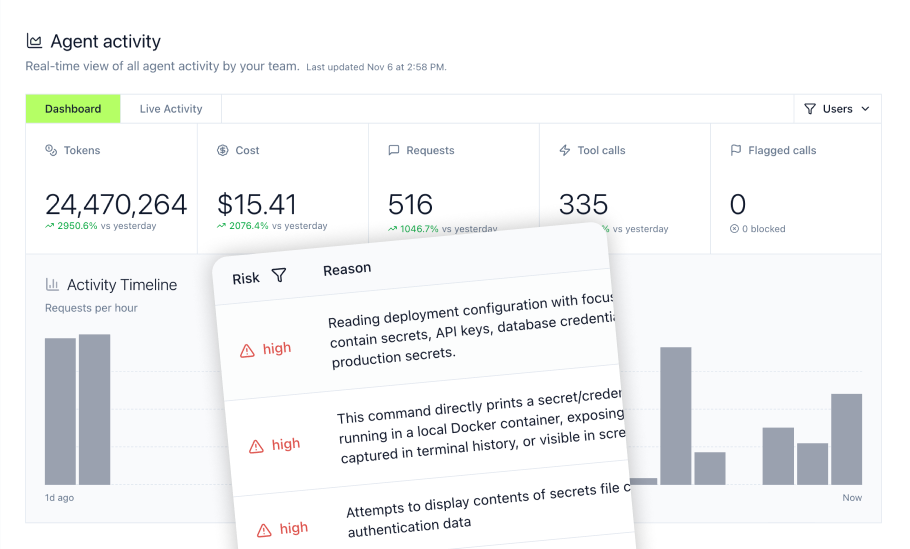
Visibility is the foundation of governance. Agent Monitor provides organizational visibility into supported AI-agent activity including prompts, file access, commands, MCP tool calls, usage, and token costs. This extends governance beyond gateway traffic to local agent activity across coding environments.
Ensuring AI compliance: Strategies and frameworks for enterprise AI
The shift from periodic audits to continuous compliance represents a fundamental change in how organizations demonstrate regulatory alignment. IAPP's 2025 AI Governance Profession Report found that 77% of surveyed organizations were working on AI governance, illustrating how broadly governance programs are now being developed.
Building a culture of AI compliance: Best practices for organizations
Compliance culture requires:
- Clear documentation: Model cards, dataset datasheets, system cards, and technical documentation
- Continuous monitoring: Real-time oversight rather than periodic reviews
- Human oversight modes: Human-in-the-loop, human-on-the-loop, or human-in-command depending on risk level
- Cross-functional coordination: Alignment across legal, compliance, security, and business teams
From policy to practice: Operationalizing AI compliance frameworks
MintMCP's configuration-as-code capabilities enable declarative management of gateway configuration and global rules, ensuring governance policies are versioned, reviewable, and consistently applied across the organization.
Identity and permissions: The foundation for governing autonomous agents
Autonomous agents introduce fundamentally different governance requirements than traditional AI systems. When agents can reason, plan, and act independently, the central governance question becomes "who did what."
Why autonomous agents need their own identities
Agents operating through human credentials or shared API keys collapse audit logs, over-privilege agent access, and break credential rotation. Non-human identity management requires treating agents as first-class principals with their own credentials, scoped permissions, and attributable audit trails.
Implementing secure identity management for your AI workforce
MintMCP's Agent Gateway provides each autonomous agent with:
- Its own identity as a named, org-scoped non-human principal
- Scoped MCP access through Virtual MCPs purpose-built for that agent
- Authentication via bearer keys, M2M tokens, or workload identity federation
- Independent credential rotation and revocation
- Attributable audit trails for governed agent activity
This approach ensures that agents operate with least-privilege access while maintaining complete auditability.
Unified governance: Managing AI clients and autonomous agents across platforms
Enterprises face a heterogeneous AI landscape where employees use Claude, Cursor, ChatGPT, Gemini, Copilot, and custom agents simultaneously. Without unified governance, each tool operates with separate permission models, logs, and security controls.
Addressing shadow AI: Bringing unmanaged AI clients under governance
Shadow AI represents governance's largest blind spot. Reports of a February 2025 OmniGPT breach alleged exposure of data associated with more than 30,000 users and over 34 million lines of chat history, including sensitive information such as API keys and credentials. The incident illustrates the risks of storing large volumes of AI conversation data and secrets without adequate controls.
Detection can combine approaches such as network analysis, endpoint or browser monitoring, identity and SaaS telemetry, and continuous discovery to identify unauthorized AI usage and risky data flows.
Scalable solutions for governing a diverse AI ecosystem
MintMCP provides vendor-neutral governance across supported AI clients and agent harnesses. Organizations can keep identity, permissions, audit, monitoring, and data-governance controls consistent across supported environments as their AI stacks evolve.
The future of AI governance: Building a system of record for your agent workforce
As Gartner predicts 40% of enterprise applications will include task-specific AI agents by end of 2026, organizations need a comprehensive system of record that answers:
- Which agents exist?
- Who owns or operates them?
- Which systems can they access?
- What credentials and permissions do they use?
- What actions have they taken?
- What memory do they retain?
- How can they be restricted or shut down?
Beyond compliance: Proactive governance for an evolving AI landscape
Governance must evolve from reactive compliance to proactive risk management. IBM expanded watsonx.governance's agentic capabilities during 2025: AI-agent governance objects and inventory support appeared by June, while runtime agent monitoring and additional tool-call hallucination guardrails became available in December.
Memory and persistence: Enabling governed autonomous work
MintMCP's Coworker Agents extend governance to persistent autonomous work. These long-running agents can operate through Slack, maintain company-owned memory, continue work across days, and use scoped tool access through Virtual MCPs. Memory is git-backed, versioned, and auditable rather than hidden inside opaque vendor systems.
For organizations evaluating AI agent governance, the key insight is that governance should begin with permissions and governed access to company systems, not with broad agent access that is restricted afterward.
MintMCP: Unified AI governance infrastructure for enterprise
MintMCP helps enterprises govern AI adoption across human-operated AI clients and autonomous agents without adding unnecessary friction to development and deployment workflows.
The platform addresses three core governance gaps:
- Agent identity and permissions: Agent Gateway gives autonomous agents scoped identities, credentials, permissions, and attributable audit trails.
- Governed tool access: MCP Gateway replaces scattered local configurations with centrally governed Virtual MCPs.
- Visibility and enforcement: Agent Monitor extends visibility beyond gateway traffic to supported local agent activity, while Guardrails enforce runtime policies across supported agent and tool interactions.
MintMCP supports environments using Claude, Cursor, ChatGPT, Gemini, Copilot, and autonomous agents, helping organizations apply consistent governance across supported systems. Coworker Agents extend this model to persistent autonomous work with scoped tools and company-owned, auditable memory.
Together, these capabilities provide centralized access control, monitoring, runtime enforcement, and auditability as enterprise AI adoption scales.
Frequently asked questions
How much should organizations budget for AI governance implementation?
AI governance budgets vary significantly based on organization size, regulatory exposure, AI portfolio complexity, and the maturity of existing risk and compliance controls. Organizations should budget across technology platforms, policy development, training, audit and assurance, and ongoing monitoring rather than treating governance as a one-time project. The key is balancing investment across people, process, and technology to build sustainable governance capabilities.
What distinguishes AI governance from traditional IT governance?
Traditional IT governance focuses on infrastructure availability, data integrity, and access controls for deterministic systems. AI governance must address probabilistic outputs, model drift, emergent behaviors, and the unique risks of systems that learn and adapt. AI governance also requires specialized expertise in machine learning operations, bias detection, and explainability that traditional IT governance frameworks were not designed to address.
How do organizations balance innovation velocity with governance requirements?
Well-designed governance can reduce rework and approval ambiguity when controls are embedded into development workflows rather than added after deployment. The key is embedding governance into development workflows through configuration-as-code approaches, automated policy enforcement, and pre-approved tool catalogs that enable teams to move quickly within defined guardrails. Governance becomes an accelerator rather than a brake when implemented as infrastructure.
What role do guardrails play in preventing dangerous AI actions?
Guardrails provide runtime controls that screen and control AI tool calls before they execute. Effective guardrail architectures operate at multiple layers: managed detection policies for known threat categories like prompt injection and credentials, declarative rules for organization-specific patterns, and programmable middleware for integration with external security systems. The key principle is that visibility alone is insufficient; organizations need the ability to block dangerous actions in real time.
How should organizations approach cross-border AI governance when regulations differ by jurisdiction?
Organizations operating globally may need to address overlapping obligations and frameworks, including EU AI Act conformity assessments where applicable, alignment with the voluntary NIST AI RMF, ISO/IEC 42001 certification, and sector-specific requirements. A practical approach is to identify the obligations that apply in each jurisdiction, build a common control baseline, and map those controls to each applicable framework. Organizations should engage legal counsel with multi-jurisdictional AI expertise.