Traditional REST APIs provide general-purpose interfaces for software-to-software communication, while AI applications introduce additional integration needs around tool discovery, model-readable schemas, and dynamic tool invocation. The Model Context Protocol (MCP) standardizes how AI applications connect to tools, resources, and external systems, while platforms like the MCP Gateway add centralized governance, credential handling, tool curation, access policies, and auditability for enterprise deployments.
This article explains the technical and business distinctions between MCP and APIs, why these differences matter for enterprise AI governance, and how to determine which approach fits your organization's AI deployment strategy.
Key takeaways
- MCP is an AI-native protocol designed for agent-to-system interactions, while REST APIs were built for general-purpose application integration with fundamentally different patterns
- MCP standardizes how AI applications discover and invoke tools, reducing the need for model-specific integration interfaces across Claude, Cursor, ChatGPT, Gemini, and Copilot
- Dynamic tool discovery allows MCP clients to retrieve available tools at runtime through
tools/listwithout hardcoding every integration - The protocol solves the "N×M problem" where N AI clients accessing M enterprise systems would otherwise require separate integration logic for many combinations
- Agent identity is a governance requirement for production AI: autonomous agents need first-class non-human principals with their own credentials, scoped permissions, and audit trails
- MintMCP's governance platform provides Virtual MCPs, centralized authentication, RBAC, credential brokering, and runtime guardrails that the MCP protocol itself does not define
Understanding APIs: the foundation of digital integration
Application Programming Interfaces have served as the standard mechanism for system-to-system communication for decades. REST APIs in particular dominate enterprise integration, providing predictable request-response patterns that developers understand well.
What is an API?
An API defines how software components interact. REST APIs use HTTP methods (GET, POST, PUT, DELETE) to perform operations on resources, returning data in standardized formats like JSON or XML. This approach works well when:
- Developers know exactly which endpoints they need to call
- Integration requirements are static and well-defined
- Each application-to-system connection can be built and maintained independently
- Human developers are available to read documentation, handle errors, and update integrations when APIs change
Key characteristics of REST APIs
REST APIs operate on several principles that made them the dominant integration pattern:
- Stateless operations: Each request contains all information needed to complete it, with no session memory between calls
- Interface discovery varies: REST does not define a standard tool-discovery mechanism, although HTTP APIs can publish machine-readable descriptions such as OpenAPI
- Authentication per-service: Each API commonly has its own authentication setup, credentials, scopes, and token lifecycle
- Application-specific integration logic: API calls are commonly encoded into application logic or generated from API specifications, although dynamic and schema-driven approaches are also possible
Common use cases for API integrations
Traditional API integrations serve human-facing applications effectively:
- Mobile apps calling backend services for user data
- Web applications fetching content from CMS platforms
- Business applications syncing data between CRM and ERP systems
- Scheduled jobs pulling reports from analytics platforms
The challenge emerges when AI agents need these same integrations. An agent must decide at runtime which tools to call, often across dozens of enterprise systems, without human developers available to write custom integration code for each combination.
Introducing the Model Context Protocol
MCP is an open standard that enables AI systems to securely connect with enterprise data sources, SaaS applications, and tools through a standardized framework. Unlike APIs designed for human developers building applications, MCP was purpose-built for AI agents that need to discover, authenticate with, and use tools dynamically.
What is the Model Context Protocol?
The Model Context Protocol provides a standardized interface between AI applications and MCP servers exposing tools, resources, and prompts. Each MCP-compatible client and server can implement the common protocol rather than requiring a proprietary interface for every pairing. MintMCP extends this model through Virtual MCPs, which can bundle approved connectors and curated tools behind one governed endpoint for a team, role, use case, or agent.
The protocol standardizes:
- Tool discovery: AI applications retrieve available tools through
tools/list - Authorization patterns: Remote MCP deployments can use OAuth-based authorization defined by the protocol
- Resources and tools: Servers expose standardized interfaces for data access and executable capabilities
- Execution: Standardized request-response patterns support tool invocation through
tools/call
How MCP addresses AI-specific integration challenges
Traditional point-to-point integrations can create an "N×M problem" when multiple AI clients need separate integration logic for multiple enterprise systems. MCP can reduce this duplication by giving clients and servers a common protocol surface: AI clients implement MCP support, while enterprise capabilities are exposed through MCP servers. Actual interoperability still depends on the protocol version, supported capabilities, authorization model, and server implementation.
MCP is primarily an interoperability standard rather than a performance optimization. Agent response time still depends on model latency, tool execution, network conditions, the number of tool calls, and gateway or server architecture.
The role of context in AI interactions
MCP does not maintain conversational context automatically. The 2026-07-28 MCP specification introduced a stateless protocol core with no protocol-level sessions. Conversation history and workflow state are typically maintained by the AI host, application, or agent. When an MCP server needs state across calls, it can expose an explicit state handle that the client passes back in later requests.
Key distinctions: MCP vs API in AI governance
The differences between MCP and traditional APIs extend beyond technical protocol details. They represent fundamentally different approaches to how AI systems interact with enterprise data and tools.
Beyond data exchange: context, identity, and control
Both REST architectures and the current MCP protocol can use stateless request patterns. The important governance difference comes from how an organization implements identity, authorization, tool access, and auditing around AI activity.
With a governed MCP platform:
- Identity can be attributed: Determine which user or autonomous agent initiated an action
- Permissions can be scoped: Limit which tools and data a specific user, role, or agent can access
- Tool activity can be audited: Record governed MCP calls for security investigations and compliance evidence
- Agent credentials can be separated: Give autonomous agents identities and credentials independent from human users
These controls can support an organization's security and compliance program, but MCP or an MCP gateway does not automatically make a deployment compliant with SOC 2, HIPAA, or another framework.
Orchestrating AI agent actions
API integrations typically follow predictable patterns coded by developers. AI agents are fundamentally different: they decide at runtime which tools to call based on their understanding of a task.
This creates governance challenges that APIs were never designed to address:
- Dynamic tool selection: Agents may discover available tools via
tools/listwithout hardcoding every tool into the client - Unpredictable sequences: The same prompt might result in different tool call sequences on different runs
- Context window risks: Tool descriptions themselves become potential injection surfaces
MCP gateways address these risks by providing a governed layer between AI clients and tools. Organizations can curate which tools each role or agent can access, rather than giving agents unrestricted access to everything.
The need for granular control
Traditional API gateways commonly provide authentication, authorization, rate limiting, validation, observability, transformation, and other traffic controls. MCP and agent governance layers can add controls expressed in AI-specific terms such as tools, agent identities, tool arguments, and model-facing responses:
- Tool-level allowlisting: Restrict which specific MCP tools an agent can invoke
- Argument validation: Screen parameters before they reach downstream systems
- Response filtering: Redact sensitive data before it enters the AI context
- Kill switches: Immediately revoke agent access when suspicious activity is detected
Organizations handling sensitive data need the ability to assess and mitigate MCP risks before connecting AI agents to enterprise systems.
Why MCP matters for enterprise AI
The shift from experimentation to production AI deployments creates governance requirements that traditional integration patterns may not address in AI-specific terms such as tool access, agent identity, and model-facing responses.
Solving the enterprise AI governance challenge
Exposure of sensitive company data is a top concern with AI adoption. This concern is justified: AI agents with broad API access can read, copy, and potentially exfiltrate any data they can reach. MCP gateways solve this by centralizing the governance layer:
- Centralized authentication: Users authenticate once through SSO; credentials are never stored on developer laptops
- Credential injection: MCP connectors receive credentials per-call rather than holding long-lived secrets
- Access policy enforcement: RBAC driven by directory groups determines which tools each user or agent can access
- Complete audit trails: Every tool call is logged with user, agent, tool, arguments, and timestamp
Empowering safe autonomous agent operation
Production AI agents may operate without constant human supervision, which increases the importance of infrastructure that gives agents their own identities, permissions, credentials, and audit attribution:
- Independent credentials: Each agent gets its own credential that can be rotated or revoked without affecting humans
- Scoped permissions: An agent for sales operations accesses different tools than an agent for engineering support
- Attributable actions: When reviewing logs, you can distinguish "Agent-SalesBot called Salesforce.updateLead" from "User-JohnDoe called Salesforce.updateLead"
Using a standard MCP interface can reduce duplicated integration work across AI clients and enterprise systems. Governance capabilities such as centralized access policies, agent identity, credential controls, and auditability depend on the gateway and platform implementation rather than MCP alone.
Governed access and permissions
A governed MCP platform can control which tools each user, role, or agent can access through governed endpoints.
Virtual MCPs: tailored access for teams
The Virtual MCP (VMCP) abstraction bundles approved connectors and a curated tool surface behind one governed endpoint. Rather than giving everyone access to all tools, organizations create purpose-built VMCPs:
- Sales Intelligence VMCP: Salesforce (read-write), Gong (read), Slack (channel-specific)
- Engineering Support VMCP: GitHub (read-write), PagerDuty (read), Datadog (read)
- Finance Analysis VMCP: QuickBooks (read), Snowflake (read), Stripe (read)
Each VMCP can be the unit of deployment, access control, tool curation, audit, and administration. Directory groups drive membership through SCIM, so organizations apply consistent access policies without requiring every employee to configure each MCP server separately.
Centralized authentication and credential brokering
Centralized authentication is a gateway capability rather than a property of MCP itself. MintMCP's authentication model centralizes identity and credential handling so developers do not need to manage individual API credentials on their laptops:
- Users can authenticate through existing SSO
- Supported hosted connectors can receive credentials at request time rather than storing user tokens in the connector process
- Credential models can include inline API keys, per-user OAuth, and per-user AWS SSO depending on the connector
- Stored credentials are encrypted at rest
This architecture means that if an employee's laptop is compromised, attackers do not gain access to API keys that could access enterprise systems indefinitely.
Role-based access control
Enterprise MCP deployments use RBAC driven by directory groups via SCIM. When HR updates a user's role in the identity provider, their MCP access changes automatically:
- Promoted to manager? Gain access to the Management VMCP
- Left the sales team? Lose access to the Sales Intelligence VMCP
- Account suspended? All MCP access revokes immediately
This integration eliminates the manual access management that creates security gaps in traditional API integrations.
First-class identity for autonomous agents
When autonomous agents operate independently, they need identities separate from the humans who created them. This is the core capability that distinguishes AI-ready infrastructure from retrofitted API management.
Why agents need their own identities
Consider what happens when an agent runs without proper identity:
- Credential sharing: The agent uses whichever developer's API key was available
- Audit collapse: Logs show "User-Developer123 called..." when it was actually the automated agent
- Over-privileging: The agent inherits all the developer's permissions, not just what it needs
- Rotation chaos: Rotating the developer's credentials breaks the agent; not rotating creates security debt
MintMCP's Agent Gateway treats autonomous agents as first-class non-human principals. Each agent can have its own identity, credentials, scoped MCP access, independent credential expiration, independent revocation, and an attributable audit trail.
Secure authentication methods
MintMCP's Agent Gateway supports multiple authentication approaches for autonomous agents:
- Bearer keys: Static key on every request; named, with expiry, individually revocable
- M2M tokens: OAuth client-credentials exchange for short-lived tokens; the secret stays out of the request path
- Workload identity federation: The agent's own infrastructure (Kubernetes service account, cloud role, CI job identity) mints short-lived OIDC tokens; the MCP gateway holds no secret at all
Each approach has tradeoffs between implementation complexity and security posture. Bearer keys are simplest but create long-lived credentials. Workload identity federation avoids storing a long-lived agent secret in the gateway but requires infrastructure that supports OIDC token exchange.
Independent credential management
Agent-owned credentials can be rotated or revoked independently:
- Security incident? Revoke the compromised agent's credential without affecting humans
- Agent decommissioned? Delete its identity; access ends immediately
- Compliance audit? Show exactly which credentials existed at any point and what each could access
This is fundamentally different from traditional API key management where shared credentials create accountability gaps.
Visibility and control with MCP guardrails
Visibility alone is not enough. Enterprises need runtime controls that determine whether an action should be allowed before it executes.
Monitoring agent activity
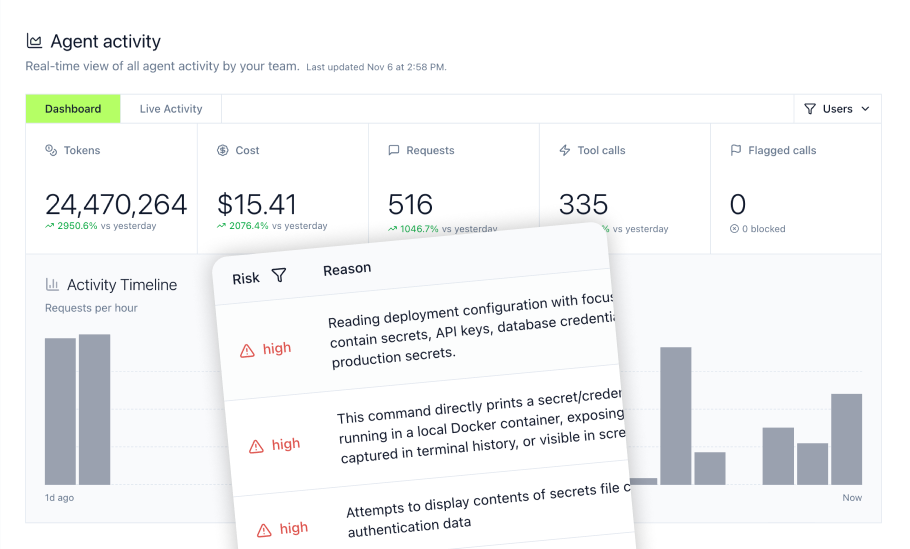
Agent Monitor provides visibility into supported activity from coding agents and related agent environments, including:
- File access, including sensitive paths such as
.envfiles and SSH keys - Commands and shell activity
- MCP tool calls
- Prompt submissions
- Usage and token costs
This visibility can extend beyond traffic routed through MintMCP's MCP Gateway. Coverage varies by client, agent, and hook phase, so Agent Monitor should not be described as capturing every action from every agent.
Proactive guardrails
MintMCP's guardrail architecture provides three complementary layers:
Mint Guard
- Managed detection policies for prompt injection, secrets, PII, and harmful content
- Off / Monitoring / Enforcing modes
- Supports monitoring and enforcement modes, with high-confidence prompt-injection detections blocked in enforcing mode
Rules
- Declarative matching on tool names, argument patterns, or content via regex
- Actions: flag, block, ask-user, mask, or notify
- Custom rules for organization-specific requirements
Gateway Middleware
- Customer-authored JavaScript logic running in a sandbox
- Transform, redact, or rewrite content
- Call external classifiers or DLP systems
- Enforce resource allowlists based on business logic
The NSA security guidance identifies manipulated tool metadata, hidden instructions, prompt injection, and poisoned downstream outputs as security risks that require careful validation and least-privilege controls.
Customizable security logic
Organizations with existing DLP or classifier investments can integrate them at the MCP layer. Gateway middleware supports:
- Integration with AWS Bedrock Guardrails
- Google Cloud Model Armor classification
- OpenAI moderation endpoints
- Custom enterprise classifiers and policy engines
This keeps security policy in the tools that security teams already manage, rather than creating a parallel governance system.
Implementation: choosing between MCP and traditional APIs
The decision between MCP and traditional API integrations depends on your use case, scale, and governance requirements.
When to choose MCP
MCP is the right choice when:
- AI agents need access to multiple enterprise systems through a standardized tool interface
- You require enterprise governance (audit trails, RBAC, compliance support)
- You want multi-provider flexibility across Claude, ChatGPT, Gemini, Cursor, and Copilot
- You're building production AI agents that need runtime tool discovery
- You need scalability without exponential integration complexity
When to choose traditional APIs
Traditional REST APIs remain appropriate when:
- You're building human-facing applications rather than AI agents
- You need simple point-to-point integrations between a small, fixed set of systems
- Your use case is non-AI or requires complete control over every API call
- You have existing API infrastructure that does not need AI access
Migration considerations
Organizations with existing API integrations can adopt MCP incrementally:
- Pilot: Deploy an MCP gateway with a limited set of managed connectors alongside existing APIs
- Validation: Test that AI agents can access systems through MCP with the required governance controls
- Expansion: Add connectors and users as teams adopt MCP-enabled AI clients
- Optimization: Retire redundant custom integrations where MCP provides equivalent required functionality
MCP runs alongside existing APIs rather than requiring a cutover. Each system can be connected to MCP independently, allowing gradual migration with minimal risk.
MintMCP: production-ready MCP governance
While the Model Context Protocol standardizes how AI applications connect to tools and resources, production enterprise deployments require additional governance, security, and operational capabilities that the protocol itself does not define.
MintMCP provides the infrastructure layer that makes MCP practical for enterprise AI:
Centralized Governance
- Virtual MCPs bundle approved connectors into curated tool surfaces for specific teams, roles, or use cases
- SCIM-driven RBAC automatically synchronizes MCP access with directory group membership
- Centralized authentication eliminates credential sprawl on developer laptops
Agent Identity and Security
- First-class agent identities enable autonomous agents to authenticate independently from humans
- Per-agent credential rotation and revocation without affecting user access
- Complete audit trails attributing every tool call to the specific user or agent that initiated it
Runtime Protection
- Agent Monitor provides visibility into file access, commands, MCP tool calls, and prompt submissions
- Mint Guard screens traffic for prompt injection, secrets, PII, and harmful content with monitoring and enforcement modes
- Gateway middleware enables custom validation, DLP integration, and organization-specific policy enforcement
Organizations deploying production AI agents need more than a protocol; they need a governance platform that makes AI safe, auditable, and scalable. MintMCP transforms MCP from an interoperability standard into an enterprise-ready foundation for governed AI deployment.
Frequently asked questions
Can MCP completely replace my existing REST APIs?
No, and that is not the goal. MCP and REST APIs serve different purposes. REST APIs remain the right choice for human-facing applications, mobile backends, and system-to-system integrations that do not involve AI agents. MCP specifically addresses AI-to-system connectivity where dynamic tool discovery and agent governance are requirements. Most organizations will operate both REST APIs for traditional applications and MCP for AI agent integrations.
How does MCP handle rate limiting and throttling compared to API gateways?
MCP gateways can enforce rate limiting, but the controls differ from traditional API gateways. Instead of simply limiting requests per second, MCP governance focuses on controlling which tools agents can access, validating the arguments they pass, and screening the responses they receive. This is more granular than traditional rate limiting because the risk is not just volume but what agents might do with unrestricted access.
What happens if an MCP server goes down?
MCP server availability depends on the server and gateway deployment architecture. MCP itself does not prescribe automatic restarts or replica failover. The 2026-07-28 specification uses a stateless protocol core, allowing remote MCP servers to run behind ordinary load balancers without protocol-level session affinity. It also supports cacheable results for operations including tools/list, resources/list, and resources/read through explicit TTL and cache-scope metadata.
How do I evaluate whether my organization is ready for MCP adoption?
Organizations ready for MCP typically have multiple AI clients or agents in use or planned, enterprise systems that AI needs to access, security or compliance requirements for AI usage, and IT capacity to configure SSO integration and access policies. If you are still experimenting with a single AI tool accessing one or two systems, traditional API integrations may be sufficient. Once you need to govern AI access across multiple tools and systems, MCP becomes the more scalable approach.
How does MCP address tool-description security risks?
MCP gateways can reduce this risk through tool curation, runtime prompt-injection detection, input and output validation, and custom gateway policy. MintMCP uses approved tool surfaces through Virtual MCPs, while Mint Guard screens supported runtime traffic for prompt injection and Gateway Middleware can apply customer-authored validation or DLP logic. The NSA security guidance identifies manipulated tool metadata, hidden instructions, prompt injection, and poisoned downstream outputs as security risks that require careful validation and least-privilege controls.