When evaluating Arcade.dev alternatives for enterprise AI governance, the choice depends on how organizations prioritize data permissions, agent identity management, and deployment flexibility. While Arcade.dev offers a capable action runtime with permission intersection capabilities, many enterprises seek platforms with stronger healthcare compliance, centralized connector management, or data-permissions-first architecture.
This guide examines five Arcade.dev alternatives for internal AI governance, with particular emphasis on how MintMCP approaches governed data access, agent identity, monitoring, and runtime controls. As organizations deploy Claude, Cursor, ChatGPT, Gemini, and Copilot faster than security teams can govern them, enterprise MCP gateways become critical infrastructure for 2026.
Key takeaways
- MintMCP takes a data-permissions-first approach to enterprise AI governance, combining Virtual MCPs, first-class agent identities, Agent Monitor, and runtime guardrails
- Enterprise MCP gateways govern dynamic tool discovery and invocation where AI agents decide which tools to call at runtime, creating security challenges traditional API gateways cannot address
- HIPAA support varies by platform: MintMCP is compliant with HIPAA standards and signs BAAs, Composio offers BAAs for eligible Pro and Enterprise Developer customers, and TrueFoundry advertises HIPAA-ready deployments
- MintMCP's Virtual MCP abstraction enables organizations to create governed endpoints for roles, teams, use cases, or agents with curated tools, access policies, and SCIM-driven membership
- Agent identities prevent audit collapse by giving each autonomous agent its own credentials that can be rotated or revoked individually without affecting other agents or human users
- One-click deployment for hosted connectors eliminates infrastructure setup while maintaining governance, accelerating time to production
Understanding Arcade.dev: A capable action runtime
Arcade.dev positions itself as an agent identity and tool-calling runtime that focuses on permission intersection enforcement. The platform treats authorization as a runtime calculation where agent permissions intersect with user permissions, creating a dynamic security model for each tool call.
Key Arcade.dev strengths
- Permission intersection model that calculates agent and user permissions at runtime
- 8,000+ intent-level tools optimized for token efficiency
- Complete action runtime with hosted execution environment
- Free tier with 2,000 tool calls per month for prototyping
- Air-gapped and VPC deployment flexibility
- SOC 2 Type II attestation
Tradeoffs to consider
- Arcade.dev is designed as an action runtime that combines authorization, tool execution, governance, and credential handling rather than focusing only on MCP gateway functionality
- Its authorization model centers on evaluating agent and user permissions together at execution time, which differs from MintMCP's data-permissions-first architecture
- Arcade.dev does not use MintMCP's Virtual MCP abstraction for SCIM-driven, per-use-case governed endpoints
- Organizations comparing healthcare deployments should verify current HIPAA and BAA terms directly with Arcade.dev rather than assuming availability from its SOC 2 Type 2 status
Arcade.dev's pricing starts at $0 with a free tier offering 2,000 authentication events and 2,000 tool calls monthly. The platform charges $25 per month as a base fee plus $0.10 per authentication event and $0.01 per tool call, with enterprise tiers available for SSO, RBAC, and dedicated support.
1. MintMCP: Data-permissions-first enterprise AI governance
MintMCP provides enterprise infrastructure for governing AI clients and autonomous agents across the Model Context Protocol ecosystem. MintMCP starts from governed data access through its MCP Gateway, then extends that foundation to autonomous agents through its Agent Gateway.
Key MintMCP advantages
- Data-permissions-first architecture that governs access before granting agent capabilities
- Virtual MCPs bundle approved connectors behind one governed endpoint per role, team, or agent
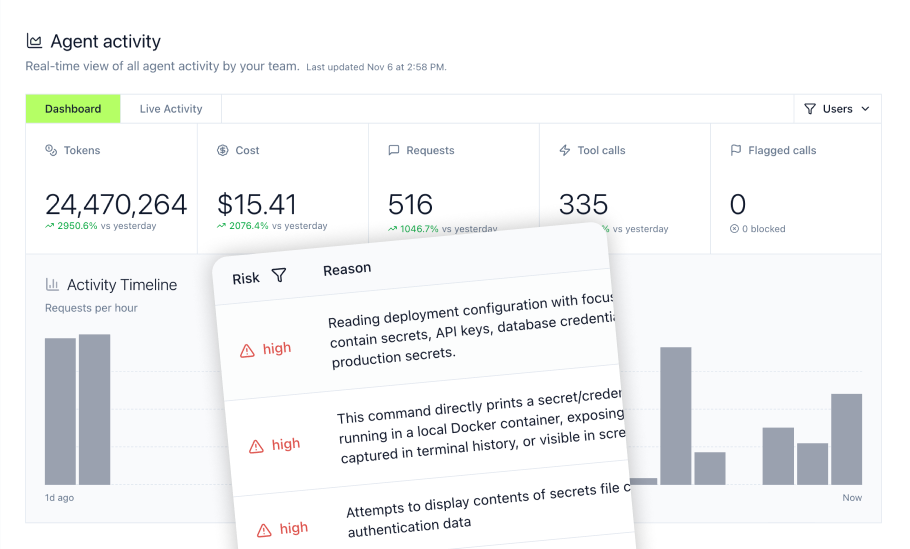
- Agent Monitor provides visibility into supported coding-agent activity, including file access, commands, and tool calls, with coverage varying by client and hook phase
- Compliant with HIPAA standards, with BAAs available for customers handling protected health information
- One-click deployment for hosted connectors without infrastructure setup
- SCIM provisioning for directory-driven access control
- SOC 2 Type II audited with continuous compliance monitoring
MCP Gateway capabilities
MintMCP's MCP Gateway serves as the single governed entrypoint between AI clients and enterprise tools. The key abstraction is the Virtual MCP, which bundles multiple connectors behind one endpoint with:
- Centralized authentication through SSO
- Credential injection without long-lived secrets on developer laptops
- Tool curation that reduces context-window bloat
- RBAC driven by directory groups via SCIM
- Complete audit logging of every tool call
Agent Gateway features
MintMCP's Agent Gateway builds on the MCP Gateway foundation by treating autonomous agents as first-class non-human principals. Each agent receives:
- Its own identity separate from human credentials
- Scoped MCP access through dedicated Virtual MCPs
- Independent credential rotation and revocation
- Authentication via bearer keys, M2M tokens, or workload identity federation
- Attributable audit trails for compliance
Guardrails and runtime controls
MintMCP provides three complementary layers of runtime security:
- Mint Guard: Managed detection for prompt injection, secrets, PII, and harmful content
- Rules: Declarative matching on tool names, arguments, and content
- Gateway Middleware: Customer-authored JavaScript for DLP integration and custom policy enforcement
Pricing structure
MintMCP uses customized pricing based on team size and deployment requirements. Current pricing includes per-user licensing based on active AI agent users, with platform fees that scale with usage and team size. Enterprise SLAs, dedicated support, and flexible deployment options are available.
Unique differentiators
MintMCP offers several capabilities that differentiate its approach:
- Virtual MCP abstraction for pre-packaged, role-based tool access with SCIM-driven membership
- Agent Monitor for workstation-level visibility beyond gateway traffic
- Hosted connectors managed by MintMCP for Snowflake, GitHub, Salesforce, and other enterprise systems
- Coworker Agents for persistent autonomous workflows with company-owned memory
2. TrueFoundry
TrueFoundry offers a unified LLM and MCP control plane with managed SaaS and private deployment options.
Key TrueFoundry strengths
- Kubernetes-native architecture optimized for K8s-first organizations
- SOC 2 attestation and advertises HIPAA-ready deployments
- Virtual MCP server support for role-based tool access
- Air-gapped deployment through forward proxy configuration
- Unified control plane for both LLM routing and MCP governance
Tradeoffs to consider
- Offers both managed SaaS and private deployment options, including VPC/on-prem and air-gapped configurations
- Does not implement Arcade.dev's permission intersection model
TrueFoundry's Pro tier starts at $25 per user per month, with Enterprise pricing available on a custom basis for advanced security, private deployment, and SLA requirements. The platform serves platform engineering teams in organizations with mature Kubernetes infrastructure who need unified LLM and MCP governance.
3. Composio
Composio focuses on SaaS integration breadth with a large managed integrations catalog and usage-based pricing. The platform targets AI engineering teams building agentic applications.
Key Composio strengths
- 1,500+ apps available through its current MCP Gateway and toolkit ecosystem
- Usage-based pricing with 100,000 tool calls included on the free tier
- Support for managed tools alongside custom and internal MCP servers
- AES-256 credential vaulting for security
- SOC 2 and ISO 27001 attestations
Tradeoffs to consider
- Composio now offers a BAA to eligible Pro and Enterprise Developer customers
- Its access-control model differs from Arcade.dev's agent-and-user permission intersection model
- Custom MCP support is currently available for bringing customer-owned remote MCP servers into Composio's governed tool layer
- VPC and on-prem deployment only on enterprise tier
Pricing
- Free: 100,000 tool calls per month
- Pro: $29 per month with $29 in monthly usage credit
- Additional tool calls: $0.0003 per call after included usage
- Enterprise: Custom pricing with additional security and deployment options
Composio serves AI engineering teams building customer-facing products who need broad SaaS integration coverage.
4. Obot
Obot provides an open-source MCP gateway for organizations that prefer self-hosted deployments with infrastructure control. The platform targets Kubernetes-fluent teams comfortable managing their own gateway infrastructure.
Key Obot strengths
- MIT-licensed open-source codebase with self-hosted deployment available
- Full self-hosted deployment control
- Docker for development, Kubernetes for production
- Community-driven development model
- No vendor lock-in concerns
Deployment considerations
- Obot supports both self-hosted deployments and the fully managed Obot Cloud offering
- Self-hosted deployments give infrastructure teams direct control over the runtime and operational environment
- Obot Enterprise adds enterprise support and additional identity capabilities
- Teams should evaluate its current connector catalog, compliance requirements, and hosting model against their own governance needs
Pricing
Obot Community is free and open source for self-hosting. Obot also offers a hosted Obot Cloud product and an Enterprise edition; current paid pricing is not publicly listed on its main product pages. The platform serves platform engineering teams with Kubernetes expertise who prioritize infrastructure control.
5. Portkey
Portkey combines LLM gateway capabilities with MCP support, targeting teams who need both model routing and tool governance in a unified platform. The platform offers hybrid deployment options.
Key Portkey strengths
- Unified LLM gateway and MCP support
- Open-source AI Gateway option available
- Hybrid deployment including EKS, AKS, GKE, and AWS Marketplace
- Air-gapped deployment for enterprise requirements
- Strong focus on LLM observability
Tradeoffs to consider
- Portkey spans LLM Gateway, MCP Gateway, and Agent Gateway capabilities rather than focusing exclusively on internal MCP governance
- Its access-control model differs from MintMCP's Virtual MCP abstraction with SCIM-driven, per-use-case endpoints
- Public Portkey materials emphasize gateway-level observability and agent execution tracing, while MintMCP also positions Agent Monitor around supported local coding-agent activity
Portkey offers tiered pricing with developer, team, and enterprise options. Self-hosted and hybrid deployments available on enterprise tier. The platform serves teams who need LLM routing as their primary capability and want MCP support integrated.
Implementation considerations
Time to production
MintMCP's one-click deployment for hosted connectors enables production rollout in minutes rather than weeks. Teams can connect Claude Code, Cursor, and ChatGPT to enterprise tools through a single governed endpoint without configuring each MCP server locally.
Security architecture
MintMCP's security model starts from data permissions. Credentials never reside on developer laptops. The gateway injects credentials per call, encrypts them at rest with rotated AES keys, and logs every access. Tamper-evident access history is signed at write time and verifiable offline.
Compliance requirements
For regulated industries, MintMCP provides SOC 2 Type II audited infrastructure with HIPAA-aligned controls. The platform signs Business Associate Agreements for organizations handling protected health information. SIEM export via OTLP or Splunk HEC enables integration with existing security tooling.
Multi-client governance
Organizations running mixed AI environments benefit from MintMCP's client-agnostic approach. The same Virtual MCPs, access policies, and audit trails apply whether teams use Claude, Cursor, ChatGPT, Gemini, or Copilot. This prevents governance fragmentation across AI tools.
Why MintMCP for enterprise AI governance
MintMCP is differentiated by its data-permissions-first architecture, which governs access before granting agent capabilities. This approach addresses core enterprise requirements:
- Governed data access: Virtual MCPs bundle approved connectors behind governed endpoints, eliminating credential sprawl and providing single audit trails per use case
- Agent identity management: The Agent Gateway treats autonomous agents as first-class principals with independent credentials, preventing audit collapse
- Comprehensive monitoring: Agent Monitor provides visibility beyond gateway traffic into what coding agents do on workstations
- Healthcare compliance: MintMCP is compliant with HIPAA standards and signs BAAs for organizations handling protected health information
- Runtime security: Three complementary guardrail layers enable managed detection, declarative rules, and custom policy enforcement
- Operational efficiency: Hosted connectors managed by MintMCP eliminate infrastructure overhead while maintaining governance
Organizations deploying Claude, Cursor, ChatGPT, Gemini, and Copilot need governance that works across all their AI tools. MintMCP's vendor-neutral approach ensures consistent security architecture regardless of which models or clients teams adopt. The platform's proven approach to agent identity, runtime guardrails, and enterprise security supports successful AI deployments at scale while maintaining compliance and audit requirements.
Start with a product tour to see how MintMCP's MCP Gateway and Agent Gateway work together to make AI agents deployable, governed, measurable, and swappable.
Frequently asked questions
What is the primary difference between an MCP Gateway and a traditional API Gateway?
Traditional API gateways govern request/response traffic for predefined endpoints. MCP gateways govern dynamic tool discovery and invocation where AI agents decide which tools to call at runtime. The list_tools capability means tools can appear, change, or disappear dynamically, creating security challenges that traditional API gateways were not designed to address. MintMCP's MCP Gateway provides governance specifically for this AI-native protocol.
What types of activities can Agent Monitor track?
Agent Monitor captures file reads including .env files and SSH keys, commands like bash and git operations, MCP tool calls, and prompt submissions. Coverage varies by supported client and hook phase. The platform can track activity from Claude Code, Cursor, Codex, and GitHub Copilot, providing visibility beyond gateway traffic into what coding agents do on developer workstations.
How do MintMCP's guardrails work together?
MintMCP provides three complementary guardrail layers. Mint Guard offers managed detection for prompt injection, secrets, PII, and harmful content with monitoring or enforcement modes. Rules provide declarative matching on tool names and arguments with actions like flag, block, or mask. Gateway Middleware enables customer-authored JavaScript for DLP integration and custom policy enforcement.
Can Coworker Agents operate continuously across workdays?
Yes. MintMCP's Coworker Agents are persistent autonomous agents that can work through Slack, run on schedules, or respond to manual triggers. They maintain company-owned memory through git-backed storage, continue work across days, and operate with scoped tool access through Virtual MCPs. The agent's instructions, memory, and audit history are reviewable files rather than hidden state.
How does governance address AI risk management?
Enterprise AI governance platforms help organizations implement AI risk management frameworks by providing visibility, control, and accountability for AI agent actions. MintMCP's approach combines access control through Virtual MCPs, identity management through the Agent Gateway, activity monitoring through Agent Monitor, and runtime security through guardrails to address key risks identified in AI governance frameworks.