Autonomous AI agents are transforming enterprise security operations, yet 82% of organizations have deployed AI agentic tools, while only 44% have comprehensive security policies in place—creating a dangerous 38-point gap between adoption and protection. Among organizations that experienced AI agent breaches, 40% estimate financial losses between $1 million and $10 million. The MCP Gateway provides enterprise-grade infrastructure to deploy AI agents with built-in security controls, transforming STDIO-based local servers and other remote servers into production-ready services with OAuth protection, real-time monitoring, and complete audit trails for SOC2 compliance.
This article outlines actionable strategies for deploying cybersecurity AI agents securely, covering threat detection capabilities, workflow automation, governance frameworks, compliance requirements, and ongoing monitoring to ensure safe AI adoption at scale.
Key takeaways
- Organizations with formal AI strategies *report* materially higher success rates than those without structured approaches
- Using AI and automation extensively in security lowers average breach costs by about $1.9M (and shortens breach lifecycle by ~80 days) compared to organizations that don’t use security AI and automation extensively
- 63% of organizations lack policies to prevent shadow AI proliferation, creating unmonitored security exposure
- Real-time monitoring and centralized policy enforcement can materially speed incident response—some reports cite ~40% faster incident response—while also reducing compliance audit findings by up to ~85%.
- MCP (Model Context Protocol) backed by Anthropic, OpenAI, Google, and Microsoft provides standardized infrastructure for secure agent deployment
Understanding cybersecurity AI agents: The new frontier of threat detection
Cybersecurity AI agents represent autonomous software systems that monitor network traffic, analyze security events, detect anomalies, and respond to threats without continuous human oversight. Unlike traditional security tools requiring manual configuration and rule-based detection, these agents use machine learning models to identify patterns indicating potential breaches, phishing attempts, or unauthorized access.
Modern AI agents operate across coding environments like Claude Code and Cursor, customer service platforms, and data analysis tools—accessing sensitive information ranging from production credentials to customer databases. 71% of organizations now regularly use generative AI, yet only 18% have enterprise-wide governance councils to oversee deployment.
Core threat detection capabilities include:
- Behavioral anomaly detection: Identifying unusual access patterns, such as agents requesting files outside normal operational scope or executing commands at irregular intervals
- Real-time policy enforcement: Blocking dangerous operations like reading .env files containing production credentials, executing database DROP commands, or accessing SSH keys
- Predictive analysis: Using historical data to forecast potential attack vectors before exploitation occurs
- Incident response automation: Triggering immediate containment actions when threat thresholds are exceeded
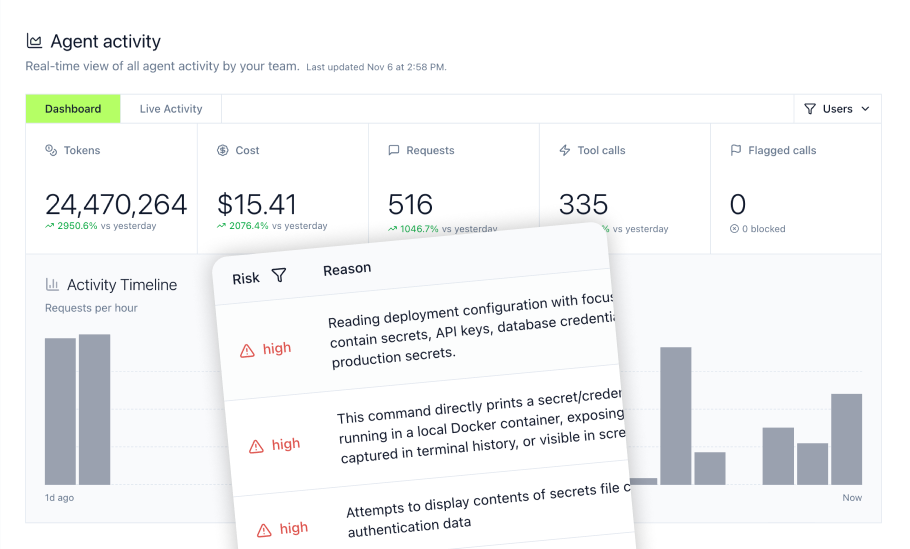
Comprehensive monitoring enables security teams to track every MCP tool invocation, bash command, and file operation. This visibility allows teams to see which MCPs are installed, monitor file access patterns, and block risky operations like reading environment secrets before damage occurs.
Security challenges unique to AI agents:
Organizations face distinct risks when deploying autonomous agents with broad system access. The "lethal trifecta" combines private data access, external communication capabilities, and processing of untrusted content—creating attack vectors where compromised agents can exfiltrate sensitive information or execute malicious commands.
Traditional security controls often fail because agents operate with legitimate credentials, making malicious activity indistinguishable from normal operations. Without real-time behavioral monitoring, security teams cannot detect when coding agents access production databases instead of development environments, or when customer service bots expose personally identifiable information through improperly scoped API calls.
Automated workflows: Revolutionizing security operations with AI
Automated security workflows eliminate manual intervention for routine tasks while maintaining human oversight for critical decisions. AI agents handle alert triage, log analysis, vulnerability scanning, and initial incident response—freeing security analysts to focus on complex threat investigations and strategic planning.
Key automation benefits:
- Alert triage and prioritization: AI agents analyze thousands of security alerts daily, correlating events across systems to identify genuine threats versus false positives, reducing alert fatigue
- Automated remediation: When agents detect known threat patterns—such as outdated software versions or misconfigured access controls—they execute predefined playbooks to patch vulnerabilities, revoke compromised credentials, or isolate affected systems
- Compliance reporting: Agents continuously monitor system configurations against regulatory requirements, generating audit trails and flagging deviations before compliance deadlines
Security operations centers using AI automation report 60-80% processing time reductions and 70-80% error rate decreases compared to manual workflows. Customer service AI specifically delivers 12x cost efficiency at $0.50 per interaction versus $6.00 for human agents.
Production-grade deployment requirements:
Transforming local STDIO-based MCP servers into enterprise-ready services requires addressing authentication, monitoring, and hosting challenges. The MCP Gateway enables one-click deployment that automatically adds OAuth protection, provides built-in hosting for both STDIO-based and other remote containerized servers, and implements enterprise-grade monitoring—eliminating the months-long manual setup typically required for production deployment.
Organizations leveraging centralized gateways reduce deployment time from weeks to days while maintaining unified policy enforcement across all connected agents.
Building secure automated workflows: Key considerations for enterprise AI
Implementing secure AI agent workflows requires balancing operational efficiency with robust security controls. Organizations must address authentication mechanisms, data access policies, audit requirements, and governance frameworks before granting agents access to sensitive systems.
Authentication and access control
Enterprise-grade AI agent security begins with workload identity management. Rather than sharing service account credentials across multiple agents, each agent instance should receive unique, short-lived tokens that automatically rotate.
Key practices:
- Use OAuth 2.0 and SAML with existing identity providers (Okta, Azure AD, Google Workspace) so agents authenticate through enterprise SSO
- Keep access policies consistent across human users and automated systems
- Prefer unique agent identity + short-lived, rotating tokens over shared service accounts
The MCP Gateway automatically wraps local MCP servers with OAuth protection, transforming servers previously accessible only on developer workstations into production services integrated with enterprise authentication.
Granular tool access control
Not all agents require identical permissions.
Examples:
- Finance team agents analyzing Snowflake data warehouses should have read-only access to specific schemas, not broad database administration rights
- Customer support agents drafting Gmail responses should access email tools, but not calendar management or document deletion capabilities
RBAC supports this by enabling organizations to configure tool availability by team function:
- Development teams access only project directories
- Support teams interact with CRM data
- Finance teams query data warehouses with pre-approved operations
Compliance and audit trail requirements
Regulated industries face stringent documentation requirements for any system accessing protected data.
Common requirements:
- Healthcare organizations need complete audit logs showing who accessed patient information, when, and for what purpose
- Financial services firms need evidence demonstrating proper segregation of duties and access controls
Audit observability capabilities should provide immutable logs of every AI agent interaction, including:
- Tool calls
- Data accessed
- Policy decisions
- Response metadata
These logs can export to compliance platforms or immutable storage with multi-year retention for regulatory requirements, according to NIST AI Risk Management Framework standards.
Organizations report 30% reduction in audit preparation time when using automated compliance logging versus manual evidence collection.
Deploying enterprise AI agents securely: Bridging the gap between innovation and compliance
The pace of AI innovation often conflicts with enterprise security and compliance timelines. 90% of organizations lack maturity to counter AI-specific threats, creating pressure to balance speed with safety.
Phased deployment approach:
Organizations achieve fastest time-to-value by implementing AI agent governance in stages:
- Discovery phase: Inventory all existing AI agents including shadow AI deployments through automated network scanning and developer environment analysis
- Audit-only monitoring: Deploy governance platforms in observation mode, logging all agent activity and establishing behavioral baselines without blocking workflows
- Gradual policy enforcement: Enable active blocking for highest-risk violations first, then expand enforcement incrementally based on violation frequency
- Continuous improvement: Review policy effectiveness quarterly as AI models update and use cases evolve
Certification and compliance requirements:
Organizations in regulated industries require specific certifications before deploying AI agents with access to protected data. MintMCP maintains SOC2 Type II certification, providing customers with pre-audited infrastructure meeting Trust Service Criteria for security, availability, and confidentiality.
Speed-to-deployment advantages:
Modern AI agent governance platforms reduce traditional deployment timelines dramatically through platform deployment in days, one-click STDIO server conversion eliminating manual containerization, pre-configured policy templates based on industry standards, and automated integration with existing identity providers. Organizations can achieve initial protection within 30 days of project kickoff.
Empowering teams with secure AI agents: From HR to finance
Different departments require AI agents tailored to specific workflows while maintaining consistent security governance. The key is scoping data access and tool availability to each team's legitimate needs.
HR teams: Knowledge base automation
The Elasticsearch MCP Server enables AI-powered semantic search across company knowledge bases. HR teams deploy AI agents that answer employee questions by querying indexed documentation, retrieving contextually relevant policy sections, and providing instant responses—with access limited to public-facing documentation and approved policy content.
Support teams: Ticket intelligence and email automation
The Gmail MCP Server enables AI assistants to search email threads, draft customer responses within organizational guidelines, and send communications through controlled workflows. Support managers maintain oversight through approval gates for sensitive communications while automating routine acknowledgments.
Finance teams: Data warehouse analysis
The Snowflake MCP Server provides AI agents with tools for natural language to SQL conversion through Cortex Analyst, semantic search against configured datasets, and pre-built query templates. Finance analysts generate revenue reports and analyze budget variances without writing complex SQL queries, with security configurations implementing semantic views limiting agent access to pre-approved dimensions.
Real-Time monitoring and control for cybersecurity AI agent workflows
Continuous visibility into AI agent behavior separates secure deployments from security incidents waiting to happen. Organizations need real-time monitoring capabilities that track tool usage, detect anomalies, enforce policies, and provide forensic evidence when investigating potential breaches.
Comprehensive observability framework:
Effective AI agent monitoring requires capturing metrics (request volume, response latency, error rates, cost per interaction), logs (detailed records of every agent interaction including tool calls and data accessed), and traces (end-to-end request flows showing how agent queries propagate through multiple systems).
Usage analytics and cost attribution:
Organizations lack visibility into which teams and projects drive AI costs. Cost analytics dashboards should provide team attribution, budget alerts, waste identification, and ROI measurement correlating agent costs with business outcomes like reduced support tickets and faster incident response.
Behavioral anomaly detection:
Behavioral analytics establish baselines for normal agent activity, then flag deviations indicating potential compromise such as access pattern changes, volume anomalies suggesting data exfiltration attempts, tool usage shifts, and failed authentication spikes. Machine learning models trained on historical agent behavior reduce false positives over time as baselines mature and policies are tuned (exact rates vary by environment and enforcement level).
Integration with security operations:
AI agent security should integrate with broader security infrastructure by exporting alerts to SIEM platforms for correlation with other security events, triggering SOAR playbooks for automated response, and integrating with ticketing systems to create incidents requiring security team investigation.
Mitigating shadow AI: Turning unsanctioned tools into secure, governed assets
Shadow AI—unsanctioned AI tools deployed without IT oversight—creates security blind spots where organizations cannot monitor data access, enforce policies, or maintain audit trails. The problem grows as employees adopt coding assistants, chatbots, and productivity tools without formal approval.
Discovery-first approach:
Rather than preventing shadow AI deployment, organizations should focus on comprehensive discovery through automated network scanning, self-service reporting channels for employees to voluntarily register AI tools, and quarterly usage surveys. Organizations with formal discovery programs identify 3-5x more unsanctioned tools than those relying solely on security team intuition.
Integration strategy:
Once shadow AI tools are identified, centralized governance platforms enable organizations to connect previously unsanctioned agents to unified authentication, audit logging, and policy enforcement—transforming shadow AI into managed AI assets while maintaining productivity gains.
Preventing future shadow deployments:
Long-term shadow AI prevention requires providing sanctioned alternatives, streamlining approval processes reducing AI tool approval time from weeks to days, and conducting regular needs assessments to survey employees quarterly about AI capabilities they need.
The future of cybersecurity: Integrating AI agents with enterprise IT infrastructure
AI agents operate most effectively when integrated with enterprise data sources, authentication systems, and business applications rather than functioning as isolated tools.
Model context protocol as integration standard:
MCP provides standardized interfaces for connecting AI clients to enterprise data and tools. Backed by Anthropic, OpenAI, Google, and Microsoft, the protocol ensures interoperability across vendors—preventing lock-in to proprietary integration formats and enabling organizations to switch AI providers, connect multiple clients, and leverage 100+ community-developed MCP servers.
The MCP Gateway provides production-ready hosting for STDIO-based MCP servers and other deployable servers, transforming local developer tools into enterprise services accessible across organizations.
Integration ecosystem:
MCP connector ecosystem provides integrations for databases (PostgreSQL, MySQL, MongoDB, Snowflake, BigQuery), productivity tools (Gmail, Google Calendar, Outlook, Notion), development platforms (GitHub, GitLab, Jira, Linear), and enterprise search (Elasticsearch). Organizations can deploy enterprise AI agents accessing approved data sources within days.
Frequently asked questions
What is the difference between AI agent monitoring and traditional application monitoring?
Traditional application monitoring tracks system performance metrics like CPU usage and request latency. AI agent monitoring adds behavioral analysis, examining what data agents access, which tools they invoke, and whether their actions match expected patterns. This behavioral layer is critical because AI agents operate with legitimate credentials—making malicious activity indistinguishable from normal operations without analyzing intent and data flow.
How do organizations measure ROI from AI agent security investments?
ROI measurement combines breach prevention value with operational efficiency gains. Organizations calculate expected breach cost reduction using IBM breach cost data showing organizations with extensive AI and automation in security average $1.76M per breach versus $3.62M without. Operational benefits include 85% faster incident response and 30% audit preparation time reduction.
Can small businesses implement AI agent security, or is IT only for enterprises?
AI agent security scales to organizational size and risk profile. Small businesses deploying 1-10 agents can start with basic monitoring and policy enforcement including blocking credential file access, implementing SSO through existing identity providers, and maintaining basic audit logs. The critical factor is data sensitivity, not employee count.
How do AI agent security requirements differ for regulated industries like healthcare and finance?
Regulated industries face mandatory compliance frameworks requiring specific controls. Healthcare organizations must maintain audit logs showing all protected health information access and ensure encryption both in transit and at rest. Financial services firms require segregation of duties preventing single agents from both initiating and approving transactions, real-time monitoring for suspicious activity, and evidence of controls for regulatory compliance. Both industries need SOC2 Type II certification from vendors demonstrating operational effectiveness of security controls.