While one-third of respondents said their organizations were already regularly using generative AI in at least one function, only 47% have established a generative AI ethics council to manage ethics policies and mitigate generative AI risks. This gap leaves organizations vulnerable to prompt injection attacks, data leakage, and unauthorized tool access—risks that can trigger HIPAA civil penalties of up to $50,000 per violation (with annual caps that vary by tier and are inflation-adjusted) or or GDPR administrative fines of up to €20 million (or 4% of global annual turnover, whichever is higher). The MintMCP Gateway addresses these challenges by providing centralized governance, OAuth protection, and real-time monitoring that transform local MCP servers into production-ready services with comprehensive security controls.
This checklist outlines actionable security measures across the LLM lifecycle—from implementing guardrails and securing tool integrations to establishing access controls and maintaining compliance—enabling developers to deploy AI systems that meet enterprise security standards.
Key takeaways
- Organizations with formal AI strategies often report higher success rates than those without structured approaches (exact results vary by survey and definition of “success”)
- The OWASP Top 10 for LLMs identifies critical vulnerabilities including prompt injection, data poisoning, and sensitive information disclosure
- Average data breach costs reach $4.4 million, making preventive security measures significantly more cost-effective than incident response
- Red-teaming tools like DeepTeam can test for 40+ vulnerability categories using LLM-simulated adversarial attacks (e.g., prompt injection and jailbreaking).
- MintMCP's LLM Proxy provides complete audit trails of every bash command, file access, and tool call with real-time blocking capabilities
Understanding the unique threat landscape of LLMs
Large Language Models introduce security paradigms distinct from traditional software applications. Unlike conventional systems with defined input validation rules, LLMs process natural language prompts that can embed malicious instructions within seemingly legitimate queries.
Critical llm-specific vulnerabilities
- Prompt injection: Attackers manipulate model behavior through crafted inputs that override system instructions, potentially exposing sensitive data or executing unauthorized actions
- Data poisoning: Malicious training data corrupts model outputs, creating backdoors that activate under specific conditions
- Model theft: Inference attacks extract proprietary model weights through systematic querying patterns
- Sensitive information disclosure: Models inadvertently reveal training data, API keys, or confidential business information in responses
- Supply chain attacks: Trojaned models or compromised dependencies introduce vulnerabilities before deployment
The OWASP Top 10 provides a comprehensive framework covering these threats, with prompt injection and insecure output handling representing the most prevalent attack vectors in production systems. The NIST AI Risk Management Framework offers additional guidance for managing AI-specific security risks.
Guardrails for preventing prompt injection and data exposure
Input validation and output filtering form the first line of defense against malicious LLM interactions. Organizations implementing comprehensive guardrails significantly reduce security review overhead while protecting against common attack patterns.
Essential guardrail implementations
- Parameter validation: Enforce strict input schemas limiting prompt length, character sets, and structural patterns before LLM processing
- Input sanitization: Strip potentially malicious patterns including "ignore previous instructions," system role manipulation attempts, and encoded payloads
- Output filtering: Scan responses for personally identifiable information, API credentials, internal system paths, and sensitive business data before delivery
- Context window management: Implement conversation history limits preventing attackers from accumulating system knowledge across extended sessions
- Tool invocation validation: Verify all MCP tool calls against allowed operation lists, blocking dangerous commands in real-time
Implementation approach
Start with permissive guardrails at 70% blocking thresholds for the first two weeks of production deployment. Collect false positive and false negative data from actual user interactions, then progressively tighten rules to 90% blocking thresholds. This gradual approach minimizes disruption to legitimate users while building an evidence-based security posture.
The MintMCP Gateway provides centralized governance for all MCP connections, enabling teams to configure granular tool access control by role—restricting write operations while permitting read-only access for specific user groups. The LLM Proxy adds an additional security layer by blocking risky tool calls like reading environment secrets or executing dangerous commands before they reach production systems.
Securing LLM tool integrations and custom functions
AI agents operating with MCP tools access databases, execute code, and interact with external APIs—capabilities that require rigorous security controls to prevent unauthorized data access or system manipulation.
Tool security fundamentals
- Maintain tool inventory: Document all MCP servers, their exposed functions, required permissions, and data access patterns across your environment
- Implement permission models: Apply least-privilege principles granting only necessary access rights for each tool's specific function
- Secure API key management: Store credentials in encrypted vaults like AWS Secrets Manager or Azure Key Vault, never in environment files or code repositories
- Configure execution sandboxing: Isolate tool operations in containerized environments limiting blast radius from compromised functions
- Enable allowlisting: Define explicit lists of permitted operations, blocking all undefined tool invocations by default
Access control strategies
Role-based access control (RBAC) ensures that business users access only analytical tools, developers work within testing environments, and administrators retain production deployment permissions. This segmentation prevents privilege escalation attacks where compromised low-permission accounts attempt to access restricted functions.
The MintMCP Gateway automatically wraps OAuth and SSO authentication around any MCP server, transforming local development tools into enterprise-ready services with centralized credential management. Organizations can configure service accounts at the admin level or enable individual OAuth flows for user-specific authentication tracking.
The LLM Proxy monitors every MCP tool invocation across all coding agents, providing visibility into which MCPs are installed, what permissions they hold, and usage patterns across teams. This inventory capability enables security teams to identify shadow AI deployments and enforce governance policies across the entire development organization.
Establishing robust access controls for LLM deployments
Enterprise authentication systems prevent unauthorized LLM access while maintaining audit trails required for compliance verification and incident investigation.
Authentication requirements
- OAuth 2.0 integration: Connect LLM applications to enterprise identity providers supporting modern authorization flows with token-based access
- SAML support: Enable single sign-on for organizations using SAML-based identity systems like Okta or Azure Active Directory
- Multi-factor authentication: Require secondary verification for all administrative access to model configuration, guardrail settings, and production deployments
- Service account management: Implement separate credential sets for automated systems with restricted permissions and enhanced monitoring
- Session isolation: Maintain separate conversation contexts preventing data leakage between concurrent user sessions
Implementing least privilege
Configure user provisioning workflows that grant minimum necessary permissions based on job function. Data scientists receive model testing environment access but not production deployment rights. Business analysts query approved data sources through natural language interfaces without direct database access. Security teams maintain read-only access to logs and compliance reports without operational control.
The MintMCP Gateway provides enterprise authentication with OAuth 2.0, SAML, and SSO integration for all MCP servers, eliminating the need to build custom authentication layers for each tool integration. This centralized approach ensures consistent security policies across your entire AI infrastructure while reducing implementation time from weeks to minutes.
Monitoring and auditing LLM interactions for anomalies
Real-time visibility into LLM operations enables rapid threat detection and provides evidence required for compliance audits and security investigations.
Essential monitoring capabilities
- Comprehensive audit logs: Record every prompt, response, tool invocation, and system access with user attribution and timestamp data
- Usage pattern analysis: Establish baselines for normal operation, flagging deviations indicating potential attacks or misuse
- Security alert systems: Configure automated notifications for suspicious activities including repeated failed authentication, unusual tool access patterns, or sensitive data exposure attempts
- Anomaly detection: Implement behavioral analytics identifying attack sequences that evade individual rule-based guardrails
- Performance metrics: Track response times, error rates, and resource consumption revealing operational issues or denial-of-service attempts
Alert threshold examples
Configure monitoring systems to trigger immediate response when detecting more than 10 failed authentication attempts within 5 minutes, prompts containing over 5 PII entities requiring manual review, or response times exceeding 30 seconds indicating performance degradation or resource exhaustion attacks.
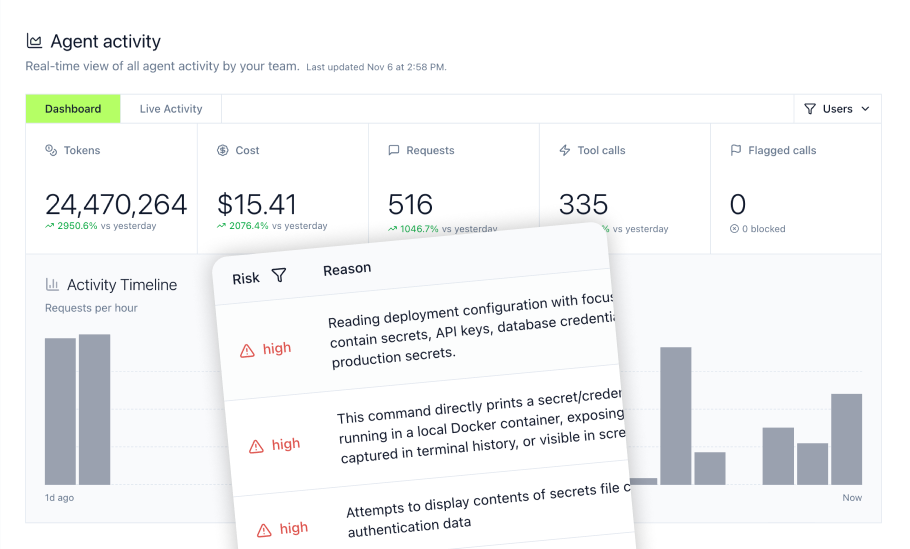
The MintMCP Gateway includes real-time monitoring dashboards displaying server health, usage patterns, and security alerts across all MCP connections. Complete audit trails capture every MCP interaction, access request, and configuration change—providing the documentation required for security and compliance.
The LLM Proxy maintains detailed command history showing every bash command, file access, and tool call executed by coding agents. This visibility enables security teams to conduct post-incident analysis, identify compromised accounts, and understand attack progression across the development environment.
Protecting sensitive data within LLM workflows
Coding agents and AI assistants frequently access configuration files, credentials, and proprietary code—creating substantial data leakage risks without proper controls.
Critical file protection
- .env files: Block all LLM access to environment configuration files containing API keys, database passwords, and service credentials
- SSH keys: Prevent reading of private keys stored in .ssh directories that grant server access
- Source code secrets: Scan repositories for hardcoded credentials using pre-commit hooks and automated detection tools
- PII redaction: Implement automatic masking of social security numbers, credit card data, and medical records in prompts and responses
- Encryption standards: Apply AES-256 encryption for data at rest and TLS 1.3 for all API communications
The LLM Proxy specifically protects sensitive files from access, including .env files, SSH keys, and credentials—directly addressing data leakage risks in development environments. Security teams configure allowlists defining which files coding agents can read, blocking access to configuration directories and credential stores.
Compliance and governance for enterprise LLM use
Regulatory frameworks impose specific requirements on AI systems handling sensitive data, with penalties for violations reaching millions of dollars and potential criminal liability for executives.
Compliance standards
- SOC 2 Type II: Demonstrates security controls protecting customer data through independent audits of system design and operational effectiveness
- GDPR requirements: Mandates data minimization, user consent tracking, right-to-deletion workflows, and cross-border transfer restrictions
- Industry-specific regulations: Financial services face SOX requirements, government contractors need FedRAMP certification, and payment processors must meet PCI-DSS standards
The CISA AI security guidance provides a federal perspective on securing AI systems, while NIST's framework offers comprehensive risk management approaches.
Governance framework components
Establish cross-functional AI governance committees including legal, security, compliance, data science, and business unit representatives. Document clear ownership structures defining who approves model updates, responds to security incidents, and maintains policy documentation. Implement quarterly review cycles assessing new vulnerabilities, regulatory changes, and emerging attack patterns.
Organizations with formal governance structures achieve 80% project success rates compared to 37% for those without structured oversight—demonstrating substantial ROI beyond compliance checkbox exercises.
The MintMCP Gateway provides centralized governance capabilities enabling security teams to enforce consistent policies across all MCP deployments while maintaining the documentation required for regulatory audits and compliance verification.
Implementing secure development practices for LLM applications
Security integrated throughout the development lifecycle prevents vulnerabilities from reaching production systems while reducing remediation costs compared to post-deployment fixes.
Development security practices
- Threat modeling: Conduct OWASP Top 10 assessments before design finalization, identifying potential attack vectors specific to your LLM use case
- Secure coding guidelines: Establish standards for prompt construction, output handling, and error management preventing common vulnerability patterns
- Dependency scanning: Automatically verify all libraries and models against known vulnerability databases before integration
- Code review processes: Require security-focused review for all LLM integration code, particularly authentication, data handling, and tool invocation logic
- CI/CD integration: Embed security scanning in deployment pipelines, blocking releases containing critical vulnerabilities or compliance violations
Developer training requirements
Technical teams need specific education on LLM security principles distinct from traditional application security. Training programs should cover prompt injection techniques, data leakage prevention, model behavior analysis, and secure integration patterns for MCP tools and external APIs.
Ongoing security validation
Monthly red-teaming exercises using tools like DeepTeam identify new vulnerabilities as models update and attack techniques evolve. Regular security assessments enable faster remediation before exploitation.
Operationalizing LLM security: Deployment and management
Production LLM deployments require infrastructure supporting high availability, rapid incident response, and continuous security monitoring at scale.
Infrastructure requirements
- Containerization: Deploy models in isolated containers limiting lateral movement during security incidents
- Auto-scaling: Configure dynamic resource allocation handling usage spikes while preventing resource exhaustion attacks
- High availability: Implement redundant deployments across multiple availability zones ensuring service continuity during failures or maintenance
- Configuration management: Treat security policies as code with version control, automated testing, and rollback capabilities
- Patch management: Establish processes for rapid deployment of security updates to models, guardrails, and supporting infrastructure
Incident response planning
Document response procedures specifying detection methods, containment actions, eradication steps, recovery workflows, and post-mortem analysis requirements. Target response times under 15 minutes for critical incidents involving active data exfiltration or system compromise.
The MintMCP Gateway enables one-click deployment for STDIO-based MCP servers with built-in hosting and lifecycle management. Enterprise features include high availability with automatic failover, real-time monitoring dashboards, and self-hosted options for organizations requiring complete infrastructure control.
Organizations can start with cloud-hosted deployments for rapid market testing, then transition to self-hosted infrastructure as security requirements or scale demands increase—all while maintaining consistent security policies and operational procedures across deployment models.
Frequently asked questions
What is the most common security vulnerability in LLM applications?
Prompt injection represents the most prevalent LLM vulnerability, appearing in the OWASP Top 10 as the number one threat. Attackers craft inputs containing hidden instructions that override system prompts, manipulating model behavior to leak data or execute unauthorized commands. Comprehensive protection requires layered defenses including input sanitization, output filtering, and behavioral monitoring.
How can I prevent my LLM from accessing sensitive internal data?
Implement defense-in-depth strategies combining access controls, data classification, and runtime monitoring. Configure role-based permissions limiting which data sources each LLM application can query. Deploy allowlists specifying permitted file paths and blocking access to configuration directories and credential stores. The LLM Proxy provides automated protection for .env files, SSH keys, and sensitive configurations with complete audit trails.
Are existing application security tools sufficient to protect LLMs?
Traditional security tools address only a subset of LLM-specific threats. Web application firewalls detect SQL injection but miss prompt injection attacks embedded in natural language. Organizations need LLM-specific security platforms covering the OWASP Top 10—including prompt injection detection, output sanitization, and tool invocation validation.
How does 'shadow AI contribute to LLM security risks?
Shadow AI occurs when employees deploy AI tools without IT oversight, creating unmanaged security gaps. These deployments bypass security reviews, lack proper access controls, and operate without audit logging—violating regulatory requirements for sensitive data. Organizations need centralized governance providing visibility into all LLM deployments while enabling approved tool access.
What audit trails are essential for LLM compliance?
Comprehensive audit logs must capture user identity, timestamp, prompt content, model response, tool invocations, and data accessed for every LLM interaction. GDPR requires records demonstrating lawful processing and consent tracking. The MintMCP Gateway provides complete audit trails of every MCP interaction, access request, and configuration change—meeting regulatory requirements with centralized log management.