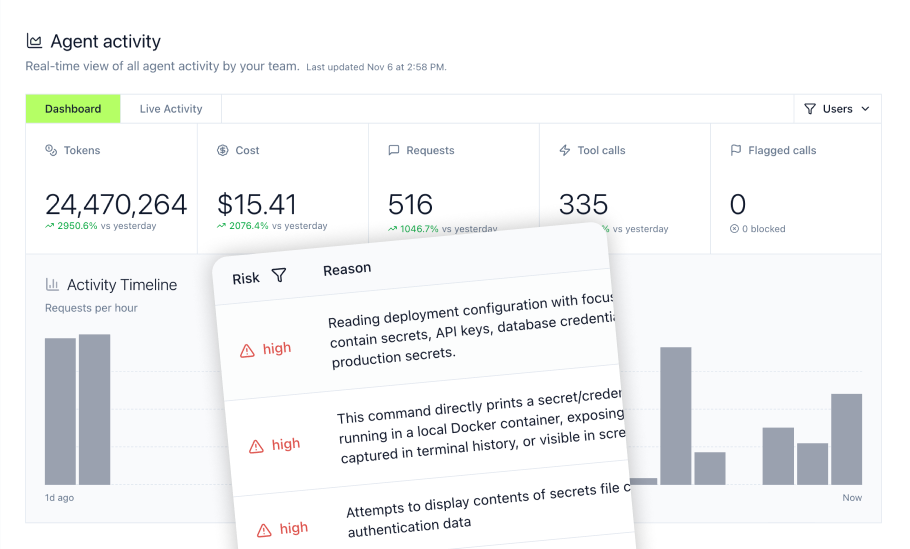
Stripe has documented a large-scale internal AI coding agent system, merging over 1,300 pull requests per week with zero human-written code. The system, called Minions, represents a shift from AI-assisted coding to fully autonomous code generation at enterprise scale. For organizations looking to deploy similar capabilities, understanding both the technical architecture and the governance requirements is essential. An MCP gateway provides the centralized authentication, access control, and audit logging that enterprise AI agent deployments require.
This article breaks down how Stripe's Minions work, the infrastructure enabling their scale, and the governance layer that any organization deploying autonomous agents needs to consider.
Key Takeaways
- Stripe's Minions produce 1,300+ merged PRs weekly using one-shot autonomous execution from natural language prompts to finished, tested pull requests
- The system connects to approximately 500 internal tools via an MCP server called "Toolshed," enabling agents to gather context, search code, and verify changes
- All agent-generated code undergoes human review before merge, maintaining a critical safety checkpoint while shifting engineer effort from writing to reviewing
- Pre-warmed development environments are ready in 10 seconds, and Stripe reports an engineer might have about half a dozen devboxes running at a time, enabling parallel work without shared local worktree conflicts
- Blueprint architecture interleaves deterministic validation steps with AI reasoning, capping CI retries at 2 rounds to avoid diminishing returns
Understanding Stripe's 'Minions': The AI-Powered Coding Assistants Behind the Scale
Stripe's Minions are autonomous coding agents that take a single natural language prompt and produce a complete, tested pull request ready for human review. Unlike AI coding assistants that suggest completions or require ongoing human guidance, Minions operate end-to-end without intervention during execution.
The system handles complete software development tasks from Slack, CLI, or web interfaces. An engineer can trigger a Minion with a bug description or task request, and the agent will spin up an isolated development environment, reproduce the issue, write the fix, run tests, and submit a PR.
How Minions work in practice:
- Engineer tags a Slack bot with an emoji and task description
- Minion provisions an isolated "devbox" environment in 10 seconds
- Agent gathers context from internal docs, searches codebase via Sourcegraph, and reads relevant code
- Code changes are written, linted locally, and submitted to CI
- If CI fails, the agent applies fixes for up to 2 retry rounds
- Final PR is submitted for human review
The foundation is a fork of Block's open-source Goose agent framework, customized with Stripe-specific integrations. This base provides the agent loop, tool calling infrastructure, and session management that Minions build upon.
The Role of AI Coding Assistants in Modern Development
Stripe's approach represents a different category than tools like Cursor or GitHub Copilot. Where those tools accelerate individual developers writing code, Minions parallelize execution by spinning up multiple independent agents working simultaneously.
At this throughput, human review can become a capacity constraint, making it important to calibrate review depth based on task risk and agent track record. Parallel Minion runs make it more practical to attempt well-scoped backlog tasks, although Stripe has not published a marginal-cost comparison with human engineering work.
The Infrastructure Enabling High-Volume Automation at Stripe
Minions operate at scale because of years of prior investment in developer productivity infrastructure. Without isolated environments, comprehensive test coverage, and fast feedback loops, autonomous agents would create conflicts and quality issues.
Critical infrastructure components:
- Pre-warmed devboxes: Isolated AWS EC2 environments provision in 10 seconds with the full codebase, services, and tooling pre-loaded. Each agent works in its own environment without git worktree conflicts.
- Comprehensive test suite: Stripe's Ruby monorepo contains approximately 1.2 million test units, and its CI system uses selective test execution rather than running the entire suite for every change.
- Fast local feedback: Local linting completes in under 5 seconds, allowing agents to catch obvious errors before expensive CI runs.
- Toolshed MCP server: A central MCP server hosts approximately 500 internal tools including Sourcegraph search, internal documentation access, ticketing integration, feature flags, and build systems.
The CI/CD Integration Pattern
Stripe caps CI retry rounds at 2 because diminishing returns make additional attempts wasteful in both tokens and time. If an agent cannot fix a failing build in two attempts, the issue surfaces to a human engineer.
This constraint is intentional. Rather than letting agents spiral on complex problems, Stripe designed the system to handle well-defined, repetitive tasks effectively and escalate ambiguous situations.
Streamlining Code Review: How AI Augments Human Oversight
All Minion-generated code goes through human review before merge. Minions open pull requests that require human review before merge. This checkpoint provides a deliberate human approval gate before code is merged.
Quality gates built into the agent workflow:
- Pre-submission linting and formatting checks
- Automated test execution with pass/fail gates
- CI pipeline validation before PR creation
- Human approval required for merge
For organizations scaling agent-generated code, Agent Monitor extends visibility to supported local non-MCP activity such as Bash commands, file reads and writes, and prompt submissions through Claude Code and Cursor hooks.
The Blueprint Architecture: Deterministic Nodes Meet AI Reasoning
Stripe uses "blueprints" to structure agent execution, interleaving deterministic workflow nodes with AI reasoning steps. This hybrid approach provides reliability that pure agentic systems lack.
Blueprint structure:
- Deterministic nodes handle validation steps: linting, test execution, format checking
- AI nodes handle reasoning steps: understanding requirements, writing code, debugging failures
- Transitions between nodes are explicit and auditable
- Failed deterministic checks trigger specific AI remediation paths
This architecture means agents follow predictable patterns while retaining flexibility for novel problems. A blueprint for dependency updates will always run specific validation steps regardless of which AI model generates the code.
Conditional Rules for Large Codebases
Global agent rules do not work in massive codebases. Stripe uses subdirectory-specific conditional rules that load different instructions based on which part of the codebase an agent is modifying.
This addresses context window constraints. Instead of loading all rules into every agent session, rules are conditionally loaded based on the task and location.
Governing AI Agents: Centralized Security and Observability
Stripe's public posts focus primarily on execution architecture rather than presenting a complete enterprise governance specification. They do describe a centralized Toolshed shared across hundreds of agents, curated tool subsets, an internal security-control framework, and isolated QA devboxes without real user data, production-service access, or arbitrary network egress.
The public posts do not document whether Stripe maps Minions controls to frameworks such as the NIST AI RMF, how it inventories agent activity outside Minions, or whether it retains complete reasoning traces for governance investigations.
Organizations deploying autonomous coding agents need a governance layer that sits above individual agent implementations. MintMCP's MCP Gateway provides governed data and tool connections through authentication, tool-level access control, credential management, and audit logging. Built on that foundation, MintMCP's Agent Gateway adds agent identities, permissions, memory, and monitoring across Claude, Cursor, ChatGPT, Gemini, and Copilot deployments.
Policy Enforcement for Agent Teams
Managing agents at scale requires grouping governance by team or use case. MintMCP's Bundle architecture packages tool access, policy enforcement, and audit logging into single governance units. Each Bundle ties SCIM group membership to a curated MCP server list, custom policy rules, and isolated audit trails.
This approach differs from manual configuration of separate plugin, access rule, and credential objects. When an agent's access should change, updating the Bundle propagates changes automatically rather than requiring modifications across multiple systems.
The 'Last Mile Problem': Connecting Agents to Internal Systems
Stripe's Toolshed MCP server connects Minions to approximately 500 internal tools, solving what the industry calls the "last mile problem" in enterprise AI: giving agents secure, governed access to internal systems without requiring extensive engineering overhead for each integration.
Toolshed integration categories:
- Code intelligence and search via Sourcegraph
- Internal documentation access
- Ticketing system integration with "Fix with Minion" buttons
- Feature flag management for automated cleanup
- Build and deployment systems
Building this level of integration required years of investment in developer productivity infrastructure that most organizations lack. The Toolshed approach works because Stripe already had unified internal APIs and comprehensive tooling.
For organizations that cannot invest years building custom MCP server infrastructure, MCP Gateway provides hundreds of prebuilt connectors for common enterprise tools alongside the ability to host custom MCP servers. MintMCP operates the connector runtime on behalf of customers, handling auto-scaling and isolated execution without requiring teams to manage Kubernetes pods.
Protecting Against Shadow AI in Agent-Driven Development
Stripe's Minions run through sanctioned channels with defined entry points. However, organizations deploying AI coding tools face a broader challenge: shadow AI risk when agents and assistants operate outside sanctioned, monitored systems.
Shadow AI agents introduce risks that traditional security tools miss:
- Developers using personal AI coding assistants with access to production code
- Agents connecting to unauthorized data sources through locally installed MCP servers
- Prompt injection vulnerabilities in community-maintained integrations
- Credential exposure through unmonitored tool calls
MintMCP's Agent Monitor provides two-layer governance: the gateway covers MCP traffic, while hooks in Claude Code and Cursor detect local non-MCP agent activity including bash commands, file operations, and prompt submissions. MDM integration enables consistent policy enforcement across developer machines.
Compliance and Security for Autonomous Code Generation
Stripe's Minions process code changes supporting over $1 trillion in annual payment volume. The security model relies on:
- Agents running in isolated devboxes with no internet access and no production access
- Agents running with broad permissions inside quarantined devboxes, while MCP tool access is limited through curated tool sets and internal security controls
- All changes going through standard git workflow with human review gates
- Comprehensive test coverage validating every change
Organizations need runtime monitoring for AI-specific attacks alongside traditional security controls. MintMCP provides agent identities with M2M authentication, allowing each agent to have its own credentials and scope that can be rotated independently. This approach avoids shared service account keys and enables precise audit attribution.
Building an AI Governance Framework
Enterprise AI agent deployments require mapping to emerging compliance frameworks. An agentic AI governance framework addresses:
- Agent registration and inventory tracking
- Permission scoping and least-privilege access
- Behavioral monitoring and anomaly detection
- Audit trails for compliance investigations
- Kill switches for anomalous agent activity
MintMCP is SOC 2 Type II audited and compliant with HIPAA standards. The platform is penetration tested, encrypts data in transit and at rest, and offers data residency options. Customers handling protected health information can request HIPAA documentation, and MintMCP signs BAAs. For complete security documentation, visit the Trust Center.
MintMCP: Enterprise-Grade Governance for Autonomous Agent Deployments
Stripe's Minions demonstrate the potential of autonomous coding agents at scale, but they also highlight the governance foundation required to run agents safely in production. Most organizations cannot spend years building the custom infrastructure, security controls, and observability layer that Stripe constructed internally.
MintMCP addresses this gap with a two-layer approach:
- MCP Gateway: The MCP Gateway provides governed tool and data access through authentication, credential management, tool-level policies, and audit logs for governed MCP tool calls. This foundation supports AI systems including Claude, Cursor, ChatGPT, Gemini, and Copilot.
- Agent Gateway: Built on the MCP Gateway foundation, MintMCP's Agent Gateway extends governance to agent-specific requirements, including persistent agent identities with M2M authentication, scoped permissions that follow least-privilege principles, enterprise memory with version history and audit trails, and behavioral monitoring that provides visibility into supported agent activity.
Organizations running coworker agents need additional controls because these agents are:
- Long-running and Slack-native
- Able to hold memory and continue work across days
- Designed to operate alongside employees
- Connected to company tools and data through scoped permissions
MintMCP's Bundle architecture packages several governance controls into shared units:
- Curated tool access
- Policy enforcement
- SCIM-driven group membership
- Isolated audit trails
This structure makes it practical to govern agents across teams while reducing repeated policy and access configuration.
For teams deploying autonomous coding agents similar to Stripe's Minions, MintMCP provides centralized visibility, access control, and audit reporting that internal builds can require substantial engineering investment to replicate. This allows platform and security teams to maintain oversight while enabling developers to run agents productively.
Frequently Asked Questions
What tasks are Stripe's Minions best suited for?
Minions excel at well-defined, repetitive tasks with clear acceptance criteria. The most common use cases include dependency and security updates across multiple services, feature flag cleanup, API migrations, documentation updates, and bug fixes with reproducible steps. During Stripe's "Atlas Fix-It Week," Minions handled tasks that would otherwise never be prioritized because the human time cost exceeded the value. Tasks requiring ambiguous judgment, customer communication, or architectural decisions still require human engineers.
How does Stripe measure the success rate of Minion-generated PRs?
Stripe has publicly disclosed Minion throughput, human review, and the two-round CI limit, but it has not published detailed success-rate metrics such as first-pass CI rate, review-cycle counts, rejection rate, or the share of PRs requiring substantial human modification. The system is designed to fail fast, surfacing problems to humans after a maximum of 2 CI retry attempts rather than letting agents struggle with complex issues indefinitely.
Can other companies build their own version of Stripe's Minions?
Technically yes, but the investment is substantial. Stripe has not published a general build-time or staffing estimate for recreating Minions. Its public posts indicate that the system depends on substantial pre-existing developer infrastructure, including isolated devboxes, CI automation, internal tools, and extensive test coverage. Organizations without mature developer-environment, CI, testing, and internal-tooling foundations should compare the cost of building a custom harness with available commercial coding-agent options.
How does Stripe handle agent access to sensitive production data?
Minions operate in isolated environments without production access. The devbox architecture creates sandboxed development environments that are isolated from production resources and the internet. Agents gather context from internal documentation, tickets, build systems, and code search tools through curated MCP tool access. For organizations where agents need governed access to production data sources, an MCP gateway with tool-level access control provides the boundary enforcement that Stripe achieves through infrastructure isolation.
What happens when a Minion encounters an error it cannot resolve?
Stripe limits Minions to two CI rounds rather than allowing repeated autonomous retries. When a run does not fully succeed, the resulting branch can still provide a starting point for focused human engineering work. Stripe's public posts do not describe a formal "needs human help" PR state or a standardized takeover workflow.