The OWASP Top 10 for Agentic Applications represents the first comprehensive security framework specifically designed for autonomous AI systems. Released in December 2025, this framework addresses vulnerabilities that extend far beyond traditional LLM threats—covering persistent memory attacks, tool misuse, and multi-agent coordination risks that organizations must address when deploying AI agents at scale. With average breach costs reaching $4.4M and coding assistant vulnerabilities proliferating rapidly, enterprises need structured approaches to secure their agentic deployments. An MCP Gateway provides the centralized governance layer required to address these risks systematically.
Key Takeaways
- The OWASP Agentic Top 10 (ASI01-ASI10) provides the first standardized taxonomy for autonomous AI security risks, released December 2025
- Memory poisoning attacks can be highly effective when agents lack defensive architecture, with published research demonstrating high-severity outcomes across many tested scenarios
- 30+ CVEs documented in AI coding tools during December 2025 alone, including CurXecute and MCPoison exploits
- AWS Scope classification (Scope 1-4) provides immediate risk assessment framework based on agent autonomy level
- Cascading failures in multi-agent systems can poison 87% of downstream agents within 4 hours
- Organizations with stacked defenses see dramatically reduced attack success rates
- Shadow AI grows 120% year-over-year, requiring centralized governance to bring unsanctioned agents under control
Understanding Agentic Systems and Their Unique Security Footprint
Agentic AI systems differ fundamentally from traditional software and even standard LLM deployments. These autonomous agents can make decisions, execute actions, maintain persistent memory across sessions, and coordinate with other agents—all without continuous human oversight. This autonomy creates attack surfaces that conventional security frameworks fail to address.
What Makes Agentic AI Different?
Traditional AI security focuses on prompt injection and output filtering. Agentic security must address:
- Persistent memory that attackers can poison over time
- Tool access enabling shell commands, file operations, and API calls
- Multi-agent communication where one compromised agent affects others
- Autonomous decision-making that bypasses human verification
The AWS Security Scoping Matrix classifies agents into four scope levels: Scope 1 (read-only), Scope 2 (human-in-loop), Scope 3 (supervised autonomy), and Scope 4 (full autonomy). Each level requires exponentially more security investment. Organizations should prioritize agents using the formula: Risk = Scope Level × Data Sensitivity × Tool Privilege × User Count.
Risk 1: Untracked Tool Invocations and Command Execution
Coding agents operating with extensive system access—reading files, executing commands, and accessing production systems through MCP tools—create significant blind spots when organizations cannot monitor their actions.
The Dangers of Unmonitored Agent Actions
Without proper tracking, agents can:
- Execute arbitrary bash commands without oversight
- Invoke MCP tools that modify production data
- Access sensitive configuration files silently
- Perform operations that trigger compliance violations
Real-world exploits documented in December 2025 include CVE-2025-54135 (CurXecute) and CVE-2025-54136 (MCPoison), both targeting popular coding assistants with remote code execution capabilities.
Blocking Risky Commands in Real-Time
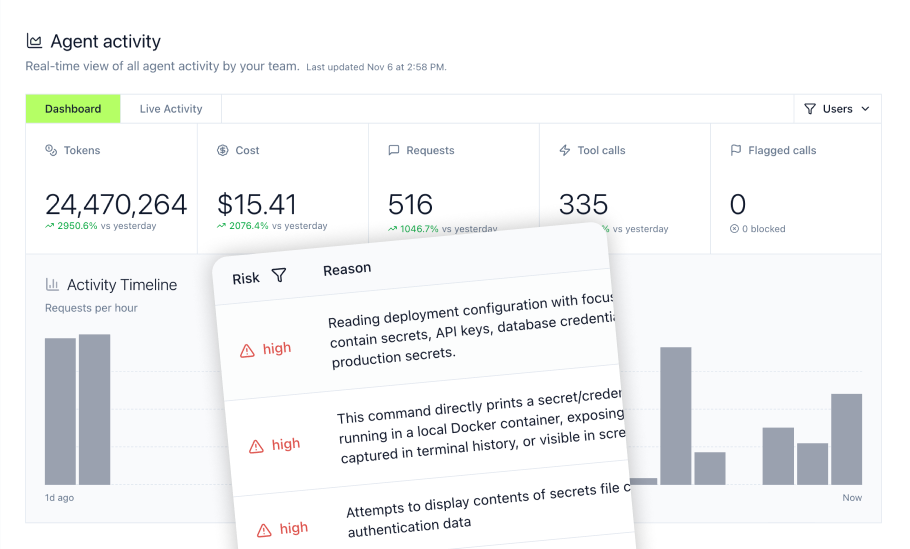
MintMCP's LLM Proxy monitors every MCP tool invocation, bash command, and file operation from all coding agents. The platform tracks every tool call, shows which MCPs are installed, and monitors what files agents access. Security guardrails block dangerous commands in real-time while maintaining a complete audit trail of all operations.
Risk 2: Data Exfiltration and Sensitive File Access
Agents with file system access can inadvertently or maliciously expose credentials, API keys, SSH keys, and other sensitive configuration data. The EchoLeak vulnerability (CVE-2025-32711) demonstrated zero-click data exfiltration through Microsoft 365 Copilot via a single email.
Preventing AI Agent Access to Confidential Information
Effective data protection requires:
- Sensitive file blocking: Prevent access to .env files, SSH keys, and credential stores
- Encryption requirements: AES-256 at rest, TLS 1.3 in transit for all agent communications
- Provenance tracking: Log source, timestamp, and creator for all data access
- Access monitoring: Real-time alerts for unusual file access patterns
The LLM Proxy provides sensitive file protection that prevents access to .env files, SSH keys, credentials, and other sensitive configuration—critical for maintaining GDPR compliance and preventing systematic privacy violations.
Risk 3: Inadequate Authentication and Authorization for MCP Tools
AI agents connecting to internal databases, CRMs, and business applications require the same authentication rigor as human users—yet many deployments use shared credentials or no authentication at all.
Securing Agent Connectivity to Internal Systems
Proper authentication architecture includes:
- OAuth 2.0 and SAML integration for enterprise SSO
- Per-user authentication flows rather than shared service accounts
- Role-based access control limiting tools by user role
- Least privilege principles restricting agents to minimum necessary access
MintMCP's MCP Gateway provides enterprise authentication with OAuth 2.0, SAML, and SSO integration for all MCP servers. The platform supports both shared and per-user auth, offering flexibility to configure service accounts at the admin level or enable individual OAuth flows.
Risk 4: Compliance and Audit Trail Deficiencies
Organizations deploying AI agents face SOC 2 and GDPR requirements that demand comprehensive logging of all agent actions. Without proper audit trails, compliance attestation becomes impossible.
Building Comprehensive Audit Trails for AI Usage
Key audit requirements include:
- Complete interaction logs: Every MCP call, data access, and configuration change
- Immutable records: Tamper-proof storage with cryptographic verification
- Retention policies: 30-day minimum for incident recovery, longer for compliance
- Evidence automation: Eliminate weeks of manual gathering for audits
The MCP Gateway maintains complete audit trails of every MCP interaction, access request, and configuration change—providing the documentation required for compliance. Organizations report eliminating weeks of manual evidence gathering through automated compliance reporting.
Risk 5: Shadow AI and Unsanctioned Agent Deployments
With shadow AI growing 120% year-over-year, organizations cannot secure what they cannot see. Developers deploying Cursor, Windsurf, or custom MCP servers without IT knowledge create unknown attack surfaces.
Bringing Shadow AI Under Enterprise Control
Effective shadow AI governance requires:
- Network monitoring for AI traffic patterns and MCP protocol connections
- Agent discovery across development environments and workstations
- Approval workflows for new MCP server deployments
- Centralized registry of sanctioned tools and configurations
MintMCP's mission is to "turn shadow AI into sanctioned AI" by providing security and governance for enterprise deployment. The LLM Proxy provides complete visibility into installed MCPs and their usage across coding agents, identifying and managing unsanctioned tools before they create compliance gaps.
Risk 6: Improper Agent Inventory and Configuration Management
As agent count grows past 50-100 deployments, manual security reviews become bottlenecks. Without centralized inventory management, organizations lose track of agent versions, configurations, and security patches.
Maintaining a Clear Picture of Your Agentic Ecosystem
Inventory management essentials:
- Central registry of all MCP servers with version tracking
- Configuration baselines for security-critical settings
- Dependency scanning for vulnerable components
- Lifecycle management from deployment to decommissioning
The MCP Gateway offers a central registry of available MCP servers with one-click installation and configuration. Combined with the LLM Proxy's visibility into installed MCPs, permissions, and usage patterns across teams, organizations maintain comprehensive agent inventories.
Risk 7: Lack of Observability and Real-time Monitoring
Batch log analysis proves insufficient for detecting rapid attack propagation in multi-agent systems. Cascading failures can poison 87% of downstream agents within 4 hours—requiring real-time detection capabilities.
Proactive Threat Detection for Agentic Systems
Effective monitoring requires tracking:
- Refusal Rate Delta: Alert at ±15% deviation from baseline
- Tool usage patterns: Detect anomalous command sequences
- Memory access anomalies: Identify potential poisoning attempts
- Inter-agent communication: Monitor for cascading compromise
The MCP Gateway provides real-time monitoring with live dashboards for server health, usage patterns, and security alerts. This observability and control enables detecting anomalies and maintaining SLA compliance while the LLM Proxy tracks how employees use LLM clients and what tools the LLMs invoke.
Risk 8: Insecure Integration with Internal Data and APIs
Agents connecting to databases, APIs, and business applications require secure integration patterns. Research shows memory poisoning attacks achieve 80%+ success rates when agents consult poisoned RAG databases without proper validation.
Bridging AI Agents to Enterprise Data Safely
Secure integration architecture includes:
- Memory partitioning: Separate system instructions from user data in 4-tier privilege systems
- Input sanitization: Validate all RAG ingestion points against malicious injection
- Granular tool access control: Configure access by role, enabling read-only operations while excluding write tools
- API security: Authenticate all agent-to-service communications
MintMCP bridges the gap between AI assistants and internal data, handling authentication, permissions, and audit trails. Purpose-built connectors like the Elasticsearch MCP Server and Snowflake MCP Server enable governed access to enterprise data while maintaining security controls.
Risk 9: Supply Chain Risks from Third-Party MCPs and Tools
30+ CVEs documented in December 2025 demonstrate the vulnerability of third-party and open-source agent components. Organizations integrating untrusted MCPs inherit their security flaws.
Mitigating Risks from Untrusted Agent Components
Supply chain security requires:
- Vendor assessment before MCP adoption
- Dependency scanning for known vulnerabilities
- Registry security with approval workflows
- Code integrity verification for third-party components
The MCP Gateway's central registry and one-click installation help standardize and secure the onboarding of agent tools, providing a governed pathway for adding new capabilities while blocking unauthorized components.
Risk 10: Lack of Enterprise-Ready Infrastructure and Scalability Concerns
Developer utilities require hardening before production deployment. Local MCP servers lack the high availability, security controls, and monitoring that enterprise operations demand.
Building Resilient and Scalable Agentic Systems
Enterprise infrastructure requirements:
- High availability: Automatic failover and redundancy
- Enterprise SLAs: Defined uptime commitments with support
- Containerized deployment: Transform local servers into managed services
- Centralized management: Unified control plane for all agent infrastructure
The MCP Gateway provides enterprise hardening that transforms local MCP servers into production-grade infrastructure. Organizations gain high availability with automatic failover and enterprise SLAs—moving from developer utility to production service in minutes rather than months.
Implementing Comprehensive Agentic Security with MintMCP
Addressing the OWASP Agentic Top 10 requires more than point solutions—organizations need an integrated governance platform that spans authentication, monitoring, compliance, and infrastructure management. MintMCP delivers this comprehensive approach through two complementary services working in concert.
The MCP Gateway serves as the central control plane for all agent infrastructure. Organizations can deploy STDIO servers through MintMCP's managed infrastructure or connect their own deployable and remote servers through the unified gateway. This architecture provides enterprise authentication, centralized configuration management, and one-click deployment of vetted MCP servers—transforming shadow AI into governed infrastructure.
The LLM Proxy complements this with comprehensive visibility and real-time security controls. Every tool invocation, file access, and command execution flows through the proxy's security guardrails, creating complete audit trails while blocking dangerous operations before execution. Together, these services address eight of the ten OWASP risks directly: untracked invocations (ASI01), data exfiltration (ASI02), authentication gaps (ASI03), audit deficiencies (ASI04), shadow AI (ASI05), inventory chaos (ASI06), observability gaps (ASI07), and infrastructure readiness (ASI10).
This stacked defense architecture enables organizations to deploy autonomous agents at scale while maintaining the security posture regulators and auditors demand. The platform's automated compliance reporting, real-time threat detection, and centralized governance eliminate the manual overhead that makes agentic security impractical for resource-constrained teams—turning the OWASP framework from aspirational guidance into operational reality.
Frequently Asked Questions
How should organizations prioritize which ASI risks to address first?
Start with agent inventory using the AWS Scope classification. Prioritize Scope 3-4 agents with sensitive data or privileged tool access. Calculate risk scores: Scope Level × Data Sensitivity × Tool Privilege × User Count. Address high-scoring agents first, focusing on memory partitioning and tool access controls as highest-ROI measures.
What indicators suggest an agent may be compromised?
Monitor Refusal Rate Delta (significant changes in declined requests), Instruction Echo Score (agents repeating injected instructions), and Behavioral Drift Index (gradual response pattern changes). Watch for unusual tool usage, unexpected file access, or anomalous inter-agent communication.
How do multi-agent systems increase security complexity?
Multi-agent systems create cascading failure risks where one compromised agent poisons shared knowledge bases affecting all connected agents. Mitigations require per-agent memory isolation, validation chains, cryptographic agent identity, and mutual TLS for inter-agent communication.
What compliance frameworks map to the OWASP Agentic Top 10?
The ASI framework aligns with GDPR Articles 22 and 35, SOC 2 CC6.6 authorization controls, NIST AI RMF risk functions, and ISO/IEC 42001 AI management standards. Map each ASI risk to your specific compliance obligations and document controls accordingly.
When should organizations use managed security versus self-managed governance?
DIY approaches work for small deployments (under 10 agents, Scope 1-2, non-sensitive data). Platform vendors become essential at 25+ agents, rapid proliferation, limited security team bandwidth, or active compliance pressure from SOC 2 or ISO 27001 audits.