Model Context Protocol has become the universal standard for connecting AI agents to enterprise data—backed by Anthropic, OpenAI, Google, and Microsoft. Yet with over 1,000 exposed MCP servers discovered and adoption accelerating faster than security implementation, SaaS companies face a critical inflection point. The EU AI Act is already in force, with major requirements rolling out in phases through 2025–2026 (with many obligations applying from August 2, 2026), with penalties that can reach up to 7% of global annual revenue for the most serious violations. Organizations that fail to implement MCP Gateway infrastructure now risk regulatory penalties, data breaches averaging $4.4 million per incident, and competitive disadvantage as rivals gain 20% productivity advantages from secure AI deployment.
This article outlines why 2026 marks the mandatory adoption point for MCP security, covering the threat landscape, compliance requirements, implementation strategies, and operational benefits that transform shadow AI deployments into governed, production-ready infrastructure.
Key Takeaways
- EU AI Act enforcement begins August 2, 2026, with penalties up to 7% of global revenue for AI governance failures—making MCP security mandatory, not optional
- Shadow AI sprawl creates ungoverned access to sensitive data, with automated discovery often revealing significantly more unauthorized agents and tooling than IT expects
- Average data breach costs reach $4.4 million according to IBM, while while reporting has suggested many AI pilots stall or fail to reach production without the right operating model (governance, security, and deployment discipline)
- Endor Labs’ analysis suggests a meaningful share of MCP server code uses patterns/APIs associated with command-injection risk—reinforcing why gateway-level controls matter, requiring gateway-level security to mitigate risks
- Implementation timeline spans 60-90 days for pilot-to-production deployment, with one-click deployment eliminating weeks of manual security configuration
- Organizations with formal AI strategies report 80% success rates versus 37% for those without structured governance approaches
- SOC 2 Type II certification available through managed MCP gateway platforms with complete audit trails
Understanding the Urgency: Why SaaS Needs MCP Security Now
The gap between AI adoption and security implementation has reached a breaking point. While 71% of organizations regularly use generative AI, only 18% have enterprise-wide AI governance councils. This governance-containment gap means companies can monitor AI agent activity but cannot stop dangerous operations in real time.
The Shadow AI Crisis
- Employees deploy AI tools without IT knowledge, creating ungoverned access to sensitive data
- API keys get embedded in code repositories, exposing credentials to supply chain attacks
- No audit trails exist for data access, creating compliance failures during SOC 2 reviews
- Shadow AI grows 120% year-over-year, outpacing security team capacity
Why 2026 Is Different
The regulatory environment has fundamentally shifted. EU AI Act enforcement starts August 2, 2026, requiring documented governance for AI systems accessing personal data. Cyber insurance providers increasingly mandate AI governance as a policy condition. Enterprise customers now include AI security questions in most procurement processes.
For SaaS companies, the calculus is straightforward: implement MCP security now and gain competitive advantage, or wait and face regulatory penalties, higher insurance premiums, and lost enterprise deals.
The New Landscape: MCP Security for Enterprise AI
MCP security platforms address the fundamental challenge of enterprise AI governance: maintaining control over AI agents that access production systems, customer data, and internal tools. Unlike traditional security approaches, MCP gateways operate at the protocol layer, intercepting every tool call between AI clients and backend systems.
Core MCP Security Capabilities
- Centralized control plane: Single dashboard managing all AI agent infrastructure with unified authentication
- Automatic security wrapping: OAuth and SSO applied to any MCP server through one-click deployment
- Complete visibility: Every tool invocation, file access, and data query logged for compliance
- Real-time blocking: Dangerous operations stopped before execution, not just detected after
The MCP Gateway architecture transforms local STDIO-based servers into production-ready services. Organizations can host MCP servers on managed infrastructure instead of running them locally, eliminating the security risks of developer workstations accessing production databases.
What Makes Enterprise MCP Different
Standard MCP servers lack authentication, audit trails, and access controls. Enterprise gateways add these layers automatically, enabling organizations to deploy the same Snowflake or Elasticsearch connectors with SOC 2-compliant governance without custom development.
Bridging the Gap: From Shadow AI to Sanctioned AI with MCP Gateways
The path from uncontrolled AI tool sprawl to governed infrastructure follows a predictable pattern. Organizations typically discover 3-10x more MCP deployments than IT expected, creating immediate compliance gaps that require systematic remediation.
Phase 1: Discovery and Inventory (Week 1-2)
Run automated scanning to identify all MCP servers across the organization. Shadow AI discovery commonly reveals:
- Developers using Claude, ChatGPT, and Cursor with direct database access
- API keys hardcoded in repositories, bypassing credential management
- Multiple teams running identical MCP servers without coordination
- No visibility into what data AI agents access or when
Phase 2: High-Risk Migration (Week 3-4)
Migrate servers accessing customer data, payment systems, and PII first:
- Replace hardcoded credentials with OAuth flows automatically
- Apply role-based access controls matching organizational structure
- Configure PII detection alerts for sensitive data access
- Enable audit logging for compliance documentation
Phase 3: Organization-Wide Rollout (Week 5-8)
Expand governance across all teams and use cases:
- Standard business systems (CRM, support tools, analytics)
- Developer tools (coding agents with LLM Proxy monitoring)
- Internal productivity tools (documentation, communication)
The goal is transforming shadow AI into sanctioned AI—maintaining developer productivity while adding the governance layer enterprises require. MintMCP's one-click deployment model achieves this without forcing workflow changes that create user resistance.
Achieving Cloud Security and Compliance with MCP
SaaS companies face overlapping compliance requirements that MCP security platforms can address systematically. The key is mapping MCP controls to existing compliance frameworks rather than treating AI governance as a separate initiative.
SOC 2 Type II Alignment
MCP gateway audit trails directly support SOC 2 CC6 (Logical Access) requirements:
- Complete logging of every authentication event and data access
- Role-based access controls with quarterly review documentation
- Encryption in transit (TLS 1.3) and at rest (AES-256) for all MCP traffic
- Incident response capabilities with real-time alerting
MintMCP maintains SOC 2 Type II certification, providing customers with attestation reports for their own compliance audits.
GDPR and Data Protection
For SaaS companies serving European customers, MCP security must address:
- Consent tracking for AI agent data access
- Right to erasure through automated deletion workflows
- Privacy by design with minimal data collection
- Data processing documentation for regulatory audits
Compliance Automation Benefits
Manual compliance reporting requires 80+ hours per quarter. MCP platforms with automated audit capabilities reduce this to 1-hour exports, freeing security teams for higher-value work.
Real-time Monitoring and Control for AI Agents
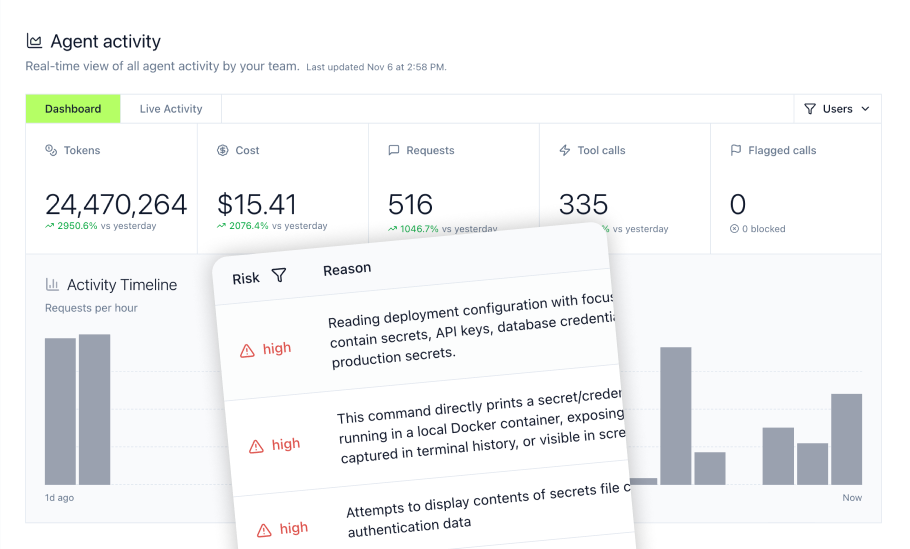
Visibility without control creates a dangerous governance gap. Organizations can see what AI agents access but cannot prevent harmful operations in real time. This is where LLM Proxy capabilities become essential for coding agents and other high-risk AI deployments.
Tool Call Tracking
Monitor every MCP tool invocation across all AI clients:
- Which tools each agent uses and how frequently
- What data sources agents query and what they retrieve
- Patterns indicating misuse or potential data exfiltration
- Correlation between user identity and agent behavior
Security Guardrails
Block dangerous operations before they execute:
- Commands attempting to read .env files, SSH keys, or credentials
- Database queries accessing unauthorized tables or schemas
- File operations in sensitive directories
- Network requests to unapproved external endpoints
Anomaly Detection
Machine learning-based pattern recognition identifies:
- Unusual access patterns suggesting compromised credentials
- Volume anomalies indicating data exfiltration attempts
- Timing irregularities suggesting automated attacks
- Geographic anomalies from impossible travel scenarios
Practical Implementation
A 500-person SaaS platform deployed LLM Proxy to monitor coding agents (Cursor, GitHub Copilot). Within the first month, the system blocked multiple attempted secret-exfiltration behaviors—operations that could have exposed API keys and customer credentials without gateway protection.
Protecting Your Data: Sensitive File Protection and Access Control
AI agents operate with extensive system access that traditional security controls never anticipated. Coding agents read files, execute bash commands, and query databases—activities that require granular governance beyond network-level security.
File Access Protection
Prevent AI agents from accessing sensitive configuration:
- .env files containing API keys and secrets
- SSH keys and certificates
- Credential stores and password files
- Configuration files with database connection strings
Role-Based Tool Access
Configure what each user role can do through MCP:
- Read-only operations for analysts and support teams
- Write access limited to authorized developers
- Admin operations restricted to platform team members
- Tool governance policies enforced automatically
Data Classification Integration
Apply existing data classification policies to AI agent access:
- PII detection with automatic alerting
- Customer data access logged with business justification
- Financial data queries requiring additional approval
- Intellectual property protections for source code access
Implementation Approach
Start with explicit denylists (block access to .env, SSH keys, credentials) then expand to allowlists as you understand legitimate access patterns. This approach prevents security gaps while minimizing developer friction during rollout.
Streamlining Operations: One-Click Deployments and Enterprise Ready MCPs
Traditional security implementations require months of custom development. MCP gateway platforms compress this timeline to days through automated deployment and pre-configured security policies.
One-Click Deployment Capabilities
- Deploy STDIO-based MCP servers with automatic hosting
- Apply OAuth authentication wrapper without code changes
- Configure audit logging and monitoring automatically
- Enable high availability with built-in failover
What This Eliminates
Manual Approach: 4-6 weeks custom OAuth integration, custom audit logging development, manual scaling and failover configuration, per-server security reviews
Gateway Approach: 15-30 minutes one-click deployment, automatic immutable logging, built-in high availability, centralized policy enforcement
Enterprise-Grade Infrastructure
The MCP Gateway transforms developer tools into production services:
- Containerized servers accessible to clients without local installations
- Enterprise SLAs with automatic failover
- Integration with existing monitoring and alerting systems
- Support for both STDIO servers on managed infrastructure and remote/deployable servers
For engineering teams, this means deploying AI-powered database access, code repository integration, or CRM connectivity in minutes rather than months—with security built in from day one.
Unified Authentication and Identity Management for MCP
MCP servers without centralized authentication create credential sprawl that undermines security. Each developer maintains separate API keys, service accounts, and access tokens across multiple tools—an unmanageable state at scale.
SSO Integration
Connect MCP gateway to existing identity providers:
- Okta, Azure AD, Google Workspace support
- SAML and OIDC protocols for enterprise compatibility
- Automatic user provisioning and deprovisioning
- Authentication and identity management from single console
Credential Centralization
Replace scattered API keys with managed authentication:
- Service accounts configured at admin level for shared resources
- Per-user OAuth flows for individual accountability
- Automatic token rotation without developer intervention
- Secrets stored in encrypted vaults, not code repositories
Access Lifecycle Management
Maintain appropriate access as employees change roles:
- Onboarding with automatic MCP server access based on role
- Role changes triggering access reviews and updates
- Offboarding with immediate credential revocation
- Quarterly access certifications for compliance audits
Multi-Tenant Support
SaaS companies building AI features for customers need:
- Customer-specific MCP server isolation
- Tenant-level access controls and audit trails
- White-label options for customer-facing AI tools
- Usage tracking per customer for billing and governance
Cost Control and Performance Insights for Enterprise AI
Ungoverned AI tool usage creates unpredictable costs and performance issues. MCP security platforms provide the visibility needed to optimize spending and maintain service levels.
Usage Analytics
Track AI tool consumption across the organization:
- Tool call volume by team, project, and individual
- Token consumption and model cost allocation
- Peak usage patterns for capacity planning
- Trend analysis for budget forecasting
Performance Monitoring
Maintain SLA compliance for AI-powered features:
- Response time tracking across MCP servers
- Error rate monitoring with automated alerting
- Throughput analysis for scaling decisions
- Latency impact assessment (typically under 50ms for gateway routing)
Cost Allocation
Enable chargeback and showback for AI infrastructure:
- Department-level cost attribution
- Project-specific usage tracking
- Per-customer cost analysis for SaaS companies
- ROI calculation by use case
Optimization Opportunities
Analytics often reveal consolidation opportunities:
- Multiple teams running identical MCP servers (consolidate to shared infrastructure)
- Underutilized servers consuming resources (right-size or decommission)
- High-volume low-value queries (optimize prompts or add caching)
- Redundant tool calls (implement response caching)
Building a Future-Proof Foundation: The Strategic Advantage of MCP in 2026
Early MCP security adoption creates compounding advantages. Companies implementing governance now avoid technical debt that makes later migration 3-5x harder while capturing productivity gains their competitors cannot access.
Competitive Positioning
- 20% productivity gains from secure AI tool access
- 30% shorter enterprise sales cycles when demonstrating AI governance
- First-mover advantage in AI-powered product features
- Enhanced customer trust through documented security controls
Risk Reduction
- $4.4M average breach cost avoided through preventive controls
- Regulatory penalties eliminated through proactive compliance
- Insurance premium reductions for documented AI governance
- Reputation protection from AI-related security incidents
Scalability
Organizations that implement governance early can scale AI adoption without rearchitecting:
- Add new MCP servers through one-click deployment
- Onboard teams with role-based access templates
- Expand to new use cases with existing security controls
- Integrate new AI clients as they emerge
Implementation Timeline
Milestone Timeline and Outcomes:
Shadow AI discovery (Week 1-2): Complete inventory of ungoverned AI
First governed server (Week 3-4): Production deployment with audit trails
High-risk migration (Week 5-8): Customer data protected
Full rollout (Week 9-12): Organization-wide governance
Optimization (Ongoing): Continuous improvement
The organizations acting now position themselves for EU AI Act enforcement in August 2026 with mature governance capabilities, while competitors scramble to implement controls under regulatory pressure.
Frequently Asked Questions
What is the difference between MCP Gateway and LLM Proxy?
MCP Gateway governs the server side: it turns MCP servers into production services with OAuth/SSO, audit logs, and centralized management, and supports one-click deployment of connectors (databases, CRMs, etc.). LLM Proxy governs the client side: it sits between AI tools (e.g., coding agents) and LLMs to observe and block risky actions like tool calls, bash commands, and file operations in real time.
Enterprises often use both: Gateway to secure MCP server infrastructure, Proxy to control coding-agent behavior.
How does MCP security affect developer productivity?
When implemented well, security adds little day-to-day friction. Gateway latency is typically <50ms and SSO uses existing credentials. One-click deployment avoids weeks of manual OAuth/logging setup. The main workflow change is requesting access to new MCP servers—platform teams can usually approve in hours, not weeks. With phased rollout and training, orgs report no net productivity loss, and secure access can increase productivity by enabling previously blocked use cases.
What happens with existing ungoverned MCP servers?
They’re typically migrated, not rebuilt. Start with automated discovery—many orgs find 3–10× more servers than expected. Migrate highest-risk servers first (PII, payments, customer data) into the managed gateway. The gateway can replace hardcoded API keys with OAuth and add audit logging without changing server code. Keep legacy configs available for about 30 days as rollback. Full migration commonly takes 6–10 weeks, depending on server count and access complexity.