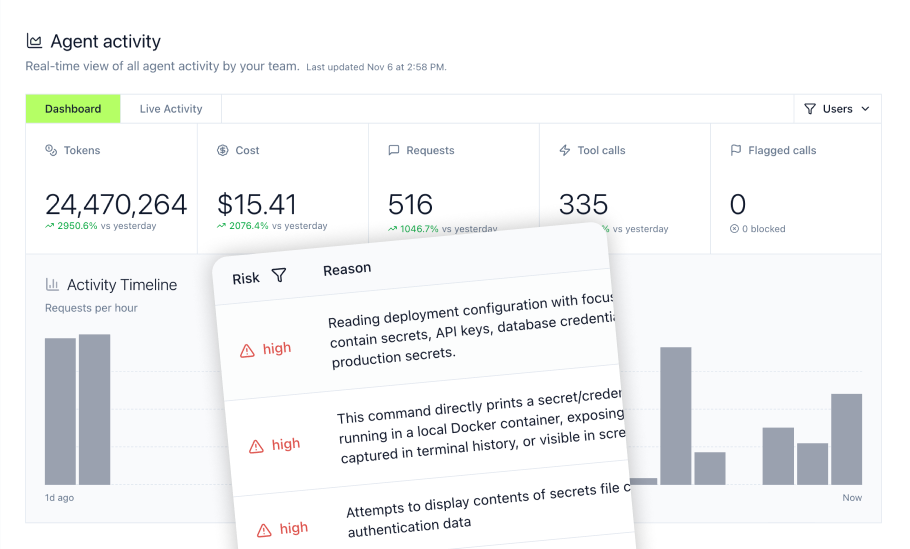
Deploying AI agents in environments subject to SOC 2 requirements requires more than basic authentication. Organizations need governed infrastructure that provides complete audit trails, granular access controls, and real-time monitoring across every tool call and data interaction.
The MCP Gateway category has matured rapidly, with platforms now offering enterprise-grade governance for AI agents connecting to production systems. As security concerns rank among the top challenges for enterprise AI adoption, selecting the right gateway directly impacts your ability to pass audits and maintain compliance posture.
This guide covers seven agent gateways that can support organizations with SOC 2 reporting requirements, each evaluated against enterprise security requirements, audit capabilities, and deployment flexibility.
Key Takeaways
- MintMCP provides an Agent Gateway with first-class agent identities, M2M auth, scoped tools, independent credential rotation, and centralized audit logs, built on top of enterprise MCP Gateway infrastructure with Virtual MCP Bundles and OAuth brokering
- Hybrid deployment models balance managed SaaS convenience with self-hosted infrastructure control for organizations with data sovereignty requirements
- Open-source foundations with enterprise governance tiers offer platform teams transparency and self-hosting options with commercial support paths
- Performance-optimized architectures deliver low-latency overhead for high-throughput environments, though benchmarks vary by test conditions
- Security-first designs emphasize threat detection, prompt injection defense, and PII redaction as foundational capabilities
- Identity-based governance through native SSO integration, OAuth authentication, and centralized user management supports audit evidence collection
- API management platforms extending to MCP support provide unified operational models for organizations with existing gateway infrastructure
1. MintMCP Agent Gateway
MintMCP delivers an Agent Gateway that gives AI agents first-class identities, permissions, memory, and monitoring. Built on top of MintMCP's MCP Gateway foundation, the platform provides governed infrastructure for agents that work alongside employees.
What makes MintMCP Agent Gateway different
MintMCP addresses the governance gap for autonomous and coworker agents operating across multiple data sources. While the MCP Gateway layer provides SSO-fronted endpoints, OAuth brokering, and tool-level policy for AI systems like Claude, Cursor, and ChatGPT, the Agent Gateway layer extends this with agent-specific identities, scoped permissions, and lifecycle management.
Core capabilities
- Agent Bundles: Give internal agents first-class identities with M2M auth, scoped tools, independent rotation and revocation, and an "act as agent" flow for connectors requiring per-agent OAuth
- Virtual MCP Bundles: Create team-specific, per-use-case endpoints that expose only the minimum required tools with SCIM-driven membership and fine-grained role-based access
- Custom Gateway Middleware: Runs customer-authored middleware in a JS sandbox with external DLP and guardrails integrations for masking, blocking, and policy enforcement
- Hosted MCP Connectors: Connector instances with auto-scaling and sandboxed execution per connector
- OAuth Brokering: Add enterprise authentication to local and hosted MCP servers without rebuilding each server
Security architecture
MintMCP implements security governance through centralized controls, SSO enforcement, SCIM-driven RBAC, tool-level policy, credential management, and observability. The platform provides visibility into which teams and agents use which tools, when they access data, and how frequently.
Enterprise integrations
- Snowflake access with natural language queries
- Elasticsearch search for documentation and log analysis
- Claude, Cursor, ChatGPT, Gemini, and Copilot governance through centralized gateway and Agent Monitor coverage
Compliance
- SOC 2 Type II audited with continuous compliance monitoring
- Compliant with HIPAA standards; signs BAAs
- Penetration tested with data encrypted in transit and at rest
Getting started
Visit mintmcp.com for deployment documentation.
2. TrueFoundry MCP Gateway
TrueFoundry MCP Gateway offers a unified control plane for LLM and MCP traffic with hybrid deployment options. The platform targets organizations seeking both managed SaaS convenience and self-hosted infrastructure control.
Primary focus
TrueFoundry emphasizes a low-latency architecture for high-throughput deployments. Its published materials report roughly 3-4ms of gateway overhead and 350+ requests per second on 1 vCPU in some tests, while a more recent MCP comparison cites approximately 10ms under load, so these figures should be treated as vendor-reported benchmark results that depend on test conditions.
Core capabilities
- Unified LLM and MCP gateway control plane
- API key, OAuth, and identity-provider-based authentication with centralized downstream credential management
- Hybrid deployment supporting managed SaaS and self-hosted options
- Air-gapped deployment options for restricted environments
Where TrueFoundry fits
Organizations with existing ML platform investments who want to extend infrastructure to MCP governance. Teams requiring air-gapped or self-hosted deployments with enterprise compliance features.
Deployment
Hybrid model with managed SaaS and self-hosted control plane options in customer Kubernetes or cloud environments.
3. Lunar.dev MCPX
Lunar.dev MCPX provides an MCP gateway focused on centralizing policy enforcement, access control, and observability for production deployments. The platform combines open-source foundations with enterprise governance tiers.
Primary focus
MCPX targets platform and infrastructure teams deploying MCP to production environments. The gateway emphasizes identity-based governance through native identity-provider integration, OAuth authentication, centralized user management, and comprehensive audit capabilities.
Core capabilities
- Granular RBAC and comprehensive audit logs
- Full observability including latency, token costs, and request tracing
- Support for STDIO and remote Streamable HTTP MCP servers, with SSE retained for legacy compatibility
- Docker deployment for the open-source gateway and Kubernetes, VPC, on-premises, or air-gapped deployment for MCPX Enterprise
Where Lunar.dev fits
Platform engineering teams wanting to self-host gateway infrastructure with enterprise-tier governance features. Organizations seeking open-source foundations with commercial support paths.
Deployment
The open-source gateway can be deployed through Docker, while MCPX Enterprise is self-hosted in Kubernetes, on-premises, in a VPC, or air-gapped with a centralized control plane.
4. Bifrost
Bifrost from Maxim AI delivers an open-source AI gateway with emphasis on ultra-low latency performance. The platform supports air-gapped and VPC deployment for organizations requiring full infrastructure control.
Primary focus
Bifrost prioritizes gateway performance and reports approximately 11 microseconds of internal gateway overhead at 5,000 requests per second in a high-throughput benchmark. This measures gateway overhead rather than end-to-end model or tool-call latency. Bifrost Enterprise provides immutable, exportable per-request audit logs designed to support evidence collection for SOC 2, GDPR, HIPAA, and ISO 27001 programs.
Core capabilities
- Native guardrails integration with AWS Bedrock, Azure, and third-party providers
- Air-gapped and VPC deployment support
- Immutable audit logging in Bifrost Enterprise
- Unified LLM, MCP, and agent gateway capabilities
Where Bifrost fits
Organizations requiring on-premises deployment with minimal latency overhead. Teams prioritizing open-source transparency with compliance-ready audit formats.
Deployment
Self-hosted via Apache 2.0 licensed binary or Docker. Enterprise tier available for VPC installations.
5. Composio
Composio provides a managed SaaS integration platform with extensive pre-built connectors for AI agent workflows. The platform emphasizes developer velocity through unified authentication and rapid setup.
Primary focus
Composio targets AI engineering teams building agentic applications who need broad integration coverage without custom connector development. The platform abstracts OAuth complexity across hundreds of managed integrations.
Core capabilities
- Pre-built managed integrations across SaaS tools
- Unified authentication layer for OAuth and API keys
- Developer-focused experience with rapid setup
- SOC 2 Type II audited
Where Composio fits
Development teams prioritizing integration breadth and speed to deployment. Organizations building AI products that need managed connectors rather than governance-first architecture.
Deployment
Managed SaaS-first with VPC and on-premises options at Enterprise tier.
6. Lasso Security
Lasso Security offers an open-source, security-focused MCP gateway with threat detection as the foundational design principle. The platform specializes in protecting agentic workflows from prompt injection and credential theft.
Primary focus
Lasso prioritizes security controls including real-time prompt injection detection, PII masking, and role-based permissions with policy enforcement. The platform implements layered protection across AI, MCP, and API layers.
Core capabilities
- Real-time prompt injection detection and blocking
- MCP server discovery, inventory, and risk scoring
- Role-based permissions and policy enforcement
- Real-time DLP for PII, API keys, credentials, and other sensitive data
- Complete audit trails with SIEM export
Where Lasso fits
Organizations prioritizing threat protection in AI deployments. Teams in regulated industries requiring defense-in-depth security architecture for agent workflows.
Deployment
Open-source MCP gateway available through GitHub, with broader enterprise capabilities delivered through Lasso's AI Security Platform.
7. Kong AI Gateway
Kong AI Gateway extends the established Kong API management platform with MCP protocol support. The platform leverages existing authentication, rate limiting, and monitoring capabilities from the broader Kong ecosystem.
Primary focus
Kong targets organizations already standardized on Kong infrastructure who want to add MCP support without deploying separate systems. The platform provides unified management of APIs and MCP servers through a single control plane.
Core capabilities
- PII sanitization across multiple categories
- Agent-to-agent traffic governance
- Extensive plugin ecosystem for customization
- Hybrid deployment with managed and self-hosted options
Where Kong fits
Enterprises with existing Kong API gateway investments seeking to extend infrastructure to MCP governance. Teams preferring unified operational models across APIs and MCP servers.
Deployment
Hybrid model with Konnect SaaS control plane and self-hosted data plane, or fully self-hosted deployment.
Selecting an agent gateway for SOC 2 environments
Audit trail requirements
A SOC 2 Type II examination evaluates the design and operating effectiveness of controls over a specified period. Gateway evidence can support the organization's defined control scope, with useful capabilities including:
- Complete logging of tool invocations with user attribution
- Timestamp records for every MCP interaction
- Configurable retention policies meeting audit windows
- Export capabilities for SIEM integration
MintMCP's audit logging records tool invocations, parameters, results, identity and session context, credential lifecycle events, and access-policy changes, with SIEM export.
Authentication architecture
Enterprise MCP deployments require robust identity management:
- OAuth 2.0 and SAML integration with corporate identity providers
- SCIM-driven group synchronization for automated access management
- Per-agent identity with independent credential rotation
- Session management and token lifecycle controls
Access control granularity
Tool-level permissions matter for compliance:
- Role-based access aligned with organizational structure
- Read-only versus write operation controls per tool
- Approval workflows for new tool additions
- Policy inheritance from organization to team level
Deployment flexibility
Compliance requirements often dictate deployment models:
- Managed SaaS for operational simplicity
- Self-hosted or VPC options for data sovereignty
- Hybrid models balancing convenience with control
- Air-gapped support for restricted environments
Understanding MCP gateway architecture for compliance
MCP gateways solve the governance problem that emerges when AI agents connect directly to production tools and data sources. Without centralized control, organizations face fragmented security policies, zero visibility into agent actions, and duplicated authentication logic across every integration.
The compliance gap without gateways
Direct agent-to-tool connections create audit challenges:
- No centralized record of which agents accessed which data
- Inconsistent authentication and authorization across tools
- Manual credential management at scale
- Limited ability to demonstrate control effectiveness
Gateway value for SOC 2
Centralized gateways can make control evidence easier to collect and review:
- Single point for authentication policy enforcement
- Complete audit trails across all agent interactions
- Unified monitoring and alerting infrastructure
- Demonstrable access controls with evidence
Defense-in-depth architecture
Layered security addresses multiple Trust Services Criteria:
- Authentication layer protecting agent identity
- Authorization layer enforcing tool-level permissions
- Monitoring layer providing detection and alerting
- Logging layer maintaining audit evidence
Implementation approach for SOC 2 environments
Phase 1: Pilot deployment
Start with limited scope to validate architecture:
- Select 3-5 low-risk MCP servers for initial deployment
- Configure authentication with corporate identity provider
- Enable comprehensive logging from day one
- Document control configurations for audit evidence
Phase 2: Governance framework
Establish policies before broad rollout, using the NIST AI RMF as a neutral governance reference:
- Define role-based access aligned with job functions
- Create approval workflows for new tool additions
- Implement monitoring and alerting rules
- Document operational procedures for audit trails
Phase 3: Production expansion
Scale governance across the organization:
- Extend to additional teams based on pilot results
- Integrate production data sources with appropriate controls
- Enable self-service within governance guardrails
- Maintain continuous monitoring for control effectiveness
Deploy governed AI agents with MintMCP
For organizations operating in SOC 2-scoped environments, MintMCP delivers both the MCP Gateway and Agent Gateway layers auditors look for: complete audit trails, granular access controls, and centralized policy enforcement across every AI interaction.
MintMCP's Agent Gateway gives each autonomous or coworker agent its own identity through Agent Bundles. These agents can authenticate independently using M2M auth, access only their scoped tools, and have credentials rotated or revoked without affecting other agents or users. This agent-specific layer builds on MintMCP's MCP Gateway foundation, which already provides SSO-fronted remote endpoints, OAuth brokering for downstream services, Virtual MCP Bundles with SCIM-driven membership, and tool-level policy enforcement.
Together, these two layers address the full governance challenge: the MCP Gateway governs data and tool connections for AI systems users already run (Claude, Cursor, ChatGPT, Gemini, Copilot), while the Agent Gateway extends that governance to autonomous agents with identities, permissions, memory, and monitoring. Every agent action is logged with full context: which agent initiated it, which tools were called, what data flowed through, and when.
SOC 2 Type II audited with continuous compliance monitoring, MintMCP signs BAAs for customers handling protected health information. Every tool invocation, credential lifecycle event, and access-policy change is captured with configurable retention and SIEM export, creating the evidence auditors need to verify control effectiveness over time.
Get started at mintmcp.com to deploy governed AI agents across your organization.
Frequently asked questions
What authentication methods do gateways used in SOC 2-scoped environments support?
Enterprise gateways support OAuth 2.0, SAML for SSO integration, OpenID Connect for modern identity providers, and API token management for service accounts. MintMCP provides shared service accounts, per-user OAuth flows, and per-agent identity models including M2M auth for autonomous agents.
How do MCP gateways create audit trails for SOC 2 compliance?
Gateways capture every tool invocation with user attribution, timestamps, parameters, and responses. MintMCP Gateway logs tool calls, parameters, results, credential events, and access-policy changes with SIEM export, while Agent Monitor adds visibility into local prompt submissions and non-MCP agent activity. This creates the evidence auditors need to verify control effectiveness over time.
Can MCP gateways support both managed and self-hosted deployments?
Yes. MintMCP offers managed SaaS-first delivery with US and EU availability, while self-hosted and VPC deployment options are available on request. This flexibility addresses organizations with varying data sovereignty and infrastructure control requirements.
How do Virtual MCP Bundles help with SOC 2 access controls?
Virtual MCP Bundles create per-use-case endpoints with SCIM-driven membership and curated tool lists. This can support SOC 2 access-control evidence by helping ensure users and agents only access tools appropriate for their role, with documented records of access grants.
What is the difference between MCP Gateway and Agent Gateway?
MCP Gateway governs data and tool connections for AI systems like Claude, Cursor, ChatGPT, Gemini, and Copilot. Agent Gateway extends this with identities, permissions, memory, and monitoring for agents that work alongside users. MintMCP builds its Agent Gateway capabilities on top of its MCP Gateway foundation, providing both governed tool access and full agent lifecycle management.