Data engineering teams deploying AI agents face a critical infrastructure challenge: connecting autonomous systems to production databases, data warehouses, and ETL pipelines without creating security vulnerabilities or operational chaos. As agent gateways become the control plane for enterprise AI, selecting the right gateway determines whether your AI agent deployment scales smoothly or becomes a governance nightmare.
The MintMCP Gateway addresses this challenge with a data-permissions-first architecture that starts from SSO, SCIM-driven RBAC, and tool-level policy before enabling agents. For data engineering teams managing connections to Snowflake, BigQuery, Databricks, and internal data pipelines, this approach ensures agents access only the data sources they need with complete audit trails for every query.
Key takeaways
- MintMCP Gateway delivers enterprise MCP governance with data-permissions-first architecture, Virtual MCP Bundles for role-based data access, Agent Bundles with M2M auth, hosted connectors, and audit logging
- Kong Agent Gateway covers the complete AI data path from LLM to MCP to A2A protocols with mature API management heritage
- TrueFoundry provides Kubernetes-native deployment with compliance-oriented controls for regulated data environments
- Bifrost offers performance-focused open-source gateway with semantic caching and minimal overhead
- Solo.io agentgateway brings Linux Foundation governance with Rust-based performance and protocol-native MCP support
- Zuplo MCP Gateway introduces virtual server architecture with OAuth 2.0 bundled authentication
- Lunar.dev MCPX centralizes policy enforcement and observability for production MCP deployments
- Portkey integrates with Palo Alto Networks security platform for enterprise threat protection
- LiteLLM provides broad LLM provider coverage with 100+ integrations under MIT license
- Composio offers extensive toolkit catalog via MCP or direct APIs for rapid connector deployment
- Apache APISIX extends API gateway infrastructure with AI proxy plugin capabilities
- Cloudflare AI Gateway delivers edge-based caching with zero infrastructure management
1. MintMCP Gateway: Enterprise MCP infrastructure for data engineering
MintMCP Gateway provides enterprise-grade governance for Model Context Protocol focused on authentication, tool-level access control, credential management, and audit logging. Its data-permissions-first architecture starts with SSO, SCIM-driven RBAC, IdP groups, Virtual MCP Bundles, tool-level policy, and audit logs, then enables agents on top.
For data engineering teams, this architecture solves the fundamental problem of connecting AI agents to sensitive data sources. When your agents need to query Snowflake data warehouses, run BigQuery analytics, or access PostgreSQL databases, MintMCP ensures every connection flows through governed infrastructure with complete visibility.
What makes MintMCP different
MintMCP solves the credential sprawl and visibility gaps that create operational chaos when managing point-to-point connections between AI agents and data tools. The platform's architecture wraps stdio, hosted, HTTP-streamable, and SSE MCP servers behind SSO-fronted remote MCP endpoints with OAuth brokering, SCIM-driven membership, and rule-based policy.
Unlike approaches that require weeks of infrastructure setup, MintMCP helps teams turn MCP servers and hosted connectors into governed production services with centralized observability, enterprise authentication, and SOC 2 Type II audited infrastructure.
Core capabilities for data teams
- Virtual MCP Bundles: Create team-specific endpoints that expose only the minimum required data tools with SCIM-driven membership, curated tool lists, and per-Bundle access policy. Data analysts get read-only database access while data engineers get write permissions to development environments.
- Agent Bundles with M2M auth: Give internal data agents first-class identities with bearer API keys plus OAuth 2.0 client-credentials per agent. Rotation and revocation happen independently of human users.
- Hosted MCP Connectors: MintMCP runs connector instances on your behalf with auto-scaling and sandboxed execution per connector, reducing the infrastructure overhead for database integrations.
- Custom Gateway Middleware: Runs customer-authored middleware in a JS sandbox with external DLP and guardrails integrations for masking, blocking, and policy enforcement on sensitive data queries.
- OAuth brokering for stdio and hosted MCP servers: Add enterprise authentication to local and hosted MCP servers without rebuilding each server.
Data engineering integrations
- Snowflake data warehouse access with natural language queries and Cortex Analyst support
- BigQuery analytics with governed query execution
- MongoDB document database connectivity
- PostgreSQL and MySQL relational database access
- Databricks data platform integration
- dbt Cloud transformation workflow connectivity
Security and compliance
MintMCP is SOC 2 Type II audited, with continuous compliance monitoring via Drata. Enterprise SSO, complete audit trails, PII detection, and role-based access control are built into every layer of the platform. MintMCP is compliant with HIPAA standards, and customers handling protected health information can request HIPAA documentation. MintMCP signs BAAs.
Two-layer governance
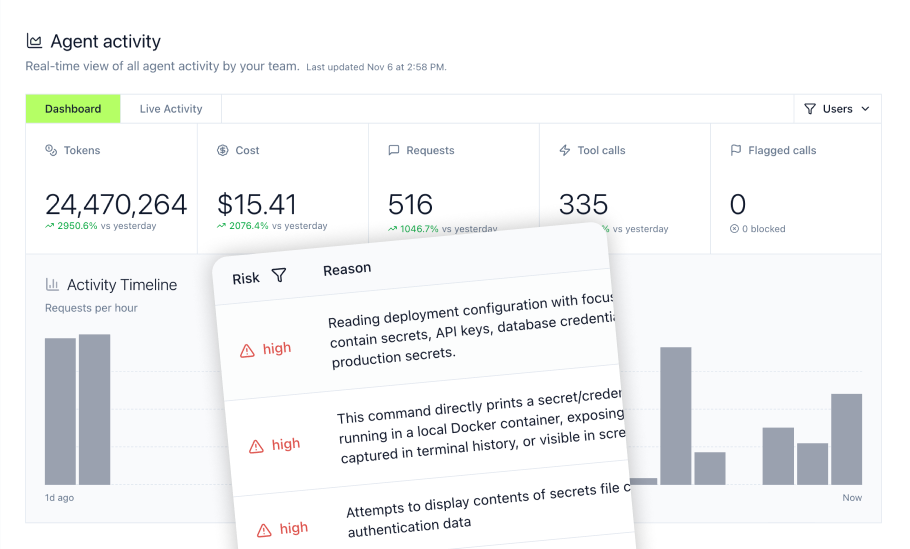
MintMCP provides Gateway plus Agent Monitor coverage. The Gateway covers MCP traffic while Agent Monitor covers local non-MCP agent activity including Bash usage, file reads and writes, and prompt submissions via Claude Code and Cursor hooks.
Deployment
Managed SaaS-first delivery with US and EU availability. VPC and self-hosted deployment available on request.
Pricing
Contact for enterprise demonstration and pricing.
Getting started
Visit mintmcp.com/mcp-gateway for deployment guides and documentation.
2. Kong Agent Gateway
Kong Agent Gateway extends Kong's established API management platform to cover AI agent workflows, providing unified governance for LLM, MCP, and A2A traffic in a single platform.
Kong's primary focus
Kong addresses organizations with existing API management infrastructure who want to extend proven gateway capabilities to agent workflows. The platform covers the complete AI data path from LLM requests through MCP tool calls to Agent-to-Agent protocol communication.
Core features
- Native A2A protocol support with RPC tracing for agent-to-agent communication
- Unified governance across LLM, MCP, and A2A traffic
- Flexible deployment through Konnect SaaS, self-hosted, or hybrid configurations
- Real-time telemetry on every A2A call with tamper-evident audit logs
Kong for data engineering
Kong's API management heritage provides mature rate limiting, authentication, and monitoring capabilities that translate well to data pipeline governance. Organizations already using Kong for API management can extend their existing infrastructure to cover AI agent data access.
Deployment options
Konnect SaaS control plane with self-hosted data plane, or fully self-hosted deployment.
Pricing
Custom enterprise pricing, contact Kong for details.
3. TrueFoundry Agent Gateway
TrueFoundry Agent Gateway provides a Kubernetes-native platform for AI agent deployment with unified gateway coverage across LLM, MCP, and agent workflows.
TrueFoundry's primary focus
TrueFoundry targets platform engineering and ML teams who need cloud-native deployment with strong compliance posture. The platform handles approximately 350+ requests per second on 1 vCPU with latency in the 3-4ms range under load.
Core features
- Kubernetes-native deployment with VPC isolation, on-premises, and air-gapped support
- Hierarchical governance with team-level RBAC, budgets, and MCP tool allow-lists
- Multi-step workflow orchestration for complex agent pipelines
- Compliance-oriented controls for teams with SOC 2, HIPAA, or GDPR requirements
TrueFoundry for data engineering
TrueFoundry's Kubernetes-native architecture fits data engineering teams already operating in containerized environments. The platform supports multi-step workflow orchestration patterns common in data pipeline scenarios.
Deployment options
Managed SaaS or self-hosted control plane in customer's Kubernetes environment. Air-gapped deployment available via forward proxy.
Pricing
Contact TrueFoundry for enterprise pricing. Free trial available.
4. Bifrost (Maxim AI)
Bifrost is an open-source AI gateway written in Go, focusing on high-performance routing with minimal overhead for latency-sensitive data workloads.
Bifrost's primary focus
Bifrost targets performance-sensitive deployments where gateway overhead matters. The platform reports approximately 11 microsecond overhead at sustained load, with semantic caching capabilities.
Core features
- Go-based implementation for performance-focused deployments
- Semantic caching with Weaviate integration
- Native MCP gateway with Code Mode for token reduction
- Four-tier budget hierarchy for cost governance
- Apache 2.0 open-source license
Bifrost for data engineering
Bifrost's semantic caching can reduce redundant queries to data sources, and its budget hierarchy supports team-level cost attribution for data platform usage.
Deployment options
Docker, Kubernetes, or air-gapped deployment. Self-hosted only; no managed SaaS offering.
Pricing
Free under Apache 2.0 license. Enterprise tier available with additional features.
5. Solo.io Agentgateway
Solo.io Agentgateway is an open-source project donated to the Linux Foundation Agentic AI Foundation, providing vendor-neutral MCP and A2A protocol support.
Solo.io's primary focus
Solo.io targets organizations wanting vendor-neutral, community-governed infrastructure. The project is hosted under Linux Foundation governance, with an open-source model and community-driven roadmap.
Core features
- Rust-based implementation for sub-millisecond overhead
- Native MCP and A2A protocol support
- Kubernetes Gateway API conformance for HTTPRoute, GRPCRoute, TCPRoute, and TLSRoute
- OpenTelemetry instrumentation for distributed tracing
Solo.io for data engineering
The Linux Foundation governance model appeals to data engineering teams concerned about vendor lock-in. Kubernetes Gateway API conformance integrates with existing cloud-native data infrastructure.
Deployment options
Self-hosted via Kubernetes. Enterprise support available from Solo.io.
Pricing
Free under Apache 2.0 license. Commercial support available.
6. Zuplo MCP Gateway
Zuplo MCP Gateway provides a fully managed cloud gateway with virtual MCP server architecture for simplified deployment.
Zuplo's primary focus
Zuplo targets teams wanting managed infrastructure without self-hosting complexity. The platform's virtual server model fronts upstream MCP servers with scoped tokens and governance controls.
Core features
- Virtual MCP servers with curated tool and resource exposure
- OAuth 2.0 authorization server bundled with IdP integration for Okta, Microsoft Entra, and Auth0
- OpenAPI-to-MCP generation for existing APIs
- Two-layer authentication between client, gateway, and upstream servers
Zuplo for data engineering
Zuplo's OpenAPI-to-MCP generation helps data teams expose existing data APIs as MCP servers without rebuilding infrastructure. Virtual server architecture enables scoped access to different data sources.
Deployment options
Managed cloud SaaS only.
Pricing
Free tier available. Usage-based pricing for higher volumes.
7. Lunar.dev MCPX
Lunar.dev MCPX provides MCP server aggregation with centralized policy enforcement and observability for production deployments.
Lunar.dev's primary focus
Lunar.dev targets platform and infrastructure teams moving MCP from experimentation to production. MCPX functions as a meta-server that aggregates other MCP servers behind a single gateway.
Core features
- MCP server aggregation behind single gateway endpoint
- Built-in administrative approval process for MCP server additions
- Dedicated per-agent workspaces with approval gates
- Full observability including latency, token cost, and request tracing
Lunar.dev for data engineering
The approval workflow model fits data governance requirements where new data source connections need review before deployment. Observability features support cost attribution for data platform usage.
Deployment options
Open-source version for self-hosting. Enterprise edition for private cloud deployment.
Pricing
Open-source version free. Enterprise pricing on request.
8. Portkey
Palo Alto Networks completed its acquisition of Portkey in May 2026, integrating AI gateway capabilities into the Prisma AIRS security platform.
Portkey's primary focus
Portkey now targets security-focused enterprises through Palo Alto Networks' distribution. The acquisition positions Portkey as part of a broader security platform for privileged-insider agent scenarios.
Core features
- Fine-grained authorization at organization, team, workspace, or user level
- OAuth 2.1 flow initiation or IdP delegation
- In-depth tracing and AI gateway integration
- Integration with Palo Alto Networks security platform
Portkey for data engineering
The Palo Alto Networks integration provides enterprise security controls for data access scenarios. Fine-grained authorization supports complex data governance requirements.
Deployment options
SaaS, VPC, or self-hosted options.
Pricing
Contact Palo Alto Networks for enterprise pricing.
9. LiteLLM
LiteLLM is an open-source Python LLM proxy providing broad provider coverage with 100+ integrations under MIT license.
LiteLLM's primary focus
LiteLLM targets developer and ML teams needing unified access to multiple LLM providers. The platform's Python-first approach fits naturally into data science and ML engineering workflows.
Core features
- 100+ LLM provider integrations with unified OpenAI-format output
- Virtual keys with team management and spend tracking
- MIT open-source license with large community
- Cost tracking and budget management per team
LiteLLM for data engineering
LiteLLM's broad provider coverage supports multi-model data analysis workflows. Virtual keys enable team-level cost attribution for LLM usage in data pipelines.
Considerations
LiteLLM focuses on LLM routing rather than MCP governance. Data teams needing MCP-specific controls should evaluate whether LiteLLM's feature set covers their requirements.
Deployment options
Self-hosted proxy, hosted LiteLLM Cloud, and Enterprise options are available.
Pricing
Free under MIT license. Enterprise tier with SSO and RBAC available.
10. Composio
Composio provides managed MCP and API-based tool connectivity for teams building agentic applications.
Composio's primary focus
Composio targets developer and AI engineering teams building agentic applications who want extensive pre-built integrations without custom development.
Core features
- Broad toolkit and tool catalog available through MCP or direct APIs
- Runtime tool selection and sandboxed environments
- IdP delegation for Okta, Microsoft Entra, and Google Workspace
- Context window optimization through just-in-time tool selection
Composio for data engineering
Composio's extensive integration catalog includes database connectors and data tools. Runtime tool selection can reduce context overhead when agents access multiple data sources.
Deployment options
Managed SaaS-first. VPC and on-premises deployment on Enterprise tier.
Pricing
Contact Composio for pricing details.
11. Apache APISIX
Apache APISIX is a cloud-native API gateway with AI proxy plugins for LLM and embedding traffic.
Apache APISIX's primary focus
Apache APISIX targets organizations with existing APISIX deployments who want to add AI capabilities without deploying separate infrastructure.
Core features
- High-performance NGINX and Lua core with cloud-native architecture
- AI proxy plugin for OpenAI, Anthropic, and other providers
- Apache Software Foundation governance with active contributor community
- Extensible via Lua, Go, Python, and Java plugins
Apache APISIX for data engineering
APISIX's plugin architecture allows custom extensions for data-specific requirements. Organizations already using APISIX for API management can extend it to cover LLM proxying for AI applications.
Deployment options
Self-hosted only under Apache 2.0 license.
Pricing
Free under Apache 2.0 license.
12. Cloudflare AI Gateway
Cloudflare AI Gateway provides edge-based AI traffic management with global caching and zero infrastructure management.
Cloudflare's primary focus
Cloudflare targets teams already using Cloudflare infrastructure who want basic AI gateway capabilities with minimal setup.
Core features
- Edge caching on Cloudflare's global network
- Zero infrastructure to deploy or maintain
- Real-time usage analytics and unified billing
- Generous free tier for initial deployment
Cloudflare for data engineering
Cloudflare's edge caching can reduce redundant LLM calls for repeated data analysis queries. Teams already on Cloudflare can add AI gateway capabilities without new infrastructure.
Considerations
Cloudflare AI Gateway provides exact-match caching only without semantic caching. Data teams needing deep MCP governance should evaluate whether Cloudflare's feature set covers their requirements.
Deployment options
Edge SaaS only on Cloudflare infrastructure.
Pricing
Free tier available. Usage-based pricing for higher volumes.
Choosing the right agent gateway for your data engineering team
For data engineering teams evaluating agent gateways, the decision comes down to how you balance governance depth, deployment speed, and integration requirements.
MintMCP Gateway provides the data-permissions-first architecture that data engineering teams need when connecting AI agents to production data sources. The platform's Virtual MCP Bundles enable team-specific data access with SCIM-driven membership, while Agent Bundles give each data agent its own identity with scoped credentials that rotate independently.
For teams managing connections to Snowflake, BigQuery, MongoDB, and other data platforms, MintMCP's hosted connectors eliminate the infrastructure overhead of running and scaling MCP servers while maintaining complete audit trails for compliance.
MintMCP's approach addresses both MCP Gateway needs (governed data and tool connections for AI systems users already run) and Agent Gateway requirements (identities, permissions, memory, and monitoring for agents that work alongside users). The platform's Agent Monitor extends governance beyond MCP traffic to cover local agent activity in Cursor and Claude Code, addressing the shadow AI detection challenge that creates blind spots in data access visibility.
Unlike point solutions that address either authentication or monitoring in isolation, MintMCP delivers both MCP Gateway infrastructure for governed tool connections and Agent Gateway capabilities for agent identity and lifecycle management. This two-layer approach ensures data engineering teams maintain complete visibility and control as they scale from individual developer usage to production agent deployments accessing sensitive data warehouses and analytics platforms.
The platform's data-permissions-first architecture starts with the foundational question: which humans and which agents should access which data tools? Virtual MCP Bundles answer this for teams, while Agent Bundles extend the same scoped-access model to non-human principals with M2M authentication, independent credential rotation, and per-agent audit trails.
Start with MintMCP Gateway to deploy governed AI agent access to your data infrastructure.
Frequently asked questions
What is an agent gateway and why do data engineering teams need one?
An agent gateway is infrastructure that governs how AI agents connect to tools, data sources, and enterprise systems as protocols like MCP and A2A become common building blocks for agent interoperability. For data engineering teams, gateways solve the credential sprawl and visibility problems that emerge when multiple AI agents need access to databases, data warehouses, and ETL pipelines. Without a gateway, organizations face fragmented security policies, duplicated authentication logic, and zero visibility into which agents access which data.
How do agent gateways integrate with existing data infrastructure like Snowflake and Databricks?
Agent gateways provide governed connectivity to data platforms through MCP server integrations. MintMCP offers hosted connectors for Snowflake, BigQuery, Databricks, PostgreSQL, MongoDB, and other data systems. These connectors wrap data platform APIs with enterprise authentication, tool-level access controls, and audit logging so data teams can enable AI agent access without rebuilding security infrastructure for each connection.
Can agent gateways handle both MCP traffic and direct LLM API calls?
Gateway capabilities vary by vendor. MintMCP provides two-layer governance through Gateway plus Agent Monitor, covering MCP traffic through the gateway while Agent Monitor covers local non-MCP agent activity including LLM calls, Bash commands, and file operations in tools like Cursor and Claude Code.
How do Virtual MCP Bundles and Agent Bundles work for data team governance?
Virtual MCP Bundles create team-specific endpoints that expose only the minimum required data tools with SCIM-driven group membership. Data analysts might get read-only database access while data engineers get write permissions. Agent Bundles extend this model to non-human principals, giving each AI agent its own identity with scoped credentials, M2M authentication, and independent rotation and revocation that does not affect other agents or human users.
What is shadow AI and how do gateways detect ungoverned agent activity?
Shadow AI refers to AI agents running through local tools without organizational oversight. This creates governance gaps where data access happens outside audit trails and security policies. MintMCP's Agent Monitor detects off-gateway MCP usage in Cursor and Claude Code through hooks, providing visibility into agent activity that would otherwise bypass gateway controls.