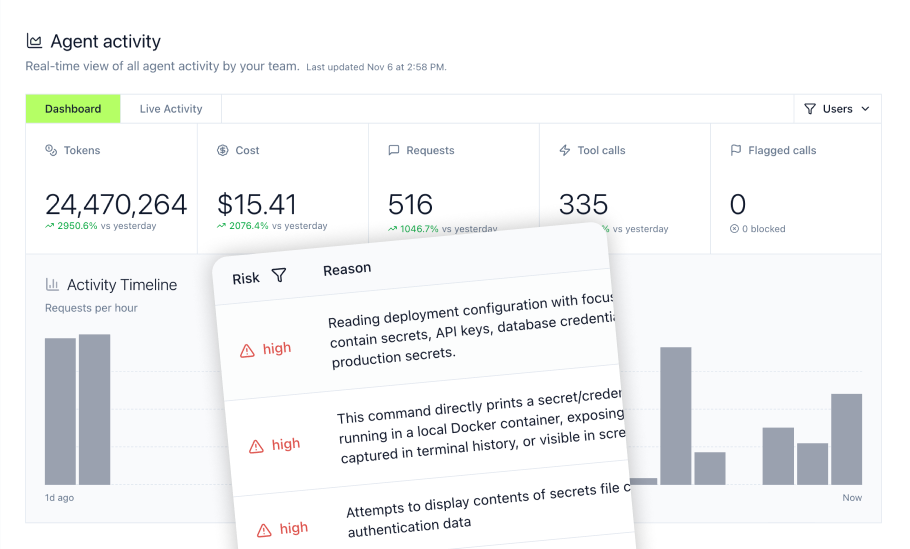
Platform engineering teams deploying AI agents face a critical infrastructure decision: how to govern, secure, and scale agent access to enterprise data and tools. With the MCP ecosystem reaching 97 million monthly SDK downloads in December 2025, agent gateways have evolved from optional middleware to essential enterprise infrastructure.
The stakes are high. Gartner projects that over 40% of agentic AI projects will face cancellation by 2027 due to escalating costs, unclear value, or inadequate risk controls. An MCP gateway addresses these challenges by centralizing authentication, access control, and observability across all agent-to-tool connections, transforming an exponentially complex N-to-N mesh into a manageable hub-and-spoke model.
This guide evaluates 12 agent gateways across governance depth, production readiness, platform engineering fit, MCP protocol fidelity, and ecosystem support to help platform teams make informed infrastructure decisions.
Key takeaways
- MintMCP Gateway delivers enterprise MCP infrastructure with a data-permissions-first architecture, Virtual MCP Bundles for per-use-case endpoints, Agent Bundles with M2M auth, hosted MCP connectors, custom gateway middleware in a JS sandbox, and centralized governance for Claude, Cursor, ChatGPT, Gemini, and Copilot
- Some gateways publish low-overhead benchmarks, but teams should distinguish gateway overhead from end-to-end tool-call latency when evaluating production performance
- Unified AI and MCP control planes address the M×N integration problem by routing model traffic and tool traffic through shared governance infrastructure
- Open-source gateway options provide flexibility for teams requiring full infrastructure control, with deployment options spanning Kubernetes, VPC, and on-premises environments
- Enterprise authentication integration through SSO, SCIM, and OAuth brokering enables platform teams to add governance to existing MCP servers without rebuilding each server
1. MintMCP Gateway: Enterprise MCP infrastructure with governed agent access
MintMCP Gateway provides an enterprise gateway for Model Context Protocol focused on authentication, tool-level access control, credential management, logging, rule-based policy, and agent governance. Its data-permissions-first architecture starts with SSO, SCIM-driven RBAC, IdP groups, Virtual MCP Bundles, tool-level policy, and audit logs, then enables agents on top.
MintMCP addresses the problem that most gateway rankings focus on feature count when the real question is which architecture fits your constraints. The platform transforms local MCP servers into governed production services with centralized observability and enterprise authentication.
What makes MintMCP Gateway different
MintMCP solves the fundamental problem platform engineering teams face when managing multiple AI agents across the organization. The platform's architecture wraps stdio, hosted, HTTP-streamable, and SSE MCP servers behind SSO-fronted remote MCP endpoints with OAuth brokering, SCIM-driven membership, and rule-based policy.
Core capabilities
- Virtual MCP Bundles: Team-specific, per-use-case endpoints that expose only required tools with SCIM-driven membership, curated tool lists, and fine-grained role-based access
- Agent Bundles: First-class identities for internal agents with M2M auth and independent credential rotation, so each agent gets its own rotatable credentials with no shared keys to leak
- Custom Gateway Middleware: Runs customer-authored middleware in a JS sandbox with external DLP and guardrails integrations for masking, blocking, and policy enforcement
- OAuth Brokering: Add enterprise authentication to stdio and hosted MCP servers without rebuilding each server
- Tool-Update Policy: Auto-enable new upstream tools or require admin approval, addressing silent capability expansion
Security and compliance
MintMCP is SOC 2 Type II audited, compliant with HIPAA standards, and penetration tested. Every agent action is logged with full context: who initiated it, which tools were called, what data flowed through, and when. Enterprise SSO, complete audit trails, PII detection, and role-based access control are built into every layer of the platform. Customers handling protected health information can request HIPAA documentation, and MintMCP signs BAAs.
Enterprise integrations
- Snowflake data warehouse access with natural language queries
- Elasticsearch knowledge base search for documentation and log analysis
- Gmail integration for AI-driven customer response automation
- Claude, Cursor, ChatGPT, Gemini, and Copilot governance through centralized gateway and Agent Monitor coverage
Deployment
Managed SaaS-first delivery with US and EU availability, hosted MCP connectors, pre-configured policies, and self-service access for developers. VPC and self-hosted deployment available on request.
Pricing
Contact for enterprise demonstration and pricing.
2. Bifrost (Maxim AI)
Bifrost is an open-source AI gateway that unifies LLM, MCP, and Agent traffic in a single binary with shared governance. Built in Go, Bifrost targets platform teams prioritizing performance overhead in high-throughput AI workloads.
Performance focus
Bifrost's 2025 benchmarks show 11 microseconds of gateway overhead at 5,000 requests per second in sustained benchmarks. The platform also markets Code Mode for reducing tool-description overhead when multiple MCP servers are connected.
Core capabilities
- Open-source Apache 2.0 license with enterprise tier available
- Stateless, explicit tool execution where tool calls are suggestions requiring separate authenticated calls
- Air-gapped, VPC, and on-premises deployment options for regulated industries
- Memory efficiency compared to alternatives through Go-based architecture
Platform engineering fit
Bifrost targets platform teams that want to self-host their gateway infrastructure with full control over the runtime. The unified gateway handles LLM, MCP, and Agent traffic through a single binary, reducing operational complexity for teams already managing Kubernetes environments.
Deployment
Self-hosted via Go binary or Docker. Enterprise tier available for VPC installations.
3. TrueFoundry
TrueFoundry provides an enterprise AI gateway and MLOps platform with a centralized MCP registry that addresses the M×N integration problem through a single MCP endpoint architecture.
Industry recognition
TrueFoundry says it was named in the 2025 Gartner Market Guide for AI Gateways.
Core capabilities
- Centralized MCP registry solving M×N integration complexity
- Published benchmarks showing 3-4ms latency at load with 350+ RPS on 1 vCPU
- Unified AI and MCP control plane where model traffic and tool traffic share governance
- Multi-step workflow support for agentic task execution involving multiple tools
Platform engineering fit
TrueFoundry targets platform engineering and ML platform teams who need unified governance across LLM and MCP traffic. The platform supports Kubernetes, VPC, and on-premises deployment for teams requiring infrastructure flexibility.
Deployment
Kubernetes, VPC, and on-premises deployment options. Managed SaaS also available.
Pricing
Contact TrueFoundry for current pricing.
4. Lunar.dev MCPX
Lunar.dev MCPX is an MCP gateway that centralizes policy enforcement, access control, and observability to take MCP from local experimentation to governed production deployments.
Core capabilities
- RBAC and ACLs at global, service-level, or tool-level permissions per agent
- Tool customization to create safe tool variants by rewriting descriptions or locking parameters
- AI Gateway integration for end-to-end traffic inspection, prompt sanitization, and policy enforcement
- Evaluation sandbox to test MCP server behavior before production deployment
- Open-source MIT license for the MCPX core
Platform engineering fit
MCPX targets platform and infrastructure teams deploying MCP to production. The gateway supports STDIO and remote HTTP/SSE MCP servers with Docker and Kubernetes deployment options.
Deployment
Self-hosted via Docker or Kubernetes with optional SaaS dashboards for telemetry and control plane visibility.
5. Portkey
Portkey provides an enterprise AI gateway and LLMOps platform that centralizes authentication, access, and observability across MCP servers. The platform serves 3,000+ GenAI teams and processes over 1 trillion tokens daily.
Acquisition context
Palo Alto Networks announced its intent to acquire Portkey on April 30, 2026, and announced the acquisition had closed on May 29, 2026. Portkey now serves as "AI Gateway for Prisma AIRS" security platform. Buyers should evaluate whether PANW's security-focused roadmap aligns with standalone gateway needs.
Core capabilities
- Unified access to 1,600+ LLMs via single API
- Fine-grained OAuth 2.1 authentication at org, team, and user levels
- Apache 2.0 open-source core
- SaaS, VPC, and self-hosted deployment options
Platform engineering fit
Portkey targets developers and platform engineering teams who need centralized LLM and MCP governance. The platform's LLMOps focus provides observability and cost tracking across multiple AI providers.
Deployment
SaaS, VPC, and self-hosted options. Post-acquisition roadmap now tied to Palo Alto Networks priorities.
6. Kong AI Gateway
Kong AI Gateway extends established API gateway infrastructure to support AI workloads, providing unified governance for API, LLM, MCP, and A2A protocol traffic through a single control plane.
Core capabilities
- Unified governance across API and AI traffic from a single platform
- Semantic caching for LLM response optimization
- A2A protocol support for agent-to-agent communication governance
- Kong plugin ecosystem extending to AI features
- Konnect SaaS control plane with self-hosted data plane options
Platform engineering fit
Kong targets platform engineering and API platform teams already standardized on Kong who want to extend existing infrastructure to AI workloads. The plugin architecture allows teams to add AI capabilities without deploying separate infrastructure.
Deployment
Hybrid deployment with Konnect SaaS control plane and self-hosted data plane, or fully self-hosted.
Pricing
Enterprise license with contact-based pricing.
7. Composio
Composio is an agentic integration platform with MCP support that provides 900+ pre-built connectors for rapid integration across enterprise tools.
Security incident disclosure
Composio disclosed a May 2026 security incident affecting API keys and GitHub OAuth tokens for a subset of connections. Credentials were rotated and revoked. This incident highlights centralized credential storage risks applicable to any gateway architecture.
Core capabilities
- 900+ pre-built connectors with managed OAuth flows and token refresh
- Tool Router for dynamic discovery and single MCP endpoint intelligent routing
- Runtime tool selection loading only needed capabilities
- Published latency overhead under 5 milliseconds
Platform engineering fit
Composio targets developer and AI engineering teams building agentic applications who prioritize time-to-integration. The breadth of pre-built connectors reduces custom integration work.
Deployment
Managed SaaS-first. VPC and on-premises available on Enterprise tier.
8. Zuplo MCP Gateway
Zuplo MCP Gateway provides a fully managed gateway with virtual MCP servers that create curated views of upstream servers exposing only selected tools and prompts.
Beta status
Zuplo MCP Gateway entered public beta in June 2026, making it a newer offering in the category. Production maturity should be evaluated against longer-established gateways.
Core capabilities
- Virtual MCP servers creating curated capability subsets of upstream servers
- OAuth 2.0 with credential brokering at two layers (client-to-gateway, gateway-to-upstream)
- OpenAPI-to-MCP generation turning existing APIs into MCP tools
- Library of curated servers for Linear, GitHub, Notion, and Stripe
- Capability curation creating read-only MCP server versions by filtering destructive tools
Platform engineering fit
Zuplo targets teams wanting minimal operational overhead with a fully managed cloud platform. The virtual server architecture addresses over-privileged access concerns.
Deployment
Fully managed SaaS. No self-hosted option.
9. Cloudflare AI Gateway
Cloudflare AI Gateway brings edge-native AI traffic management with distributed presence across Cloudflare's global network.
Core capabilities
- Global edge network deployment reducing latency
- Durable Objects providing persistent agent state across requests
- Shadow MCP detection through DLP engine identifying unauthorized MCP server usage
- Cloudflare Workers integration for hosting MCP servers at edge
- Free tier with usage-based pricing
Platform engineering fit
Cloudflare targets organizations whose security perimeter already lives at the network edge. Most capabilities assume Cloudflare One, Workers, and Access are already in place, which limits portability for multi-cloud environments.
Deployment
Managed edge deployment through Cloudflare infrastructure.
Pricing
Free tier available with usage-based pricing tiers.
10. LiteLLM
LiteLLM is an open-source Python-based LLM gateway that normalizes API calls into OpenAI format, providing flexibility for teams avoiding vendor lock-in.
Core capabilities
- Provider abstraction normalizing API calls across LLM providers
- Open-source MIT license with self-hosted deployment
- Python-based architecture familiar to data science teams
- Active developer community with extensive documentation
Platform engineering fit
LiteLLM targets developers building prototypes and teams requiring full infrastructure control. Multiple sources note LiteLLM struggles beyond moderate RPS and is best suited for light or prototype workloads rather than production enterprise deployments.
Deployment
Self-hosted open-source. Enterprise support available.
Pricing
Free open-source. Enterprise support pricing available.
11. Lasso Security
Lasso Security provides a security-first MCP gateway focused on protecting agentic workflows from prompt injection, credential theft, and tool poisoning attacks. The company was named a 2024 Gartner Cool Vendor for AI Security.
Core capabilities
- Real-time prompt injection detection and blocking
- Tool reputation analysis tracking and scoring MCP servers based on behavior
- Tool authorization with parameter validation
- Network filtering and allowlisting for MCP destinations
- MCP-specific threat handling including tool poisoning and rug-pull detection
Platform engineering fit
Lasso targets security-sensitive deployments requiring active threat detection. The platform implements protection across three distinct layers: AI layer, MCP layer, and API layer. Performance overhead in the 100-250 millisecond range means Lasso is typically layered onto a governance or identity gateway rather than replacing one.
Deployment
Open-source core with enterprise offering. Cloud-managed service with enterprise SLA.
12. Solo.io Agent Gateway
Solo.io Agent Gateway brings Kubernetes-native agent governance with Envoy-based data plane technology, now under Linux Foundation governance through the Agentic AI Foundation.
Linux Foundation governance
Solo.io Agent Gateway was donated to the Linux Foundation's Agentic AI Foundation, transitioning to community governance with backing from T-Mobile, CoreWeave, Akamai, Dell, and UBS.
Core capabilities
- Kubernetes-native configuration via custom resources integrating with Gateway API
- MCP and A2A protocol support for agent-to-agent communication
- Envoy-based data plane built on mature service mesh technology
- Policy-as-code approach using CEL descriptors for per-tool rate limiting
- Open core with enterprise tier
Platform engineering fit
Solo.io targets platform teams already operating Kubernetes and Envoy. The service mesh heritage positions it as "service mesh for agentic AI." Teams without that infrastructure footprint, or teams whose primary need is identity or a connector catalog, may find other options more aligned.
Deployment
Self-hosted on Kubernetes. Requires platform engineering maturity for operations.
Choosing the right agent gateway for your platform team
For platform engineering teams evaluating agent gateways, the decision comes down to architectural fit and operational requirements.
MintMCP Gateway addresses the core challenge platform teams face: deploying AI agents with full governance without slowing down engineering velocity. The data-permissions-first architecture means governance is the foundation rather than an afterthought. Virtual MCP Bundles provide per-use-case endpoints with SCIM-driven membership, while Agent Bundles give each AI agent its own identity with M2M auth and scoped credentials.
MintMCP's Agent Gateway extends the MCP Gateway foundation to provide identities, permissions, memory, and monitoring for agents that work alongside users. For teams deploying Claude, Cursor, ChatGPT, Gemini, or Copilot across the organization, MintMCP provides two-layer governance: the gateway covers MCP traffic while Agent Monitor covers local non-MCP agent activity including Bash usage, file reads/writes, and prompt submissions.
The platform's hosted MCP connectors run on MintMCP's infrastructure with auto-scaling and sandboxed execution per connector, eliminating the need for platform teams to manage Kubernetes pods, runtimes, or scaling for the connector layer. Combined with OAuth brokering for stdio and hosted servers, teams can turn MCP servers into governed production services in minutes rather than weeks.
Visit mintmcp.com/mcp-gateway to learn more about MintMCP Gateway.
Frequently asked questions
What is an agent gateway and why do platform engineering teams need one?
An agent gateway is infrastructure that governs how AI agents connect to enterprise tools and data sources. Without a gateway, platform teams face fragmented security policies across dozens of individual MCP servers, zero visibility into which agents access which tools, duplicated authentication logic, and inconsistent logging. Agent gateways transform this N-to-N complexity into a manageable hub-and-spoke model with centralized authentication, authorization, and observability.
How do agent gateways differ from traditional API gateways?
Agent gateways specifically handle the Model Context Protocol for connecting AI assistants to tools and data, supporting transports such as stdio, HTTP-streamable, and SSE. Traditional API gateways route HTTP/REST requests between services. While some API gateway vendors are adding MCP features, purpose-built agent gateways understand protocol-specific requirements like context state management across multi-step agent workflows, tool authorization semantics, and stdio server hosting that traditional gateways do not address.
What security and compliance features should I look for in an agent gateway?
Enterprise agent gateways should provide SSO integration, SCIM-driven RBAC for identity provider group sync, tool-level access controls, comprehensive audit trails, credential management with rotation capabilities, and compliance documentation and attestations appropriate to your industry. Gateways serving healthcare organizations should support HIPAA documentation and BAA signing. Look for real-time monitoring that shows which agents access which tools, when they access data, and how frequently.
Can agent gateways detect and prevent shadow AI in my organization?
Yes. Agent gateways with monitoring capabilities can identify unauthorized MCP server usage and block unsanctioned connections. MintMCP's two-layer governance provides Gateway coverage for MCP traffic plus Agent Monitor coverage for local non-MCP agent activity through Claude Code and Cursor hooks. This creates visibility into agent actions that would otherwise operate outside IT governance.
How does an agent gateway integrate with existing identity providers and SIEMs?
Enterprise agent gateways integrate with identity providers like Okta and Azure AD through SCIM for group membership sync and SSO for authentication. Audit logs can be exported to SIEM platforms including Microsoft Sentinel, Splunk, and S3 for centralized security monitoring. Look for gateways that support OAuth 2.x brokering so you can add enterprise authentication to MCP servers without rebuilding each server.