Selecting the right agent gateway determines whether your cybersecurity organization can deploy AI agents securely or face uncontrolled access to sensitive systems. With 86% of enterprises requiring tech stack upgrades to properly deploy AI agents, cybersecurity companies need infrastructure that provides centralized authentication, real-time monitoring, and enterprise-grade compliance from day one.
An agent gateway sits between AI agents and enterprise systems, providing authentication, authorization, audit logging, and policy enforcement for autonomous AI workflows. For cybersecurity companies handling sensitive client data, threat intelligence, and security operations, the right gateway transforms scattered agent-to-tool connections into governed, observable infrastructure that security teams can actually audit.
The challenge is acute: 52% of deployed agents are actively monitored or secured, leaving 48% without coverage, creating blind spots that cybersecurity firms cannot afford. This guide evaluates the agent gateways that address these gaps for security-focused organizations.
Key Takeaways
- MintMCP Gateway provides a data-permissions-first architecture with SSO and SCIM-driven RBAC, Virtual MCP Bundles, Agent Bundles with per-agent identity, hosted MCP connectors, tool-level policy enforcement, and comprehensive audit logging for cybersecurity compliance
- MCP Gateway handles governed data and tool connections for AI systems like Claude, Cursor, ChatGPT, Gemini, and Copilot
- Agent Gateway provides identities, permissions, memory, and monitoring for agents that work alongside security teams
- Agent Monitor tracks agent activity in real-time across the organization, including MCP calls made outside the gateway through hooks in Cursor and Claude Code
- TrueFoundry offers unified LLM and MCP management with semantic caching for high-volume AI workloads
- Lasso Security offers an open-source MCP gateway with request and response guardrails, sensitive-data sanitization, server risk scanning, and plugin-based tracing
- Portkey provides LLM and MCP gateway capabilities with centralized authentication, access control, policy enforcement, logging, and observability
- Composio combines a managed integration catalog with an enterprise MCP gateway, scoped endpoints, delegated authentication, fine-grained RBAC, and execution logs
- Obot Platform offers open-source and hosted MCP management with server hosting, access policies, audit logs, registries, and agent capabilities
- AgentGateway.dev provides a Linux Foundation-backed open-source option for organizations with operational capacity for gateway infrastructure
1. MintMCP Gateway: Enterprise AI governance for cybersecurity teams
MintMCP Gateway provides an enterprise gateway for Model Context Protocol focused on authentication, tool-level access control, credential management, logging, rule-based policy, and agent governance. The platform's data-permissions-first architecture starts with SSO, SCIM-driven RBAC, IdP groups, Virtual MCP Bundles, tool-level policy, and audit logs, then enables agents on top.
For cybersecurity companies, this approach addresses the security concerns that 62% of practitioners identified when developing and deploying AI agents. Rather than retrofitting security onto existing agent deployments, MintMCP builds governance into the foundation.
What makes MintMCP Gateway different
MintMCP solves the integration complexity that 42% of enterprises encounter when needing access to 8 or more data sources for AI agent deployment. The architecture wraps stdio, hosted, HTTP-streamable, and SSE MCP servers behind SSO-fronted remote MCP endpoints with OAuth brokering, SCIM-driven membership, and rule-based policy.
The platform connects MCP Gateway capabilities with Agent Gateway functionality. MCP Gateway handles governed data and tool connections for AI systems like Claude, Cursor, ChatGPT, Gemini, and Copilot. Agent Gateway provides identities, permissions, memory, and monitoring for agents that work alongside security teams.
Core capabilities for cybersecurity organizations
- Hosted MCP Connectors: MintMCP runs connector instances with auto-scaling and sandboxed execution per connector, reducing infrastructure overhead for security operations
- OAuth Brokering: Add enterprise authentication to local and hosted MCP servers including OAuth 2.x, bearer tokens, headers, and SSO-fronted access without rebuilding each server
- Real-Time Monitoring: Live dashboards showing server health, usage patterns, tool call tracking, and security alerts across all MCP connections
- Granular Access Control: Configure tool access by role with read-only operations for analysts while restricting write tools to authorized administrators
- Virtual MCP Bundles: Create team-specific endpoints that expose only the minimum required tools with SCIM-driven membership, curated tool lists, and fine-grained role-based access
- Agent Bundles: Give internal agents first-class identities with M2M auth, scoped tools, independent rotation and revocation, and an "act as agent" flow for connectors requiring per-agent OAuth
- Custom Gateway Middleware: Runs customer-authored middleware in a JS sandbox with external DLP and guardrails integrations for masking, blocking, and policy enforcement
Shadow AI detection with Agent Monitor
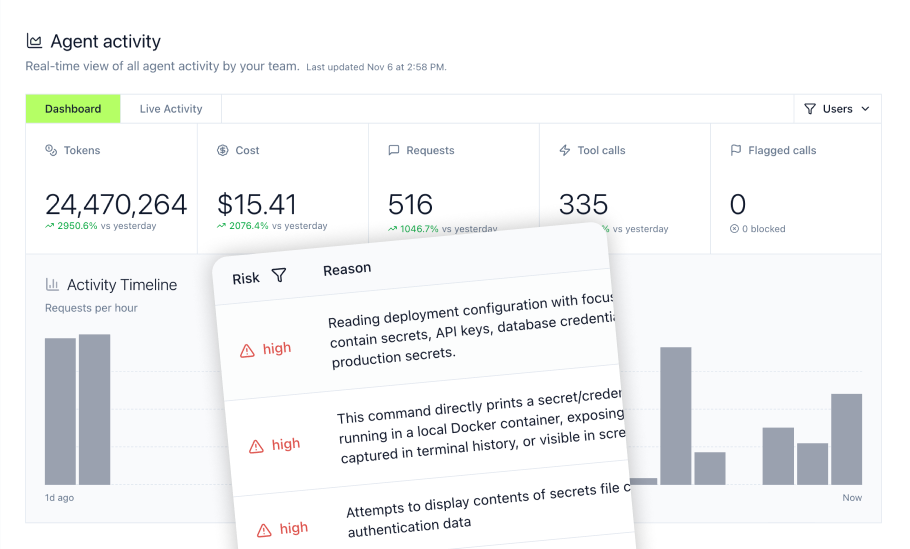
Agent Monitor tracks agent activity in real-time across the organization, including MCP calls made outside the gateway through hooks in Cursor and Claude Code. For cybersecurity companies, this addresses the visibility gap where security teams cannot see what tools agents access or when they touch sensitive data.
The platform detects:
- Sensitive file access in agent workflows
- Credential leakage including API keys and tokens
- Risky bash commands executed by coding agents
- Prompt injection attempts targeting security tools
When configured rules detect leaked credentials, risky commands, unauthorized tool access, or prompt-injection patterns, Agent Monitor can flag, block, request approval, mask supported content, or send Slack notifications. PII and DLP controls are handled through gateway middleware integrations.
This creates two-layer governance: the gateway covers MCP traffic while Agent Monitor covers local non-MCP agent activity including bash usage, file reads and writes, and prompt submissions.
Security architecture for regulated environments
MintMCP implements defense-in-depth security through centralized governance, SSO enforcement, SCIM-driven RBAC, tool-level policy, credential management, and observability controls. The platform addresses the reality that 53% of leaders identified security as a top challenge when developing and deploying AI agents.
Every agent action is logged with full context: who initiated it, which tools were called, what data flowed through, and when. Logs export to SIEM platforms including Microsoft Sentinel and Splunk through the SIEM export functionality.
Enterprise integrations for security workflows
- Snowflake data warehouse access for threat intelligence queries and security analytics
- Elasticsearch knowledge base search for log analysis, incident documentation, and security research
- GitHub, Jira, and CI/CD pipeline connections for secure development workflows
- Custom MCP server deployment for internal security tools and APIs
- Claude, Cursor, ChatGPT, Gemini, and Copilot governance through centralized gateway and Agent Monitor coverage
Compliance posture
MintMCP is SOC 2 Type II audited with continuous compliance monitoring via Drata. Enterprise SSO, complete audit trails, sensitive file access detection, and role-based access control are built into every layer of the platform. Customers handling protected health information can request HIPAA documentation. MintMCP is compliant with HIPAA standards and signs BAAs.
Visit the Trust Center at trust.mintmcp.com or contact security@mintmcp.com for compliance documentation.
Deployment and pricing
Deploy with managed SaaS-first delivery with US and EU availability, hosted MCP connectors, pre-configured policies, and self-service access for developers. VPC and self-hosted deployment are available on request.
Contact MintMCP for enterprise demonstration and pricing at enterprise@mintmcp.com.
2. TrueFoundry Agent Gateway
TrueFoundry Agent Gateway provides unified management for LLM routing and MCP server orchestration in a single platform. The solution focuses on organizations running high-volume AI workloads that need both model management and tool governance.
TrueFoundry's primary focus
The platform emphasizes LLM cost optimization through semantic caching and intelligent routing. Organizations using multiple model providers can consolidate API management while adding MCP governance capabilities.
Core capabilities
- Unified LLM and MCP management through a single control plane
- Semantic caching for reducing redundant model calls
- Team-level budget controls and cost allocation
- Support for both SaaS and self-hosted deployment models
- Integration with Kubernetes environments for infrastructure teams
Where TrueFoundry fits
Platform engineering and ML teams managing substantial AI infrastructure who want consolidated LLM routing alongside MCP governance. Organizations with existing Kubernetes expertise and teams prioritizing cost optimization for high-volume AI workloads.
Considerations for cybersecurity teams
Cybersecurity organizations should evaluate whether TrueFoundry provides the MCP-specific governance primitives needed for security workflows, including SCIM-driven Virtual MCP Bundles, Agent Bundles with M2M auth, tool-update policy controls, hosted connector operations, and OAuth brokering for stdio and hosted MCP servers.
3. Lasso Security
Lasso Security provides an open-source MCP Gateway with threat protection as the foundational design principle. The platform focuses on protecting agentic workflows through request and response guardrails.
Lasso's primary focus
The platform emphasizes security controls for MCP traffic through plugin-based interception. Security teams concerned with applying guardrails to agent requests and responses may find the plugin architecture aligns with their priorities.
Security features
- Request and response interception with sensitive-information sanitization
- Security scanning for MCP server reputation and potential risks before loading
- Plugin-based guardrails that inspect and modify requests and responses
- Tracing plugins for logging, metrics, and debugging
- Extensible support for custom security and monitoring plugins
Protection architecture
Lasso uses a plugin-based gateway architecture that can apply guardrails to MCP requests and responses, scan MCP servers before loading, and add tracing for monitoring and debugging.
Where Lasso fits
Organizations prioritizing threat protection in AI deployments, particularly those handling sensitive data requiring defense-in-depth security architecture. Teams with existing security tool investments who want MCP-specific threat detection.
Considerations for cybersecurity teams
A security-first MCP gateway emphasizes threat detection and policy enforcement. Cybersecurity organizations should also evaluate whether it supports the operational governance layer including SCIM-driven RBAC, per-use-case tool bundles, audit logs, centralized observability, hosted connector management, and per-agent identity with rotation and revocation.
4. Portkey
Portkey provides AI, MCP, and agent gateway capabilities spanning model routing, observability, centralized MCP authentication, access control, policy enforcement, and logging.
Portkey's primary focus
The platform emphasizes unified management across LLM and MCP infrastructure with detailed observability. Teams building AI applications can consolidate their model and tool management through a single interface.
Core capabilities
- Multi-provider LLM routing with failover support
- SCIM-based organization management and workspace provisioning
- MCP server authorization and tool provisioning
- Identity forwarding and centralized logging
- Request logging and debugging tools
- Support for major model providers
- Both SaaS and self-hosted deployment options
Where Portkey fits
Developer and platform engineering teams building AI applications who need unified LLM and MCP management. Organizations wanting detailed observability across their AI infrastructure.
Considerations for cybersecurity teams
Portkey provides SCIM-based organization management, workspace and user provisioning, MCP server authorization, tool provisioning, identity forwarding, and centralized logging. Cybersecurity organizations should compare these capabilities with their requirements for per-agent identity, off-gateway activity monitoring, hosted connector operations, and policy workflows.
5. Composio
Composio provides a managed MCP Gateway and integration platform for connecting AI agents to external services with delegated authentication, scoped access, execution infrastructure, and governance controls.
Composio's primary focus
The platform emphasizes breadth of integrations combined with enterprise MCP Gateway capabilities. Development teams building AI products that need to interact with multiple external services can access pre-built connectors with governance controls.
Core capabilities
- Extensive catalog of third-party application connectors
- Scoped MCP endpoints with fine-grained RBAC
- Managed authentication and OAuth handling
- Execution logs and audit trails
- Support for multiple AI agent frameworks
- Managed SaaS deployment with enterprise options
Where Composio fits
AI engineering teams building agentic applications that need integration with third-party services. Organizations prioritizing connector breadth combined with enterprise governance capabilities.
Considerations for cybersecurity teams
Composio provides scoped MCP endpoints, fine-grained RBAC, managed authentication, and execution logs alongside its integration catalog. Cybersecurity organizations should compare these capabilities with their requirements for directory-driven provisioning, per-agent identity, tool-update approval workflows, and off-gateway activity monitoring.
6. Obot Platform
Obot Platform offers open-source and hosted MCP management with server hosting, access policies, audit logs, registries, and agent capabilities as part of a broader AI agent orchestration framework.
Obot's primary focus
The platform emphasizes MCP management with both open-source and hosted options. Teams can choose between infrastructure ownership through open-source deployment or managed delivery with the hosted platform.
Core capabilities
- Open-source gateway implementation with community support
- Hosted platform option with managed infrastructure
- MCP hosting with access policies and authentication
- Audit logs, usage tracking, and request filtering
- Agent workflow orchestration via the companion Nanobot framework
- Extensible architecture for custom integrations
- Docker for development and Kubernetes for production environments
Where Obot fits
Platform engineering teams who want flexibility between hosted and self-hosted options. Organizations building custom AI agent platforms and teams prioritizing open-source tools for transparency and community-driven development.
Considerations for cybersecurity teams
Obot supports both hosted and self-hosted deployment and includes MCP hosting, access policies, authentication, audit logs, usage tracking, and request filtering. Cybersecurity teams should compare its identity-provider support, policy granularity, agent identity model, and operational responsibilities with their requirements.
7. AgentGateway.dev
AgentGateway.dev provides an open-source MCP gateway backed by the Linux Foundation's Agentic AI Foundation. The project focuses on providing community-driven gateway capabilities for organizations with operational capacity for gateway infrastructure.
AgentGateway's primary focus
The platform emphasizes open-source development with Linux Foundation governance. Teams comfortable operating gateway infrastructure can deploy and contribute to the project.
Core capabilities
- Open-source implementation under Linux Foundation governance
- Support for MCP and A2A protocols
- Authorization and traffic policies
- TLS, rate limiting, retries, and observability features
- Community-driven development and support
- Standalone and Kubernetes deployment options
Where AgentGateway fits
Organizations that prefer open-source gateway infrastructure and have the operational capacity to deploy and maintain it. Teams wanting unified handling of HTTP, gRPC, MCP, A2A, and LLM traffic may also consider the project.
Considerations for cybersecurity teams
Agentgateway includes authorization, traffic policies, TLS, rate limiting, retries, and observability-oriented gateway capabilities. Cybersecurity teams should evaluate whether its identity integration, organization-level RBAC, audit evidence, support model, and compliance controls meet their requirements.
Essential selection criteria for cybersecurity organizations
Authentication and identity architecture
Cybersecurity companies need gateway solutions that support enterprise identity requirements. Evaluate whether your gateway provides:
- SSO integration with your identity provider
- SCIM-driven group membership for automated access provisioning
- Per-agent identity with independent credential rotation
- M2M authentication for autonomous agent workflows
- OAuth brokering for MCP servers that require it
MintMCP provides all these capabilities through its SCIM integration with Okta and Azure AD, plus Agent Bundles that give each agent its own credential set.
Audit and compliance capabilities
With 62% of practitioners identifying security as a top challenge, cybersecurity organizations need comprehensive audit trails. Essential requirements include:
- Conversation-level logging with full context
- Tool call tracking with data flow visibility
- SIEM export to existing security infrastructure
- Immutable audit records for compliance investigations
- Configurable retention policies
Shadow AI detection
The reality that 52% of deployed agents are actively monitored or secured, leaving 48% without coverage, creates unacceptable risk for cybersecurity firms. Evaluate whether your gateway provides visibility into:
- Off-gateway MCP usage in developer tools
- Local agent activity including bash commands and file operations
- Unauthorized tool access attempts
- Sensitive file exposure in agent workflows
MintMCP's Agent Monitor addresses this through hooks in Cursor and Claude Code that detect activity outside the gateway.
Governance architecture
Cybersecurity organizations managing multiple teams and agent deployments need governance primitives that scale. Key capabilities include:
- Per-use-case endpoints with scoped tool access
- SCIM-driven membership that syncs with directory groups
- Tool-update policies that require admin approval
- Granular access controls at the tool level
- Credential management with rotation and revocation
MintMCP's Virtual MCP Bundles provide this governance through a single abstraction that ties SCIM group membership to curated tool lists, custom policy rules, and isolated audit trails.
Deployment and operational requirements
Consider your organization's infrastructure capabilities and preferences:
- Managed SaaS for rapid deployment with minimal operational overhead
- Self-hosted options for full infrastructure control
- VPC or self-hosted deployment for infrastructure-control requirements
MintMCP offers managed SaaS-first delivery with US and EU availability, plus VPC and self-hosted options on request.
Understanding agent gateway architecture for security operations
The point-to-point problem in cybersecurity
Without gateways, cybersecurity organizations face fragmented security policies across dozens of individual MCP servers, zero visibility into which agents access which tools, duplicated authentication logic, and inconsistent logging. This creates operational complexity that makes AI agent security impossible to maintain.
MCP is now governed under the Linux Foundation's Agentic AI Foundation, reflecting its growing role as shared infrastructure for agent-to-tool connectivity. Cybersecurity companies cannot manually audit each connection as MCP adoption expands.
Gateway value for security teams
Centralized gateways provide:
- Unified authentication eliminating scattered credentials
- Complete audit trails for compliance requirements
- Real-time monitoring across all interactions
- Simplified troubleshooting through single logging endpoints
- Shared policy enforcement across all agents
As MCP server usage grows, gateway infrastructure can reduce repeated authentication, governance, and monitoring work.
Defense-in-depth architecture
Effective agent gateways implement layered security:
- Gate 1 protects AI client-to-LLM communication including prompt injection and sensitive data filtering
- Gate 2 protects LLM-to-MCP server communication including tool authorization and parameter validation
- Gate 3 protects MCP server-to-external API communication including rate limiting and authentication
This layered approach addresses security vulnerabilities that affect MCP deployments.
Implementation roadmap for cybersecurity deployments
Phase 1: Pilot deployment
Begin with a limited-scope deployment for a small user group accessing a carefully selected set of MCP servers. Choose low-risk use cases like internal knowledge base search or development tool integration. This phase validates architecture, identifies integration challenges, and establishes baseline metrics without organization-wide risk.
Phase 2: Governance framework
Establish policies for server vetting and approval. Define role-based access controls aligned with organizational structure. Implement monitoring and alerting for security events. Document operational procedures for ongoing management. Create a governance council including security, legal, and business stakeholders to approve new MCP server deployments.
Phase 3: Enterprise rollout
Expand to additional teams and use cases based on pilot success metrics. Integrate with enterprise identity providers for SSO enforcement. Connect production data sources like data warehouses and enterprise search. Enable self-service access for developers while maintaining centralized governance. Monitor usage patterns to optimize resource allocation.
Success metrics for security organizations
Track deployment velocity and time from server request to production. Monitor security events detected and prevented. Measure developer satisfaction with tooling access. Calculate compliance audit preparation time reduction. Evaluate cost per AI interaction across teams.
Deploy governed AI agents for your cybersecurity organization
For cybersecurity companies deploying AI agents in 2026, the choice of agent gateway directly impacts security posture, compliance readiness, and operational efficiency. MintMCP Gateway provides the data-permissions-first architecture that security teams need with two connected layers: MCP Gateway for governed data and tool connections to AI systems like Claude, Cursor, ChatGPT, Gemini, and Copilot, and Agent Gateway for identities, permissions, memory, and monitoring of agents working alongside security teams.
The MCP Gateway foundation delivers SSO and SCIM-driven RBAC, Virtual MCP Bundles for per-team governance, hosted MCP connectors with auto-scaling and sandboxed execution, OAuth brokering for local and hosted servers, and comprehensive audit logging. The Agent Gateway layer builds on this foundation with Agent Bundles that provide per-agent identity, M2M authentication, scoped tools, independent credential rotation and revocation, and an "act as agent" flow for connectors requiring per-agent OAuth.
The platform's two-layer governance through MCP Gateway plus Agent Monitor addresses both MCP traffic and local agent activity, closing the visibility gaps that create risk in cybersecurity environments. Agent Monitor tracks off-gateway MCP usage in developer tools like Cursor and Claude Code through hooks that detect bash commands, file operations, credential leakage, and prompt-injection attempts, providing security teams with coverage across both governed gateway traffic and local developer activity.
With SOC 2 Type II audited controls, compliance with HIPAA standards, BAA availability, and SIEM export to existing security infrastructure, MintMCP supports the compliance requirements that cybersecurity organizations face. The custom gateway middleware runs customer-authored code in a JS sandbox with integrations for external DLP and guardrails tools including AWS Bedrock Guardrails, Google Cloud DLP, Microsoft Purview, Nightfall, and Skyflow.
Start your evaluation at mintmcp.com/mcp-gateway or contact enterprise@mintmcp.com for a demonstration tailored to cybersecurity use cases.
Frequently asked questions
What is an agent gateway and why is it essential for cybersecurity companies?
An agent gateway is a centralized control layer that sits between AI agents and enterprise systems, providing authentication, authorization, audit logging, and policy enforcement for autonomous AI workflows. For cybersecurity companies, agent gateways transform scattered agent-to-tool connections into governed infrastructure where security teams can see which tools agents access, when they touch sensitive data, and how frequently. This addresses the compliance requirements and audit trail needs that cybersecurity firms face when deploying AI agents that interact with threat intelligence, customer data, and security operations systems.
How does MintMCP's Bundle architecture enhance security and compliance for AI agents?
MintMCP's Bundle architecture, including Virtual MCP Bundles and Agent Bundles, packages tool access, policy enforcement, and audit logging into single governance units. Virtual MCP Bundles create per-team or per-use-case endpoints with SCIM-driven membership, curated tool lists, and fine-grained access controls. Agent Bundles give each AI agent its own identity with M2M authentication, scoped tools, and independent credential rotation. This means security teams can grant least-privilege access, audit each agent's actions separately, and rotate or revoke credentials for one agent without affecting others.
What is shadow AI and how does MintMCP detect and mitigate it?
Shadow AI refers to AI agent activity that occurs outside governed infrastructure, creating blind spots where security teams cannot monitor data access or tool usage. MintMCP's Agent Monitor detects off-gateway MCP usage in developer tools like Cursor and Claude Code through hooks that track local agent activity including bash commands, file operations, and prompt submissions. When configured rules detect leaked credentials, risky commands, unauthorized tool access, or prompt-injection patterns, the platform provides real-time alerts and can automatically block the action. PII and DLP controls are handled through gateway middleware integrations.
Which compliance standards does MintMCP meet for cybersecurity firms?
MintMCP is SOC 2 Type II audited with continuous compliance monitoring via Drata. The platform is compliant with HIPAA standards and signs BAAs for customers handling protected health information. Enterprise SSO, complete audit trails, sensitive file access detection, and role-based access control are built into every layer. Audit logs export to SIEM platforms including Microsoft Sentinel and Splunk for integration with existing security monitoring infrastructure. Visit trust.mintmcp.com for full security documentation.
How does MintMCP integrate with existing enterprise security infrastructure?
MintMCP integrates with enterprise identity providers including Okta and Azure AD for SSO and SCIM-driven access provisioning. Audit logs export to SIEM platforms like Microsoft Sentinel and Splunk. The platform includes custom gateway middleware that runs in a JS sandbox with integrations for external DLP and guardrails tools including AWS Bedrock Guardrails, Google Cloud DLP, Microsoft Purview, Nightfall, and Skyflow. Data warehouse connections support Snowflake and Elasticsearch for security analytics and log analysis workflows.