Data analytics teams generate value when AI agents can securely query data warehouses, pull metrics from business intelligence platforms, and automate reporting workflows. But connecting those agents to production data creates governance challenges most organizations are not prepared to handle.
The enterprise AI market reached $114.87B in 2026, and 86% of enterprises report needing technology stack upgrades to properly deploy AI agents. For data analytics companies specifically, the challenge compounds: analysts need AI assistants with access to Snowflake, BigQuery, and Elasticsearch, while security teams need audit trails, credential management, and compliance controls.
An MCP gateway solves this by providing a centralized control plane where authentication, authorization, monitoring, and policy enforcement happen in one place. Instead of managing dozens of point-to-point connections between agents and data sources, teams route everything through a governed layer that transforms chaotic N-to-N integrations into a manageable hub-and-spoke model. As organizations move from AI assistants to persistent coworker agents that hold memory and operate alongside employees across days and weeks, the need for agent identity, permissions, and monitoring becomes critical. This is where agent gateways become the control plane for long-running AI agents.
This guide evaluates the top agent gateways for data analytics companies in 2026, ranked by compliance posture, data platform integrations, performance benchmarks, and production readiness.
Key Takeaways
- MintMCP Gateway provides enterprise MCP infrastructure with data-permissions-first architecture, native Snowflake and Elasticsearch connectors, Virtual MCP Bundles for per-use-case endpoints, and Agent Bundles for per-agent identity governance
- Unified AI infrastructure platforms can pair MCP governance with AI Gateway performance benchmarks of roughly 3–4ms latency and 350+ RPS on one vCPU
- Open-source performance options deliver approximately 11 microseconds of internal gateway overhead with semantic caching for cost optimization
- Existing API management platforms can extend to support MCP, transforming REST APIs into AI-accessible data tools
- Multi-team analytics organizations benefit from governance controls balanced with 4-20ms latency overhead
- Broad model routing capabilities provide access to extensive model catalogs with 50+ LLM guardrails
- Kubernetes-native architecture with Rust-based performance and Linux Foundation governance ensures vendor neutrality
- Edge caching across global networks can reduce latency by up to 90% for identical repeated requests
- Multi-region deployment with distributed data planes addresses data residency requirements
- All-in-one platforms combining gateway, catalog, admin console, and agent framework simplify unified MCP infrastructure
1. MintMCP Gateway: enterprise MCP infrastructure for data analytics
MintMCP Gateway provides enterprise infrastructure for Model Context Protocol focused on authentication, tool-level access control, credential management, logging, rule-based policy, and agent governance. Its data-permissions-first architecture starts with SSO, SCIM-driven RBAC, IdP groups, Virtual MCP Bundles, tool-level policy, and audit logs, then enables agents on top.
For data analytics companies, MintMCP addresses the core challenge of governing AI-agent access across multiple enterprise data sources.
What makes MintMCP Gateway different
MintMCP wraps stdio, hosted, HTTP-streamable, and SSE MCP servers behind SSO-fronted remote MCP endpoints with OAuth brokering, SCIM-driven membership, and rule-based policy. This reduces fragmented security policies and visibility gaps that create operational chaos when managing connections between AI agents and data warehouses.
The platform's Bundle architecture packages tool access, policy enforcement, and audit logging into single governance units per team or role. Each AI agent receives its own persistent identity with scoped credentials that can be rotated independently, which is critical for audit attribution and credential hygiene at scale.
MintMCP as Agent Gateway
Beyond its MCP Gateway foundation, MintMCP is defining the Agent Gateway category by providing identities, permissions, memory, and monitoring for coworker agents that work alongside users. Where MCP Gateway governs tool and data connections for AI systems users already run (Claude, Cursor, ChatGPT, Gemini, Copilot), Agent Gateway extends that governance to long-running agents that hold memory, continue work across days, and operate as persistent team members. Agent Bundles give internal agents first-class identities with M2M auth, scoped tools, independent rotation and revocation, and an "act as agent" flow for connectors requiring per-agent OAuth.
Core capabilities for analytics teams
- Native data warehouse connectors: Pre-built integrations for Snowflake data warehouse access with natural language queries and Cortex Analyst support, plus BigQuery and Elasticsearch for log analysis and knowledge base search
- Hosted MCP Connectors: MintMCP runs connector instances on the customer's behalf with auto-scaling and sandboxed execution per connector, reducing infrastructure overhead
- OAuth brokering for stdio and hosted MCP servers: Add enterprise authentication to local and hosted MCP servers without rebuilding each server
- Virtual MCP Bundles: Create team-specific, per-use-case endpoints that expose only the minimum required tools with SCIM-driven membership and curated tool lists
- Agent Bundles: Give internal agents first-class identities with M2M auth, scoped tools, independent rotation and revocation, and an "act as agent" flow for connectors requiring per-agent OAuth
- Custom Gateway Middleware: Runs customer-authored middleware in a JS sandbox with external DLP and guardrails integrations for masking, blocking, and policy enforcement
Security and compliance
MintMCP is SOC 2 Type II audited, compliant with HIPAA standards, and penetration tested. Data is encrypted in transit and at rest. Customers handling protected health information can request HIPAA documentation, and MintMCP signs BAAs.
The platform provides visibility into which teams and agents use which tools, when they access data, and how frequently. This addresses the security concerns that 53% of leaders and 62% of practitioners report when developing and deploying AI agents.
Deployment
Managed SaaS-first delivery with US and EU availability. VPC and self-hosted deployment available on request.
Getting started: Visit mintmcp.com/mcp-gateway for the deployment guide
2. TrueFoundry MCP Gateway
TrueFoundry provides a unified AI infrastructure platform that combines LLM gateway and MCP gateway capabilities in a single control plane. The platform focuses on performance optimization for high-frequency workloads.
TrueFoundry for analytics workloads
TrueFoundry reports roughly 3–4ms latency and 350+ RPS on one vCPU for its AI Gateway, while its MCP Gateway provides the governance layer for tool connections. TrueFoundry's Virtual MCP Server abstraction provides team-based access control similar to role-based bundling approaches.
The unified control plane manages both LLM traffic and MCP connections, which reduces operational complexity for teams running multiple AI infrastructure components.
Key features
- AI Gateway benchmark of roughly 3–4ms latency with 350+ RPS on one vCPU
- Compliant with HIPAA standards and holds SOC 2 Type II attestation
- Kubernetes-native deployment with hybrid GPU/MCP server support
- Virtual MCP Server abstraction for team-based access control
- Unified LLM and MCP infrastructure in single control plane
Deployment model
Cloud-managed plus self-hosted on customer Kubernetes. Air-gapped deployment available via forward proxy.
3. Bifrost by Maxim AI
Bifrost is an open-source AI gateway built for high-performance workloads. The Apache 2.0 licensed project emphasizes raw speed and cost optimization through semantic caching.
Bifrost performance characteristics
Bifrost reports approximately 11 microseconds of internal gateway overhead at 5,000 RPS in its AWS t3.xlarge benchmark, making it one of the faster options for throughput-intensive data processing. The semantic caching feature can reduce costs and latency for repeated queries, which benefits analytics workloads with common query patterns.
The project runs as a single Go binary, simplifying deployment for teams comfortable with self-hosted infrastructure.
Key features
- Approximately 11 microseconds of internal gateway overhead at 5,000 RPS in an AWS t3.xlarge benchmark
- Semantic caching for cost and latency reduction
- Hierarchical budget management and RBAC
- Apache 2.0 open-source licensing
- Unified LLM, MCP, and agent gateway in single binary
Deployment model
Self-hosted via Go binary or Docker. Enterprise tier available for in-VPC deployment.
4. Kong AI Gateway
Kong extends its API management platform with MCP protocol support, allowing organizations to transform existing REST APIs into AI-accessible tools without rebuilding infrastructure.
Kong for existing API infrastructure
Kong's approach generates MCP servers from existing REST APIs, which benefits data analytics companies with established API layers around their data warehouses and BI platforms. The centralized OAuth 2.1 plugin provides authentication across MCP servers.
Organizations already standardized on Kong for API gateway functionality can add MCP support without deploying separate infrastructure.
Key features
- Generate MCP servers from existing REST APIs
- Centralized OAuth 2.1 plugin for MCP servers
- Integration with Kong Developer Portal
- LLM-as-a-Judge output validation for response quality
- Plugin-based architecture with AI Prompt Guard and PII sanitizer
Deployment model
Hybrid with Konnect SaaS control plane plus self-hosted data plane, or fully self-hosted.
5. Lunar.dev MCPX
Lunar.dev's MCPX provides governance-focused MCP gateway capabilities with a balance of access control, policy enforcement, and observability.
Lunar.dev for multi-team governance
MCPX reports 4-20ms latency overhead combined with granular RBAC at global, service, and tool levels. The administrative approval workflow for new MCP servers addresses tool sprawl concerns in growing analytics organizations.
The platform integrates with Lunar AI Gateway for unified LLM and MCP visibility, providing consolidated monitoring across both traffic types.
Key features
- 4-20ms latency overhead with enterprise-grade governance
- Granular RBAC at global, service, and tool levels
- Tool customization with parameter locking
- Administrative approval workflow for new MCP servers
- Prometheus-compatible metrics
Deployment model
Open-source version available. Enterprise pricing on request. SaaS plus VPC deployment options.
6. Portkey MCP Gateway
Portkey provides an LLMOps platform with MCP gateway capabilities. The company was acquired by Palo Alto Networks in May 2026, integrating with the Prisma AIRS platform.
Portkey model routing
Portkey's AI Gateway routes across a broad model catalog and provides 50+ LLM guardrails. Its MCP Gateway documentation lists MCP-specific guardrails as coming soon. The platform lists a SOC 2 Type II attestation, ISO 27001 certification, and support for HIPAA and GDPR compliance.
The acquisition positions Portkey within Palo Alto Networks' security ecosystem, which may benefit organizations already using Prisma products.
Key features
- Broad model catalog across multiple providers
- MCP Gateway with OAuth 2.1 support
- 50+ guardrails in the AI Gateway, with MCP-specific guardrails listed as coming soon
- SOC 2 Type II attestation, ISO 27001 certification, and HIPAA/GDPR compliance support
- Flexible authentication schemes including OAuth 2.1, IdP, and API keys
Deployment model
MIT-licensed open-source gateway. SaaS plus hybrid enterprise deployment options.
7. Solo.io Agentgateway
Solo.io Agentgateway is a Kubernetes-native open-source gateway welcomed to the Linux Foundation in August 2025 and accepted into the Agentic AI Foundation in June 2026. The project has 300+ contributors across 60 organizations including CoreWeave, Red Hat, Adobe, and Salesforce.
Solo.io for Kubernetes environments
The Rust-based data plane provides performance characteristics suitable for service mesh environments. The CEL-based policy engine enables tool-level filtering with JWT claims-based access control.
Linux Foundation governance ensures vendor neutrality, which appeals to platform teams avoiding vendor lock-in.
Key features
- Rust-based data plane for high performance
- MCP tool governance with CEL-based policy engine
- Tool-level filtering with JWT claims-based access
- Multi-protocol support for LLM, MCP, and A2A from single data plane
- Linux Foundation governance with 300+ contributors
Deployment model
Free under Apache 2.0. Kubernetes-native deployment.
8. Cloudflare AI Gateway
Cloudflare AI Gateway provides edge network caching for AI traffic, with MCP Server Portals added in 2025.
Cloudflare for global analytics
The gateway offers caching across Cloudflare's global network, which Cloudflare says can reduce latency by up to 90% for identical repeated requests. MCP Server Portals integrate with Cloudflare Access for SSO and MFA.
Zero-configuration startup makes Cloudflare a low-friction option for teams already on the Cloudflare platform.
Key features
- Global edge caching across Cloudflare's network
- MCP Server Portals with Cloudflare Access SSO/MFA
- Zero-configuration startup
- Shadow-MCP detection capabilities
- Free tier with storage for 100,000 logs total across all gateways in the account
Deployment model
Fully managed SaaS. Free tier available, usage-based scaling with Workers Paid plans.
9. Tetrate Agent Router
Tetrate Agent Router builds on Envoy AI Gateway, a CNCF-backed project co-created with Bloomberg. The platform enables multi-region deployment with distributed data planes.
Tetrate for distributed analytics
The architecture allows data planes to run in AWS, Azure, GCP VPCs, or on-premises while governed by a single control plane. Per-region model catalogs and FINOS AI governance controls address data residency requirements for global analytics organizations.
Provider-agnostic failover supports cross-provider routing for the same model.
Key features
- Distributed data planes governed by managed control plane
- Multi-region deployment with per-region model catalogs
- FINOS AI governance controls with pre-built guardrails
- Built on Envoy, CNCF-backed data plane
- Provider-agnostic failover including cross-provider for same model
Deployment model
Tetrate Agent Router Service uses pay-as-you-go pricing with introductory free credit. Enterprise pricing for additional features.
10. Obot Platform
Obot provides open-source MCP gateway capabilities as part of a broader AI agent orchestration framework.
Obot for unified MCP infrastructure
Obot combines gateway, catalog, admin console, and chat client in a single platform. The Nanobot framework enables building specialized data analysis agents with MCP-to-agent conversion.
Enterprise IdP support includes Okta and Microsoft Entra integration. GitOps-ready configuration management aligns with infrastructure-as-code workflows.
Key features
- Built-in MCP Catalog with discovery
- Nanobot framework for MCP-to-agent conversion
- Kubernetes-native deployment with GitOps-ready config
- Enterprise IdP support for Okta and Microsoft Entra
- All-in-one platform combining gateway, catalog, admin console, and chat client
Deployment model
Open-source plus enterprise edition. Docker for development, Kubernetes for production, along with a hosted MCP platform.
Deploy governed AI agents for your data analytics workflows
Data analytics companies face a unique challenge: AI agents need broad access to data warehouses, BI platforms, and reporting tools, while security teams need complete visibility and control over every data access. As teams move from AI assistants to coworker agents that hold memory and operate alongside employees, the governance challenge intensifies.
MintMCP Gateway solves this with data-permissions-first architecture. Native connectors for Snowflake, BigQuery, and Elasticsearch give analysts AI-powered access to production data. Virtual MCP Bundles scope that access by role and team. Agent Bundles give each AI agent its own identity with rotatable credentials.
As an Agent Gateway, MintMCP provides the control plane for long-running agents, offering identities, permissions, and monitoring for coworker agents that continue work across days and weeks. Every tool call is logged with full context: who initiated it, which tools were called, what data flowed through, and when. Your security team gets the audit trail they need. Your analysts get the AI access they need. No trade-off required.
Visit mintmcp.com/mcp-gateway to deploy governed AI infrastructure for your data analytics team.
Frequently asked questions
What is an agent gateway and why do data analytics companies need one?
An agent gateway provides centralized authentication, authorization, monitoring, and policy enforcement for AI agents connecting to enterprise systems. Data analytics companies need agent gateways because AI assistants require access to sensitive data warehouses like Snowflake and BigQuery, and direct point-to-point connections create security gaps, fragmented policies, and no audit visibility. Agent gateways transform chaotic N-to-N integrations into a governed hub-and-spoke model where every data access is authenticated, authorized, and logged.
How do agent gateways handle data security and compliance for AI agents?
Agent gateways implement defense-in-depth security through multiple layers. At the authentication layer, they enforce SSO and role-based access control. At the authorization layer, they apply tool-level policies that determine which agents can access which data sources. At the audit layer, they log every tool call with full context including user identity, timestamp, tools called, and data accessed. Platforms like MintMCP also integrate with external DLP solutions through middleware hooks for masking, blocking, and policy enforcement on sensitive data.
Can agent gateways integrate with existing data warehouse platforms?
Yes. Leading agent gateways provide pre-built connectors for major data platforms. MintMCP offers native Snowflake integration with Cortex Analyst support, BigQuery connectors, and Elasticsearch for log analysis and knowledge base search. Other gateways support custom integrations through SDK development or API transformation. The key consideration is whether connectors are pre-built and hosted by the vendor, or require customers to build and operate their own.
What are Virtual MCP Bundles and how do they help data analytics teams?
Virtual MCP Bundles are per-use-case endpoints that package specific tools, access policies, and audit settings into a single governance unit. For data analytics teams, this means creating separate bundles for different roles: analysts might get read-only access to production data warehouses, while data engineers get write access to staging environments. SCIM integration automatically syncs bundle membership with identity provider groups, so access changes flow through existing HR and IT workflows.
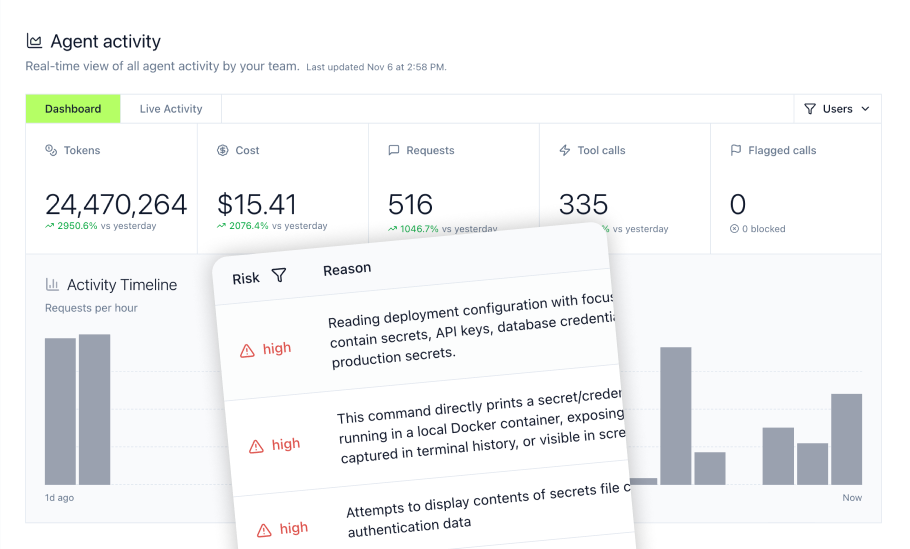
How do agent gateways detect unauthorized AI tool usage?
Agent gateways provide visibility by routing all AI agent traffic through a central control plane. Platforms like MintMCP extend this with Agent Monitor, which tracks agent activity including off-gateway usage in tools like Cursor and Claude Code. This two-layer approach covers both MCP traffic through the gateway and local non-MCP agent activity like bash commands, file operations, and prompt submissions. MDM integration enables pushing detect-only or enforce-mode configurations to developer machines for consistent policy application.