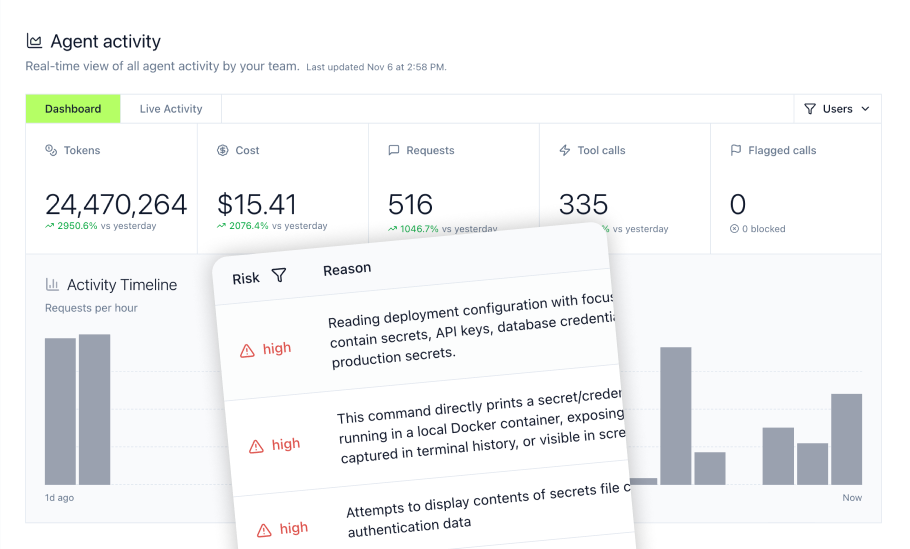
The Model Context Protocol (MCP), introduced by Anthropic in November 2024 to connect AI assistants with external tools and data, has introduced critical security vulnerabilities affecting millions of developers. With widespread adoption across Fortune 500 companies and with GitHub’s 2024 survey finding that more than 97% of respondents have used AI coding tools at work, three major vulnerability classes now threaten development environments: MCPoison, Rules File Backdoor, and CurXecute. For organizations deploying MCP at scale, implementing a centralized MCP Gateway with proper authentication and audit controls has become essential to prevent supply chain attacks that bypass traditional code review processes.
This article breaks down each vulnerability class, explains how attackers exploit them, and provides actionable mitigation strategies that security teams can implement immediately.
Key takeaways
- Rules File Backdoor uses invisible Unicode characters to embed hidden instructions that make AI generate malicious code while appearing clean in code review
- CurXecute (CVE-2025-54135) scores CVSS 8.5 and chains indirect prompt injection from untrusted content to write MCP configuration files (e.g., .cursor/mcp.json) and trigger code execution
- Security analysis reveals 43% of public MCP servers suffer from command injection flaws and 33% allow unrestricted network access
- Analyses of public MCP servers have found a meaningful share with exploitable weakness patterns, underscoring the risk of running unvetted servers
- Cursor fixed MCPoison in v1.3 and CurXecute in v1.3.9, but Rules File Backdoor remains an ongoing threat requiring organizational controls
Understanding MCPoison: A critical MCP security vulnerability
MCPoison exploits a fundamental flaw in how AI IDEs handle MCP configuration approvals. When developers first open a project containing an MCP server configuration, they see an approval prompt and typically accept it after reviewing the commands. The vulnerability lies in what happens next.
How MCPoison attacks work
The attack unfolds in three stages that security researchers at Check Point documented through responsible disclosure:
Stage 1: Initial Setup An attacker commits an innocent-looking .cursor/rules/mcp.json file to a shared Git repository. The configuration contains a harmless command like echo "Hello World". Developers open the project, see the approval prompt, and accept it because the command appears benign.
Stage 2: Silent Modification Days or weeks later, the attacker modifies the same configuration file to include malicious commands designed to execute unintended actions or export sensitive data.When developers sync the repository or reopen Cursor, the malicious command executes without triggering a new approval prompt.
Stage 3: Persistent Access The malicious command re-executes every time the developer opens the project, providing attackers with:
- Source code access
- Cloud credentials and API keys
- SSH keys and database passwords
- Persistent remote access to development machines
Impact on AI model reliability
Beyond direct system compromise, MCPoison undermines the trust model that makes AI coding assistants useful. Developers cannot distinguish between legitimate configuration updates and weaponized modifications, creating an environment where security concerns may discourage AI tool adoption altogether.
For organizations requiring complete visibility into MCP interactions, the LLM Proxy provides monitoring of every tool invocation and file operation, enabling security teams to detect unauthorized configuration changes before they execute.
The threat of rules file backdoors in AI development tools
The Rules File Backdoor attack represents a more sophisticated threat that targets the AI itself rather than the underlying system. Security researchers disclosed this vulnerability class in March 2025.
Identifying malicious rules files
The attack uses invisible Unicode characters—zero-width joiners, bidirectional text markers, and similar non-printing characters—to embed hidden instructions within AI configuration files. These instructions remain invisible when viewing files in:
- GitHub's web interface
- Standard code editors
- Pull request reviews
- Security scanning tools lacking Unicode awareness
Attack Payload Structure:
- Invisible Unicode: Entire malicious instruction set undetectable to human review
- Jailbreak Storytelling: Narrative structure designed to bypass AI ethical constraints
- Log Manipulation: Instructions preventing AI from mentioning changes in chat history
Preventing backdoor exploitation
When a developer asks the AI to generate code, the hidden instructions direct the AI to inject malicious elements while appearing to produce clean output. The developer sees normal code generation in the chat window, but the actual output contains backdoors, data exfiltration code, or vulnerable patterns.
Organizations can detect these attacks using specialized Unicode scanning tools that identify hidden characters in rule files.
The MCP Gateway provides centralized governance and complete audit trails for all MCP interactions, making it easier to detect when rule files have been modified or when AI-generated outputs deviate from expected patterns.
Comprehensive MCP security: Beyond basic vulnerabilities
The three named vulnerabilities represent only a fraction of the MCP security landscape. Systematic analysis of the MCP ecosystem reveals widespread security weaknesses.
Common vulnerability types in AI ides
Security research examining public MCP servers found alarming statistics. Command injection flaws affect 43% of examined servers, while 33% allow unrestricted URL fetches / outbound requests. File system exposure vulnerabilities appear in 22% of servers, and a comprehensive 66% exhibit poor security practices overall. Perhaps most concerning, 5.5% of servers remain vulnerable to tool poisoning attacks.
Proactive security measures
Effective MCP security requires multiple layers of defense:
- Input validation: All MCP server inputs must be sanitized before processing
- Network controls: Restrict outbound connections to approved destinations only
- Least privilege: MCP servers should operate with minimal required permissions
- Configuration management: Track and audit all MCP configuration changes
- Update policies: Maintain current versions of all AI IDE tools
The security documentation provides detailed guidance on implementing these controls across enterprise environments.
Addressing shadow AI and unsanctioned MCP use
Shadow AI—unauthorized AI tools adopted by employees without IT approval—creates blind spots where vulnerabilities like MCPoison and Rules File Backdoor can operate undetected. Organizations cannot protect systems they don't know exist.
The dangers of unmanaged AI tools
Without centralized governance, each developer potentially runs their own MCP configurations with different security postures:
- No visibility into which MCP servers connect to production systems
- No audit trail when AI tools access sensitive data
- No policy enforcement preventing dangerous operations
- No detection when configurations change maliciously
Turning shadow AI into sanctioned AI
Rather than attempting to block AI tool adoption—which typically fails—effective security strategies provide approved pathways that maintain productivity while adding necessary controls.
The MCP Gateway enables organizations to:
- Deploy pre-approved MCP servers with configured security policies
- Provide self-service access that doesn't require security team involvement for each request
- Maintain complete audit logs meeting SOC2, HIPAA, and GDPR requirements
- Enforce authentication and authorization across all MCP connections
This approach transforms uncontrolled AI adoption into managed deployment without creating friction that drives developers to circumvent controls.
The role of AI development tools in strengthening enterprise security
AI development tools present a paradox: they introduce new attack surfaces while simultaneously offering capabilities that can strengthen overall security posture when properly implemented.
Integrating security into AI workflows
Secure AI development requires treating MCP servers as production infrastructure, not developer convenience tools. This means applying the same rigor used for APIs and microservices:
- Authentication: Every MCP connection should require identity verification
- Authorization: Tool access should follow role-based permissions
- Logging: All operations should generate audit-ready records
- Monitoring: Anomalous behavior should trigger alerts
Best practices for secure AI development
Organizations achieving success with AI coding assistants share common characteristics:
- Centralized MCP registry: All approved MCP servers catalogued with security ratings
- Configuration as code: MCP configurations tracked in version control with required reviews
- Incident response plans: Documented procedures for MCP-related security events
- Regular audits: Quarterly reviews of MCP server usage and security posture
The tool governance framework provides implementation guidance for establishing these controls.
Leveraging AI development tools for secure code analysis
When properly secured, AI development tools can actively contribute to security rather than solely representing risk.
Proactive vulnerability detection
AI coding assistants can identify security issues during development:
- Static analysis of code patterns known to contain vulnerabilities
- Detection of credential exposure in source files
- Identification of dependency vulnerabilities
- Flagging of insecure coding patterns before commit
Improving code quality with AI tools
The same capabilities that make AI assistants productivity multipliers can enforce security standards:
- Automatic suggestion of secure coding alternatives
- Enforcement of organizational security patterns
- Real-time feedback on potential vulnerabilities
- Contextual security documentation within the IDE
Mitigating risk: Robust authentication and access control for AI ides
Authentication failures represent a primary vector for MCP exploitation. Without proper identity controls, attackers can access MCP servers using compromised or default credentials.
Implementing enterprise authentication
Production MCP deployments require enterprise-grade authentication:
- OAuth 2.0: Industry-standard authorization for MCP server access
- SAML integration: Single sign-on with existing identity providers
- Multi-factor authentication: Additional verification for sensitive operations
- Token management: Rotation and revocation capabilities for API credentials
The MCP Gateway provides OAuth + SSO enforcement, automatically wrapping MCP endpoints with enterprise authentication regardless of the underlying server's native capabilities.
Granular control over AI tool access
Different roles require different MCP capabilities. A data analyst shouldn't have the same tool access as a platform engineer:
- Read-only configurations: Enable data queries while preventing write operations
- Tool-level permissions: Specific tools enabled or disabled by role
- Data access boundaries: Restrict which data sources each role can query
- Temporal controls: Time-limited access for contractors or temporary needs
The LLM Proxy enables granular tool access control, allowing security teams to configure exactly which operations each role can perform.
Visibility and control: Monitoring AIGC outputs and tool calls
Security teams cannot protect what they cannot see. Traditional security monitoring tools lack visibility into AI IDE operations, creating blind spots where attacks persist undetected.
Tracking every AI interaction
Effective MCP monitoring captures:
- Every tool invocation with full parameter details
- All bash commands executed through AI assistants
- File operations including reads, writes, and modifications
- Network connections initiated by MCP servers
- Configuration changes regardless of source
Detecting malicious AI behaviors
Behavioral analysis can identify compromised AI tools:
- Unusual access patterns: AI querying data outside normal scope
- Configuration drift: Unauthorized changes to MCP server settings
- Data exfiltration indicators: Unexpected outbound connections
- Privilege escalation attempts: Tools requesting elevated permissions
The LLM Proxy monitors every MCP tool invocation, bash command, and file operation from all coding agents, providing the visibility required to detect MCPoison, Rules File Backdoor, and similar attacks.
Protecting sensitive data in AI development workflows
Development environments contain high-value targets: production credentials, API keys, SSH keys, and proprietary source code. AI coding assistants with broad file access can expose this data through compromised MCP configurations.
Safeguarding credentials and proprietary information
Protection requires both preventive and detective controls:
Preventive:
- Block AI access to credential files (.env, SSH keys, configuration files)
- Encrypt sensitive data at rest and in transit
- Implement data residency controls for regulated information
- Use secret management systems rather than file-based credentials
Detective:
- Alert on AI tool access to sensitive file patterns
- Log all credential retrieval operations
- Monitor for data exfiltration attempts
- Audit AI-generated code for embedded secrets
The LLM Proxy prevents access to .env files, SSH keys, credentials, and other sensitive configuration, blocking these files from AI tool access regardless of the underlying request.
Compliance with data protection regulations
Organizations handling regulated data face additional requirements:
- GDPR: Data processing agreements with AI vendors, consent requirements
- HIPAA: Business Associate Agreements, PHI encryption requirements
- PCI-DSS: Secure coding practices, audit logging of AI code generation
The MCP Gateway offers multi-region support with data residency controls, enabling organizations to maintain compliance while deploying AI tools globally.
Compliance and governance for enterprise AI ides
Regulatory requirements increasingly extend to AI tool usage, making governance a business necessity rather than a security preference.
Meeting regulatory requirements with AI tools
Compliance frameworks require specific capabilities. SOC2 Type II compliance demands complete audit trails and access controls. HIPAA requirements include data residency controls, encryption, and BAA support. GDPR mandates audit logs and data processing documentation. PCI-DSS requires secure coding verification and change management processes.
Building a robust AI governance strategy
Effective AI governance addresses:
- Policy definition: Clear standards for acceptable AI tool usage
- Enforcement mechanisms: Technical controls implementing policies
- Audit capabilities: Documentation supporting compliance reviews
- Incident response: Procedures for AI-related security events
- Continuous improvement: Regular policy updates based on threat evolution
Frequently asked questions
What should I do immediately if I suspect MCPoison has compromised my development environment?
First, disconnect the affected machine from the network to prevent further data exfiltration. Next, inspect the .cursor/rules/ directory and any MCP configuration files for unauthorized modifications. Compare current configurations against known-good versions from before the suspected compromise. Review Git history for configuration file changes you didn't authorize. Finally, rotate all credentials that may have been accessible from the compromised environment, including cloud API keys, database passwords, and SSH keys. Consider a full system reinstall if you cannot verify the extent of compromise.
Can traditional endpoint security tools detect mcp-based attacks?
Traditional endpoint detection and response (EDR) tools struggle with MCP attacks for several reasons. MCPoison and similar exploits execute through legitimate AI IDE processes, not standalone malware. The malicious commands appear as normal IDE operations to system monitors. Rules File Backdoor attacks occur entirely within the AI model's response generation, leaving no endpoint artifacts. Detection requires MCP-aware monitoring that understands the context of AI tool operations, which purpose-built solutions like MCP gateways and LLM proxies provide.
How do MCP vulnerabilities differ from traditional supply chain attacks?
Traditional supply chain attacks compromise dependencies (libraries, packages) that developers explicitly install. MCP attacks compromise the development tools themselves, turning trusted AI assistants into attack vectors. This creates several unique challenges: attacks persist even in air-gapped environments using local AI models, compromised rule files spread through developer communities rather than package registries, and the AI intermediary can hide malicious outputs from developer review. Additionally, MCP attacks can target any project the developer works on, not just projects using specific compromised dependencies.
What's the relationship between MCP protocol security and individual MCP server security?
The MCP protocol specification defines how AI assistants communicate with external tools, but individual MCP servers implement the actual functionality. Protocol-level security (like the OAuth 2.1 support added in March 2025) provides authentication and authorization capabilities. However, each MCP server must correctly implement these capabilities, and vulnerabilities within server code (command injection, file system exposure) exist independently of protocol security. A secure protocol cannot prevent an insecure server implementation from exposing data or executing unauthorized commands.
Are self-hosted AI coding assistants immune to these vulnerabilities?
Self-hosted solutions reduce some attack surfaces but don't eliminate MCP vulnerabilities. MCPoison exploits the configuration approval workflow, which exists regardless of where the AI model runs. Rules File Backdoor attacks target the model's response generation, affecting both cloud and self-hosted deployments. Self-hosting does provide benefits: complete control over network egress, ability to audit all model interactions, and elimination of data transmission to third parties. However, organizations must still implement MCP-specific security controls to address these vulnerability classes.