Your AI agents may soon be making decisions across tools, data, and workflows that auditors will expect you to explain. As organizations deploy AI agents across Claude, Cursor, ChatGPT, Gemini, and Copilot, the gap between agent capability and enterprise governance widens. An MCP Gateway provides governed data and tool connections across Claude, Cursor, ChatGPT, Gemini, and Copilot. Agent Gateway builds on that foundation with agent identities, scoped permissions, memory, monitoring, and auditability for agents that work alongside users.
This article outlines nine essential capabilities every enterprise should evaluate when selecting an agent gateway to govern, secure, and scale AI agent deployments while maintaining compliance and operational control.
Key Takeaways
- Identity-first security is foundational: Agents must have unique identities with scoped credentials rather than shared API keys to enable audit attribution and prevent credential sprawl across teams
- Data governance requires inline policy enforcement: Pre- and post-execution hooks that integrate with existing DLP tools prevent sensitive data from leaving your environment without requiring new security infrastructure
- Shadow AI detection addresses the visibility gap: Gateway-only monitoring misses agent activity in local developer tools; comprehensive observability requires hooks into Cursor, Claude Code, and similar environments
- Pre-configured connectors accelerate deployment: Access to prebuilt connectors for Salesforce, GitHub, Slack, and similar platforms reduces custom integration work
- Compliance programs need audit-ready records: Agent activity should be logged with user or agent attribution, tool-call context, retention controls, and export paths for security review and regulated workflows
- Bundle-based governance simplifies administration: Packaging tool access, policy rules, and audit logging into single units per team or role eliminates manual configuration of separate components
- Sandboxed execution protects against untrusted code: Containerized environments with input/output inspection prevent malicious MCP servers from compromising enterprise systems
- Centralized governance reduces unmanaged AI overhead: Gateway controls help teams standardize access, reduce duplicate integrations, and monitor usage without treating model-routing savings as the primary Agent Gateway value
Why Agent Gateways Matter for Enterprise AI Deployments
The agent gateway category addresses a fundamental challenge in enterprise AI: the gap between what AI agents can access and what they should access. Traditional API gateways were designed for request-response patterns between known services. AI agents operate differently, making autonomous decisions about which tools to invoke, what data to retrieve, and how to chain operations together.
This autonomy creates governance challenges at a time when the average breach cost reached $4.88M globally in 2024. Agent gateways provide the control plane for managing identities, permissions, and monitoring for agents that work alongside employees, built on top of governed data and tool connections.
#1. Establishing Secure AI Agent Identity and Access
What it is
Agent identity management assigns persistent, unique credentials to each AI agent rather than relying on shared API keys or inherited user permissions. This includes OAuth 2.0 and SAML authentication, automatic credential rotation, and rate limiting per user and team.
Why it matters
Shared credentials make audit attribution impossible. When three agents use the same API key to access customer data, incident response teams cannot determine which agent performed a specific action. Identity-first security improves attribution and containment by ensuring every agent action traces to a specific identity, credential scope, and permission boundary.
How to implement
- Configure SSO/OAuth integration as the first deployment step; agent identity is the foundation of all governance
- Assign each agent its own rotatable credentials independent of creator access levels
- Implement tool-level access controls (enable database reads but block writes)
- Set rate limits per agent to prevent runaway API consumption
MintMCP's tool governance capabilities include Agent Bundles that give each deployed agent its own bearer API keys plus OAuth 2.0 client-credentials, with rotation and revoke operations independent of human users.
#2. Ensuring Data Governance and DLP Integration
What it is
Data Loss Prevention integration enables custom policy code execution on every tool call, connecting agent gateways to existing enterprise DLP infrastructure including AWS Bedrock Guardrails, GCP DLP, Microsoft Purview, Nightfall, and Skyflow.
Why it matters
Enterprises have already invested in DLP tools that understand their data classification schemes, regulatory requirements, and risk tolerances. Agent gateways that force proprietary DLP approaches create redundant systems and compliance gaps. Inline policy enforcement can inspect requests and responses before sensitive data moves through agent-to-tool workflows.
How to implement
- Map existing DLP vendor APIs to gateway middleware hooks
- Configure pre-execution policies to scan prompts for sensitive patterns
- Set up post-execution policies to redact or block responses containing PII
- Establish escalation workflows for policy violations
MintMCP supports custom policy code in a JS sandbox with allowed-domains fetch, secret injection, and built-in templates for OpenAI moderation, jailbreak detection, and AWS Bedrock Guardrails integration. Teams with existing DLP investments can integrate their tools inline at the gateway without replacing what already works.
#3. Achieving Comprehensive Observability and Shadow AI Detection
What it is
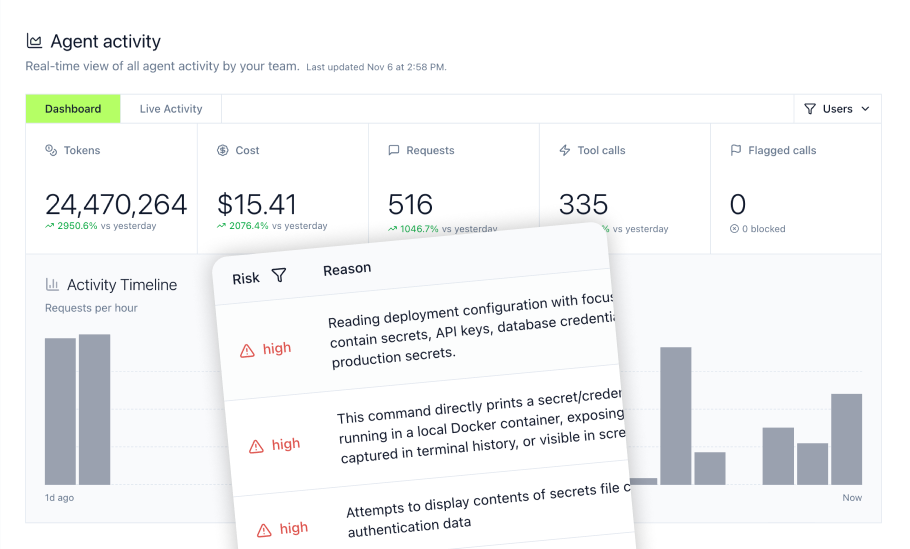
Observability for AI agents includes real-time visibility into agent actions across the organization, detection of off-gateway activity in developer tools like Cursor and Claude Code, and identification of PII exposure, credential leakage, and prompt injection attempts.
Why it matters
Gateway-only monitoring creates blind spots. Developers running local agents can bypass centralized controls entirely, creating "Shadow AI" that operates outside governance frameworks. Comprehensive observability helps incident response teams reconstruct what happened, which agent acted, which tools were invoked, and what data was exposed.
How to implement
- Deploy gateway-level logging for all MCP traffic
- Install hooks for local agent activity in Cursor and Claude Code
- Configure MDM integration to push detect-only or enforce-mode policies to developer machines
- Set up org-level analytics dashboards for usage patterns by team and tool
MintMCP's Agent Monitor provides two-layer governance: Gateway covers MCP traffic while Agent Monitor covers local non-MCP agent activity including Bash commands, file reads/writes, and prompt submissions via Claude Code and Cursor hooks.
#4. Simplifying Deployment with Pre-configured Connectors
What it is
Pre-configured connectors provide one-click activation of integrations with enterprise tools including Salesforce, GitHub, Slack, HubSpot, Notion, Linear, Gmail, and Stripe. Virtual MCPs bundle multiple servers with role-based tool access for specific teams or use cases.
Why it matters
Building custom integrations for each MCP server consumes engineering resources that could focus on core business value. Pre-configured connectors and OAuth brokering for stdio or hosted servers help transform locally run MCP servers into governed production services without forcing teams to rebuild integrations.
How to implement
- Audit current tool landscape and identify high-value integration targets
- Activate pre-configured connectors for standard enterprise tools
- Create Virtual MCPs that bundle relevant tools for specific roles (engineering, sales, support)
- Configure role-based access so each team sees only relevant tools
MintMCP's VMCP concepts documentation covers how to package tool access, policy enforcement, and audit logging into single governance units. The platform supports pre-configured connectors with one-click activation plus hosting of custom stdio-based MCP servers from the community ecosystem.
#5. Enabling Compliance and Audit-Ready Logging
What it is
Audit-ready logging captures full conversation-level data including prompts, tool calls, responses, and context with per-user attribution, configurable retention, and export to SIEM platforms like Splunk and Microsoft Sentinel.
Why it matters
Regulated AI and data environments often require organizations to demonstrate traceability, access controls, human oversight, and security review processes. For higher-risk AI workflows, direct LLM API calls often lack the audit context, identity attribution, and post-deployment monitoring that governance teams need.
How to implement
- Configure audit records with retention periods aligned to legal, security, and customer requirements; for healthcare workflows, validate HIPAA-related retention obligations with counsel and compliance teams
- Set up SIEM integration for centralized security monitoring
- Enable per-user attribution to trace actions to specific identities
- Review available data residency options and confirm regional compliance requirements before deployment
MintMCP's audit observability capabilities include full conversation-level logging with SIEM export to Sentinel, Splunk, and S3. The platform is SOC 2 Type II audited with continuous compliance monitoring via Drata. Customers handling protected health information can request HIPAA documentation, and MintMCP signs BAAs.
#6. Streamlining Governance with the Bundle Model
What it is
Bundles package SCIM group membership, curated MCP server lists, custom policy rules, and isolated audit trails into single governance units. Agent Bundles extend this model to non-human principals with independent credentials and permission scopes.
Why it matters
Traditional governance requires manual configuration of separate plugin, access rule, and credential objects for each team and tool combination. This complexity slows deployment for enterprise environments. Bundle-based governance reduces configuration overhead while maintaining granular control.
How to implement
- Map organizational structure to Bundle hierarchy (org-level, team-level, role-level)
- Configure SCIM sync with Okta or Azure AD for automatic group membership
- Set tool-update policies to auto-enable new tools or require admin approval
- Create Agent Bundles for autonomous agents with scoped permissions independent of creator access
MintMCP Bundles (Virtual MCPs) are the platform primitive. One endpoint per role or use case, SCIM-driven group membership, curated tool list, and per-Bundle access policy apply the same governance model to human teams and agent identities.
#7. Supporting Diverse Agent Ecosystems and Custom Builds
What it is
Multi-transport support handles stdio, streamable HTTP, and legacy SSE-based MCP servers through unified endpoints. REST APIs and SDKs enable programmatic management for CI/CD integration and infrastructure-as-code workflows, while MCP traffic follows the protocol's JSON-RPC-based interaction model.
Why it matters
Enterprise AI environments include multiple agent frameworks, custom-built tools, and community MCP servers that must interoperate through consistent governance. Supporting diverse ecosystems with minimal code changes for routing through the gateway accelerates adoption without requiring application rewrites.
How to implement
- Inventory all agent frameworks and MCP server types in current deployment
- Configure transport normalization for stdio, HTTP-streamable, and SSE endpoints
- Set up OAuth brokering for hosted containers with redirect-URI limitations
- Integrate gateway APIs with existing CI/CD pipelines for infrastructure-as-code deployment
MintMCP normalizes all three upstream transports plus OAuth 2.x, bearer tokens, and headers. Clients connect through one SSO-fronted remote MCP endpoint regardless of upstream variety. REST APIs and SDKs enable programmatic management for teams building custom deployment automation.
#8. Ensuring Robust Security and Sandboxing
What it is
Containerized sandbox execution isolates untrusted MCP server code with input/output inspection. Zero-trust architecture requires mandatory authentication and authorization per request with no default access assumptions.
Why it matters
Community and custom MCP servers introduce code that enterprises cannot fully vet. Sandboxed execution prevents malicious servers from accessing data outside their designated scope or persisting beyond their intended operation.
How to implement
- Deploy MCP servers in containerized environments with resource limits
- Configure input/output inspection for all tool calls
- Implement mandatory authentication for every request (no implicit trust)
- Set up provenance tracking across multi-step agent workflows
MintMCP's security overview details how the platform operates connector instances with auto-scaling and isolated/sandboxed execution per connector. Customers do not manage Kubernetes pods, runtimes, or scaling for the connector layer.
#9. Gaining Insights into Agent Performance and PII Exposure Prevention
What it is
Real-time detection of PII exposure, credential leakage, risky bash commands, and prompt injection attempts using built-in rules and custom guardrail policies with block/flag/alert actions. Org-level analytics track latency, error rates, and usage patterns.
Why it matters
Reactive security that identifies breaches after they occur is insufficient for AI agents that can exfiltrate data in seconds. Proactive detection reduces manual review burden by surfacing risky activity, policy violations, and usage anomalies before they become security incidents.
How to implement
- Enable built-in detection rules for common exposure patterns (SSN, credit cards, API keys)
- Configure custom guardrail policies for organization-specific sensitive data
- Set up alert escalation workflows for high-severity detections
- Review org-level analytics weekly to identify usage anomalies
MintMCP's data risk guide covers frameworks for assessing and mitigating data exposure through AI agents. Agent Monitor detects PII exposure, credential leakage, risky bash commands, and prompt injection attempts using built-in rules with support for custom guardrail policies that block, flag, or alert based on detection severity.
Why MintMCP for Enterprise Agent Gateway Deployments
MintMCP delivers an Agent Gateway platform that brings these nine capabilities into a unified governance model. Instead of managing agent identity, monitoring, policy, and audit export as disconnected workflows, teams can centralize those controls through MintMCP’s governance layer.
The platform's Bundle model simplifies administration by packaging tool access, policy enforcement, and audit trails into single governance units. Teams configure one Bundle per role or use case rather than manually connecting dozens of individual components. SCIM integration with Okta and Azure AD ensures group membership stays synchronized automatically, while Agent Bundles extend the same governance model to non-human principals with independent credentials.
MintMCP's two-layer observability approach addresses the Shadow AI challenge that gateway-only monitoring cannot solve. While the Gateway layer governs MCP traffic, Agent Monitor hooks into Cursor, Claude Code, and local development environments to detect off-gateway activity before it creates compliance gaps. This comprehensive visibility includes real-time detection of PII exposure, credential leakage, and prompt injection attempts across both layers.
For compliance-focused organizations, MintMCP is SOC 2 Type II audited with continuous monitoring via Drata. Customers handling protected health information can request HIPAA documentation, and MintMCP signs BAAs. The platform provides SIEM export to Sentinel, Splunk, and S3 for centralized security monitoring, with conversation-level logging that captures prompts, tool calls, responses, and per-user attribution. Organizations can validate their AI governance approach using frameworks like the NIST AI Risk Management Framework to identify and manage AI-related risks systematically.
Frequently Asked Questions
What is the typical implementation timeline for an enterprise agent gateway?
Implementation timelines vary based on authentication complexity, connector scope, custom MCP server requirements, and compliance review. Teams usually start with identity integration, a small set of governed tools, and audit logging before expanding to broader agent monitoring and policy enforcement. Running existing workflows in parallel during rollout helps teams validate latency, access controls, and audit coverage without disrupting production workloads.
How do agent gateways differ from traditional API gateways?
Traditional API gateways manage request-response patterns between known services with predictable traffic patterns. Agent gateways address the unique challenges of autonomous AI systems: agents make dynamic decisions about which tools to invoke, chain operations in unpredictable sequences, and operate with varying levels of user oversight. Agent gateways provide identity management for non-human principals, tool-level access control beyond simple endpoint authorization, and observability that captures the reasoning chain, not just the final API call. The control plane extends to agent permissions, memory, and monitoring rather than simple traffic routing.
What cost savings can enterprises expect from agent gateway deployment?
Cost impact varies by deployment size, connector scope, and existing AI usage. Agent gateways can reduce duplicate integration work, centralize policy enforcement, and improve visibility into tool usage. The larger financial value is risk reduction: organizations can limit unmanaged access, strengthen auditability, and reduce the blast radius of agent mistakes or compromised credentials.
How should enterprises handle agents that operate outside the gateway?
Shadow AI detection requires monitoring beyond gateway traffic. Developers running local agents in Cursor, Claude Code, or similar tools can bypass centralized controls entirely. Effective governance includes MDM integration to push policies to developer machines, hooks that capture local agent activity for centralized logging, and enforcement modes that can block unauthorized tool access at the device level. Organizations should start with detect-only mode to establish baselines before enabling enforcement, reducing false positives and developer friction during rollout.
What compliance posture should agent gateway vendors maintain?
Enterprise deployments should treat SOC 2 Type II audited status as a baseline signal, not a standalone differentiator. For healthcare workflows, look for alignment with HIPAA standards, HIPAA documentation, and BAA support. For privacy-sensitive deployments, confirm how the vendor handles access controls, audit logs, retention, deletion workflows, and available data residency options. NIST AI Risk Management Framework alignment can provide additional structure for organizations formalizing AI governance programs.