Data-driven insights revealing how Virtual MCPs (VMCPs) transforms enterprise AI deployment, governance, and operational efficiency for engineering teams
MCP adoption delivers measurable, transformative results for enterprise engineering teams. Traditional AI integration approaches leave organizations struggling with fragmented tooling, security gaps, and inconsistent governance across AI deployments. MintMCP's MCP Gateway provides the centralized infrastructure enterprises need—with one-click deployment, OAuth protection, and complete audit trails. The data proves that production-grade V-MCP infrastructure outperforms manual server management by enabling deployment in minutes rather than days. This comprehensive analysis examines market growth, adoption velocity, performance improvements, security considerations, and implementation patterns shaping the future of enterprise AI infrastructure.
Key takeaways
- Market growth validates V-MCP adoption – According to Dimension Market Research, the MCP Server market is projected to grow from $2.7 billion to $5.6 billion by 2034, demonstrating 8.30% CAGR
- Developer adoption accelerates rapidly – The MCP Python SDK receives over 9 million downloads weekly, with over 16,000 servers in the ecosystem
- Integration development accelerates – Companies achieve 60-80% reductions in integration development time
- Security remains critical – 22% of tested implementations allowed arbitrary file access, highlighting the need for enterprise-grade governance
Market growth and size statistics
1. The global MCP server market is projected to grow from $2,713.90 million in 2025 to $5,565.60 million by 2034
According to Dimension Market Research, market research data estimates strong growth in the MCP server market, with the market more than doubling over nine years. This expansion reflects mainstream enterprise adoption as organizations recognize measurable ROI from standardized AI-to-data integration. The projection encompasses deployment platforms, governance tools, and optimization services across industries globally. Note: This data is accessed through a third-party compilation and represents one market research estimate.
2. The MCP market demonstrates an 8.30% compound annual growth rate through 2034
Industry analysts project sustained 8.30% CAGR growth that validates V-MCP as strategic infrastructure rather than experimental technology. This growth rate reflects the urgent need for scalable, governed AI tool access. The acceleration stems from proven efficiency gains at enterprises like Block and Bloomberg, driving competitive pressure as early adopters gain substantial advantages.
3. The global AI market reached approximately $391 billion in 2025 and is projected to reach $1.81 trillion by 2030
Broader AI market analysis shows the context for V-MCP growth—a nearly 5x expansion in five years. V-MCP infrastructure represents critical enabling technology for this expansion, providing the standardized connectivity layer between AI models and enterprise data sources that organizations require for production deployments.
4. North america holds the largest MCP market share at 39.40% in 2025
Regional analysis reveals North America's dominance in V-MCP adoption, driven by mature enterprise AI initiatives and regulatory requirements demanding governance infrastructure. This concentration creates opportunities for organizations in other regions to gain competitive advantage through earlier V-MCP adoption while establishing compliance and audit capabilities before market maturation.
Developer adoption statistics
5. The MCP Python SDK receives over 9 million downloads weekly
Developer adoption data reveals massive weekly download volumes for the Python SDK, demonstrating V-MCP's position as a mainstream development standard. This adoption velocity indicates V-MCP has moved beyond early adopter phase into widespread production use, with developers actively building integrations and tools.
6. The TypeScript MCP SDK receives 6.7 million downloads weekly
TypeScript SDK downloads confirm broad adoption across the JavaScript ecosystem. Combined with Python downloads, over 15 million weekly SDK downloads demonstrate V-MCP's cross-platform momentum. This developer activity translates directly into the growing ecosystem of connectors and integrations available through platforms like MintMCP.
7. Over 16,000 MCP servers exist in the ecosystem
Ecosystem data quantifies the production footprint of V-MCP infrastructure. These servers span enterprise deployments, open-source implementations, and community-built tools. The volume creates both opportunity and challenge—organizations need centralized management to track which servers teams use and maintain security controls across deployments.
8. The GitHub topic 'model-context-protocol' lists over 1,664 repositories as of november 2025
Open-source ecosystem data shows substantial community investment in V-MCP tooling and integrations. This repository count reflects servers, clients, utilities, and documentation projects. The breadth of open-source activity accelerates capability development while creating governance challenges for enterprises selecting and monitoring approved tools.
9. MCP server implementations grew from 1,000 to over 7,260 documented implementations between february and may 2025
Ecosystem growth data reveals 626% growth in just three months, demonstrating explosive momentum. This rapid expansion reflects both new server development and improved documentation of existing implementations. For enterprises, this growth underscores the need for centralized MCP registries to curate approved servers and maintain visibility.
Performance and efficiency statistics
10. At block, thousands of employees use MCP tools daily, and many report workflows dropping from days to hours
Enterprise implementation data from Block confirms measurable efficiency gains from standardized AI-to-data connectivity. The overhead reduction stems from eliminating custom integration code, reducing authentication complexity, and enabling reuse of existing connectors. Teams spend less time on infrastructure plumbing and more on business-value features.
11. Organizations report 50-75% time savings on common tasks with VMCP
Block's research confirms substantial time savings across routine engineering workflows when V-MCP infrastructure is properly implemented. Most Block employees report saving 50-75% of their time on common tasks. The savings range reflects variation in implementation maturity and use case complexity. Organizations with production-grade platforms like MintMCP's gateway achieve the higher end through pre-built connectors and automated deployment.
12. Block (square) reports up to 75% time reduction on daily engineering tasks using VMCP
Enterprise case study data from Block validates transformative productivity gains at scale. Thousands of Block employees use V-MCP-driven tools daily, with the 75% reduction reflecting mature implementation across engineering workflows. This benchmark demonstrates achievable results for organizations with comprehensive V-MCP infrastructure.
13. Bloomberg reduced time-to-production from days to minutes using VMCP
Production deployment data shows Bloomberg achieved dramatic deployment acceleration through V-MCP standardization. The shift from days to minutes represents the difference between manual integration development and leveraging pre-built, governed connectors. This speed improvement enables rapid iteration on AI capabilities without infrastructure bottlenecks.
14. Companies report 60-80% reductions in integration development time with VMCP
Integration efficiency data quantifies one of V-MCP's primary value propositions—eliminating redundant integration work. Instead of building custom connectors for each AI tool and data source combination, teams leverage standardized V-MCP interfaces. Platforms offering database connectors and pre-built integrations maximize these efficiency gains.
15. Twilio achieved 100% task success rate with VMCP compared to 92.3% without IT
Task completion data demonstrates V-MCP's impact on AI agent reliability. The improvement from 92.3% to 100% success rate reflects better context availability and more consistent tool execution through standardized protocols. Higher reliability translates directly to user satisfaction and operational efficiency.
16. Twilio reduced user interactions by 3.2% and AI token consumption by 6.3% using VMCP
Efficiency metrics show V-MCP optimization extends beyond speed to resource efficiency. Fewer user interactions indicate better first-attempt resolution, while reduced token consumption lowers operational costs. These compound savings scale significantly across high-volume enterprise deployments. Note that Twilio's implementation showed approximately 27.5% higher costs, demonstrating that V-MCP optimization prioritizes reliability and user experience over pure cost reduction.
Business impact statistics
17. Customer support teams report 25-40% reductions in average handle time through VMCP
Support efficiency data validates V-MCP's impact on customer-facing operations. AI assistants with V-MCP access to CRM data, ticket history, and knowledge bases resolve inquiries faster. The Gmail and Outlook integrations available through MintMCP enable these support workflow improvements.
18. Finance departments see 50-70% reductions in manual reporting effort with VMCP
Financial automation data demonstrates substantial productivity gains in reporting workflows. AI agents connected to financial data through V-MCP—such as Snowflake integrations—automate report generation, variance analysis, and forecasting tasks that previously required manual SQL queries and spreadsheet manipulation.
19. Sales organizations achieve 10-25% improvements in conversion rates using VMCP with CRM systems
Revenue impact data links V-MCP infrastructure directly to business outcomes. AI-powered sales tools with real-time CRM access provide better recommendations, faster follow-ups, and more personalized outreach. The conversion improvement range reflects variation in implementation depth and sales process complexity.
Ecosystem concentration statistics
20. The top 10 MCP servers account for nearly half (45.7%) of all GitHub stars
Analysis of the V-MCP ecosystem reveals a winner-take-most dynamic. The top servers—including browser automation, GitHub integration, and database connectors—capture disproportionate attention and adoption. This concentration validates focusing on proven, widely-adopted servers rather than experimental implementations.
21. The top 10% of MCP servers make up 88.3% of all GitHub stars
Long-tail distribution analysis shows extreme concentration in ecosystem popularity. For enterprises, this pattern suggests curating a small set of production-ready servers rather than managing hundreds of options. Platforms like MintMCP provide this curation through Virtual MCPs that expose only approved, tested tools.
22. Three categories dominate VMCP usage: Computer & web automation (24.8%), software engineering (24.7%), and database & search (23.1%)
Category distribution analysis identifies the primary use cases driving V-MCP adoption. These three categories together represent 72.6% of ecosystem activity, indicating clear patterns in what organizations automate first. Database connectors and Elasticsearch integration address the database and search category directly.
23. Together, the top three VMCP categories received 72.6% of all GitHub stars
Use case concentration analysis validates focused implementation strategies. Organizations gain maximum value by deploying robust infrastructure for browser automation, development workflows, and data access before expanding to niche categories. This concentration informs prioritization decisions for V-MCP gateway implementations.
Security and governance statistics
24. 22% of tested MCP implementations allowed arbitrary file reads in testing
Security assessment data reveals significant vulnerability in community V-MCP implementations. Nearly one quarter of tested servers lacked proper access controls, enabling AI agents to read sensitive files. This finding underscores the critical importance of security guardrails that block dangerous commands and protect sensitive files from agent access.
25. 75% of API gateway vendors and 50% of integration platform as a service (ipaas) vendors are expected to adopt VMCP by 2026
Vendor adoption projection from Gartner indicates V-MCP is becoming the standard integration protocol for AI connectivity. This mainstream vendor adoption validates V-MCP as strategic infrastructure rather than niche technology. Organizations implementing V-MCP gateways now gain first-mover advantages in workflow automation and AI agent deployment.
Future projections
26. By 2028, 33% of enterprise software will include agentic RAG up from less than 1% today
Capability projection data from Gartner's 2025 Software Engineering Survey forecasts rapid expansion of AI agent capabilities in enterprise software. This growth trajectory—from under 1% to 33% in three years—creates massive demand for governed AI-to-data connectivity that V-MCP infrastructure provides.
Strategic implementation insights
V-MCP infrastructure works best when it's built for enterprise-grade production deployment, not just developer experimentation. The winners aren't organizations with the most V-MCP servers—they're teams using gateways that provide centralized governance with clear security controls, complete audit trails, and automated compliance. That's why production-ready platforms like MintMCP's MCP Gateway consistently outperform manual server management: they're designed around deploying in minutes, not days.
Here's how to maximize results:
- Start by auditing which V-MCP servers teams currently use (the 22% security vulnerability rate demands visibility)
- Implement centralized authentication with OAuth and SSO integration before expanding V-MCP access
- Prioritize audit logging—governance requirements demand complete trails of every V-MCP interaction
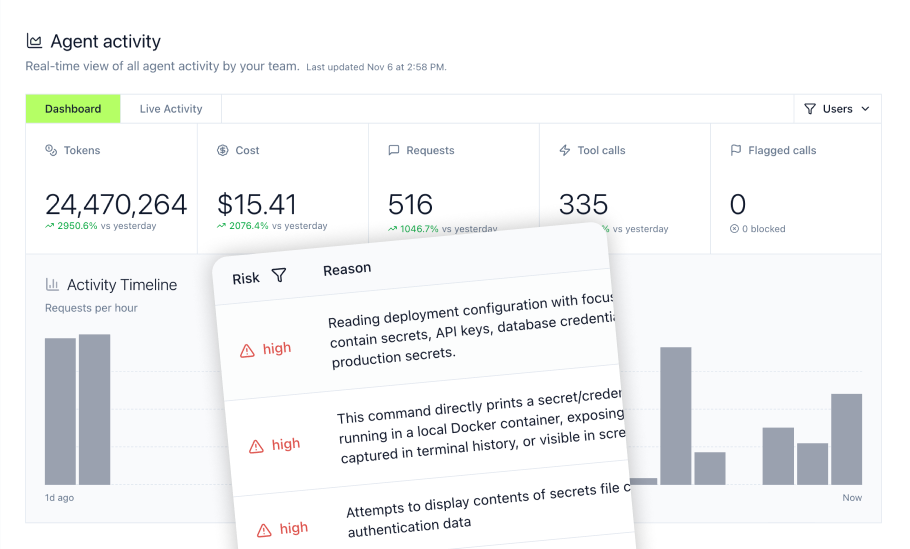
- Use real-time monitoring dashboards to track usage patterns and detect anomalies
- Deploy LLM Proxy to block dangerous commands and protect sensitive files
If you want the fastest path to production-grade V-MCP, follow proven deployment patterns: implement governance infrastructure first, connect high-value data sources through pre-built connectors, then expand coverage systematically. Organizations highlighted in enterprise deployment guides show what happens when infrastructure, security, and integrations align—teams deploy in minutes, compliance requirements are met automatically, and AI tool access becomes predictable at scale.
Frequently asked questions
What is the average productivity improvement achieved through VMCP implementation?
Leading implementations achieve 50-75% time savings on common tasks, with enterprise examples like Block reporting up to 75% reduction in daily engineering task time. These gains reflect mature implementations with comprehensive connector coverage and governed deployment infrastructure.
How does VMCP infrastructure impact integration development time?
Organizations report 60-80% reductions in integration development time through V-MCP standardization. Bloomberg reduced time-to-production from days to minutes by leveraging pre-built, governed connectors rather than custom integration development for each AI tool.
What security considerations should enterprises prioritize for VMCP?
Security assessments revealed 22% of tested implementations allowed arbitrary file reads in testing. Enterprises should implement centralized authentication, audit logging for all V-MCP interactions, and security guardrails that block dangerous commands. SOC2 Type II certified platforms provide these controls automatically.
How quickly is the VMCP market growing?
According to Dimension Market Research, the MCP Server market is projected to grow from $2.7 billion to $5.6 billion by 2034 at 8.30% CAGR. Developer adoption is even faster—over 15 million weekly SDK downloads across Python and TypeScript, with over 16,000 servers in the ecosystem.
Which VMCP use cases deliver the highest business impact?
Three categories dominate: Computer & Web Automation, Software Engineering, and Database & Search—together representing 72.6% of ecosystem activity. Business-specific impacts include 25-40% reductions in customer support handle time and 50-70% reductions in manual reporting effort for finance teams.