Data-driven insights revealing how unsanctioned AI usage creates enterprise risk—and what governance frameworks deliver measurable protection
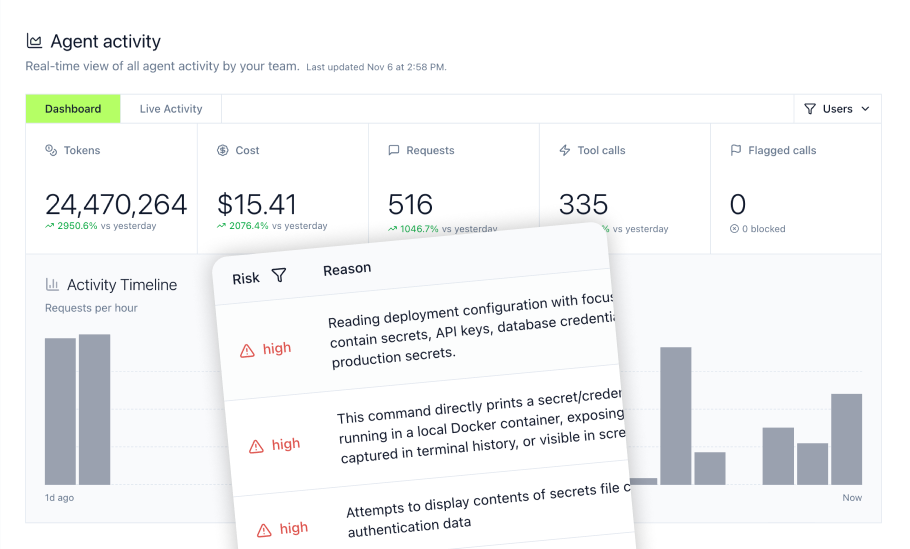
Shadow AI has reached epidemic proportions across enterprises. Employees adopt AI tools faster than IT can track them, creating blind spots that expose sensitive data and inflate breach costs. MintMCP's MCP Gateway transforms this chaos into controlled, production-ready AI infrastructure—providing the visibility, authentication, and audit trails enterprises need to turn shadow AI into sanctioned AI. The data confirms that organizations with proper governance frameworks save millions in breach costs while enabling faster, safer AI adoption. This analysis examines adoption trends, governance gaps, security risks, financial impacts, and the operational controls that separate high-performing organizations from those exposed to preventable losses.
Key takeaways
- Shadow AI is nearly universal – 98% of organizations have employees using unsanctioned apps, including shadow AI tools
- Governance gaps create costly breaches – Organizations with high shadow AI levels had $670,000 higher average breach costs
- Visibility remains the critical failure point – 86% of organizations are blind to AI data flows across their enterprise
- Technical controls are severely lacking – Only 17% of companies have controls capable of preventing employees from uploading confidential data to AI tools
- Policy gaps accelerate risk – 63% of organizations lack any AI governance policies despite widespread adoption
- Proper governance delivers measurable ROI – Organizations using AI and automation extensively saved $1.9 million in breach costs and reduced breach lifecycle by 80 days
The alarming rise of shadow AI in the enterprise
1. 98% of organizations have employees using unsanctioned apps, including shadow AI
Enterprise security research confirms that virtually every organization faces shadow AI exposure. This near-universal prevalence reflects the gap between employee adoption speed and IT governance capabilities. Workers discover AI tools that boost productivity and deploy them immediately—without waiting for security reviews, procurement approval, or policy guidance. The result is a sprawling attack surface that security teams cannot see, monitor, or protect.
2. 78% of AI users bring their own AI tools to work (BYOAI)
Workplace behavior data reveals that nearly four in five AI users adopt tools outside official channels. This BYOAI trend mirrors the earlier shadow IT phenomenon but moves faster and carries higher data exposure risks. Employees access AI through personal accounts, browser extensions, and mobile apps that bypass corporate network controls entirely.
3. Daily AI use at work doubled from 4% to 8% of employees between 2024 and 2025
Gallup research documents the continued acceleration of AI adoption. The 100% year-over-year increase in daily usage indicates AI is becoming embedded in routine workflows rather than occasional tasks. This integration deepens data exposure risks as employees use AI tools for increasingly sensitive work activities.
4. 68% of employees use free-tier AI tools like ChatGPT via personal accounts
Security research reveals that most enterprise AI usage flows through consumer-grade tools without enterprise security features, audit capabilities, or data residency controls. Free-tier personal accounts provide zero visibility into what data employees submit, no retention controls, and no integration with corporate identity management.
5. 80% of employees at small and medium-sized companies use their own AI tools
SMB-specific data shows shadow AI concentration is highest where IT resources are thinnest. Smaller organizations lack the security staff and tooling to monitor AI adoption, creating disproportionate risk exposure. These businesses face the same data security requirements as enterprises but with fewer resources to achieve compliance.
Key AI governance frameworks and their impact on shadow AI
6. 63% of organizations lack AI governance policies
IBM breach research documents a fundamental governance gap: the majority of organizations have no formal policies governing AI usage despite near-universal employee adoption. This policy vacuum leaves employees making individual decisions about what data to submit to AI tools, which tools to trust, and what constitutes acceptable use—with no organizational guidance or guardrails.
7. Only 37% have governance policies, with just 45% implementing strict approval processes for AI deployments
Enterprise governance data reveals that even among organizations with policies, fewer than half enforce approval workflows before AI deployment. The gap between policy existence and policy enforcement creates false confidence—organizations believe they have governance when they actually have documentation without operational controls.
8. Only 34% of organizations with AI governance policies perform regular audits for unsanctioned AI
Compliance research shows that two-thirds of organizations with AI policies never verify whether employees follow them. Auditing requires tooling that can detect AI tool usage across the enterprise—exactly what MintMCP's audit and observability features provide through complete audit trails of every MCP interaction, access request, and configuration change.
9. 58% of employees have never received formal training on safe AI use from their employer
Workforce readiness data documents that the majority of employees using AI have never received guidance on secure usage practices. This training gap means employees don't recognize risks when submitting sensitive data, connecting AI to internal systems, or granting AI tools access permissions.
10. Only 30% of u.S. Employees say their organization has AI use guidelines or a formal policy
Employee awareness research reveals that even when policies exist, employees often don't know about them. This communication failure means governance investments don't translate to behavior change. Effective AI governance requires both policy infrastructure and employee awareness programs.
Leveraging AI governance tools for visibility and control
11. 86% of organizations are blind to AI data flows
Enterprise visibility research confirms that the vast majority of organizations cannot see what data employees submit to AI tools. This blindness extends to which AI services employees use, what data those services receive, and how AI tools integrate with internal systems. Without visibility, organizations cannot assess risk, enforce policies, or respond to incidents.
12. Netskope tracks more than 1,550 distinct generative AI SaaS applications, up from 317 in february 2024
AI ecosystem monitoring shows the number of AI applications enterprises must track has nearly quintupled in 15 months. This proliferation makes manual governance approaches impossible—organizations cannot evaluate and approve thousands of tools faster than employees discover and adopt them.
13. Average enterprise unknowingly hosts 1,200 unofficial applications creating potential attack surfaces
Application inventory research documents the scale of unauthorized software across enterprises. Each unofficial application represents a potential data exposure point, credential store, and integration pathway that security teams cannot monitor. AI applications amplify this risk because they're specifically designed to process and learn from user data.
Ensuring IT security and compliance in AI deployments
14. 20% of organizations suffered a security breach involving shadow AI
Breach incidence data confirms that shadow AI risk has already materialized into actual security incidents for one in five organizations. This isn't theoretical exposure—it's documented harm. The 20% figure likely underreports actual incidents given visibility limitations at most organizations.
15. Among organizations reporting breaches of AI models/apps, 97% reported lacking proper AI access controlstrols
Breach analysis reveals that nearly all AI security incidents trace back to missing access controls. This finding validates that governance infrastructure—not AI technology itself—determines security outcomes. Organizations with proper controls avoid breaches that compromise their ungoverned peers.
16. 57% of employees admitted to entering sensitive information into AI tools
Employee behavior research documents that the majority of workers submit confidential data to AI systems. This behavior isn't malicious—employees use AI to work with real work data. Without controls that prevent sensitive data submission or route requests through governed channels, data exposure becomes inevitable.
17. 43% of employees shared sensitive work information with AI tools without employer permission
Unauthorized data sharing research shows that nearly half of employees knowingly bypass organizational boundaries when using AI. This conscious policy violation reflects either unawareness of risks or calculation that productivity benefits outweigh compliance concerns. Both factors require organizational response through education and technical controls.
18. Only 17% of companies have technical controls capable of preventing employees from uploading confidential data to public AI tools
Control capability research confirms that 83% of organizations lack the infrastructure to enforce AI data policies technically. Policy documents without technical enforcement create compliance theater—organizations believe they're protected when they actually rely entirely on employee judgment. MintMCP Gateway provides the technical controls organizations need, including OAuth protection, granular tool access control, and centralized governance across all MCP connections.
Building a robust enterprise AI platform: Statistics for success
19. High shadow AI drove average breach costs to $4.74M vs $4.07M for low/none
Breach cost analysis quantifies the financial penalty for governance failures. The $670,000 premium represents investigation complexity, expanded scope, regulatory penalties, and remediation costs specific to shadow AI incidents. This premium alone typically exceeds the cost of implementing comprehensive governance infrastructure.
20. Shadow AI breaches averaged $4.63M when a breach involved shadow AI
Comparative breach data documents that shadow AI incidents cost 17% more than typical breaches. The premium reflects the difficulty of identifying breach scope when organizations don't know what AI tools employees use or what data those tools accessed. Visibility gaps translate directly to cost increases.
21. United states average cost of data breach: $10.22 million—a 9% increase from 2024
U.S. breach cost data shows American organizations face the highest breach costs globally, with costs continuing to rise. U.S. enterprises face disproportionate shadow AI exposure due to high knowledge worker density and aggressive AI adoption rates. The combination creates urgent governance requirements.
22. Security breaches at high-shadow-ai organizations resulted in customer PII in 65% of shadow AI incidents compromised
Data exposure analysis documents that shadow AI amplifies breach severity, not just frequency. When breaches occur at organizations with high shadow AI usage, attackers access substantially more sensitive data. The 65% increase in PII exposure reflects both broader attack surfaces and reduced visibility that delays detection and containment.
The role of audit trails in AI governance and compliance
23. 60% of ai-related security incidents led to compromised data and 31% led to operational disruption
Incident impact research reveals that AI security failures cause severe consequences across multiple dimensions. The majority of incidents result in data loss, while nearly a third disrupt operations. Complete audit trails enable faster incident response by documenting exactly what systems and data AI tools accessed—critical for AI governance compliance requirements.
24. Organizations using AI and automation extensively saved an average $1.9 million in breach costs
Security ROI research validates that governance investments deliver measurable financial returns. The $1.9 million savings reflects faster detection, accelerated containment, reduced scope, and streamlined remediation. Organizations that invest in AI security infrastructure recover from incidents substantially faster and cheaper than ungoverned peers.
25. Organizations with proper AI controls reduced breach lifecycle by 80 days
Detection and response research shows that governance infrastructure dramatically accelerates incident resolution. The 80-day improvement represents nearly three months of reduced exposure, investigation, and remediation time. Faster resolution limits damage scope and reduces total incident costs—explaining much of the $1.9 million savings documented above.
Strategic implementation insights
Shadow AI management succeeds when organizations deploy visibility infrastructure before adoption curves accelerate further. The data confirms that reactive approaches fail—by the time organizations recognize shadow AI problems, thousands of tools have become embedded across workflows. Effective governance requires proactive monitoring, technical controls, and clear policies enforced through tooling rather than trust.
Here's how to implement effective shadow AI management:
- Deploy real-time monitoring to track AI tool usage across the enterprise before attempting policy enforcement
- Implement technical controls that prevent sensitive data submission rather than relying on employee awareness
- Establish centralized authentication through OAuth and SSO to ensure all AI access flows through governed channels
- Create complete audit trails for every AI interaction to meet SOC2, HIPAA, and GDPR compliance requirements
- Enable sanctioned alternatives that match shadow tool productivity so employees choose governed options voluntarily
Organizations highlighted in MintMCP's enterprise deployment guide demonstrate what happens when governance infrastructure matches adoption speed—security teams gain visibility, compliance requirements are met, and developers retain the AI productivity gains that drove shadow adoption initially.
Frequently asked questions
What is shadow AI and why is IT a concern for enterprises?
Shadow AI refers to artificial intelligence tools and applications that employees adopt and use without IT approval, security review, or organizational governance. The concern stems from data exposure risks—57% of employees submit sensitive information to AI tools, and 86% of organizations cannot see these data flows. Shadow AI breaches cost an additional $670,000 compared to standard incidents.
How do AI governance frameworks help manage shadow AI?
Effective governance frameworks combine policy documentation with technical enforcement. Of the organizations that experienced an AI-related breach, 97% lacked proper AI access controls. However, policies alone are insufficient—only 17% of organizations have technical controls to enforce them. MintMCP provides both policy infrastructure and enforcement tooling through centralized authentication, audit logging, and granular access controls.
What key statistics indicate the ROI of managed AI solutions?
Organizations using AI security extensively save $1.9 million in breach costs and reduce breach lifecycle by 80 days. The shadow AI breach premium of $670,000 alone typically exceeds governance implementation costs. Properly managed AI also avoids the $4.63 million average cost of shadow AI breaches.
How does MintMCP address the challenges of shadow AI?
MintMCP transforms shadow AI into sanctioned AI through three mechanisms: visibility (tracking every MCP tool call and file access), control (OAuth protection and granular tool access), and compliance (complete audit trails for SOC2, HIPAA, and GDPR). The MCP Gateway provides one-click deployment of production-ready AI infrastructure, while the LLM Proxy monitors coding agent behavior and blocks risky operations in real-time.
What compliance certifications are crucial for enterprise AI management?
SOC2 Type II certification validates security controls across AI infrastructure. HIPAA compliance is mandatory for healthcare organizations handling protected health information. GDPR compliance ensures data residency and audit trail requirements for European operations. MintMCP is SOC2 Type II certified with HIPAA compliance options and complete audit logs meeting all three standards—addressing the 63% of organizations currently lacking AI governance policies.