Model Context Protocol (MCP) is moving from experimental standard to production infrastructure as more teams connect AI agents to internal tools and data. As enterprises move MCP servers from experiments into production, security teams face a critical gap: the API security tools they have relied on for years were not designed for this architecture. MCP introduces dynamic tool discovery, autonomous agent decision-making, and stateful context management that fundamentally break the assumptions traditional API gateways were built to enforce. Organizations need purpose-built security through an MCP Gateway that addresses these new attack surfaces while enabling governed access to enterprise data. For longer-running agents, MintMCP's Agent Gateway builds on that MCP Gateway foundation with identity, permission, memory, and monitoring controls for agents that work alongside users.
This article explains why traditional API security measures fall short for MCP deployments, outlines the specific threats MCP introduces, and provides a practical framework for implementing enterprise-grade MCP security with authentication, zero trust policies, compliance controls, and real-time monitoring.
Key Takeaways
- Traditional API gateways are not designed to evaluate agent behavior or dynamic context, leaving MCP deployments exposed to novel attack vectors including confused deputy attacks and tool poisoning
- The NSA released formal MCP guidance warning that MCP introduces agentic risks standard cyber defenses do not fully address
- MCP deployments can expose arbitrary-code-execution and command-execution risks when user-controlled inputs reach execution environments without strong constraints
- For remote MCP deployments that implement authorization, the MCP specification requires OAuth 2.1-aligned token handling and PKCE for clients; static API keys are a weak fit for production governance
- Properly secured MCP implementations should prioritize per-user attribution, scoped authorization, complete audit trails, and real-time policy enforcement
- Implementation should start with a scoped pilot, then expand toward production after authentication, logging, approval workflows, and incident-response processes are validated
- Security must be foundational, not retrofitted; organizations that add security after deployment face costly redesigns and potential breaches averaging $4.4M globally
Understanding the Gaps in Traditional API Security for AI Agents and MCPs
Traditional API security operates on assumptions that do not apply to MCP. REST APIs typically involve developers hardcoding which endpoints to call, with predictable request patterns that gateways can validate against schemas. API gateways excel at rate limiting, authentication token validation, and blocking malformed requests. These tools work because the calling application follows deterministic logic that humans programmed.
MCP breaks this model entirely. When an AI agent connects through MCP, it dynamically discovers available tools at runtime based on natural language instructions. The agent decides which tools to invoke, in what sequence, and with what parameters. This autonomous decision-making means security controls cannot simply validate requests against static schemas.
Key Architectural Differences
- Dynamic tool discovery: MCP agents automatically discover and select tools at runtime rather than calling pre-defined endpoints
- Stateful context management: MCP maintains evolving conversation state across multiple tool interactions, unlike stateless API requests
- Non-human identity framework: AI agents operate as non-human actors with their own identity and permission requirements, not service accounts making predictable calls
- Chained operations: Agents can orchestrate complex workflows across multiple systems in a single session
Traditional API gateways validate static requests. They cannot evaluate whether an agent's tool selection pattern indicates malicious intent or whether the cumulative context across a session represents a security risk. This is why organizations attempting to secure MCP with existing API gateway investments find critical gaps in their security posture.
The Critical Need for Specialized MCP Security: Beyond Basic API Protection
MCP introduces attack vectors that do not exist in traditional API architectures. Understanding these threats is essential for implementing effective controls.
Confused Deputy Attacks
Confused deputy attacks occur when a malicious MCP server tricks a trusted client into performing actions the attacker could not execute directly. Because MCP agents make autonomous decisions about tool usage, they can be manipulated through carefully crafted responses that lead them to invoke sensitive operations.
Tool Poisoning
Tool poisoning involves compromised MCP servers injecting malicious capabilities or modifying existing tool behaviors. Without comprehensive monitoring, organizations cannot detect when tool definitions change or when new capabilities appear unexpectedly.
Prompt Injection Through Tools
Prompt injection through tools enables attackers to embed instructions in tool responses that override the agent's original intent. Traditional API security has no concept of this attack because it requires understanding the semantic content flowing through the protocol.
Token Passthrough Vulnerabilities
Token passthrough vulnerabilities emerge when credentials intended for one system are inappropriately forwarded to another through MCP's tool chaining capabilities.
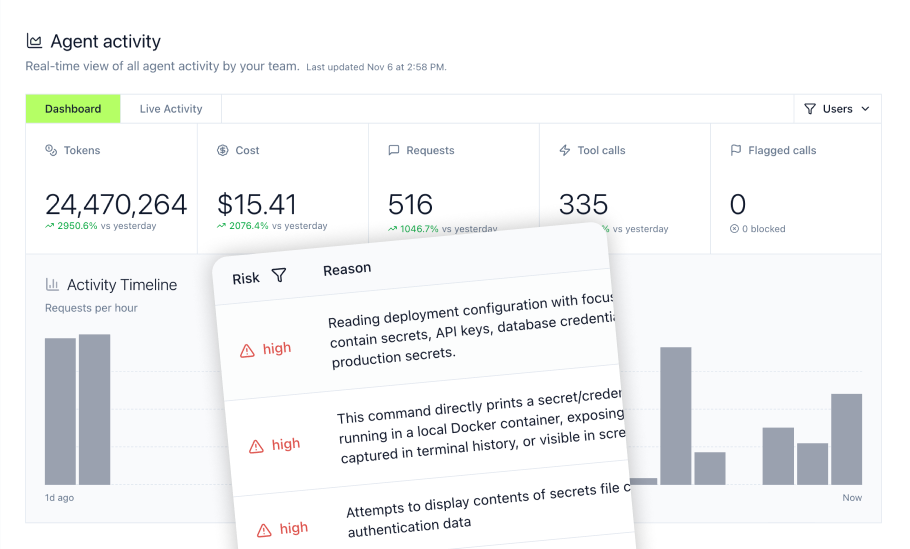
An Agent Monitor layer that tracks tool invocations, command execution, prompt submissions, and file access provides the visibility required to detect these threats. Without this layer, organizations operate without visibility when AI agents interact with production systems. The monitor tracks which MCPs are installed, what files agents access, and can block dangerous commands in real time before they execute.
Establishing Robust Authentication and Access Control for All MCP Servers
For remote MCP deployments that implement authorization, the MCP specification requires OAuth 2.1-aligned token handling and PKCE for clients. This requirement exists because static API keys, service accounts, and shared credentials create unacceptable risk in MCP architectures.
Why Static Credentials Fail for MCP
- No per-user attribution means audit logs cannot track who performed what action
- Shared credentials prevent revoking access for individual compromised agents
- Static keys cannot support the dynamic permission scopes MCP operations require
- Service accounts violate least-privilege principles when agents need varying access levels
Enterprise MCP security requires integration with existing identity providers through SAML and SSO. When an employee accesses an MCP server through Claude, Cursor, ChatGPT, Gemini, or Copilot, their corporate identity should flow through to the tool layer. This enables role-based access control at the tool level, not just the session level.
Granular tool access control allows administrators to configure which operations each role can perform. A support team member might have read access to customer data through the CRM MCP server but no ability to modify records. This granularity is impossible with traditional API keys that grant either full access or none.
Agent identities require separate treatment from human users. An autonomous agent running background analysis needs its own credentials with M2M authentication, allowing rotation and revocation independent of the human who deployed it. Organizations exploring how MCP connects to enterprise data should review the MCP data risk guide for detailed exposure scenarios.
Achieving Zero Trust Security for AI Agents and MCP Infrastructure
Zero trust principles apply with particular urgency to MCP deployments. The NSA guidance explicitly states that organizations should never assume MCP servers or AI agents are trustworthy without continuous verification.
Core Zero Trust Requirements for MCP
- Verify every request: Each tool invocation must be authenticated and authorized independently, regardless of previous successful calls in the session
- Maintain strict allowlists: Only explicitly approved MCP servers should be reachable; fail closed on any unverified tool
- Implement least privilege: Grant agents the minimal necessary access for each operation; use incremental privilege elevation for sensitive actions
- Require human approval for high-risk actions: Operations involving deletion, financial transactions, or privileged access must require explicit human confirmation
The gateway pattern centralizes these controls. Rather than allowing clients to connect directly to MCP servers, all traffic flows through a security gateway that enforces authentication, validates permissions, logs activity, and applies policy rules before forwarding requests.
Policy enforcement must happen in real time. When an agent attempts to access a sensitive file or execute a potentially dangerous command, the gateway should evaluate the action against organizational policies and block violations immediately. Post-hoc detection is insufficient because the damage occurs the moment the action executes.
Compliance and Auditability: Supporting SOC 2, HIPAA, and GDPR Requirements for AI Deployments
Regulated industries face particular challenges with MCP because traditional compliance frameworks were not designed for AI agent access patterns. Every tool invocation should be logged with user attribution, timestamps, result status, and enough request context for auditability, while sensitive values are masked or handled according to data-retention policy.
Audit Trail Requirements
- Complete record of every MCP tool invocation across all agents and users
- User identity linked to each action through SSO integration
- Parameter values logged for forensic analysis (with appropriate PII handling)
- Response metadata captured for incident reconstruction, with full content retained only when policy allows
- Session context preserved to understand multi-step workflows
Healthcare organizations deploying MCP for clinical data access need controls aligned with HIPAA standards. This requires encrypted credential storage per data source, role-based access control at the protocol level, and comprehensive audit logging of all PHI access. For regulated deployments, the safer pattern is to keep PHI access scoped through identity-aware permissions, encrypted credential storage, and complete audit trails before expanding MCP access beyond read-only workflows.
For GDPR and regional privacy requirements, teams should confirm where MCP traffic, logs, and connected-system data are processed. Gateway architecture can centralize policy enforcement and audit trails, but organizations should validate residency requirements against their own legal and compliance obligations.
For MintMCP specifically, the platform is SOC 2 Type II audited, compliant with HIPAA standards, penetration tested, and provides encryption in transit and at rest with complete audit trails and BAA signing available for customers handling protected health information.
Real-time Monitoring, Observability, and Threat Detection for AI Operations
Security without visibility is theater. Organizations deploying MCP need live dashboards showing server health, usage patterns, and security alerts across all AI agent activity.
Critical Monitoring Capabilities
- Tool call tracking: Every MCP tool invocation logged with latency, success/failure, and user attribution
- Anomaly detection: Baseline normal behavior patterns and alert on deviations indicating compromise or misuse
- Cost analytics: Track spending per team, project, and tool to identify runaway agent costs early
- Performance metrics: Measure response times and error rates to maintain SLA compliance
Threat detection for MCP requires understanding AI-specific attack patterns. Prompt injection attempts often manifest as unusual sequences of tool calls or parameters containing instruction-like content. Tool poisoning appears as unexpected changes to tool definitions or capabilities. Confused deputy attacks show up as agents accessing resources beyond their intended scope.
Integration with existing SIEM infrastructure allows MCP security events to flow into established incident response workflows. Security teams should not need separate tooling to investigate MCP-related incidents. The gateway should emit standard log formats that existing security operations centers can process.
Bridging Enterprise Systems: Securely Integrating AI with Your Data and Tools
MCP's value comes from connecting AI agents to enterprise data. The challenge is enabling this access without creating new breach vectors.
Common Enterprise Integration Patterns
- Data warehouses: AI agents query Snowflake for financial reporting, product analytics, and business intelligence through natural language
- Enterprise search: Elasticsearch integration enables AI-powered knowledge base search across documentation, support tickets, and historical data
- Productivity tools: Gmail, calendar, and collaboration platforms connect to AI assistants for communication analysis and scheduling automation
- Development systems: Repositories, issue trackers, and CI/CD pipelines become accessible to coding assistants through governed MCP connections
Each integration requires credential isolation. The MCP server connecting to Snowflake should hold only Snowflake credentials, with no ability to access credentials for other systems even if the server is compromised. This compartmentalization limits blast radius.
Read-only access should be the default. Most AI agent use cases involve querying data, not modifying it. Starting with read-only MCP servers and adding write capabilities incrementally, with additional approval gates, reduces risk significantly.
Financial services implementations should treat MCP as a governed access layer for risk analysis, with read-first access, user-bound scopes, approval gates for sensitive actions, and audit trails for regulatory review.
Deployment and Governance: Scaling Enterprise AI with Security Built-In
The path from shadow AI to governed enterprise deployment requires infrastructure that security teams control. Organizations cannot wait months to establish this foundation as shadow AI expands and employees adopt AI tools without IT oversight.
Deployment Timeline Expectations
- Pilot phase: Start with read-only MCP servers in an isolated environment with authentication and comprehensive logging
- Security hardening: Add gateway enforcement, zero trust policies, SIEM integration, and incident response procedures
- Production rollout: Add MCP servers incrementally, enable write operations only with approval gates, and validate compliance controls before broader access
One-click deployment for STDIO-based MCP servers accelerates this timeline significantly. Rather than managing Kubernetes pods and runtime environments, teams can deploy connectors instantly with built-in hosting and monitoring. This transforms local MCP servers into production services with security controls already applied.
Centralized credential management eliminates the security risk of developers storing API keys in configuration files. All credentials flow through the gateway with encryption at rest, rotation policies, and access logging.
Tool update policies address a subtle but important risk: upstream MCP servers can add new capabilities without notice. Organizations must choose whether to auto-enable new tools or require explicit admin approval, preventing silent capability expansion that could introduce unexpected access patterns.
MintMCP: Enterprise-Grade MCP Security Without the Implementation Burden
Implementing the security controls outlined in this article requires specialized infrastructure that most organizations lack. MintMCP provides a complete MCP security platform that handles authentication, authorization, monitoring, and governance out of the box, allowing teams to move from pilot to production in weeks rather than months.
MintMCP's MCP Gateway centralizes security controls across all MCP traffic. Every tool invocation flows through authentication checks, policy evaluation, and real-time monitoring before reaching backend systems. The platform integrates with existing identity providers through SSO, enabling per-user attribution and role-based access control at the tool level. For organizations with autonomous agents, Agent Gateway extends these controls with persistent memory, long-running workflows, and agent-specific identity management.
The Agent Monitor layer provides visibility that extends beyond MCP protocol traffic to track what local agents actually do, including shell commands, file access, database queries, and prompt submissions through tools like Claude Code and Cursor. This comprehensive view enables security teams to detect threats that would otherwise remain invisible until damage occurs.
One-click deployment transforms local STDIO-based MCP servers into production-ready services with hosting, monitoring, and security controls included. Teams avoid the complexity of managing runtime environments while maintaining full governance over agent access to enterprise data. Centralized credential management ensures API keys never touch developer machines, with encryption at rest, automatic rotation, and complete audit trails.
MintMCP is SOC 2 Type II audited, compliant with HIPAA standards, and provides BAA signing for healthcare organizations. The platform supports zero trust architecture and security controls aligned with the NSA MCP security guidance while helping teams ship AI features with security built in from the start.
Frequently Asked Questions
What is the difference between an API gateway and an MCP gateway?
An API gateway validates HTTP requests against schemas, enforces rate limits, and handles authentication for traditional REST/GraphQL endpoints. It operates on the assumption that calling applications follow predictable, programmed logic. An MCP gateway must handle dynamic tool discovery, autonomous agent decisions, stateful context across sessions, and AI-specific threats like prompt injection and tool poisoning. API gateways cannot evaluate agent behavior or validate the semantic content flowing through MCP. Organizations need both: API gateways for traditional traffic and MCP gateways for AI agent connectivity.
How do I secure MCP servers that run on local machines rather than cloud infrastructure?
Local STDIO-based MCP servers present unique challenges because they lack built-in authentication and run with the user's local permissions. The solution involves OAuth brokering that wraps local servers with authentication, even when they cannot handle redirect URIs natively. Organizations should also implement an Agent Monitor layer that tracks what local agents do beyond MCP traffic, including bash commands, file access, and prompt submissions through tools like Claude Code and Cursor. This provides visibility into local agent activity that would otherwise be completely unmonitored.
Can existing DLP solutions integrate with MCP security infrastructure?
Yes, but integration requires middleware that processes content at the gateway layer. Traditional DLP tools inspect files and network traffic but do not understand MCP's tool invocation patterns. Effective integration involves JS sandbox middleware that can call external DLP services like AWS Bedrock Guardrails, Google Cloud DLP, or Microsoft Purview before forwarding requests. The middleware can block, mask, or transform content based on DLP responses. Organizations should verify their MCP gateway supports pre- and post-phase hooks with the ability to call external services through allowed domain lists.
What happens when an MCP server adds new tools without administrator approval?
Uncontrolled tool expansion represents a significant risk because it can introduce capabilities that bypass existing access controls. Organizations should configure their MCP gateway to either auto-enable new upstream tools or require explicit admin approval before making them available to agents. The latter approach prevents silent capability expansion but requires ongoing administrative attention. Comprehensive monitoring should alert administrators when tool definitions change, even for approved tools, to detect potential tool poisoning attacks.
How should organizations handle MCP latency in performance-sensitive workflows?
MCP can add orchestration overhead, so teams should avoid placing it directly in latency-sensitive paths like checkout flows, trading systems, or real-time control applications unless performance has been tested under realistic load. Organizations should deploy MCP as an intelligence layer adjacent to critical paths rather than inline with them. For example, an AI agent can analyze customer behavior and generate recommendations through MCP, but the actual transaction processing should use traditional low-latency APIs. Sidecar deployment patterns allow MCP-powered intelligence to inform decisions without blocking time-critical operations.