The Model Context Protocol has become a common standard for connecting AI assistants to enterprise systems, but recent MCP vulnerability disclosures show how implementation flaws can expose organizations to command injection and remote code execution risks. With 71% of organizations regularly using generative AI in at least one business function, security teams face an urgent challenge: enable AI tool adoption without exposing databases, credentials, and internal systems to compromise. An MCP Gateway provides the authentication, authorization, and audit controls required to deploy MCP servers safely at enterprise scale.
This checklist covers the essential security controls for enterprise MCP deployments, including governance frameworks, authentication best practices, compliance requirements, agent protection, monitoring infrastructure, and secure integration patterns.
Key Takeaways
- MCP implementation flaws can expose AI-connected systems to command injection and remote code execution risks, requiring input validation, dependency review, and secure coding practices
- CVE-2025-6514 in the mcp-remote npm package was patched in v0.1.16, highlighting supply chain risks in MCP client dependencies
- Continuous monitoring helps teams maintain audit-ready evidence instead of relying only on point-in-time assessments
- Shadow AI expands as AI adoption grows, making governed deployment essential to transform unsanctioned tools into secure, auditable infrastructure
- Implementation follows a phased approach: foundation (30 days), authentication and authorization (60 days), full governance (90 days)
- Gateway architecture is the recommended control layer for governed MCP deployments, centralizing policy enforcement and audit logging across approved AI-to-tool connections
Establishing Enterprise-Grade Governance for MCP Deployments
MCP enables AI assistants like Claude, ChatGPT, Gemini, and Copilot to access databases, APIs, and internal tools through standardized servers. However, MCP security still depends on implementation choices, transport configuration, authentication, authorization, and operational controls.
Beyond Shadow AI: Turning Unsanctioned Use into Governed Deployment
Shadow AI usage creates significant risk when employees connect AI tools to company systems without IT oversight. The first step toward governance is complete visibility into existing MCP deployments across your organization.
Foundation phase (Days 1-30):
- Inventory all existing MCP server deployments across engineering teams
- Implement basic audit logging for every MCP interaction
- Move credentials from environment variables to secret management systems like AWS Secrets Manager or HashiCorp Vault
- Document which AI clients (Cursor, Claude Code, ChatGPT) employees currently use
Centralized Control: Unifying AI Tool Management
A centralized MCP gateway serves as the single control point for all AI-to-data connections. Rather than managing security server-by-server, teams configure authentication, access policies, and monitoring once at the gateway layer.
Key governance capabilities:
- Unified authentication wrapping for all MCP endpoints
- Role-based access control at the tool level
- Centralized audit trails with user attribution
- Policy enforcement before requests reach backend systems
MintMCP's centralized governance provides unified authentication, audit logging, and rate control for all MCP connections, transforming local development servers into production-ready infrastructure.
Securing AI Access: Authentication and Authorization Best Practices
Static API keys and shared credentials represent the most common security weakness in MCP deployments. OAuth 2.1-based authorization is the expected pattern for protected HTTP-based MCP servers under the MCP authorization specification.
Implementing Robust Federated Identity
Enterprise authentication requires integration with existing identity providers rather than standalone credential management.
Authentication requirements:
- OAuth 2.0 or SAML integration with corporate IdP (Okta, Azure AD, Auth0)
- Single sign-on enforcement for all MCP access
- Multi-factor authentication for administrative operations
- Session management with appropriate timeouts
Granular Control: Defining Who Can Do What with AI Tools
Tool-level permissions prevent over-privileged access where users gain capabilities beyond their job requirements.
Authorization best practices:
- Configure access by role (read-only operations for analysts, write access for administrators)
- Implement approval workflows for new MCP server installations
- Separate service accounts from user accounts with distinct permission sets
- Enable per-user authentication flows rather than shared service credentials
MintMCP supports both shared and per-user auth with flexibility to configure service accounts at the admin level or enable individual OAuth flows for each employee.
Comprehensive Data Security and Compliance for Enterprise AI
Regulated industries face specific requirements when AI agents access protected data. SOC 2, HIPAA, and GDPR each impose distinct obligations for audit trails, access controls, and data handling.
Building a Defensible Audit Trail for AI Interactions
Compliance frameworks require complete records of who accessed what data and when. Continuous monitoring helps teams maintain audit-ready evidence instead of relying only on point-in-time assessments.
Audit requirements:
- Immutable logging with minimum 90-day retention
- User attribution for every MCP request (no anonymous access)
- Timestamp, tool invoked, parameters passed, and response metadata
- Export capabilities for auditor review
Protecting Sensitive Data: Data Residency and Access Controls
Data residency controls matter when AI agents process information subject to geographic restrictions. GDPR requires explicit consent and data minimization; HIPAA demands Business Associate Agreements for protected health information.
Compliance checklist:
- Review available data residency options and align deployment architecture with regulatory requirements
- Implement PII detection and filtering before data reaches AI models
- Enable consent tracking for user-initiated AI interactions
- Request HIPAA documentation and confirm BAA coverage before handling protected health information
For compliance documentation and security posture details, visit the MintMCP Trust Center.
Protecting Against AI Agent Malfunctions and Misuse
Coding agents in tools like Cursor and Claude Code operate with extensive system access, executing bash commands, reading files, and accessing production systems through MCP tools. Without controls, agents can exfiltrate credentials, execute destructive commands, or access data outside their intended scope.
Monitoring and Intercepting Risky AI Agent Actions
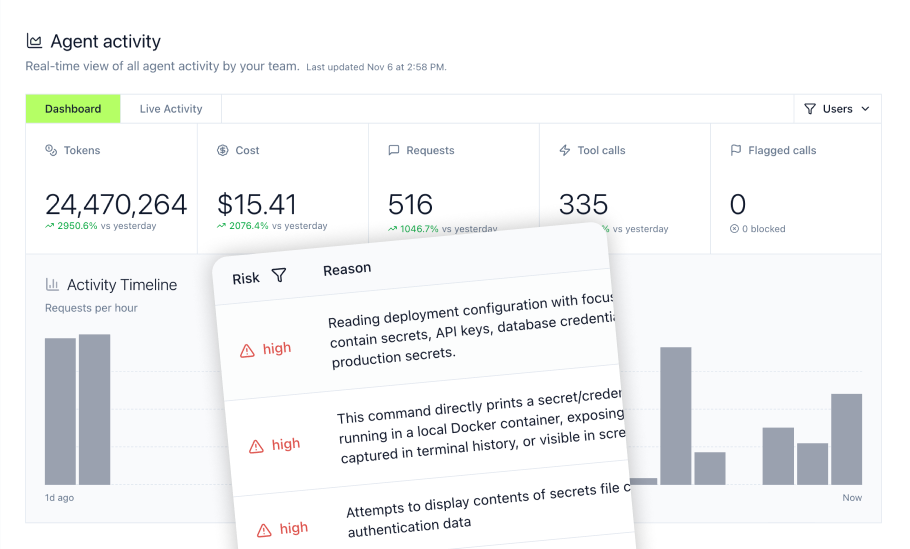
MintMCP's Gateway and Agent Monitor provide visibility across MCP tool calls and local agent activity, including bash commands, file access, and risky workflow patterns.
Agent monitoring capabilities:
- Track MCP tool calls with structured audit metadata and appropriate sensitive-data handling
- Monitor bash commands executed by coding agents
- Detect access to sensitive files (.env, SSH keys, credentials)
- Alert on anomalous patterns like bulk data access or privilege escalation attempts
Implementing Guardrails for File Access and Command Execution
Real-time guardrails help teams block or escalate dangerous operations before they create damage.
Security guardrails:
- Block destructive commands (rm -rf, chmod 777, database drops)
- Prevent access to credential files and environment secrets
- Allowlist permitted operations by role and context
- Require approval for sensitive actions through human-in-the-loop workflows
OWASP LLM01:2025 prompt injection remains the top AI security risk, requiring multi-layer defenses including input validation, output filtering, and user approval for sensitive operations.
Real-time Monitoring and Observability for AI Deployments
Visibility into AI tool usage enables proactive security and cost management. Without monitoring, organizations cannot detect misuse, measure adoption, or demonstrate compliance.
Gaining Full Visibility into Your AI Operations
Effective observability covers usage patterns, performance metrics, and security events across all AI tools and MCP connections.
Monitoring requirements:
- Real-time dashboards for server health and usage patterns
- Security alerts for policy violations and anomalous behavior
- Cost tracking per team, project, and tool
- Performance metrics including response times and error rates
Strong observability shortens investigation workflows by giving security teams searchable logs, policy events, and user-attributed tool activity in one place.
Cost and Usage Analytics for Responsible AI Adoption
Understanding consumption patterns helps optimize spend and identify shadow usage before it creates compliance risk.
Analytics capabilities:
- Track spending by team, project, and individual tool
- Identify unused or underutilized MCP connections
- Monitor token consumption across AI providers
- Generate reports for budget planning and chargeback
Building Secure Integrations for AI Tools with Internal Data
Connecting AI assistants to databases, search systems, and business applications requires careful architecture to prevent data leakage while enabling productivity.
Connecting AI to Databases and Internal Systems with Confidence
The Snowflake MCP Server enables AI agents to query data warehouses for analytics, financial reporting, and business intelligence. The Elasticsearch MCP Server provides AI-powered knowledge base search and log analysis capabilities.
Secure integration patterns:
- Implement read-only connections by default, requiring explicit approval for write operations
- Use service accounts with least-privilege permissions scoped to specific schemas or indices
- Enable query logging to track exactly what data AI agents access
- Configure rate limiting to prevent bulk data extraction
Ensuring Data Integrity Across AI Workflows
Data governance extends beyond access control to include accuracy and consistency.
Data integrity controls:
- Validate AI-generated queries before execution
- Implement result set limits to prevent accidental data floods
- Log data modifications with before-after state where backend systems support it
- Enable rollback capabilities for AI-initiated changes
For a deeper understanding of data access risks in MCP deployments, see the MCP data risk guide.
Deploying MCP Servers with High Availability and Reliability
Production MCP deployments require infrastructure that matches enterprise availability expectations. Development-grade server configurations create single points of failure and performance bottlenecks.
Architecting AI Infrastructure for Resilience and Scalability
Enterprise SLAs demand automatic failover, redundancy, and multi-region support.
Infrastructure requirements:
- Containerized server deployment with automatic scaling
- Load balancing across multiple server instances
- Health checks with automatic restart on failure
- Regional deployment and disaster recovery planning aligned with vendor-supported options
From Local Dev to Enterprise Production
The transition from local STDIO servers to production-grade infrastructure is usually faster with managed gateway workflows than with fully self-hosted builds that require teams to operate the runtime, authentication, monitoring, and scaling layers themselves.
Deployment options:
- Managed cloud service with vendor-supported uptime commitments (fastest time to production)
- Self-hosted on customer infrastructure (maximum control, higher operational burden)
- Hybrid approach with cloud control plane and on-premises data plane
MintMCP deploys in minutes through one-click deployment that transforms STDIO-based MCP servers into hosted services with built-in monitoring.
Empowering Developers with Secure and Sanctioned AI Tools
Security controls that block developer productivity create shadow IT. Effective governance enables rapid AI tool adoption while maintaining oversight.
Accelerating Innovation: Deploying AI Tools in Minutes
Self-service access with pre-configured policies removes bottlenecks while preserving security boundaries.
Developer enablement features:
- One-click installation of approved MCP servers
- Pre-configured security policies that activate automatically
- Request workflows for new tools with rapid approval cycles
- Centralized credential management eliminating local secret storage
From Unsanctioned AI to Governed Productivity
Converting shadow AI into sanctioned tools requires meeting developers where they work rather than forcing workflow changes.
Adoption strategy:
- Support existing AI clients (Claude, Cursor, ChatGPT, Gemini, Copilot) rather than mandating new tools
- Maintain day-to-day workflows while adding governance layers
- Provide visibility into usage patterns without blocking legitimate work
- Enable gradual rollout starting with willing teams before organization-wide deployment
For detailed implementation guidance, see the enterprise MCP deployment guide covering phased rollout, team onboarding, and security configuration.
Securing Your Enterprise AI Deployment with MintMCP
Enterprise AI security requires more than isolated controls. Organizations need integrated visibility, policy enforcement, and audit trails across every AI-to-data connection. MintMCP delivers production-ready governance through a unified gateway architecture that transforms local development servers into secure, auditable infrastructure.
MintMCP provides centralized authentication wrapping for all MCP endpoints, eliminating static credentials and enabling SSO integration with corporate identity providers. Tool-level RBAC ensures developers access only the capabilities their roles require, while continuous audit logging creates defensible records for compliance reviews. Organizations handling protected health information benefit from HIPAA documentation and BAA coverage, while SOC 2 Type II audited controls provide baseline assurance for regulated deployments.
The platform monitors agent behavior in real time, detecting risky file access patterns, destructive bash commands, and anomalous data extraction attempts before they execute. Security teams gain searchable logs, policy violation alerts, and user-attributed activity across Cursor, Claude, ChatGPT, Gemini, Copilot, and other AI clients employees already use. Rather than forcing workflow changes that drive shadow AI adoption, MintMCP meets developers where they work while preserving IT oversight.
Deployment takes minutes through managed workflows that help teams handle authentication, monitoring, scaling, and reliability planning without building every layer from scratch. Self-service developer access with pre-configured security policies accelerates innovation without creating compliance gaps. For organizations deploying MCP at scale, MintMCP transforms unsanctioned AI tool usage into governed, auditable infrastructure that enables productivity while protecting data, credentials, and internal systems.
Frequently Asked Questions
What is the difference between MCP Gateway and Agent Gateway?
MCP Gateway provides governed data and tool connections for AI systems employees already use, including Claude, Cursor, ChatGPT, Gemini, and Copilot. Agent Gateway extends this foundation with identities, permissions, memory, and monitoring for autonomous agents that work alongside users. Organizations typically start with MCP Gateway to secure existing AI tool usage, then expand to Agent Gateway as they deploy coworker agents that operate independently across days with persistent memory and scoped tool access.
How do I prioritize which MCP security controls to implement first?
Start with authentication and audit logging in the first 30 days. Move credentials to secret management, implement basic request logging, and inventory existing deployments. In days 31-90, deploy a centralized gateway, migrate from static tokens to OAuth 2.1, and configure tool-level RBAC. Days 91-180 address advanced controls including DLP integration, automated threat detection, and compliance reporting automation. This phased approach delivers immediate risk reduction while building toward comprehensive governance.
What supply chain risks exist with MCP servers and how do I mitigate them?
MCP servers installed from public registries may contain malicious code. CVE-2025-6514 in the mcp-remote npm package affected versions before v0.1.16, showing why MCP dependencies need version pinning, approval workflows, and rapid patch management. Mitigation requires mandatory code review before installation, cryptographic verification of package signatures, version pinning to known-good releases, and maintaining an allowlist of approved MCP servers. Centralized gateway deployment with admin approval workflows prevents unauthorized server installations.
How does MCP security integrate with existing SIEM and security tooling?
MCP gateways export audit logs in standard formats compatible with Splunk, ELK Stack, Datadog, and other SIEM platforms. Integration enables correlation of MCP activity with other security events, automated alerting on policy violations, and unified incident investigation across AI and traditional infrastructure. DLP integrations with AWS Bedrock Guardrails, Google Cloud DLP, and Microsoft Purview enable content inspection and PII masking inline at the gateway layer.
What compliance documentation should I prepare before deploying MCP in a regulated environment?
Healthcare organizations handling protected health information should confirm HIPAA documentation, BAA coverage, and processor responsibilities before deploying MCP-connected workflows. Financial services require documentation mapping MCP controls to SOX and PCI DSS requirements. Regulated organizations should document how MCP controls map to their required frameworks and confirm whether vendors provide SOC 2 Type II audited controls, audit logs, access control evidence, and relevant compliance documentation. Prepare data flow diagrams showing how information moves between AI clients, MCP servers, and backend systems, along with access control matrices documenting who can access what data through which tools.