AgentOps represents the operational discipline for managing autonomous AI agents in production environments. As organizations deploy AI agents across customer support, data analysis, and development workflows, they face critical challenges around observability, cost management, security, and governance that traditional monitoring tools cannot address. With the broader AI agents market projected to grow from $5 billion to $50 billion by 2030, companies need structured approaches to deploy, monitor, and govern AI agents at scale. MintMCP's MCP Gateway provides the enterprise-grade infrastructure layer that transforms AgentOps from concept to operational reality, enabling organizations to govern AI agent tool access, authenticate connections, and maintain complete audit trails across Claude, Cursor, ChatGPT, Gemini, and Copilot deployments.
This article explains what AgentOps is, details the tools and frameworks available, and provides a practical guide for getting started with AI agent infrastructure that meets enterprise security and compliance requirements.
Key Takeaways
- AgentOps extends DevOps and MLOps principles to address AI agent-specific challenges including non-deterministic reasoning, autonomous tool use, and multi-agent coordination
- Organizations implementing AgentOps platforms can reduce LLM API costs through token management and model routing optimization, although results vary by workload
- AgentOps implementation time varies based on agent count, framework complexity, identity integration, security controls, and deployment requirements
- 89% of surveyed CIOs identify agent-based AI as a strategic priority for productivity and workflow automation
- Cross-functional ownership spanning engineering, operations, compliance, and finance is essential for AgentOps success
- Session-level tracing and execution logs help teams investigate failures and identify where agent workflows break down
Understanding AgentOps: The Backbone of AI Agent Infrastructure
AgentOps is the emerging operational discipline for managing the full lifecycle of autonomous AI agents in production environments. It extends principles from DevOps and MLOps to address the unique challenges of agentic AI systems, including non-deterministic reasoning, autonomous tool use, multi-agent coordination, and cost management.
Unlike traditional application monitoring that tracks uptime and error rates, AgentOps captures observable execution traces, model interactions with external systems, multi-agent collaboration patterns, and semantic quality of outputs. This enables organizations to debug failures, optimize performance, control costs, and maintain governance across distributed agent deployments.
Why AgentOps Matters for Enterprise AI
- Non-deterministic behavior: AI agents produce variable outputs even with identical inputs, requiring specialized observability to understand decision paths
- Autonomous tool access: Agents interact with databases, APIs, and internal systems without human approval for each action, creating security and compliance exposure
- Multi-agent workflows: Complex tasks involve multiple specialized agents delegating to each other, creating cascading failure risks that traditional monitoring cannot trace
- Cost unpredictability: Token consumption varies dramatically based on agent execution depth, making budget management difficult without purpose-built tracking
The concept of AgentOps emerged as organizations moved from experimental AI chatbots to production-grade autonomous agents. While a single chatbot interaction is stateless and bounded, an AI agent might query a database, analyze results, call external APIs, draft communications, and update records across a multi-step workflow. Each step creates audit, security, and operational concerns that compound without proper infrastructure.
The Last Mile Problem in Enterprise AI
Most enterprises have invested heavily in AI model access through providers like OpenAI, Anthropic, and Google. The challenge is not model capability but rather connecting those models to internal data sources, enforcing access policies, and maintaining visibility into what agents do with enterprise data.
This "last mile problem" manifests as credential sprawl, audit gaps, shadow AI, and policy fragmentation. AgentOps infrastructure addresses these challenges by providing a unified control plane for AI agent governance. Rather than treating each agent-to-system connection as a separate integration, AgentOps platforms create a centralized layer for authentication, authorization, logging, and policy enforcement.
Exploring Key Tools and Frameworks for AI Agents
The AgentOps ecosystem includes both agent development frameworks and operational platforms. Understanding both categories helps organizations make informed infrastructure decisions.
Agent Development Frameworks
Agent frameworks provide the building blocks for creating AI agents:
- LangChain/LangGraph: The dominant open-source framework for building LLM applications and agents, with extensive tool integrations and workflow orchestration capabilities
- AutoGen and AG2: AutoGen is Microsoft's framework for building agent applications, while AG2 is a separate open-source framework that diverged from the original AutoGen codebase and supports multi-agent collaboration
- CrewAI: Role-based agent orchestration focused on team-like agent collaboration
- OpenAI Agents SDK: OpenAI's official framework for building agents with function calling and tool use
- LlamaIndex: Specialized for data-intensive agent applications with strong retrieval and indexing capabilities
AgentOps Platforms
Operational platforms sit above agent frameworks to provide monitoring, evaluation, and governance. Key capabilities include:
Agent monitoring and observability:
- Real-time tracing of agent execution paths and LLM calls
- Tool invocation tracking with latency and error diagnostics
- Session replay capabilities for debugging complex failures
- Multi-agent workflow visualization
Cost and token management:
- Per-agent and per-session token usage tracking
- Budget alerts and spending controls
- Model routing optimization to balance cost and quality
Compliance and audit logging:
- Automated audit trails for regulatory requirements
- Documentation for GDPR, EU AI Act, and HIPAA where applicable
- Complete decision history with user attribution
- Retention policies aligned to compliance standards
AI security and guardrails:
- Prompt injection detection and prevention
- Output filtering for PII and sensitive data
- Policy enforcement on tool access
- DLP integration with enterprise security tools
Platform Comparison Considerations
When evaluating AgentOps platforms, consider setup complexity, pricing models, framework compatibility, and enterprise system integration. Developer-tier platforms provide SDK-based instrumentation that can be relatively lightweight for an initial test, although production setup time depends on the application and required integrations. Enterprise tiers generally use custom pricing based on trace volume, retention, deployment model, support, security, and hosting requirements.
Some platforms advertise support for 400+ LLMs and frameworks, alongside native integrations with widely used agent frameworks. Consider your current framework investments and future expansion plans when evaluating compatibility.
Real-Time AI Agent Monitoring and Observability
Traditional observability tools were built for deterministic software. AI agents require fundamentally different monitoring approaches that understand execution patterns, tool use, and semantic quality.
What Makes Agent Observability Different
Execution trace visibility: Standard monitoring captures input and output. Agent observability must capture observable intermediate events, tool selections, model interactions, and execution branches that led to a final output. When an agent produces an incorrect result, you need to identify whether the failure occurred in initial understanding, tool selection, data retrieval, or synthesis.
Tool invocation tracking: Agents interact with multiple external systems during task execution. Observability must track each tool call including which tool was invoked and why, input parameters, response received and processing time, and how the response influenced subsequent execution.
Multi-agent coordination: Complex workflows involve multiple specialized agents delegating tasks to each other. Multi-agent tracing can help isolate whether failures originate in retrieval, orchestration, model behavior, or an external tool.
Semantic quality evaluation: Unlike traditional software where success is binary, agent outputs have qualitative dimensions. Was the response accurate? Was it helpful? Did it follow guidelines? Semantic evaluation requires LLM-as-judge frameworks and human feedback integration.
Key Observability Capabilities
Session-level tracing and execution logs can help teams investigate failures and identify where an agent workflow broke down. Session replay captures the full context including user input, agent execution, tool calls, and final output.
Anomaly detection identifies unusual patterns including agents making unexpected tool calls, token usage spikes indicating infinite loops or excessive execution, latency degradation affecting user experience, and error rate increases on specific agent types or workflows.
Per-agent and per-session cost attribution enables optimization. Organizations can discover which agents, users, or use cases drive token consumption, enabling targeted optimization.
MintMCP's Agent Monitor Approach
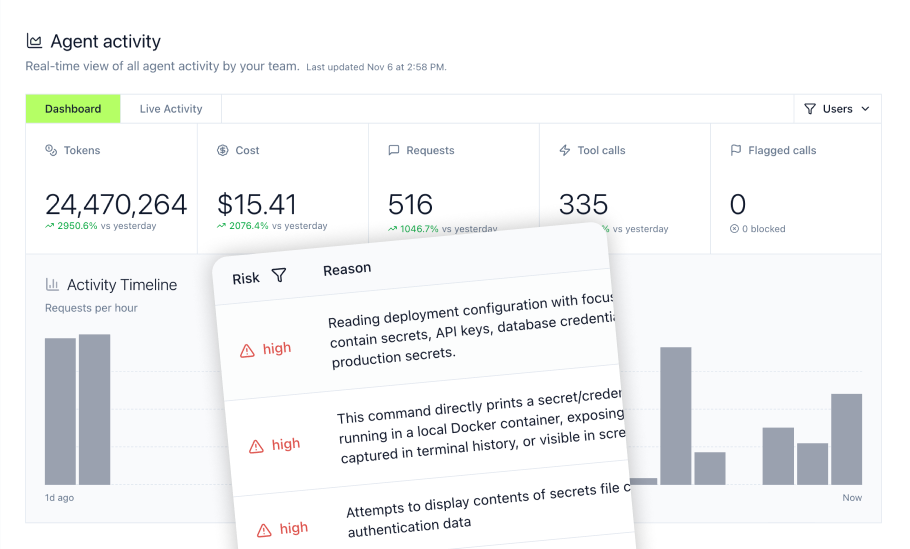
MintMCP's Agent Monitor provides observability across two dimensions. First, it tracks all MCP traffic flowing through the gateway, providing visibility into tool calls, data access, and policy enforcement. Second, on devices and supported clients where Agent Monitor hooks are deployed, the platform can provide visibility into local agent actions that occur outside MCP, including file access, command execution, and prompt submissions.
This two-layer approach addresses the shadow AI problem. Developers using AI coding assistants often configure connections outside IT governance. Agent Monitor detects this off-gateway activity, enabling security teams to understand the full scope of AI usage.
Agent Monitor includes built-in detection rules for PII exposure in agent inputs or outputs, credential leakage, risky bash commands that could harm systems, and prompt injection attempts targeting agent behavior. Custom guardrail policies can be configured with block, flag, or alert actions based on organizational requirements.
Securing Your AI Agents: Governance, Authentication, and Compliance
Security and compliance requirements have emerged as the primary barriers to enterprise AI agent deployment. While 89% of surveyed CIOs identify agent-based AI as a strategic priority, security teams often lack visibility and control over what agents can access.
Authentication and Identity
AI agents require identity infrastructure analogous to human users. Without proper agent identity, audit logs cannot attribute actions to specific agents, credentials cannot be rotated per-agent when compromised, access policies cannot distinguish between agents with different purposes, and compliance investigations cannot trace decisions to responsible parties.
Best practices for agent authentication:
- Per-agent credentials: Each agent should have its own identity with independently rotatable credentials, not shared service accounts
- M2M OAuth flows: OAuth 2.0 client-credentials flow enables agents to authenticate without human intervention while maintaining audit attribution
- Scoped permissions: Agent identities should receive minimum necessary access, not inherit creator's full permissions
- Credential lifecycle management: Automated rotation, revocation, and monitoring for agent credentials
MintMCP's agent identities support per-agent bearer API keys and OAuth 2.0 client-credentials for machine-to-machine authentication. Each agent receives its own credentials that can be rotated or revoked independently of human users, with an "act as agent" admin flow for connectors requiring per-agent OAuth.
Tool-Level Access Control
Agent governance must operate at the tool level, not just the system level. An agent authorized to query a database should not automatically gain permission to modify it. Effective governance requires enabling specific tools while blocking others within the same system, restricting tool parameters, requiring approval workflows for sensitive tool access, and implementing time-bound access for temporary agent deployments.
A subtle security risk is tool capability expansion. When MCP servers add new tools, agents may gain capabilities that security teams never approved. Effective governance requires policies for blocking automatic enablement of new upstream tools, requiring admin approval for tool additions, and alerting on capability changes to connected systems.
Compliance Requirements
Organizations in regulated industries face specific compliance obligations for AI agent deployments. Logs, documentation, access records, and review evidence must be appropriate to the applicable regulatory framework and use case.
EU AI Act considerations for systems within scope:
- Logging and record-keeping where required for high-risk AI systems
- Human-oversight mechanisms appropriate to the system's risk classification
- Technical documentation and transparency measures required for the applicable system and organizational role
- Risk-management processes for high-risk systems
HIPAA requirements for healthcare:
- Business Associate Agreements with platform vendors
- Audit controls for all PHI access
- Access controls limiting agent data access to minimum necessary
- Incident response procedures for agent-related breaches
Financial services regulations:
- Audit trails for automated trading or advisory decisions
- Model risk management documentation
- Supervisory review of agent actions
- Data retention meeting regulatory requirements
MintMCP provides security governance capabilities including SOC 2 Type II audited controls with continuous monitoring through Drata, compliance with HIPAA standards, HIPAA documentation, and BAA availability for applicable customers, plus DLP integrations with AWS Bedrock Guardrails, Google Cloud DLP, Microsoft Purview, Nightfall, and Skyflow.
Zero-Trust Architecture
Modern agent security requires zero-trust principles where no default access is assumed and every request requires authentication and authorization. This means no inherited permissions where agent capabilities must be explicitly granted, continuous verification where each tool call should be authenticated and authorized, least privilege where agents receive minimum necessary access, and assuming breach where architecture should limit blast radius when individual agents are compromised.
Getting Started with AI Agents: Practical Steps and Use Cases
Moving from experimental AI agents to production-grade deployments requires structured implementation. The following process provides a practical roadmap based on enterprise deployment patterns.
Phase 1: Foundation
Platform selection and trial activation: Research platform capabilities based on your agent framework. Sign up for free trials or developer accounts to evaluate dashboard interfaces, SDK documentation, and configuration options. Where a trial or developer tier is available, use it to evaluate instrumentation, dashboards, integrations, and operational workflows before making a broader commitment.
Basic instrumentation: Install platform SDKs and add initialization code to your agent applications. For most frameworks, this requires 2-3 lines of code. Expected result: first traces appear in platform dashboard showing agent execution paths, tool calls, and timing information.
Define success metrics: Before expanding instrumentation, establish what success looks like through quality metrics, performance metrics, cost metrics, and compliance metrics.
Phase 2: Evaluation and Governance
- Build evaluation datasets: Create test cases representing realistic scenarios your agents will handle. These "golden tasks" enable automated evaluation and regression testing as you iterate. Include edge cases, adversarial inputs, and compliance-sensitive scenarios.
- Configure guardrails and alerts: Establish policies before production deployment including cost budgets with alerts, latency thresholds triggering investigation, error rate limits prompting automatic throttling, and security rules blocking PII exposure or credential leakage.
- Integrate with identity systems: Connect AgentOps platform to your identity provider for SSO and SCIM-based group synchronization. This ensures agent access policies align with organizational structure and change automatically when team membership changes.
Phase 3: Production Deployment
- Canary deployment: Roll out instrumented agents gradually. Start with 5-10% of traffic to validate stability before expanding. Monitor dashboards for anomalies and be prepared to roll back if issues emerge.
- Establish runbooks: Document procedures for responding to cost alerts, investigating failed agent sessions, handling security policy violations, rotating compromised credentials, and onboarding new agent types.
- Cross-functional communication: Ensure engineering, operations, security, and compliance teams all have appropriate dashboard access and understand their responsibilities. AgentOps requires coordination that traditional siloed monitoring does not.
Real-World Use Cases
- Customer support automation: AgentOps tracing can help teams review which knowledge sources, tools, and model calls contributed to a support response, making it easier to investigate incorrect answers and escalations.
- LLM cost optimization: Per-agent and per-session cost attribution can reveal oversized prompts, repeated model calls, unnecessary retries, and inefficient context use.
- Multi-agent workflow debugging: Multi-agent tracing can help teams follow delegation paths and determine whether a failure originated in retrieval, orchestration, an external tool, or a model response.
The AgentOps Ecosystem: Integration Standards
AgentOps platforms must integrate across the AI stack, from foundation models to enterprise systems to development tools.
LLM Provider Integration
Modern AgentOps platforms support all major foundation model providers:
- OpenAI models and APIs
- Anthropic Claude models
- Google Gemini models
- Azure-hosted model deployments
- Open-source and self-hosted models, including model families from Meta, Mistral, and other providers
Platform-level integration enables consistent observability regardless of which model powers your agents.
MCP Protocol Standards
The Model Context Protocol (MCP) has emerged as the standard for AI agent-to-tool connectivity. MCP provides standardized tool definitions, support for local stdio and remote Streamable HTTP connections, OAuth 2.1-based authorization and bearer access-token usage for protected remote servers, and structured error responses for agent reasoning.
MCP was donated by Anthropic to the Linux Foundation and became a founding project of the Agentic AI Foundation, placing the protocol under neutral open-source governance. This standardization means AgentOps platforms built on MCP will have broader compatibility as the ecosystem matures.
Enterprise System Integration
Production agent deployments require connectivity to enterprise systems including developer tools like GitHub, GitLab, and Jira, business systems like Salesforce and Snowflake, and security infrastructure like Okta and Splunk. MintMCP provides 50+ pre-configured connectors covering common enterprise systems, plus the ability to host custom MCP servers for proprietary integrations.
MintMCP: Enterprise AgentOps Infrastructure
MintMCP approaches AgentOps differently than standalone observability platforms. Rather than focusing solely on monitoring, MintMCP provides the infrastructure layer that makes AI agent governance operational through its two connected categories: MCP Gateway and Agent Gateway.
MCP Gateway: Governed Tool Connections
MintMCP's MCP Gateway provides governed data and tool connections for the AI systems users already run, including Claude, Cursor, ChatGPT, Gemini, and Copilot. Most agent platforms start from the agent and retrofit data permissions afterward. MintMCP inverts this model, starting from data permissions (SSO, SCIM, identity groups, policy, audit) and enabling agents on top. This means an agent's access is always a subset of an already-governed permission model.
This architectural difference has practical implications:
- Governed permission boundaries: Agent capabilities can be scoped through tool-level policies and Virtual MCP Bundles
- Centralized policy management: Teams can apply shared access policies across governed users, teams, and agent identities
- Audit support: Centralized logs and access controls help organizations collect evidence for applicable compliance programs
- Reduced repeated configuration: Reusable Bundles can package tool access, policy, and audit settings for specific roles and use cases
Agent Gateway: Coworker Agent Infrastructure
Building on its MCP Gateway foundation, MintMCP's Agent Gateway provides identities, permissions, memory, and monitoring for agents that work alongside users. This emerging category addresses coworker agents, long-running agents that live in Slack, hold memory, continue work across days, and operate alongside employees.
Agent Gateway capabilities include:
- Agent Bundles with M2M authentication: First-class machine-to-machine authentication with bearer API keys, OAuth 2.0 client-credentials flow, independent credential rotation per agent, and "act as agent" admin flow
- Two-layer governance: Gateway-layer visibility for all MCP traffic plus Agent Monitor hooks for local agent activity in Claude Code and Cursor, capturing bash commands, file operations, and prompt submissions
- Custom gateway middleware: Customer-authored middleware in a JS sandbox with pre- and post-phase hooks for tool calls, access to secrets for external API integration, and built-in templates for OpenAI moderation, jailbreak detection, and DLP integration
Organizations can explore MintMCP's guides for practical implementation approaches to both MCP Gateway and Agent Gateway use cases.
Frequently Asked Questions
What distinguishes AgentOps from MLOps and DevOps?
DevOps manages software delivery, while MLOps focuses on machine learning pipelines, model deployment, and monitoring. AgentOps addresses autonomous AI agents, including variable behavior, tool use, multi-agent coordination, cost tracking, and output quality. It traces execution paths, tool calls, and workflow performance across production agent systems.
How do organizations handle agent credential rotation without service disruption?
Organizations use per-agent credentials, overlap periods, and automated rotation. New credentials become active before old ones are revoked, preventing downtime. Centralized credential management simplifies rotation, monitoring, and rollback. Higher-risk agents should rotate credentials more frequently based on access level and organizational policy.
What metrics indicate healthy agent performance versus emerging problems?
Key metrics include error rates, latency, completion rates, token usage, tool-call patterns, evaluation scores, user feedback, and cost per successful task. Rising token use, changing tool behavior, greater score variance, or declining feedback can signal prompt drift, inefficient execution, or emerging reliability problems.
How should organizations approach AgentOps platform migration?
Run the old and new platforms in parallel. Audit existing agents, alerts, integrations, and evaluation rules, then compare trace accuracy and alert delivery. Gradually move operational workflows to the new platform while keeping the old system as backup. Decommission it only after successful validation and retention-policy migration.
What team structure supports effective AgentOps implementation?
AgentOps requires shared ownership. Engineering manages instrumentation and technical incidents, operations handles monitoring and runbooks, security controls access and audits, and finance oversees budgets. A designated AgentOps lead should coordinate responsibilities, incident response, and continuous improvement across these functions.