Your sales team wants to @mention Claude in Slack and instantly pull pipeline data. Your CISO wants audit logs, access controls, and clear governance over where sensitive data can flow. The solution is deploying Claude Tag alongside an MCP Gateway that governs every tool call, credential, and data access before Claude touches production systems.
Claude Tag transforms Claude from a standalone chatbot into a collaborative team member living inside Slack channels. An MCP Gateway centralizes security, authentication, and observability for every AI-to-system connection. These technologies solve different problems but work together to bring Claude into Slack workflows while keeping tool access governed, logged, and permissioned.
Key Takeaways
- Claude Tag and MCP Gateways are complementary technologies addressing different enterprise AI challenges
- Claude Tag enables teams to @mention Claude directly in Slack, work from shared channel context, and follow up within approved workflows
- MCP Gateways provide unified access control, audit logging, and policy enforcement for all AI-to-system connections
- Combined deployment can reduce manual context switching by letting teams delegate Slack-based work to Claude while routing sensitive tool access through governed systems
- Governed tool connections can reduce manual copy-paste workflows by letting Claude retrieve data directly from approved systems
- Deployment timelines depend on Slack administration, identity provider setup, connected systems, and security review
Understanding the Role of an MCP Gateway in AI Integration
The Model Context Protocol shifts AI integrations from static developer-controlled systems to dynamic agent-driven access. Without governance infrastructure, every AI tool call creates an untracked credential, an ungoverned data path, and a potential compliance gap.
What is an MCP Gateway?
An MCP Gateway centralizes security, authentication, and governance for AI agents connecting to enterprise data. Instead of managing separate credentials for each tool (databases, APIs, document stores), the gateway provides:
- Unified access control for all AI-to-system connections
- Audit logging capturing every tool call with full context
- Policy enforcement blocking risky operations in real time
- Credential management with automatic rotation and revocation
- Identity forwarding so every action traces back to a specific user or agent
The gateway acts as connective tissue between your AI agents (Claude, Cursor, ChatGPT, Gemini, Copilot) and internal systems. Every request passes through the gateway, where authentication, authorization, and logging happen before the tool call reaches the destination system.
Why is an MCP Gateway Essential for Enterprise AI?
Enterprise AI deployments face the "last mile problem": getting agents secure, governed access to internal systems without rebuilding authentication for each integration. An MCP Gateway solves this by providing:
- Single authentication layer fronting dozens of backend systems
- Role-based access tied to existing identity provider groups
- Complete audit trail for compliance investigations
- Real-time policy enforcement for data loss prevention
Organizations in regulated industries need audit-ready logs of all agent data access. Without a gateway, each AI tool creates its own credential silo, logging format, and security blind spot.
Initial Steps: Preparing Your Environment for Claude Integration
Deploying Claude Tag with proper governance requires coordination between IT, Security, and teams using Claude daily. Start by mapping requirements before touching configuration.
Setting Up Your MintMCP Account
The gateway comes first. Establish governance infrastructure before enabling Claude's access to internal systems.
Account provisioning:
- Create your organization in the MintMCP platform
- Designate initial administrators from IT Security
- Configure organization-level settings and confirm available data residency options during enterprise review
- Enable audit logging with preferred retention period
Identity provider integration:
- Configure SSO via SAML or OIDC with corporate IdP (Okta, Microsoft Entra ID, Google Workspace)
- Set up SCIM for automatic user provisioning and group synchronization
- Map IdP groups to gateway permission sets
- Test authentication flow with pilot users
Configuring IAM and Permissions
Permission design determines what Claude can access. Start restrictive and expand based on demonstrated need.
Permission hierarchy:
- Organization level: Global policies applying to all users and agents
- Team level: Department-specific tool access and data boundaries
- Agent level: Per-agent credentials and scoped permissions
Required roles for deployment:
- Slack Admin for workspace authorization
- IT Admin for SSO, network policies, and MCP server connections
- Security Team for data access policies and audit requirements
- Business Owner for use case approval and success metrics
Connecting Claude to the MCP Gateway for Enhanced Security
Claude Tag connects Claude to Slack for team collaboration. The MCP Gateway secures Claude's connections to internal systems. These are separate integrations working together.
Phase 1: Claude Tag Deployment
Step 1: Initial Slack Integration
- Navigate to Claude Enterprise admin console
- Go to Integrations, then Slack, then Authorize
- Claude Tag appears as available app in your Slack workspace
Step 2: Channel Configuration
- Select which Slack channels can access Claude Tag
- Configure channel-specific permissions based on sensitivity
- Mentioning @Claude in approved channels guarantees Claude picks up requests, while admins can configure how Claude works across approved Slack surfaces
Step 3: Tool and Data Access Setup
- Connect Claude Tag to internal wikis, document stores, and project management tools
- Each connected system should be authorized through the access method required by that service and approved by organization owner or administrator
- Claude can now pull from connected sources when answering questions
Phase 2: MCP Gateway Configuration
Step 1: MCP Server Registration
- Register internal MCP servers (databases, APIs, document stores) with gateway
- Configure OAuth and credential wrapping for each server
- Set tool-level permissions defining read, write, and execute boundaries
- Test connectivity with restricted test accounts
Step 2: Connect Claude to Gateway
- Configure Claude's approved tool and data access to route through MintMCP where MCP connections are supported
- Use scoped agent credentials rather than shared static service-account keys
- Validate that Claude can reach only tools approved for channel or use case
- Confirm tool calls are captured in centralized authentication, policy, and audit logs
Implementing Credential Best Practices
Credential hygiene prevents accumulation of static keys that become security liabilities.
Best practices:
- Use OAuth 2.0 client credentials flow for agent authentication
- Set credential expiration according to internal security policy
- Enable automatic rotation without manual intervention
- Scope credentials to specific tools and data sources
- Revoke immediately when agents are decommissioned
The gateway's agent identity model gives each deployed Claude agent its own credential set, independent of creator's access level. When each agent has its own credentials and scope, rotation affects one agent without touching users or other agents.
Implementing Granular Access Controls and Policies
Access control determines what Claude can do. Policy enforcement determines what happens when Claude tries something risky.
Defining Resource Permissions
Tool-level permissions let you enable database reads but block writes, allow CRM searches but prevent record deletion, or permit document retrieval but deny file uploads.
Permission configuration approach:
- Start with deny-all default
- Add allow rules for specific tools required by use case
- Group tools into logical bundles (e.g., "Sales Analytics" includes Salesforce read, HubSpot read, Google Sheets read)
- Assign bundles to teams via SCIM group membership
- Review and audit permissions quarterly
Example permission matrix:
| Tool | Sales Team | Engineering | Security |
|---|---|---|---|
| Salesforce (read) | Allowed | Denied | Audit only |
| GitHub (read/write) | Denied | Allowed | Audit only |
| Snowflake (read) | Allowed | Allowed | Allowed |
| Snowflake (write) | Denied | Denied | Denied |
Integrating DLP with Tool Calls
Data loss prevention stops sensitive information from leaving your environment through AI interactions. The gateway can execute custom policy code on every tool call for inline inspection.
DLP integration options:
- AWS Bedrock Guardrails for content filtering
- Google Cloud DLP for pattern-based detection
- Microsoft Purview for classification-based policies
- Nightfall for API-based scanning
- Skyflow for tokenization of sensitive fields
Policy enforcement actions:
- Block: Prevent tool call from executing
- Flag: Allow but mark for review
- Alert: Notify security team in real time
- Mask: Redact sensitive data from responses
When agents attempt to access PII or credentials, you get real-time alerts and automatic blocking. The policy engine inspects prompts, tool calls, and responses before they reach users or external systems.
Monitoring and Auditing Claude's Activity
Visibility into what Claude does is non-negotiable for compliance and incident response. The gateway captures every interaction with full context.
Setting Up Real-time Alerts
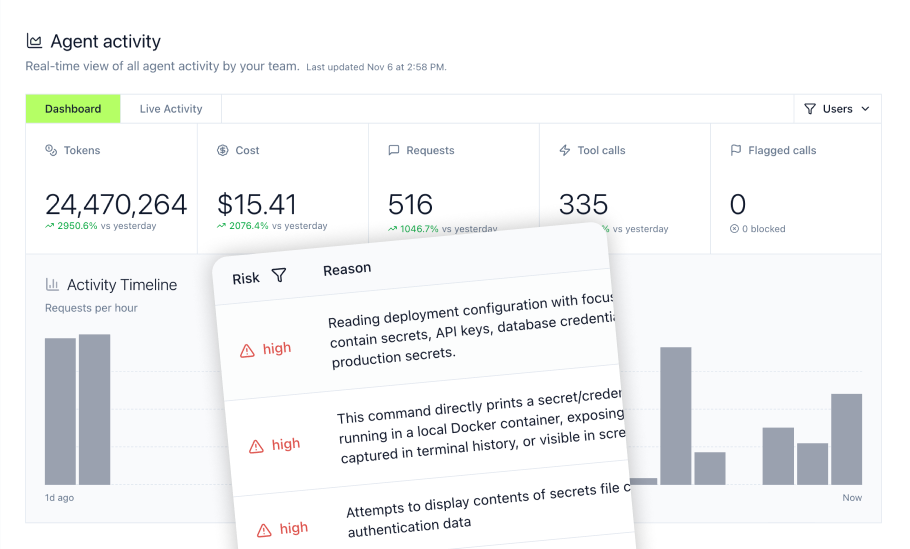
Agent Monitor tracks Claude's activity across the organization, including MCP calls made outside the gateway through hooks in Cursor and Claude Code.
Alert categories:
- PII exposure: Social security numbers, credit card numbers, health records
- Credential leakage: API keys, tokens, passwords in prompts or responses
- Risky commands: Shell execution, file deletion, network requests
- Prompt injection attempts: Patterns indicating manipulation of agent behavior
- Policy violations: Attempts to access denied resources
Alert configuration:
- Define severity levels (critical, high, medium, low)
- Set notification channels (Slack, email, PagerDuty)
- Configure escalation rules for unacknowledged alerts
- Establish on-call rotation for critical alerts
Exporting Audit Logs
Every agent action is logged with full context: who initiated it, which tools were called, what data flowed through, and when.
Log export destinations:
- Microsoft Sentinel for correlation with other security events
- Splunk for centralized log analysis
- Amazon S3 for archival and compliance retention
- Custom webhooks for internal SIEM integration
Log retention considerations:
- Retention periods should match regulatory obligations, internal security policy, and legal hold requirements
- Configure immutable storage to prevent tampering
- Establish deletion procedures for privacy compliance
- Test restore procedures quarterly
For organizations in regulated industries, immutable audit records support compliance investigations and demonstrate governance controls to auditors.
Advanced Governance: Leveraging Bundles
Scaling governance beyond a single team requires abstractions that package access, policy, and audit together.
Creating Agent Bundles
Bundles (also called Virtual MCPs) are the core abstraction for governance. One Bundle packages:
- Curated list of MCP servers the team can access
- Custom policy rules applying to all tool calls
- Isolated audit trail for team's activity
- SCIM group membership controlling who gets access
Bundle creation workflow:
- Define the use case (e.g., "Customer Support Analytics")
- Select required MCP servers (Zendesk, Snowflake, Google Sheets)
- Configure tool-level permissions (read-only for support data)
- Write policy rules (block PII export, flag refund requests over $1,000)
- Assign to SCIM group ("customer-support-managers")
- Deploy and monitor
Agent Bundles extend this model to non-human principals. Each deployed Claude agent gets its own rotatable credentials and permission scope independent of creator's access level.
Simplifying Access with Virtual MCPs
Virtual MCPs reduce configuration complexity for non-technical users. Instead of managing individual server connections, users see a single endpoint curated for their role.
Benefits of Bundle approach:
- Users connect to one endpoint, not dozens
- Permission changes propagate instantly via SCIM
- Audit logs are already scoped to team
- New team members inherit correct access immediately
- Offboarded users lose access automatically
This abstraction addresses configuration complexity that slows adoption. Teams get productive with Claude-enabled workflows in minutes, not weeks.
Detecting Shadow AI Activities
Ungoverned AI usage creates compliance gaps and security blind spots. Shadow AI detection identifies Claude usage bypassing your governance layer.
Identifying Unsanctioned Usage
Agent Monitor hooks into developer tools like Cursor and Claude Code to detect off-gateway MCP usage.
Detection capabilities:
- Local MCP server connections bypassing gateway
- Direct API calls to Claude without governance wrapping
- Unauthorized tool installations on developer machines
- Prompt submissions containing sensitive data patterns
Shadow AI indicators:
- Claude API usage from unexpected IP ranges
- MCP traffic to servers not registered in gateway
- Developer tool configurations pointing to ungoverned endpoints
- Credential usage patterns inconsistent with approved workflows
Enforcing Policies on Workstations
MDM integration enables pushing detect-only or enforce-mode configurations to developer machines for consistent policy application.
Enforcement modes:
- Detect-only: Log violations without blocking (useful for baseline assessment)
- Warn: Alert users but allow action to proceed
- Block: Prevent ungoverned connections entirely
Deployment approach:
- Start with detect-only to understand current shadow AI scope
- Communicate policy changes with 30-day notice
- Move to warn mode with user education
- Enable block mode after training completion
- Maintain exception process for legitimate edge cases
The goal is visibility first, enforcement second. Understanding usage patterns before blocking ensures you don't disrupt legitimate productivity.
Operationalizing Claude Tag: From Sandbox to Production
Moving from pilot to production requires addressing reliability, scalability, and operational runbooks.
Migrating Your Claude MCP Servers
Production deployment differs from sandbox testing in three dimensions: reliability requirements, scale handling, and incident response.
Production readiness checklist:
- Credential rotation automated and tested
- Backup authentication path configured
- Rate limiting set to prevent runaway costs
- Error handling covers all failure modes
- Alerting configured for service degradation
- Runbook documented for common incidents
- Disaster recovery plan tested
Scaling considerations:
- Claude Tag usage should be governed through current Anthropic admin controls, including organization-wide and per-channel spend limits
- MCP Gateway performance depends on underlying API rate limits
- Large organizations (10,000+ users) should plan phased rollout by team
Establishing Reliable Workflows
Reliability comes from reducing single points of failure and establishing clear ownership.
Operational practices:
- Designate primary and backup owners for each Bundle
- Schedule quarterly access reviews
- Maintain change log for policy modifications
- Test failover procedures monthly
- Document tribal knowledge in runbooks
For infrastructure-as-code workflows, the gateway supports REST APIs and SDKs for programmatic management, enabling CI/CD integration and version-controlled policy deployment.
Leveraging Analytics and Insights
Collected data informs decisions, optimizes Claude usage, and demonstrates value to stakeholders.
Analyzing Performance and Usage
Agent Monitor provides org-level analytics on MCP adoption, usage patterns by team and tool, latency monitoring, and error tracking.
Key metrics to track:
- Adoption rate: Percentage of eligible users actively using Claude Tag
- Tool call volume: Which MCP servers see most activity
- Latency distribution: P50, P95, P99 response times
- Error rate: Failed tool calls by type and destination
- Policy triggers: How often DLP rules block or flag content
Dashboard views:
- Executive summary for leadership
- Team-level breakdowns for managers
- Tool-level detail for platform engineers
- Compliance summary for security and legal
Identifying Optimization Opportunities
Usage data reveals where to invest and where to cut.
Optimization signals:
- High-latency tools may need caching or pagination
- Low-usage tools may warrant removal to reduce attack surface
- Frequent policy violations may indicate training gaps
- Repeated queries suggest opportunities for automation
Track these patterns weekly to catch issues before they affect productivity.
Ensuring Compliance and Data Residency
Regulated industries require documented controls that satisfy auditors and regulators.
Meeting Regulatory Standards
Compliance requirements vary by industry but share common themes: audit trails, access controls, data protection, and incident response.
Common compliance considerations:
- SOC 2: Maintain evidence of access controls, change management, monitoring, and auditability for agent activity
- HIPAA: For protected health information, confirm documentation, BAA requirements, and whether each system is compliant with HIPAA standards
- GDPR: Document data flows, retention, deletion workflows, and access controls for personal data
- PCI-DSS: Avoid routing cardholder data through AI workflows unless the full environment and controls are approved for that use case
Compliance gap to address: Claude Tag has admin-governed access and Anthropic Enterprise audit/compliance tooling, but organizations should still verify which Slack, tool, and agent actions are captured natively. Organizations in regulated industries should route approved Claude tool access through an MCP Gateway with audit capabilities to add gateway-level logs for governed tool calls.
Configuring Data Residency
Data residency determines where your data is processed and stored.
Residency review areas:
- Confirm where Claude Tag and connected tools process and store data
- Confirm MintMCP's available data residency options during enterprise review
- Avoid assuming custom regional routing or multi-region compliance controls unless explicitly included in your agreement
Configuration approach:
- Identify data classification requirements by regulation
- Map data types to residency requirements
- Confirm which systems process each data type and document any available residency options
- Validate with test data before production
- Document residency decisions for audit
Why MintMCP Is the Right Foundation for Claude Tag Governance
MintMCP delivers governance infrastructure that makes Claude Tag deployments enterprise-ready without slowing engineering teams. Claude Tag represents the coworker agent pattern (long-running, persistent agents working alongside employees), and MintMCP's architecture connects cleanly with this model.
MintMCP's MCP Gateway manages and hosts MCP servers with enterprise authentication and access controls, providing centralized credential management, tool-level permissions, complete audit logging with user attribution and SIEM export, and custom policy enforcement via JS sandbox middleware for inline DLP integration.
Agent Monitor adds visibility into agent activity across the organization, including off-gateway usage in developer tools, addressing the shadow AI problem that plagues enterprise deployments.
The Bundle architecture packages tool access, policy enforcement, and audit logging into single governance units per team or role. For Claude Tag deployments, your customer support team gets governed access to Zendesk and Salesforce through one endpoint, while engineering gets governed access to GitHub and Snowflake through another. Each Bundle has its own audit trail, policy rules, and access controls.
MintMCP is evolving beyond MCP Gateway into Agent Gateway territory, providing identities, permissions, memory, and monitoring for agents working alongside users. This positions MintMCP well for Claude Tag because teams can own their own agent memory system rather than relying on opaque vendor stores, and organizations retain flexibility to choose AI models rather than being locked into a single provider. For teams deploying Claude Tag today and planning broader agent adoption tomorrow, MintMCP provides the governance foundation that scales.
Getting started:
- Start with MintMCP at mintmcp.com
- Read security documentation at trust.mintmcp.com
- Explore the MCP data risk guide
- Contact enterprise sales at enterprise@mintmcp.com for custom deployment options
Frequently Asked Questions
What is the primary benefit of connecting Claude to an MCP Gateway?
The primary benefit is governed data access. Without a gateway, Claude Tag can connect to internal systems, but each connection creates an untracked credential, an ungoverned data path, and a potential compliance gap. An MCP Gateway centralizes authentication, authorization, and audit logging so every tool call passes through a single governance layer. This gives security teams the visibility and control they need while giving users the productivity gains they want.
How does MintMCP Gateway enhance the security of my Claude integrations?
MintMCP Gateway provides multiple security layers: OAuth brokering for credential management, tool-level access controls defining exactly what Claude can do, custom policy middleware for inline DLP integration, and complete audit logging with user attribution. Each Claude agent can receive its own credential set scoped to specific tools, with rotation and revocation handled automatically. When Claude attempts to access PII or credentials, the gateway provides real-time alerts and automatic blocking.
Can I monitor Claude's activity outside the MCP Gateway?
Yes. MintMCP's Agent Monitor tracks agent activity across the organization, including MCP calls made outside the gateway through hooks in Cursor and Claude Code. This addresses the shadow AI problem where developers use Claude through ungoverned paths. Agent Monitor detects local MCP server connections, direct API calls, and prompt submissions containing sensitive data patterns, giving security teams visibility into off-gateway usage.
What is the Bundle model and how does it apply to Claude deployments?
The Bundle model (also called Virtual MCPs) is MintMCP's core abstraction for governance. Each Bundle packages a curated list of MCP servers, custom policy rules, and an isolated audit trail for a specific team or role. For Claude deployments, you might create a "Sales Analytics" Bundle including Salesforce read access, HubSpot read access, and Google Sheets access, with policies blocking PII export. The Bundle is assigned to a SCIM group, so membership automatically grants correct access. Agent Bundles extend this to non-human principals, giving each Claude agent its own credentials and scope.
Does MintMCP support compliance requirements like SOC 2 or HIPAA?
MintMCP is SOC 2 Type II audited, with continuous compliance monitoring via Drata. For organizations handling protected health information, MintMCP can provide HIPAA documentation, is compliant with HIPAA standards, and signs BAAs. The platform provides audit trails, encryption in transit and at rest, role-based access control, and data residency options that should be reviewed during enterprise setup. These capabilities address compliance gaps in Claude Cowork (desktop agent) where comprehensive audit coverage may require additional governance layers. Routing approved Claude tool access through MintMCP's gateway helps create the audit trail security and compliance teams need for regulatory review.