Your team loves Claude Tag. Six months from now, when someone asks about switching to a different AI model or platform, you will discover that months of organizational knowledge, team decisions, and workflow context live inside Anthropic's system with no clearly documented standard export format for moving that memory into another AI platform. This is the context lock-in problem many enterprise teams already worry about, and Claude Tag's architecture makes it a governance question rather than a simple chatbot preference.
For organizations that need governed AI agent access while maintaining context portability, platforms like MintMCP's gateway provide a complementary approach: centralized governance over AI tool connections that works with Claude Tag through MCP agent identity, while also supporting other AI models, while helping organizations maintain ownership of agent memory and the flexibility to work across multiple providers.
That makes Claude Tag part of the broader coworker agent category: long-running agents that live alongside employees, hold memory, continue work across days, and need governance over identity, permissions, memory, and monitoring.
Key Takeaways
- Channel-scoped memory accumulates in AI agents over time, becoming organizational infrastructure that requires governance planning from deployment day one
- AI vendor dependency becomes harder to unwind when team memory, tool access, and workflow context accumulate inside one platform
- Migration costs compound when teams depend on undocumented agent memory instead of maintaining portable, company-owned records of decisions and workflows
- Ambient behavior capabilities can follow channels where AI agents have access and proactively surface updates, creating both productivity benefits and security governance requirements
- Model Context Protocol (MCP) offers a vendor-neutral standard for AI tool connections, helping reduce integration lock-in even though agent memory still needs its own portability strategy
- Gateway-based governance provides centralized policy enforcement for AI agents while preserving organizational ownership of memory and audit trails across multiple AI platforms
Understanding the AI Context Window: More Than Just Memory
A context window defines how much information a large language model can process and retain during a single conversation or session. In technical terms, it represents the maximum number of tokens (roughly 4 characters per token) that the model can hold in working memory when generating responses. Claude's models offer context windows ranging from 200,000 tokens on standard tiers to extended windows for enterprise deployments.
But Claude Tag introduces something different from traditional context windows: persistent, channel-scoped memory that accumulates across conversations over weeks and months. Unlike a context window that resets with each session, Claude Tag keeps channel and workspace context about your team's vocabulary, decisions, workflows, and preferences.
Why this matters for enterprises:
- Increasing returns: The agent becomes more useful over time as it learns team-specific terminology, past decisions, and workflow patterns
- Growing dependency: After months of accumulated context, replacing the agent can mean losing useful working context if teams have not maintained portable records elsewhere
- Hidden infrastructure: Claude Tag transitions from "AI assistant" to "organizational infrastructure" without explicit architectural decisions
The shift from session-based context to persistent organizational memory changes the risk calculus. A chatbot you can swap out in a day becomes a knowledge repository that requires months of migration planning.
Unpacking Vendor Lock-In in Large Language Models
Vendor lock-in in AI systems operates across three distinct dimensions: model lock-in, data lock-in, and integration lock-in. Most discussions focus on model lock-in, but for enterprise AI agents, data lock-in creates the most significant long-term risk.
Model lock-in occurs when your applications depend on a specific model's capabilities, pricing, or API structure. Switching models requires re-engineering prompts, adjusting for different response patterns, and validating output quality.
Integration lock-in happens when your workflows depend on proprietary APIs, SDKs, or tooling that only work with one vendor's ecosystem. The more integrations you build, the higher your switching costs.
Data lock-in emerges when your organizational knowledge, training data, or accumulated context lives inside a vendor's system. This is the most difficult dimension to reverse because recreating institutional knowledge requires human effort, not just engineering work.
Claude Tag creates all three forms of lock-in simultaneously:
- Model: Claude Tag runs inside Anthropic's Claude ecosystem, so teams do not get the same multi-model flexibility they would have in a vendor-neutral agent gateway
- Integration: Tool connections work through Anthropic's agent identity model, with access configured across organization, workspace, and private-channel scopes
- Data: Persistent memory accumulates inside Anthropic's infrastructure, keeping organizational knowledge inside Claude Tag's memory system unless teams maintain their own external documentation and governance practices
For organizations evaluating AI agent platforms, understanding which dimensions of lock-in apply, and at what cost, shapes long-term platform strategy.
Claude AI: Exploring its Context Window and Potential for Lock-In
Claude Tag operates as a shared identity inside Slack channels, not as a personal assistant for individual users. When you invite Claude Tag to a channel, every team member interacts with the same agent instance, which maintains a unified memory of all channel activity.
Key architectural differences from traditional chatbots:
- Channel-scoped memory: Claude Tag remembers conversations, decisions, and preferences specific to each channel rather than to individual users
- Agent identity credentials: Claude Tag uses organization, workspace, and private-channel access profiles instead of acting through each individual user's personal credentials
- Ambient behavior option: When enabled, Claude can follow channels where it has been granted access and proactively surface relevant information without being explicitly tagged
This shared identity model creates operational efficiencies. New team members benefit from context accumulated over months. Handoffs between shifts or time zones happen with full historical context. The agent understands acronyms, project names, and team dynamics that would take weeks to explain to a human colleague.
The same architecture creates lock-in risk proportional to the value it provides. After six months of ambient behavior in your #engineering-incidents channel, Claude Tag may retain useful context about deployment patterns, common failure modes, past incident resolutions, and which team members have expertise in which systems. That knowledge lives in Anthropic's infrastructure.
Migration implications
- No public memory export API is documented in the reviewed Claude Tag materials
- No standard export format is documented for Claude Tag's persistent memory, creating portability risk if teams want to move accumulated context into another AI platform
- Switching platforms may require manual re-documentation of institutional knowledge if teams have not maintained portable records outside Claude Tag
Organizations planning Claude Tag deployments should establish exit criteria and documentation practices before accumulated context makes switching prohibitively expensive.
The Enterprise Challenge: Context Lock-In for AI Agents
For security and compliance teams, Claude Tag's persistent memory creates governance requirements that extend beyond traditional chatbot oversight. The agent isn't just processing queries; it's accumulating organizational knowledge that may include sensitive information, customer data references, internal system details, and strategic discussions.
Security Implications of Persistent Memory
When organizational context lives exclusively inside a vendor's system, security teams face new visibility challenges:
- Memory as attack surface: Accumulated context becomes a target for prompt injection attacks designed to exfiltrate learned information
- Credential management: Agent identity credentials require ongoing governance as Claude Tag expands across the organization
- Ambient behavior scope: Claude can follow messages in channels where it has been granted access, not only threads where it is explicitly tagged
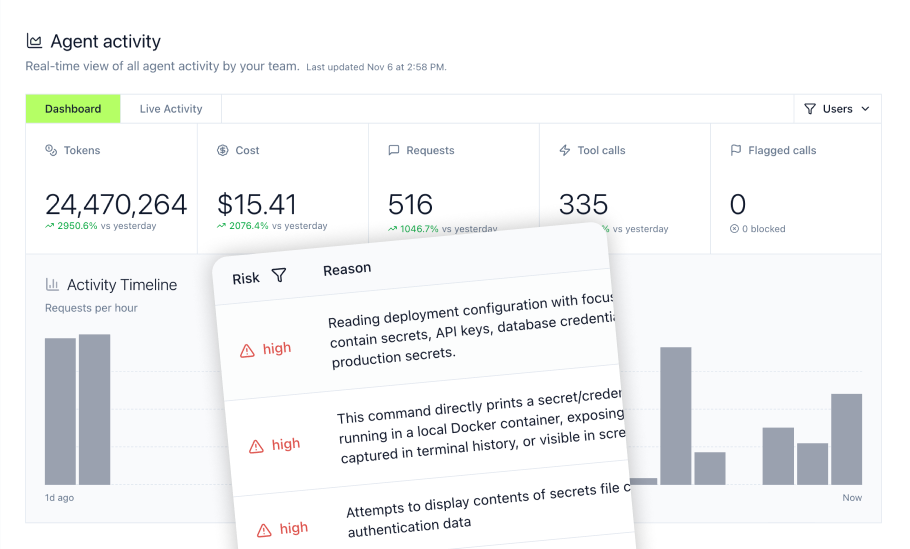
MintMCP's Agent Monitor addresses these concerns by providing visibility into agent actions across the organization, including activity in developer tools and off-gateway usage patterns.
Compliance Hurdles with Integrated Context
Enterprises operating under SOC 2, HIPAA, or GDPR face specific challenges with platform-specific agent memory:
- Data residency: Memory storage location may not align with regional compliance requirements
- Right to deletion: Anthropic documents admin review and deletion controls for Claude Tag memory, but organizations should still confirm how those controls map to their GDPR data subject access and deletion workflows
- Audit documentation: Claude Tag provides admin memory review and an Audit view for scheduled tasks, one-time tasks, and network calls, but teams should still evaluate whether those controls meet their own export, retention, and compliance documentation needs
Organizations that need centralized audit trails of AI agent data access should evaluate whether vendor-controlled memory meets their compliance posture requirements.
Governing AI Agent Access: Centralized Security and Observability
The alternative to platform-specific context lock-in is centralized governance that separates AI agent capabilities from organizational knowledge ownership. This approach uses open protocols like MCP to connect AI agents to enterprise systems while maintaining company control over credentials, access policies, and audit trails.
Components of centralized AI governance
- Identity layer: Per-agent credentials that can be rotated, scoped, and revoked independently
- Policy enforcement: Rules that govern which tools each agent can access and what data they can read or modify
- Audit infrastructure: Centralized logging of tool calls, agent actions, and policy context for compliance and security review
MintMCP's Virtual MCP Bundles implement this model by packaging tool access, policy enforcement, and audit logging into unified governance units. Each team or use case gets a dedicated endpoint with SCIM-driven membership and curated tool access.
Real-time Monitoring of All AI Agent Actions
Effective AI governance requires visibility into what agents are actually doing, not just what they're configured to do:
- Tool call logging: MCP server requests captured with the request, response, actor, and policy context needed for review, subject to the organization's logging configuration
- User attribution: Which human or agent identity initiated each action
- Policy violation detection: Real-time alerts when agents attempt unauthorized operations
- Usage analytics: Patterns that reveal which tools teams actually use versus which remain dormant
This observability layer enables security teams to answer questions like: "What data did Agent X access yesterday?" and "Which tools have elevated error rates this week?"
Ensuring Secure and Compliant Agent Interactions
Compliance-ready AI governance requires more than logging. It requires policy enforcement that prevents violations before they occur:
- Pre-call validation: Check every tool request against access policies before execution
- Data loss prevention: Integrate with DLP systems to detect and block sensitive data exposure
- Credential masking: Ensure agents never receive raw credentials that could leak through conversation
- Rate limiting: Prevent runaway agent behavior or cost overruns
MintMCP's security architecture provides these controls at the gateway layer, enabling organizations to enforce consistent policies across Claude, Cursor, ChatGPT, Gemini, and Copilot deployments.
Beyond the Gateway: Detecting Shadow AI in Tools like Claude Code
Gateway-based governance works for AI traffic that routes through your control plane. But developers using Claude Code, Cursor, or similar tools often make MCP calls directly from their local machines, bypassing centralized governance entirely.
This "shadow AI" usage creates compliance blind spots:
- No audit trail: Tool calls from developer machines may not appear in organizational logs
- Unmanaged credentials: Developers may configure personal API keys or service account tokens locally
- Policy bypass: Access controls configured at the gateway don't apply to direct local connections
Identifying Unsanctioned AI Tool Usage
MintMCP's Agent Monitor addresses shadow AI through hooks that detect MCP calls in developer tools like Cursor and Claude Code, even when those calls don't route through the gateway:
- Local activity detection: Identify which developers are using AI coding assistants and which tools they're connecting
- PII exposure monitoring: Flag when sensitive data patterns appear in local AI interactions
- Credential leakage alerts: Detect API keys, tokens, or passwords that appear in developer tool contexts
Mitigating Risks from Unmonitored Developer Tools
Once shadow AI usage is visible, organizations can make informed decisions about governance:
- Detect-only mode: Monitor usage patterns without blocking, useful for understanding baseline behavior
- Enforce mode: Block or flag policy violations in real-time through MDM-pushed configurations
- Allowlist management: Approve specific tool connections while blocking unknown or risky servers
This two-layer approach (gateway governance plus endpoint monitoring) provides comprehensive coverage for organizations where AI agents operate across both centralized infrastructure and developer workstations.
The Bundle Architecture: Simplifying AI Governance and Credential Hygiene
Most AI governance platforms require separate configuration of multiple objects: plugins, access rules, agent accounts, and credential stores. This multi-object model creates configuration sprawl and increases the likelihood of misconfigurations that create security gaps.
MintMCP's Bundle architecture addresses this through unified governance units that package:
- Tool access: Which MCP servers and individual tools are available
- Policy rules: What the agent can and cannot do with those tools
- Audit logging: Where activity gets logged and how long it's retained
- Group membership: Which users or agents have access, synced via SCIM
Streamlining Policy Enforcement with Bundles
A single Bundle configuration replaces what other platforms implement through multiple separate objects:
- One endpoint per use case: Engineering team gets different tool access than customer success
- SCIM-driven membership: Add or remove access by changing IdP group membership; no separate agent platform configuration required
- Cascading policies: Organization-level policies apply automatically to team-level Bundles
- Tool update controls: Choose whether new upstream tools get enabled automatically or require admin approval
This model scales governance without multiplying configuration complexity. Adding a new team means creating one Bundle, not configuring plugins, access rules, credentials, and audit destinations separately.
Automating Credential Management for AI Agents
Agent Bundles extend the Bundle model to non-human principals, giving each agent its own identity with:
- Per-agent OAuth tokens: Credentials scoped to each agent, not shared service accounts
- Independent rotation: Rotate or revoke one agent's credentials without affecting others
- M2M authentication: OAuth 2.0 client-credentials flow for agent-to-system communication
- Act-as-agent admin flow: Authorize agents for OAuth-protected services that require per-principal consent
This per-agent identity model addresses a fundamental security concern: when all agents share channel-level credentials, revoking access to one workflow requires reconfiguring the entire channel.
Building a Future-Proof AI Strategy with the Model Context Protocol
The Model Context Protocol provides a vendor-neutral standard for connecting AI agents to external tools and data sources. Originally developed by Anthropic, MCP was donated to the Agentic AI Foundation in December 2025, with the Linux Foundation describing adoption across Claude, Cursor, Microsoft Copilot, Gemini, VS Code, ChatGPT, and other AI platforms.
Why MCP matters for tool-connection portability
- Standardized tool connections: MCP-compatible servers can be reused across clients such as Claude, ChatGPT, Gemini, Cursor, and others when their transport, authentication, and client requirements are supported
- Protocol-level compatibility: Switching AI providers doesn't require rebuilding integrations
- Ecosystem growth: Over 10,000 MCP servers available across community and commercial sources
- Vendor independence: Organizations can multi-vendor their AI strategy while maintaining consistent tool access
The Role of MCP in Enterprise AI
MCP helps organizations separate AI model choices from tool-connection investments:
- Build once, reuse broadly: MCP connectors can work across compatible AI platforms when transport, authentication, and client requirements are supported
- Consistent governance: Apply the same access policies regardless of which AI model makes the request
- Unified audit: Log all tool calls through a single gateway rather than per-vendor integrations
- Future-proofing: New AI models that support MCP work with existing integrations immediately
MintMCP's MCP Gateway builds on this foundation by adding enterprise authentication, access controls, and audit logging on top of the open protocol.
Leveraging Standards for AI Agility
Practical steps for implementing MCP-based AI strategy:
- Inventory current integrations: Identify which tools your AI agents connect to and through what mechanisms
- Evaluate MCP coverage: Determine which integrations have MCP server implementations available
- Centralize through gateway: Route MCP traffic through a governance layer rather than direct agent-to-service connections
- Establish memory governance: Decide where organizational context should live and who controls it
- Plan for multi-model: Design workflows that can use different AI models for different tasks based on capability and cost
Organizations that adopt MCP-based architecture gain flexibility to evolve their AI stack as models improve and organizational needs change.
The Path Forward: Governed AI Without Context Lock-In
Claude Tag demonstrates the operational value of persistent, channel-scoped agent memory. Its value proposition is clear: an AI agent that can retain organizational vocabulary, past decisions, and workflow patterns over time can become more useful in day-to-day collaboration. These benefits are real and shouldn't be dismissed.
The governance challenge isn't whether to use AI agents with persistent memory. It's how to deploy them in ways that preserve organizational ownership of the knowledge they accumulate.
MintMCP's Agent Gateway addresses this through a complementary control layer for agent identities, permissions, memory, and monitoring that works with Claude Tag and other AI platforms. Organizations can deploy Claude Tag for its team collaboration features while routing tool connections through a centralized gateway that provides:
- Model flexibility: Route different tasks to different AI models, including cost-effective options like GLM-5.2 for simpler queries while reserving higher-capability models for complex reasoning
- Memory sovereignty: Maintain company-owned records of agent decisions, tool calls, and accumulated context alongside vendor-hosted convenience features
- Unified audit: Centralized logging of all agent tool access regardless of which AI platform processes each request
- Credential hygiene: Per-agent OAuth credentials that can be rotated, scoped, and revoked without reconfiguring channel-level access
This approach recognizes that no single AI vendor will meet every organizational need indefinitely. Model capabilities evolve, pricing structures change, and new platforms emerge. Organizations that build governance infrastructure independent of any single vendor preserve the flexibility to adapt as the AI landscape shifts.
The alternative is accumulated context lock-in that makes switching costs prohibitive. Re-documenting institutional knowledge can become costly when decisions, workflows, and team context are not maintained in portable company-owned systems.
Frequently Asked Questions
What happens to Claude Tag's memory if Anthropic deprecates the current model version?
Claude Tag currently runs inside Anthropic's Claude ecosystem, with no documented customer-controlled routing across non-Anthropic models for simpler or lower-cost tasks. When Anthropic releases successor models (historically on 12 to 18 month cycles), organizations face unknown migration paths. Because memory is stored in Anthropic's format, there's no guarantee that accumulated context transfers cleanly to new model versions. Organizations should document critical institutional knowledge outside of Claude Tag's memory to hedge against model lifecycle changes.
Can I run Claude Tag alongside other AI agents for different use cases?
Yes, but doing so creates governance complexity. Claude Tag operates within Slack with its own memory system, while other AI agents (ChatGPT, Gemini, local coding assistants) maintain separate contexts. This fragmentation means organizational knowledge gets siloed across multiple systems. MintMCP's Agent Gateway provides an approach where multiple AI models connect through a unified governance layer, maintaining consistent access policies and audit trails regardless of which model processes each request.
How does Claude Tag handle data subject access requests under GDPR?
Anthropic documents admin review and deletion controls for Claude Tag memory, but organizations should still confirm how those controls map to their GDPR data subject access and deletion workflows. If a customer or employee's PII appears in Slack conversations that Claude Tag monitors with ambient behavior enabled, that information may be retained in Claude Tag memory until handled through the available admin memory controls or the organization's retention process. Organizations operating under GDPR should consult with Anthropic directly about compliance mechanisms or consider whether ambient monitoring is appropriate for channels that may contain personal data.
What's the difference between Claude Tag and MintMCP's coworker agent feature?
Both are long-running agents that operate alongside employees, hold persistent memory, and execute multi-step tasks. The key differences involve ownership and flexibility. Claude Tag's memory lives in Anthropic's infrastructure; MintMCP's coworker agents store memory in company-owned systems following Git-like principles (versioned, reviewable, portable). Claude Tag runs within Anthropic's Claude ecosystem; MintMCP's Agent Gateway approach is positioned around model flexibility, including the ability to choose cheaper model options such as GLM-5.2 when appropriate. Claude Tag governs through Anthropic's admin console; MintMCP provides centralized governance through the Agent Gateway with Virtual Bundles for team-specific policies.
Should I enable Claude Tag's ambient behavior mode?
Ambient behavior creates a tradeoff between productivity and governance. With ambient behavior enabled, Claude proactively surfaces relevant information without being tagged, which teams report as valuable for incident response and customer context. However, ambient behavior also means Claude can follow messages in channels where it has been granted access, potentially ingesting sensitive information, credentials, or confidential discussions into its persistent memory. Organizations should treat ambient behavior as a security decision rather than a feature decision: review which channels are appropriate for ambient monitoring, exclude channels that handle customer PII or confidential business information, and document the decision with your security team before enabling.