Model Context Protocol (MCP) servers transform AI assistants from passive chatbots into active participants that query databases, execute commands, and modify production systems based on natural language prompts. This capability introduces significant security challenges: 25% of organizations don't know what AI services are running in their environment. Microsoft’s April 2024 Patch Tuesday addressed 147 CVEs across its products—an example of how quickly underlying platform vulnerabilities can accumulate alongside AI adoption. With 71% of organizations now regularly using generative AI, implementing proper security controls for MCP infrastructure is no longer optional—it's essential for maintaining compliance and protecting enterprise data.
Key takeaways
- OAuth 2.0 + RBAC provides the security foundation for MCP deployments—prioritize this before implementing advanced frameworks
- Organizations often reduce audit surprises and findings by moving from point-in-time assessments to continuous monitoring and real-time policy enforcement.
- Implementation timeline: OAuth + RBAC can often be rolled out in weeks (scope-dependent); SOC 2 Type II typically requires a 3–12 month observation window plus preparation; ISO 27001 timelines commonly range ~3–12+ months depending on readiness and scope.
- Spotify achieved 60% less personal data processing through privacy-enhancing techniques—limit AI access to only necessary data
- Strong access control programs can materially reduce unauthorized access—especially when paired with MFA, least privilege, and just-in-time elevation.
- Grammarly reduced investigation time to under 4 minutes using MCP-based security automation
Building a secure foundation: The importance of enterprise MCP gateways
What is an enterprise MCP gateway and why do you need one?
An MCP gateway serves as a centralized control plane between AI clients (Claude, ChatGPT, Cursor) and your enterprise systems. Rather than allowing direct, unmonitored connections, the gateway intercepts every request, validates authentication, enforces access policies, and logs all interactions for compliance purposes.
Without a gateway, organizations face several critical risks:
- Shadow AI proliferation: Teams deploy MCP integrations without security review, creating unknown attack surfaces
- Credential sprawl: Static API tokens get shared across environments, often stored in plaintext configuration files
- Compliance gaps: No audit trail exists for AI-initiated actions, making SOC 2 compliance impossible
- Inconsistent policies: Each MCP server operates with different security configurations
The MCP architecture positions the gateway as the first line of defense—intercepting high-risk actions before they reach backend systems. This centralized approach enables consistent policy enforcement across all AI interactions.
Key features for Enterprise-Grade security and governance
Enterprise MCP gateways should provide:
- Policy-as-code management: JSON or HCL policies managed via CI/CD pipelines enable version-controlled security that scales with infrastructure
- Real-time access decisions: The gateway evaluates every request based on identity, context, and requested action before allowing execution
- Centralized credential management: All API keys, tokens, and secrets remain in secure vaults rather than scattered across MCP configurations
- Multi-tenant isolation: Separate environments for different teams, projects, or customers prevent cross-contamination
MintMCP's security architecture implements these capabilities with SOC 2 Type II certification, enabling organizations to deploy AI tools safely while meeting compliance requirements.
Unified authentication and access control for your MCP servers
Implementing robust identity management for AI tools
The most critical security decision for MCP deployments is replacing static API tokens with OAuth 2.0 authentication. Static tokens present multiple vulnerabilities:
- They never expire, providing indefinite access if compromised
- They cannot be scoped to specific users or sessions
- They offer no visibility into who performed what action
- They're frequently stored in plaintext configs, repos, or environment variables
OAuth 2.0 addresses these issues through short-lived tokens with automatic refresh, user-specific authentication linking every action to an identity, and scope definitions limiting what each token can access. The NIST Digital Identity Guidelines provide comprehensive frameworks for implementing modern authentication systems.
Implementation options:
- Keycloak (self-hosted): Free, full control, requires infrastructure management—setup takes 2-3 weeks
- Auth0 (managed): Professional tier available, fast setup in approximately 1 week
- Okta (enterprise): Custom pricing, advanced MFA capabilities, enterprise-grade support
OAuth integration with MCP servers requires configuring authorization servers, defining security realms, and creating OAuth clients for MCP environments with appropriate scopes and permissions.
Granular access control: Who can do what?
Role-Based Access Control (RBAC) ensures AI agents operate with least-privilege permissions. Define roles that match your organizational structure:
- Viewer role: Read-only access to safe operations like
list_prs,search_issues,get_report - User role: Write access for routine tasks including
create_issue,update_status,send_email - Admin role: Full access including
manage_roles,delete_data,execute_commands
Each MCP tool should be wrapped with authentication middleware that validates user identity and permissions before execution. Claude Code's tiered permission model provides a reference implementation: read-only operations, bash command execution, and file modifications each require explicit authorization at increasing trust levels.
Real-time monitoring and observability for AI traffic
Gaining visibility into your AI workloads
Effective security requires complete visibility into what AI agents access and when. Organizations implementing continuous monitoring achieve 90% fewer audit findings through proactive remediation rather than reactive incident response.
Essential monitoring capabilities:
- Tool call tracking: Log every MCP tool invocation with parameters, user identity, and timestamp
- Resource access logs: Record which databases, files, and APIs each AI interaction touches
- Anomaly detection: Flag unusual patterns like after-hours access, bulk data retrieval, or permission escalation attempts
- Performance metrics: Track response times, error rates, and usage patterns across teams
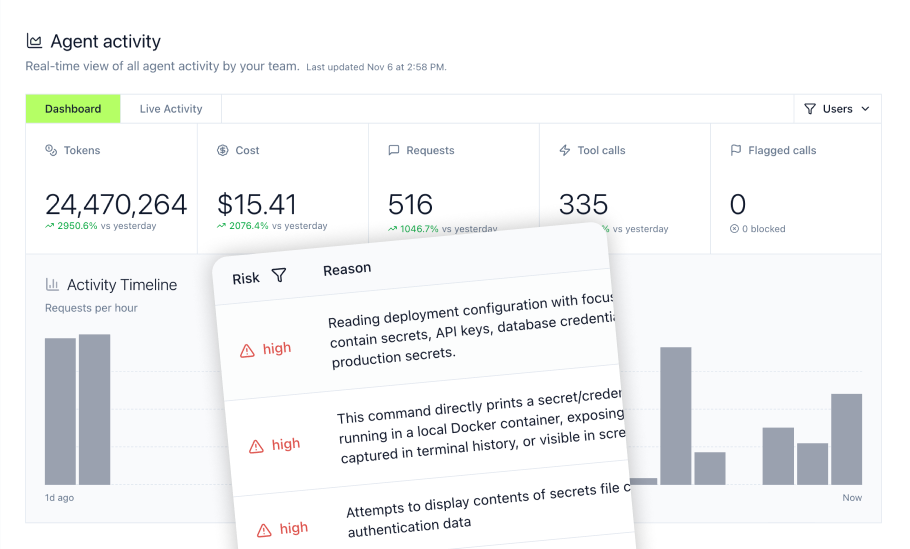
MintMCP's LLM Proxy provides this visibility layer, monitoring every MCP tool invocation, bash command, and file operation from coding agents like Cursor and Claude Code. The proxy sits between LLM clients and models, forwarding and monitoring requests without disrupting developer workflows.
Proactive threat detection and performance optimization
eal-world deployments (e.g., Grammarly’s) show the operational value of MCP-based monitoring—and MintMCP delivers the same “centralized evidence + fast investigations” outcome through unified audit trails and policy enforcement: security investigation time dropped to under 4 minutes. This efficiency gain comes from centralized logging with full decision context, enabling rapid root cause analysis.
Configure alerting for high-risk scenarios:
- Access attempts to sensitive resources (production databases, customer PII, financial systems)
- Unusual command patterns (bulk exports, system configuration changes)
- Authentication failures exceeding threshold
- Tool invocations outside normal business hours
Protecting sensitive data: Audit trails and compliance
Maintaining a comprehensive record of all AI interactions
Compliance frameworks including SOC 2 and GDPR require complete audit trails documenting who accessed what data and when. For AI systems, this extends to every tool invocation, parameter passed, and result returned.
Audit log requirements:
- Immutable storage: Logs cannot be modified or deleted, ensuring forensic integrity
- Retention periods: 90 days minimum for operational use; longer periods for specific regulatory requirements
- Searchable format: Enable rapid investigation with structured logging (JSON format with consistent schema)
- Access controls: Audit logs themselves require protection from unauthorized access
Many organizations reduce audit surprises by shifting from point-in-time assessments to continuous compliance monitoring. Rather than scrambling before audits, security teams maintain ongoing visibility into compliance status.
Meeting regulatory requirements
Compliance costs vary significantly by organization size and regulatory scope. Large enterprises can face seven-figure total compliance programs when combining SOC 2/ISO efforts, privacy work, internal resourcing, and multi-region scope—actual totals depend heavily on complexity and audit scope. Mid-size enterprises should budget $392K-$982K for initial implementation.
Implementation timelines:
- SOC 2 Type II: 12-18 months
- ISO 27001: 18-24 months
- GDPR: 6-12 months
MintMCP Gateway is SOC 2 compliant with additional compliance frameworks available, providing pre-built compliance infrastructure that reduces time-to-compliance compared to building from scratch.
Securing AI agents: Guardrails for tool calls and file access
Monitoring and controlling AI agent behavior
Coding agents operate with extensive system access—reading files, executing commands, and accessing production systems through MCP tools. Without proper controls, agents can inadvertently expose secrets, execute dangerous commands, or access resources beyond their intended scope.
OWASP's LLM01:2025 identifies prompt injection as a critical vulnerability where malicious inputs manipulate AI agents into unauthorized actions. Attackers can embed instructions in documents, emails, or database records that hijack agent behavior when processed.
Security guardrails to implement:
- Command allowlisting: Restrict bash commands to approved operations; block dangerous commands like
rm -rf,chmod 777, or database drops - File access controls: Prevent access to
.envfiles, SSH keys, credentials, and sensitive configuration - Rate limiting: Throttle requests to prevent bulk data exfiltration (100 requests/minute is a common baseline)
- Input validation: Sanitize all inputs before passing to MCP tools to prevent injection attacks
Preventing unauthorized access to critical system resources
Meta's access control implementation reduced unauthorized access by 95%. Apply similar controls to AI agent access:
- Require MFA for administrative operations or access to sensitive resources
- Implement just-in-time (JIT) access that grants temporary elevated privileges only when needed
- Apply network segmentation isolating AI agents in dedicated subnets with limited egress
MintMCP's tool governance enables granular control over which tools AI agents can invoke, with real-time blocking of dangerous operations and complete audit trails.
Scalability and high availability for enterprise AI deployments
Designing robust and resilient AI infrastructure
Production AI infrastructure requires the same reliability standards as other critical systems. Design considerations include:
- Automatic failover: Gateway failures should redirect traffic to healthy instances without service interruption
- Multi-region deployment: Distribute infrastructure across availability zones to survive regional outages
- Horizontal scaling: Handle traffic growth without performance degradation
Set explicit recovery targets (RTO/RPO) for AI security infrastructure based on business criticality, and validate them with regular failover and incident-response exercises.
Ensuring uninterrupted service
MintMCP Gateway provides enterprise SLAs with automatic failover and multi-region support. This infrastructure-level reliability eliminates the need to build and maintain high-availability systems internally.
For organizations requiring maximum control, self-hosted deployment options allow running MCP gateway infrastructure on your own systems while maintaining the same security and compliance capabilities.
Integrating AI with enterprise data: Secure connectors
Bridging AI with your internal systems safely
MCP connectors enable AI agents to interact with enterprise systems including databases, search platforms, email, and productivity tools. Each connector introduces potential attack surface that requires specific security controls.
Common integration patterns:
- Database access: AI agents query Snowflake, PostgreSQL, or Elasticsearch for business intelligence
- Communication platforms: Agents draft and send emails, create tickets, or post messages
- Development tools: AI assistants interact with GitHub, Linear, or CI/CD pipelines
MintMCP's Elasticsearch connector demonstrates secure integration patterns: search operations use query DSL with field-level access controls, preventing AI agents from accessing sensitive document fields even when querying allowed indices.
Governed access to databases and knowledge bases
Privacy-enhancing techniques and strong data minimization can significantly reduce how much personal data AI systems process—limit agents to only the fields and records required for the task.
For Snowflake integration, this means:
- Restricting semantic views to approved dimensions and metrics
- Implementing row-level security that filters results based on user identity
- Requiring approval workflows for DDL/DML operations that modify data
- Logging all queries with full context for audit purposes
From shadow AI to sanctioned AI: Empowering teams safely
Accelerating AI adoption without compromising security
Shadow GenAI usage is surging—one 2025 enterprise report found a 68% increase—making centralized governance and visibility essential. Blocking these tools entirely pushes usage underground; enabling them without controls creates unacceptable risk.
The solution is sanctioned AI: providing secure, governed AI access that meets employee needs while maintaining enterprise security standards. Key elements include:
- Self-service provisioning: Developers request and receive AI tool access instantly through approved channels
- Pre-configured policies: Security controls apply automatically without requiring per-deployment configuration
- No workflow disruption: Security measures operate transparently without changing how employees use AI tools
Automated compliance workflows can reduce manual review overhead and help security teams scale governance without becoming bottlenecks. This automation enables security teams to scale AI governance without becoming bottlenecks.
Providing secure AI access across all departments
Different teams require different AI capabilities with appropriate security controls:
- Engineering teams: Code generation, repository access, CI/CD integration—requires command execution controls
- Analytics teams: Database queries, report generation—needs data access governance
- Support teams: CRM access, ticket management, email drafting—requires PII handling controls
- Executive teams: Business intelligence, strategic analysis—needs access to aggregated data without exposing operational details
MintMCP's enterprise deployment capabilities enable teams to configure appropriate access controls by role, ensuring each department gets the AI capabilities they need within proper security boundaries.
Frequently asked questions
How long does MCP security implementation take for different organization sizes?
Implementation timelines depend on existing infrastructure and compliance requirements. Small organizations (under 100 employees) can implement basic OAuth + RBAC security in 6-8 weeks using managed identity providers. Mid-size enterprises typically require 3-6 months for comprehensive security including monitoring, audit logging, and basic compliance documentation. Large enterprises pursuing SOC 2 Type II or ISO 27001 certification should plan for 12-18 months. Organizations using pre-built solutions like MintMCP Gateway can reduce these timelines significantly since security infrastructure is already certified and operational.
What's the difference between MCP security and traditional API security?
Traditional API security focuses on authenticating applications and limiting request rates. MCP security addresses additional challenges: AI agents make decisions autonomously, potentially chaining multiple tool calls based on prompts that may contain malicious instructions. Security controls must evaluate not just "is this request authenticated" but "is this action appropriate given the context, user, and potential for prompt injection." Additionally, MCP servers often have broader permissions than typical APIs—accessing multiple databases, executing commands, and modifying files—requiring more granular access controls and comprehensive audit trails.
Can we migrate from static API tokens to OAuth without disrupting existing MCP deployments?
Yes, but it requires careful planning. Start by implementing OAuth authentication alongside existing tokens (dual-authentication period), allowing gradual migration of MCP clients. Set a deprecation timeline—typically 90 days—after which static tokens stop working. During migration, monitor both authentication methods to identify clients still using legacy tokens. Provide clear documentation and support for teams updating their configurations. The MCP specification recommends treating token rotation as a standard operational procedure rather than a one-time migration.
What training do security teams need for mcp-specific threats?
Security teams should understand three categories of AI-specific threats: prompt injection attacks where malicious inputs manipulate agent behavior, tool poisoning where compromised MCP servers return harmful instructions, and confused deputy attacks where agents are tricked into using their permissions against user interests. Training should cover MCP architecture, common attack patterns documented by OWASP, and detection techniques for anomalous AI behavior. Organizations typically invest in comprehensive security team education on AI-specific threats, including hands-on exercises with security validation tools.
How do compliance costs compare between building in-house versus using managed solutions?
Building in-house MCP security infrastructure requires substantial investment in engineering time, consulting, and implementation, plus ongoing costs for security monitoring tools. Total Year 1 costs for mid-size enterprises range from $392K-$982K. Managed solutions like MintMCP Gateway include pre-built compliance frameworks, reducing both initial implementation costs and ongoing maintenance burden. Organizations should compare total cost of ownership including engineering time, audit preparation, and incident response capabilities when evaluating build-versus-buy decisions.