The Model Context Protocol has emerged as a widely adopted open standard for connecting AI assistants to external data sources and tools, backed by Anthropic. Yet while organizations increasingly adopt generative AI, the protocol's open architecture creates critical security gaps when deploying distributed AI agents across enterprise environments. Without enterprise-grade governance, organizations face unauthorized data access, shadow AI proliferation, and compliance failures—risks that standard MCP implementations fail to address. Mintive Gateway (formerly MintMCP) transforms MCP servers into production-ready services with automatic OAuth protection, real-time monitoring, and centralized governance, enabling secure deployment at scale.
This article outlines practical strategies for securing remote MCP servers, covering authentication frameworks, compliance requirements, monitoring infrastructure, policy enforcement, and enterprise integration to protect distributed AI agents while maintaining operational velocity.
Key takeaways
- The Model Context Protocol is backed by Anthropic, establishing it as the open standard for AI-to-data connections
- Shadow AI usage continues to grow, creating compliance blind spots and security exposure across enterprise AI deployments
- Mintive is SOC 2 Type II compliant and provides GDPR-aligned auditing capabilities with detailed, exportable logs for MCP activity
- Mintive enables deployment in minutes through one-click OAuth protection and pre-configured security policies
- Comprehensive audit trails capture every tool invocation, bash command, and file access for forensic readiness and compliance reporting
- Industry standards like NIST's AI Risk Management Framework emphasize governance controls that Mintive implements
Understanding the unique security challenges of remote MCP servers
The Model Context Protocol architecture establishes a client-server model where AI applications create MCP clients that connect to MCP servers providing access to data sources and tools. This design enables powerful integrations but introduces security challenges distinct from traditional API access patterns.
The rise of distributed AI agents and their attack surface
Remote MCP deployments face fundamentally different threat models than local implementations. When AI agents operate across distributed infrastructure, they access sensitive data repositories, execute system commands, and interact with production services—all while maintaining persistent connections that bypass traditional request-response security controls.
Core security challenges include:
- Persistent connection vulnerabilities: Unlike stateless REST calls, MCP uses JSON-RPC messaging with stateful sessions; depending on the transport, connections may be short-lived (with reconnect/polling) or streamed when needed, expanding the attack window for credential compromise or session hijacking
- Capability negotiation risks: During initialization, clients and servers exchange supported features—malicious servers could advertise capabilities that extract more data than intended
- Tool invocation opacity: Without monitoring infrastructure, organizations cannot see which MCP tools agents invoke, what data they access, or what commands they execute
- Cross-system access patterns: A single compromised agent can pivot across multiple MCP servers, accessing databases, file systems, and APIs through established trust relationships
According to Gartner's research on AI governance, AI agents operate with extensive system access—reading files, executing commands, and accessing production systems through MCP tools, creating security exposure that traditional perimeter defenses cannot address.
Common vulnerabilities in remote MCP deployments
Open MCP implementations lack built-in authentication mechanisms, leaving critical security gaps that enterprises must address before production deployment.
Authentication absence: The MCP specification defines optional OAuth-based authorization for HTTP transports, but many real-world MCP servers (especially STDIO/local setups) still ship without strong, enterprise-grade auth by default, requiring organizations to build custom auth layers or accept unauthenticated access
No authorization controls: Standard MCP offers no role-based access control, meaning any connected agent can invoke any available tool without granular permissions
Missing audit infrastructure: Without logging capabilities, organizations have no record of agent actions, data access, or tool invocations for compliance or incident response
Unmonitored data flows: Open MCP provides no visibility into what data agents extract, how frequently they access systems, or whether access patterns indicate compromise
Mintive Gateway addresses these gaps through automatic OAuth and SSO protection, enterprise authentication wrapping for all MCP endpoints, and real-time monitoring of every interaction. Mintive works with STDIO servers deployed on its managed service and other deployable or remote servers you might have.
Implementing robust authentication for AI agent access
Enterprise MCP deployments require centralized identity management that integrates with existing authentication infrastructure while enforcing least-privilege access across distributed agents.
Centralized identity management for distributed MCPs
Organizations operating multiple MCP servers across departments face authentication sprawl without unified identity controls. Each server requires credential management, access provisioning, and lifecycle management—complexity that scales linearly with server count.
Enterprise authentication standards:
- OAuth 2.0 integration: Token-based authentication enabling single sign-on across MCP servers with automatic credential refresh and revocation capabilities
- SAML support: Federation with corporate identity providers allowing existing authentication policies to govern MCP access
- SSO enforcement: Centralized authentication eliminating password management across distributed infrastructure
- Multi-factor authentication: Additional verification factors protecting high-privilege MCP servers accessing sensitive data
Mintive Gateway provides OAuth and SAML support with automatic enterprise authentication wrapping for all MCP servers, including local STDIO servers that lack built-in auth capabilities.
Identity provider compatibility:
The platform supports standard enterprise identity providers including Okta, Azure AD, Google Workspace, and custom OIDC implementations. Organizations can leverage existing authentication infrastructure without rebuilding identity management for AI agent access.
Enforcing least privilege for AI agents
Role-based access control limits agent permissions to minimum required access, reducing blast radius from compromised credentials or malicious agents.
Granular permission models:
- Tool-level access control: Configure which MCP tools specific roles can invoke, such as enabling read operations while blocking write capabilities
- Data scope restrictions: Limit which databases, file paths, or API endpoints agents can access based on team membership or project assignment
- Time-based access: Implement temporary permissions for contractors or project-specific work with automatic expiration
- Context-aware authorization: Adjust permissions based on IP address, device posture, or other security signals
The platform supports both shared and per-user authentication—organizations can configure service accounts at the admin level for shared tools or enable individual OAuth flows for user-specific data access.
Ensuring compliance for remote MCP deployments
Regulatory requirements demand specific security controls, audit capabilities, and data handling practices that standard MCP deployments cannot provide without additional infrastructure.
Achieving SOC2 compliance with distributed AI
Mintive maintains SOC2 Type II certification with security controls designed specifically for AI agent governance, addressing requirements traditional platforms overlook.
SOC2 compliance controls:
- Access controls: Role-based permissions with documented authorization processes for MCP server access
- Change management: Versioned policies with approval workflows for security configuration updates
- System monitoring: Real-time alerting on anomalous agent behavior or unauthorized access attempts
- Data protection: Encryption in transit for all MCP connections with secure credential storage
GDPR compliance capabilities:
- Access logging: Complete records of which agents accessed what personal data and when
- Right to erasure: Workflows supporting data deletion requests with verification
- Processing agreements: Documentation of data processing activities for regulatory reporting
The importance of comprehensive audit trails for MCP interactions
Compliance frameworks require detailed logging of all data access, system changes, and user activities—capabilities absent from standard MCP implementations.
Complete audit trail coverage:
Mintive Gateway captures every MCP interaction, access request, and configuration change, creating exportable logs for compliance reporting. This includes:
- Tool invocation records: Which agent called which MCP tool, with what parameters, at what time
- Data access logs: Specific records, files, or API endpoints accessed during each interaction
- Authentication events: Login attempts, credential usage, and authorization decisions
- Policy enforcement: Actions blocked by security rules with rationale and user notification
- Configuration changes: Modifications to permissions, policies, or server settings with admin attribution
Organizations can export audit data in standard formats for SIEM integration or compliance audit preparation.
Monitoring and auditing AI agent behavior on remote MCP servers
Real-time observability enables security teams to detect anomalous behavior, investigate incidents, and maintain operational awareness across distributed AI infrastructure.
Real-time observability: Tracking every AI tool interaction
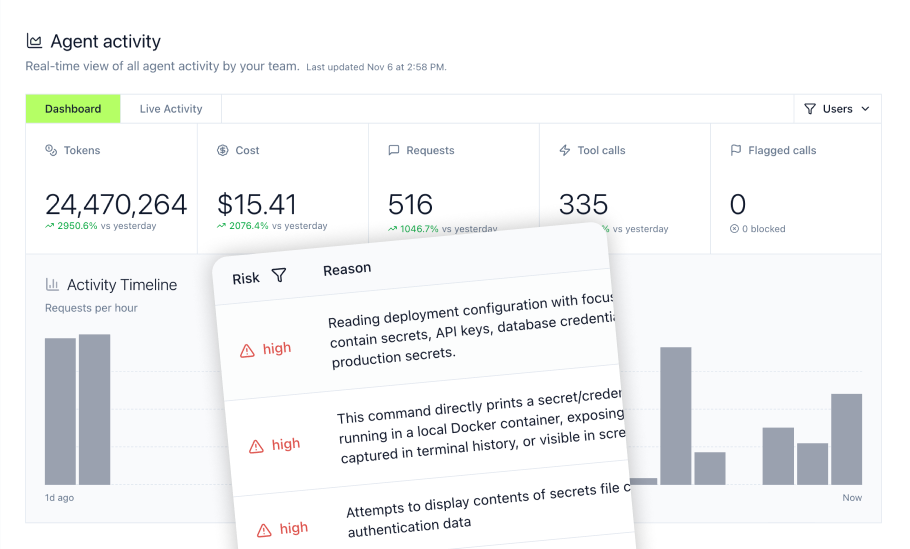
Mintive's Agent Monitor monitors every MCP tool invocation, bash command, and file operation from Claude Code, Cursor, GitHub Copilot, and Codex, providing complete visibility into agent behavior.
Monitoring capabilities include:
- Tool call tracking: Every MCP tool invocation with parameters, return values, and execution duration
- Bash command logging: Complete record of shell commands executed by agents including arguments and exit codes
- File access monitoring: Which files agents read, write, or execute with timestamps and access patterns
- MCP inventory: Visibility into installed MCPs, their permissions, and usage patterns across teams
- Usage analytics: Track spending per team, project, and tool with detailed breakdowns of resource consumption
The platform provides real-time dashboards for server health, usage patterns, and security alerts, enabling security teams to monitor AI agent activity across the organization.
Forensic readiness: Command history and file access logs
Security investigations require detailed historical records of agent actions, enabling teams to reconstruct incident timelines and determine data exposure scope.
Command history retention:
Agent Monitor maintains complete audit trails of every bash command, file access, and tool call for security review. This enables:
- Incident reconstruction: Full timeline of agent actions leading to security events
- Data exfiltration detection: Identification of unusual file access or data extraction patterns
- Malicious behavior analysis: Investigation of potentially compromised agents or insider threats
- Compliance verification: Demonstration that access controls functioned correctly during audits
Sensitive file protection:
The platform tracks access to configuration files, credentials, and other sensitive data including .env files, SSH keys, credential files, and certificates.
Implementing guardrails and policy enforcement for AI agents
Proactive security requires automated policy enforcement that blocks dangerous actions before they execute, rather than relying solely on detection and response.
Blocking malicious commands and preventing data leakage
Mint Guard screens MCP gateway tool-call arguments and results for prompt injection, secrets, and PII, while Mintive's Agent Monitor uses coding-agent hooks and rules to block risky commands and file access before they happen.
Command blocking capabilities:
- Dangerous command prevention: Block destructive operations like
rm -rf,dd, or other commands risking data loss or system damage - Credential access protection: Prevent reading of .env files, SSH keys, or other sensitive configuration automatically
- Network access control: Restrict outbound connections to approved destinations preventing data exfiltration
- Privilege escalation blocking: Prevent sudo usage or other privilege elevation attempts by agents
Organizations define security policies through centralized governance with automatic enforcement across all MCP connections, eliminating reliance on manual security reviews.
Role-Based tool access for enhanced control
Granular tool access enables organizations to configure tool access by role, enabling read-only operations while excluding write tools for junior staff or external contractors.
Policy configuration options:
- Tool whitelisting: Specify exactly which MCP tools each role can invoke, denying all others by default
- Operation restrictions: Allow database queries while blocking INSERT, UPDATE, or DELETE operations
- Data scope limits: Permit access to development databases while restricting production data
- Rate limiting: Enforce request limits preventing resource exhaustion or abuse
Organizations can configure policies through the tool governance interface, applying rules consistently across all agents without manual enforcement.
Integrating securely with enterprise data sources via remote MCPs
Secure data integration requires MCP servers that respect existing access controls while providing AI agents with necessary information access.
Database connectivity:
Pre-built MCP servers support common enterprise databases including PostgreSQL, MongoDB, and SQLite. Organizations can deploy these servers through Mintive Gateway with automatic authentication and access logging.
Elasticsearch integration for knowledge management:
Elasticsearch MCP Server enables AI agents to query enterprise knowledge bases, support tickets, and log data with controlled access to internal information. Tool capabilities include search, esql, list_indices, get_mappings, and get_shards.
Use cases for secure Elasticsearch access:
- HR teams: Build AI-accessible knowledge bases from company documentation and policies
- Support teams: Enable agents to search historical tickets and resolution patterns
- Product teams: Provide AI-powered documentation search for customer-facing help systems
Snowflake integration for data warehouse access:
Snowflake MCP Server enables AI agents to access data warehouses for reporting and analytics with natural language queries while maintaining role-based access controls. Key tools include cortex_analyst, run_snowflake_query, query_semantic_view, and list_objects.
Gmail integration for communication workflows:
Gmail MCP Server allows AI assistants to search, draft, and reply to emails with built-in security oversight for communication workflows. Available capabilities include search_email, get_email, draft_email, and send_draft.
All integrations maintain complete data access logs showing exactly what data each AI tool accesses and when, supporting compliance and security investigations.
Operationalizing secure remote MCP deployment for enterprise adoption
Successfully deploying secure MCP infrastructure requires addressing both technical security controls and organizational adoption challenges.
Rapid deployment without sacrificing security:
Mintive enables one-click deployment of STDIO-based MCP servers with pre-configured policies, transforming deployment from months to minutes. Organizations can deploy MCP servers instantly, apply automatic OAuth protection, enforce centralized policies, and enable self-service access.
Addressing shadow AI proliferation:
Research shows shadow AI usage continuing to grow, creating compliance blind spots as employees adopt AI tools without IT oversight. According to research on AI security challenges, Mintive addresses this by providing sanctioned alternatives, eliminating friction, maintaining developer velocity, and offering better capabilities.
Implementation roadmap:
Organizations can deploy secure MCP infrastructure through a phased approach:
- Pilot phase (weeks 1-2): Deploy Mintive Gateway with initial authentication integration and select first MCP server for controlled team
- Expansion phase (weeks 3-6): Add additional MCP servers addressing key use cases while refining policies based on pilot learnings
- Production phase (weeks 7-12): Scale deployment organization-wide with complete monitoring, compliance reporting, and support processes
The understanding MCP gateways guide provides additional implementation guidance for technical teams.
Frequently asked questions
What security risks exist when deploying MCP servers without enterprise governance?
Open MCP implementations lack authentication, authorization, and audit logging. Agents can access any connected data source without controls, execute arbitrary commands without monitoring, and access sensitive files without detection. Mintive addresses these gaps through automatic OAuth protection, real-time monitoring, and complete audit trails.
How does Mintive enable faster MCP deployment compared to building custom security?
Building custom authentication, monitoring, and compliance infrastructure for MCP requires months of development. Mintive provides these capabilities as a turnkey platform, enabling deployment in days through one-click server deployment, automatic OAuth wrapping, pre-configured policies, and built-in compliance reporting.
Can Mintive integrate with existing enterprise authentication systems?
Yes, Mintive Gateway supports OAuth 2.0, SAML, and SSO integration. Organizations can leverage existing authentication infrastructure from Okta, Azure AD, Google Workspace, or custom OIDC implementations. The platform provides both shared service accounts and individual OAuth flows for per-user access.
What compliance certifications does Mintive maintain for regulated industries?
Mintive is SOC2 Type II certified with security controls for AI agent governance. The platform is GDPR compliant with complete audit trails, and exportable logs for compliance reporting. All MCP interactions are logged with detailed records supporting regulatory requirements.
What visibility does Mintive provide into AI agent behavior across the organization?
Mintive's Agent Monitor tracks every MCP tool invocation, bash command, and file operation, providing complete observability. Real-time dashboards show tool usage patterns, data access logs, command history, and performance metrics across teams. The platform maintains exportable audit logs for compliance reporting and security investigations.