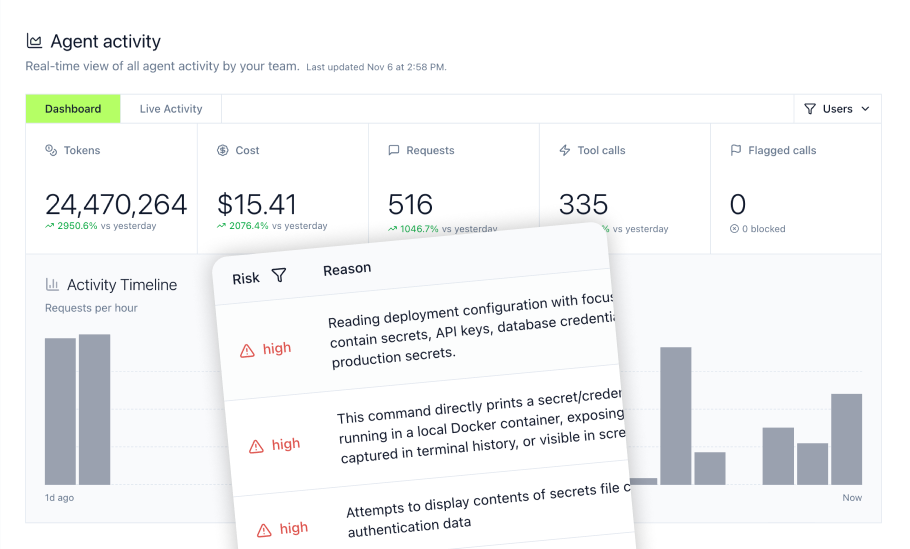
OpenClaw surged past 100,000+ GitHub stars within weeks of its November 2025 launch—and quickly became one of the most scrutinized agentic security stories of early 2026. This open-source AI agent framework connects large language models to messaging platforms, file systems, shell commands, and enterprise applications with autonomous execution capabilities. For enterprises, the appeal is obvious: productivity gains without engineering overhead. The risk is equally clear—AI agents security, as Cisco bluntly states. Organizations need robust AI governance infrastructure to deploy these tools safely.
This guide provides the complete security implementation roadmap for enterprises that cannot simply ban OpenClaw—because your employees are already using it.
Key Takeaways
- 22% of monitored organizations have employees running OpenClaw without IT approval (Token Security)
- OpenClaw's CLAW-10 composite score is 1.2/5, and many enterprises will require scores of 4+ on Identity, Authorization, and Execution Sandboxing before any production deployment
- Bitdefender's scans found almost 900 malicious ClawHub skills (nearly ~20% of packages), and separate research found ~36% of skills with security flaws (not all malicious)
- CVE-2026-25253 (CVSS 8.8 HIGH) enables malicious-link token exfiltration that can lead to gateway takeover and potentially RCE depending on enabled tools; patched in 2026.1.29
- Some companies have restricted or discouraged OpenClaw on corporate devices; WIRED reports internal bans/restrictions at multiple firms, and Microsoft advises treating OpenClaw as untrusted code execution with persistent credentials—only evaluate in fully isolated environments
- IBM’s 2025 Cost of a Data Breach Report puts the global average breach cost at ~$4.44M, down 9% year over year; agentic compromises can cascade across OAuth/API credential chains when the agent holds persistent tokens
Understanding the Enterprise Challenge: OpenClaw Adoption and Shadow AI
The Rise of Autonomous AI Agents
OpenClaw operates fundamentally differently from traditional chatbots. It runs continuously on user infrastructure, maintains persistent memory across sessions, and executes real-world actions—reading emails, managing calendars, running shell commands—without human approval. Created by Peter Steinberger in November 2025, the tool attracted massive developer adoption before security researchers could assess its enterprise readiness.
The problem compounds when employees deploy OpenClaw without IT involvement. Token Security found that 22% of monitored organizations have employees running OpenClaw without IT approval—creating deployments security teams can’t inventory or govern.
Identifying and Mitigating Shadow AI Risks
Shadow AI creates multiple attack vectors that traditional security tools miss:
- Zero telemetry — No request history or audit trail for AI agent actions
- Uncontrolled access — Agents inherit all permissions of the launching user
- Credential exposure — API keys stored in plaintext by default
- Supply chain risk — Bitdefender reports nearly 900 malicious skills (roughly ~20% of packages at the time) distributed through the ClawHub marketplace
- Network exposure — OpenClaw's gateway defaults to loopback on port 18789; public exposure usually happens through misconfigured proxies, port forwarding, improperly published container ports/host networking in Docker deployments, or cloud security groups
The CLAW-10 enterprise evaluation matrix provides a structured way to quantify these gaps across ten dimensions. OpenClaw's composite score of 1.2/5 falls far below the enterprise requirements for production deployment in regulated environments.
Establishing Enterprise-Grade Security for OpenClaw Deployments
Implementing Robust Authentication and Authorization
OpenClaw supports gateway authentication (token/password), but some setups assume the gateway host is trusted—so treat any non-loopback or proxied exposure as high risk unless you explicitly enforce auth and origin controls. If operators bypass guardrails or expose the gateway/UI improperly, anyone who can reach the service may be able to take control—treat any unintended exposure as high risk.
Critical authentication steps:
- Verify gateway authentication is enabled (token/password) and rotate the gateway secret on a defined schedule; never run non-loopback binds without auth
- Bind to loopback for baseline safety: Configure
gateway.bind: "loopback"(or equivalent loopback-only binding in your deployment model) - Enable DM pairing: Set
channels.whatsapp.dmPolicy: "pairing"to prevent stranger access - Fix file permissions: Run
chmod 700 ~/.openclaw && chmod 600 ~/.openclaw/*.json
The OCSAS security standard provides tiered implementation configs—Level 1 for individual users, Level 2 for small teams, Level 3 for enterprise compliance requirements.
Protecting Against Malicious Commands and Data Exfiltration
OpenClaw's autonomous execution model means a single compromised skill or prompt injection can trigger credential theft, lateral movement, or data exfiltration. Bitdefender identified 14 GitHub accounts involved in distributing supply chain attacks through the ClawHub marketplace, including both compromised accounts and purpose-built malicious accounts.
Security guardrails to implement:
- Sandbox mode — Configure
agents.defaults.sandbox.mode: "all"to isolate command execution - Tool allowlists — Restrict available tools to
[git, slack_send, calendar_read]rather than permitting everything by default - Approval requirements — Enable exec approvals so command execution requires explicit human approval (configure the exec tool's ask/allowlist policy per OpenClaw's Exec approvals guidance)
- Docker isolation — Deploy with read-only filesystem and dropped capabilities
The Repello AI guide provides detailed Docker Compose configurations with seccomp profiles and incident response playbooks for compromised instances. Enterprises requiring real-time monitoring of AI tool usage should implement additional proxy layers to track every tool call and bash command.
Achieving Compliance with SOC2, HIPAA, and GDPR for OpenClaw
Comprehensive Audit Trails for Regulatory Adherence
OpenClaw's architectural limitations create significant compliance gaps. The Zenity CISO checklist maps eight critical controls to NIST and CIS standards—OpenClaw fails to meet most requirements without compensating controls.
Key compliance deficiencies:
- No built-in RBAC — Cannot implement role-based access control without enterprise forks
- No tamper-evident logging — Basic local logs without SIEM integration
- Plaintext credential storage — Creates major HIPAA Security Rule risk; encryption is addressable (risk-based), but plaintext secrets typically require strong compensating controls or redesign
- No SSO/SAML support — Cannot integrate with enterprise identity providers
- No data retention policies — Memory grows unbounded without manual cleanup
Organizations subject to GDPR may need a DPIA (Article 35) where the agent's processing is likely to result in high risk—especially when deploying new technologies with broad access to personal data. The CyberArk identity analysis recommends treating AI agents as non-human identities requiring dedicated service accounts with zero standing privileges.
Data Residency and Privacy Controls
Enterprises operating across jurisdictions face additional challenges. OpenClaw stores conversation history and memory files on user-controlled infrastructure, but the agent can send data to any connected service—Claude API, Gmail, Slack—without DLP controls.
Compliance implementation steps:
- Deploy on isolated network segment with explicit egress rules
- Integrate logs with enterprise SIEM (Splunk, ELK) with 90-day retention
- Rotate credentials every 30 days via secrets manager (HashiCorp Vault, AWS Secrets Manager)
- Document all data flows for compliance audits
- Implement tool governance policies through external governance layers
Streamlining OpenClaw Deployment and Management
From Local to Enterprise: One-Click Security Hardening
The gap between "install in 5 minutes" and "production-ready deployment" spans 2-4 hours of security work. The xCloud security guide documents the full hardening process.
Deployment approaches include:
- Self-Hosted (Default) — 5-minute setup but no security controls; requires manual patching and ongoing maintenance
- Self-Hosted (Hardened) — 2-4 hours initial configuration to reach OCSAS Level 2; requires 2-4 hours monthly maintenance for patching and monitoring
- Managed Hosting — Pre-configured security included with auto-patching, but operational burden reduction does not eliminate architectural vulnerabilities
- Enterprise Consulting — Full OCSAS Level 3 implementation with dedicated resources but significant time and resource investment
Managed hosting providers like xCloud and LumaDock can reduce operational burden (patching, firewalling, TLS), but they don't replace governance controls like centralized auth, audit logging, and tool-level policy enforcement across all MCP connections.
Centralized Credential and Configuration Management
Most OpenClaw deployments rely on plaintext credential storage that any infostealer can harvest. The JFrog supply chain analysis documents how RedLine, Lumma, and Vidar malware specifically target ~/.openclaw/.env files.
Secure credential management requirements:
- Store API keys in environment variables, never in configuration files
- Use secrets managers with automatic rotation
- Implement just-in-time credential provisioning
- Audit credential access logs monthly
- Revoke compromised tokens within minutes, not hours
Monitoring and Observability for OpenClaw Usage and Performance
Gaining Deep Insights into AI Agent Interactions
Without monitoring, organizations cannot answer basic security questions: What tools did the agent invoke? What data did it access? What commands did it execute? The DigitalOcean security guide ranks lack of observability among the seven most severe enterprise risks.
Essential monitoring capabilities:
- Tool call tracking — Log every MCP tool invocation with timestamps and parameters
- Command history — Capture all bash commands for security review
- File access monitoring — Track which files agents read and write
- Network connections — Alert on unexpected outbound connections
- API cost tracking — Set spending limits before runaway costs exceed budget thresholds
Enterprise audit and observability infrastructure should capture these events in tamper-evident logs with configurable retention periods.
Detecting Anomalies and Maintaining SLA Compliance
The Jamf MDM guide provides macOS-specific detection rules for identifying unauthorized OpenClaw instances. CrowdStrike Falcon for IT users can deploy the "OpenClaw Search & Removal" content pack for automated discovery and remediation.
Anomaly detection rules to implement:
- Alert when agents access files outside designated workspace
- Flag multi-step sequences indicating exfiltration patterns
- Monitor for process signatures on port 18789 and mDNS broadcasts
- Detect DNS queries to openclaw.ai from corporate endpoints
- Trigger incident response on credential file access
Integrating OpenClaw with Enterprise Data and Applications
Connecting to Internal Knowledge Bases Securely
OpenClaw's native integrations span messaging platforms (WhatsApp, Telegram, Slack, Discord), productivity tools (Gmail, Google Calendar, Notion), and developer services (GitHub, Linear). Each integration creates an attack surface through OAuth tokens and API credentials.
Integration security requirements:
- Use scoped OAuth tokens with minimum required permissions
- Implement separate service accounts per integration
- Review token permissions quarterly
- Audit connected applications through platform admin consoles
- Revoke unused integrations immediately
The Auth0 guide to securing AI agents provides a simple implementation reference for developers—covering sandbox configuration, allowlists, and secret hygiene.
Enterprise Application Governance
Organizations connecting OpenClaw to business-critical systems—CRM data, financial systems, customer databases—require additional controls beyond basic hardening. The Aryaka ZTNA guide documents Zero Trust Network Access architecture for OpenClaw gateway protection.
Governance controls for sensitive integrations:
- Require human approval for all write operations
- Implement read-only access for analytics use cases
- Segment high-risk integrations on dedicated agent instances
- Deploy canary tokens to detect unauthorized data access
- Review integration audit logs daily during initial rollout
Robust Access Controls and Governance for All Users
Defining Who Can Access Which AI Tools and Data
OpenClaw's ambient authority model—where the agent inherits all permissions of the launching user—creates significant governance challenges. The PacGenesis risk breakdown documents how this model violates least-privilege principles required for enterprise security.
Access control implementation:
- Create dedicated service accounts with explicit permission boundaries
- Implement session isolation for direct-message contexts: Configure
\session.dmScope: "per-account-channel-peer"`so DM sessions stay separated by account, channel, and peer - Require mention for group channel interactions:
channels.*.requireMention: true - Deploy tiered agent instances for different risk levels
- Document approved use cases and prohibited actions
Implementing Granular Permissions for Secure Operations
The Contabo Docker guide provides practical examples for restricting agent capabilities through container security options:
services:
openclaw-gateway:
user: "1000:1000" # Non-root user
read_only: true # Read-only filesystem
cap_drop: [ALL] # Drop all capabilities
security_opt: ["no-new-privileges:true"]
Never mount the entire home directory or Docker socket—both configurations defeat isolation entirely. The Hostinger VPS tutorial covers firewall UFW configuration and SSH hardening for self-hosted deployments.
Centralized Governance: The Missing Layer for Enterprise OpenClaw Deployments
The research reveals a fundamental gap between OpenClaw's capabilities and enterprise requirements. With a 1.2/5 enterprise readiness score, organizations cannot deploy OpenClaw safely without compensating controls that address audit logging, role-based access, compliance mapping, and centralized governance.
MintMCP's MCP Gateway provides the production infrastructure that transforms AI agents from developer utilities into enterprise-grade tools. Rather than building compensating controls from scratch or accepting shadow AI risks, enterprises can deploy centralized governance in minutes.
MintMCP provides the governance layer OpenClaw lacks natively:
- Centralized governance — Unified authentication, audit logging, and rate control for all MCP connections across your organization
- OAuth + SSO enforcement — Automatic enterprise authentication wrapping that integrates with existing identity providers
- Complete audit trails — Track every tool call, access request, and configuration change to support SOC 2 evidence needs and broader security/privacy governance programs
- Real-time monitoring — Live dashboards for server health, usage patterns, and security alerts across all connected AI tools
- Granular tool access — Configure tool access by role, enabling read-only operations while excluding write tools
For teams already using AI coding assistants, the LLM Proxy monitors every MCP tool invocation, bash command, and file operation—providing the visibility that shadow AI deployments eliminate. Block dangerous commands in real-time, protect sensitive files from access, and maintain complete audit trails without disrupting developer workflows.
The gap between "viral AI tool" and "enterprise-ready AI agent" represents exactly the challenge MintMCP solves. Deploy faster with centralized governance controls and a single audit surface. MintMCP is SOC 2 Type II compliant.
Frequently Asked Questions
What is Shadow AI and how does MintMCP help prevent it with OpenClaw?
Shadow AI refers to unauthorized AI tool deployments operating outside IT visibility—22% of organizations currently have employees running OpenClaw without approval. These deployments create zero telemetry, no audit trails, and uncontrolled data access. MintMCP addresses this by providing centralized agent inventory, real-time policy enforcement, and tamper-evident logging. Rather than banning tools that employees will use anyway, MintMCP enables safe adoption with pre-configured governance policies.
How does MintMCP ensure OpenClaw deployments comply with SOC2 and GDPR?
OpenClaw's native compliance gaps include plaintext credential storage, no RBAC, and missing audit trails. MintMCP provides compensating controls commonly required for enterprise governance: centralized auth (OAuth/SAML/SSO), audit logs, secret scanning, and role-based access controls via virtual servers. MintMCP is SOC 2 Type II compliant; coordinate with your compliance team to map controls to your specific regulatory obligations.
Can MintMCP integrate OpenClaw with existing enterprise databases and applications?
Yes. MintMCP provides connectors for Elasticsearch, Snowflake, Gmail, and other enterprise systems with built-in security controls. Unlike direct OpenClaw integrations that grant ambient authority, MintMCP connectors enforce granular permissions—enabling read-only access for analytics while blocking write operations. This approach allows AI agents to access enterprise data without the supply chain risks of ClawHub skills.
What monitoring and observability does MintMCP offer for OpenClaw usage?
MintMCP tracks every AI tool interaction across Claude, ChatGPT, Cursor, and other clients. Capabilities include tool call tracking, MCP inventory, command history, cost analytics, and performance metrics. The LLM Proxy monitors file access in real-time and blocks risky operations like reading environment secrets or executing dangerous commands—addressing the seven security challenges identified in OpenClaw's architecture.
How quickly can an enterprise deploy and secure OpenClaw using MintMCP?
MintMCP enables one-click deployment for STDIO-based MCP servers with automatic OAuth protection and enterprise monitoring. While self-hosted OpenClaw hardening requires 2-4 hours configuration, MintMCP provides pre-configured policies that deploy in minutes. Organizations can transform local servers into production services without the significant annual investment typically required for compliant OpenClaw deployments.