OpenClaw represents one of the most rapid adoption stories in AI history—surpassing 180,000 GitHub stars within days (now at ~247,000 stars as of March 3, 2026) while simultaneously creating a documented security crisis that exposed fundamental gaps in autonomous AI governance. Unlike chatbots that simply respond, OpenClaw functions as an autonomous agent capable of executing shell commands, browsing the web, managing files, and controlling calendars across 20+ supported chat channels (WhatsApp, Telegram, Slack, Discord, Signal, iMessage and BlueBubbles, Teams, and more). This capability has made it attractive for personal productivity but problematic for enterprise deployment without comprehensive governance frameworks—something platforms like MintMCP's MCP Gateway are specifically designed to address.
This article explains OpenClaw's four-layer architecture, its extensible skills system, the critical security vulnerabilities security teams must understand, and the governance frameworks required for any enterprise considering AI agent deployment.
Key Takeaways
- OpenClaw's hub-and-spoke architecture consists of four layers: channel adapters, gateway control plane, agent runtime, and tools/execution—each introducing distinct security considerations
- Censys identified 21,639 internet-exposed instances as of January 31, 2026—most still required a gateway token, but exposure creates immediate attack vectors
- The ClawHub marketplace suffered large-scale supply-chain abuse: reporting on an audit of 2,857 skills found 341 malicious uploads (≈12%), attributed to the "ClawHavoc" campaign deploying credential-stealing malware
- CVE-2026-25253 (CVSS 8.8) enabled one-click remote code execution through malicious webpages; patched in 2026.1.29, but later follow-on findings, including Docker sandbox issues, were addressed in 2026.2.15
- Prompt injection remains an industry-wide unsolved security problem: there is no complete technical mitigation today, so enterprises rely on layered controls to reduce rather than eliminate risk
- Enterprise deployment requires treating AI agents as non-human identities with IAM governance, credential rotation, and least-privilege access controls
- Secure production deployment typically requires non-trivial hardening and operational ownership versus minutes for enterprise-grade alternatives with built-in compliance
Understanding OpenClaw's Foundational Architecture and Mechanism
OpenClaw transforms large language models into autonomous agents by providing execution infrastructure, session management, memory systems, tool sandboxing, and multi-channel message routing. The platform separates the AI interface layer from the intelligence runtime, enabling one persistent assistant accessible through any messaging platform with conversation state managed centrally on user-controlled hardware.
The Four-Layer Architecture Explained
The OpenClaw architecture operates across four distinct layers, each with specific functions and security implications:
Layer 1: Channel Adapters (User Interface)
- Normalize 20+ chat platforms into a unified format
- Handle platform-specific authentication including QR codes, bot tokens, and OAuth flows
- Enforce access control through allowlists, DM pairing, and mention-gating for groups
- Convert inbound messages to common schema and format outbound responses for each platform
Layer 2: Gateway Control Plane (Hub)
- Single WebSocket server on Node.js 22+ serving as the central coordination point
- Default binding to 127.0.0.1:18789 (localhost-only for security, though sometimes misconfigured)
- Routes messages through access control → session resolution → agent dispatch
- Coordinates system state including sessions, cron jobs, webhooks, and health monitoring
Layer 3: Agent Runtime (Brain)
- Uses Pi Agent Core library for session resolution and context assembly
- Loads session history, dynamic system prompts, and performs semantic memory search via vector embeddings
- Executes the inference loop: streams to LLM → intercepts tool calls → executes tools → persists results
- Supports model failover, automatically switching providers when rate limits are detected
Layer 4: Tools and Execution (Hands)
- Dozens of built-in tools, including shell execution, browser automation (CDP-based), file operations, and scheduled jobs—with tool availability governed by allow/deny policy and sandbox settings
- Plugin system allows custom tool registration through extensions
- Skills (markdown playbooks with YAML frontmatter) define workflows using available tools
- Optional Docker sandboxing with configurable isolation per session or agent
How Data Flows Through the System
Understanding the message-to-response flow reveals where security controls must be applied:
- Ingestion: Channel adapter receives message via WebSocket or Bot API
- Access Control: System checks allowlist and pairing approval; rejects unauthorized requests
- Session Resolution: Maps source to session ID (main vs. dm vs. group)
- Context Assembly: Loads session history, builds system prompt, performs semantic memory search
- Model Invocation: Streams context to Claude or GPT; receives tokens incrementally
- Tool Execution: Intercepts tool calls; executes in sandbox if configured; returns results
- Response Delivery: Formats for platform, chunks if needed, sends via channel adapter
- State Persistence: Updates the session index (sessions.json) and appends to per-session transcript artifacts (JSONL), stored on the gateway host under OpenClaw’s per-agent sessions directory
One published architecture breakdown provides an illustrative latency budget (highly environment-dependent): access control (~single-digit ms), session load (~tens of ms), prompt assembly (~sub-100ms), first token (~hundreds of ms), and tool execution (sub-second to seconds depending on the tool).
This architecture provides flexibility but lacks the centralized governance, audit logging, and authentication enforcement that enterprises require. MintMCP's MCP gateway architecture addresses these gaps by wrapping every connection with OAuth, maintaining complete audit trails, and providing real-time monitoring dashboards.
Enhancing API Security with OpenClaw's Governance Features
OpenClaw's security model places nearly all responsibility on the deploying user, creating significant risks when default configurations are used without hardening.
The Default Security Posture Problem
Out of the box, OpenClaw provides:
- Token-based gateway authentication: Gateway authentication is required by default in current releases, and the onboarding wizard generates a gateway token even for loopback setups
- Device pairing: Cryptographic challenge-response for new connections
- Per-channel allowlists: Configurable but requires manual setup
- Mention-gating for groups: Available but must be explicitly enabled
What it lacks by default:
- Native IdP connectors: OpenClaw doesn't ship native IdP connectors, but it does support enterprise SSO via "trusted-proxy" auth—your reverse proxy handles OAuth/OIDC/SAML and forwards authenticated identity headers that OpenClaw verifies against trusted proxy IPs
- Centralized audit logging: Session files exist but no aggregated compliance reporting
- Fine-grained tool restrictions: Tool governance exists (global and per-agent allow/deny lists, plus elevated/sandbox controls), but fine-grained restrictions like per-agent file-path allowlists aren't a first-class control unless you rely on isolation/sandboxing patterns
- Rate limiting and anomaly detection: No built-in protection against abuse patterns
Critical Vulnerabilities Exposed
CVE-2026-25253: One-Click Remote Code Execution
This CVSS 8.8 vulnerability allowed malicious webpages to trigger WebSocket handshakes that leaked gateway tokens and executed arbitrary shell commands. Any user who clicked a crafted OpenClaw /chat link while authenticated could have their gateway token exfiltrated and then abused for full gateway compromise. OpenClaw patched it in 2026.1.29, but later follow-on findings, including Docker sandbox issues, were addressed in 2026.2.15.
Exposed Gateway Instances
Censys identified 21,639 internet-exposed instances as of January 31, 2026—and noted most still required a gateway token. The root cause is almost always operator choice: users bind the Gateway beyond loopback (or deploy behind a misconfigured reverse proxy/tunnel), turning a local-first control plane into an internet-facing service.
Prompt Injection: The Unsolved Problem
Prompt injection remains an industry-wide unsolved security problem: there is no complete technical mitigation today, so enterprises rely on layered controls (isolation/sandboxing, least privilege, tool approvals, and monitoring) to reduce—rather than eliminate—risk. Zenity research demonstrated this by hiding a prompt in a Google Doc that directed OpenClaw to create a Telegram bot backdoor—the attack succeeded with zero direct access to the target system.
Available mitigations reduce but cannot eliminate risk:
- Mention-gating for group channels
- Sandboxing untrusted content processing
- Low-privilege agents for external data handling
- Tool confirmation prompts for destructive operations
However, no complete technical solution exists. OpenClaw cannot safely process untrusted content in environments with sensitive data without accepting residual risk.
Enterprise-Grade Alternatives
For organizations requiring governed AI agent deployment, MintMCP's security architecture provides what OpenClaw lacks:
- OAuth and SAML integration with enterprise identity providers
- Complete audit trails of every MCP interaction and configuration change
- Granular tool access control configurable by role
- Real-time security monitoring with anomaly detection
- SOC 2 Type II compliance with enterprise security controls
OpenClaw's Advanced Observability and Real-time Monitoring
Monitoring autonomous AI agents requires visibility into every tool invocation, file access, and command execution. OpenClaw provides basic logging but lacks enterprise-grade observability.
Built-in Monitoring Capabilities
OpenClaw stores session data as JSON files in~/.openclaw/agents/<agentId>/sessions/, providing:
- Complete conversation history per session
- Tool call records with parameters and results
- Timestamp data for all interactions
- Memory file updates (MEMORY.md, daily notes)
What enterprises need but OpenClaw doesn't provide natively:
- Centralized log aggregation across multiple agents and channels
- Real-time dashboards for usage patterns and security alerts
- Automated anomaly detection for suspicious behavior
- Compliance-ready audit reports for SOC2 or GDPR requirements
- Cost analytics tracking spending per team, project, and model
Implementing External Monitoring
Organizations deploying OpenClaw must build monitoring infrastructure:
- SIEM integration: Forward logs to your logging/SIEM stack (e.g., Splunk, Datadog, Elastic/Grafana-based pipelines) for aggregation and alerting; costs depend on ingest volume, retention, and your vendor contract
- Custom alerting: Build rules for sensitive operations like credential access or file deletion
- Session review workflows: Manual weekly review of agent activity logs
- Incident response playbooks: Documented procedures for anomaly investigation
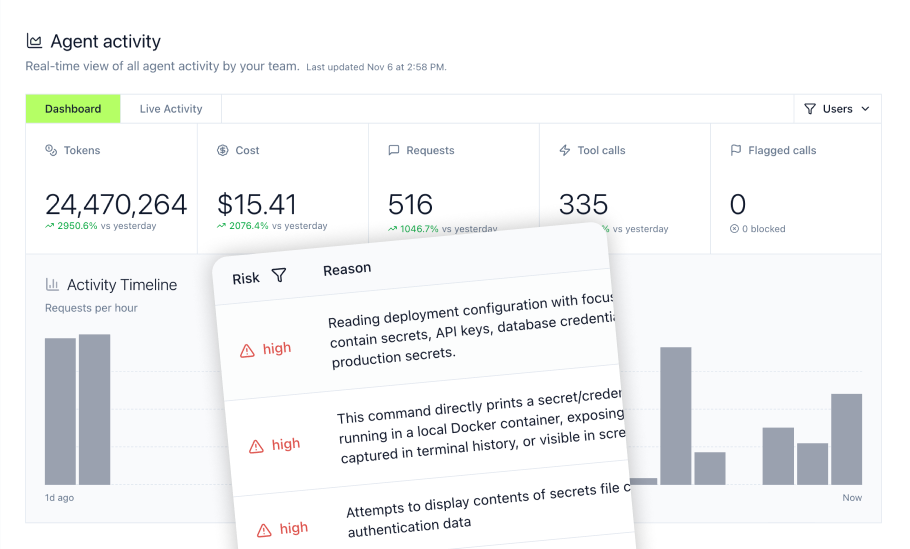
The LLM Proxy from MintMCP addresses these gaps by sitting between AI clients and models, providing:
- Tool call tracking for every MCP invocation, bash command, and file operation
- MCP inventory showing all installed tools and their usage patterns
- Command history with complete audit trails for security review
- Real-time dashboards for SLA compliance monitoring
Integrating Enterprise Data with OpenClaw's Specialized Skills
OpenClaw's extensibility comes through its skills system—markdown playbooks that define workflows using available tools. While powerful, this system introduces significant supply chain risks.
How Skills Work
Skills are structured markdown files (SKILL.md) with YAML frontmatter containing:
- Skill name and description
- Parameter definitions with types and defaults
- Step-by-step workflow instructions using available tools
The ClawHub ecosystem spans thousands of community-built skills (public scans and reporting cited roughly 3,984 skills in registry-wide analyses). Skills can also integrate with MCP (Model Context Protocol) servers from the broader community.
The ClawHub Supply Chain Crisis
The ClawHub marketplace has experienced large-scale supply-chain abuse. Reporting on an audit of 2,857 skills found 341 malicious uploads (≈12%), with a major cluster attributed to the "ClawHavoc" campaign:
- 335 skills in the main campaign cluster delivered malware, with reported payloads differing by platform and campaign—including Atomic Stealer on macOS
- Malicious skills masqueraded as productivity tools (crypto trading, SEO research)
- Hidden curl commands exfiltrated credentials to command-and-control infrastructure
- Skills reappear under new names even after removal
Skill Security Requirements:
- Verify publisher GitHub account age (minimum one week)
- Read SKILL.md source code for hidden curl/wget commands
- Check for hardcoded external URLs (potential exfiltration targets)
- Run through Cisco Skill Scanner or equivalent tool
- Test in isolated sandbox before production use
- Pin skill versions (ClawHub skills can change post-install)
Enterprise Data Integration Alternatives
For organizations needing AI agents to access enterprise data securely, MintMCP provides governed connectors:
Elasticsearch Integration: Search knowledge bases, support tickets, and logs with tools including search, ES|QL queries, index listing, and mapping retrieval—all through authenticated, audited connections.
Snowflake Integration: Natural language to SQL conversion, semantic search, and direct query execution with Cortex Agent capabilities—enabling product analytics, financial reporting, and business intelligence without SQL expertise.
Gmail Integration: AI-driven email search, drafting, and sending within controlled workflows—with security oversight preventing unauthorized access to sensitive communications.
These integrations provide the data access capabilities enterprises need while maintaining the governance, authentication, and audit requirements that OpenClaw's skill system cannot guarantee.
Ensuring Compliance and Data Governance with OpenClaw
OpenClaw's open-source nature means compliance is entirely the deploying organization's responsibility—a significant burden for regulated industries.
Compliance Certification Status
SOC 2: Not applicable (no central service to certify)
GDPR: User responsibility (self-hosted = organization is data controller)
HIPAA: Not ready (requires BAA with LLM provider plus extensive hardening)
Industry-specific: Requires custom build (government needs GovCloud, IL4/IL5 enclaves)
Data Security Considerations
Encryption:
- In transit: WSS (WebSocket Secure) or SSH tunnels
- At rest: Depends entirely on host filesystem encryption
Data Location:
- Conversation history, memory, and credentials stored locally
- LLM API calls traverse external providers (Anthropic, OpenAI, Google)
- No built-in data residency controls
Backup Policy:
- Manual user responsibility
- Session files stored as JSON in ~/.openclaw/agents/<agentId>/sessions/
- No automated backup or disaster recovery
Credential Theft Risks
InfoStealer malware specifically targets OpenClaw installations:
- RedLine, Lumma, and Vidar target ~/.openclaw/credentials/
- API keys, OAuth tokens, and WhatsApp session data stored in plaintext JSON
- Default file permissions often too permissive
- Single compromised endpoint = full organizational data exposure
Required mitigations:
- chmod 700 ~/.openclaw and chmod 600 on all credential files
- Use secrets vault (HashiCorp Vault, AWS Secrets Manager)
- Rotate keys immediately after any suspected compromise
Enterprise Compliance Alternative
MintMCP provides compliance infrastructure out of the box:
- SOC 2 Type II certified with complete audit documentation
- Enterprise security controls like RBAC, MFA, and audit logging
- Complete audit logs for every MCP interaction
- Centralized credential management eliminating plaintext storage
Architecting for Security: How OpenClaw Prevents Risky Operations
Preventing AI agents from executing dangerous operations requires defense-in-depth controls that OpenClaw supports but doesn't enforce by default.
Security Guardrails Available
Tool Denylists:
- Block specific commands (rm, sudo, chmod) at the gateway level
- Requires manual configuration in gateway.json
- No built-in templates or recommended configurations
Filesystem Scoping:
- Limit agent access to specific directories
- Requires Docker deployment with volume mounts
- Read-only filesystem option available but complex to configure
Sandbox Mode:
- Isolated containers for non-main sessions
- Network access disabled by default in sandboxed mode
- Requires Docker expertise to implement correctly
Implementation Challenges
Common security failures include:
- Gateway binding errors: Users configure external binding, exposing to internet
- Missing authentication: Token auth disabled for convenience during testing, never re-enabled
- Permissive credentials: Default file permissions allow any local user to read API keys
- Unvetted skills: Community skills installed without source code review
The "Lethal Trifecta" Framework Referenced by CyberArk
CyberArk identifies three pressure points requiring controls within the broader "lethal trifecta" risk pattern:
Endpoint Privilege:
- Sandbox isolation prevents SSH key access
- Command allowlisting (whitelist git, npm; block rm, sudo)
- Surgical kill switch to suspend agent identity instantly
Exposed Secrets:
- Automated rotation (API keys expire after defined periods)
- Runtime injection rather than .env file storage
- Proxy egress allowlisting to block exfiltration
In-Session Behavior:
- Zero standing privileges (ZSP)—just-in-time access only
- Authenticated delegation via OAuth
- Out-of-band authentication for high-risk actions
- Session monitoring linking agent actions to human identity
Built-in Security from MintMCP
The LLM Proxy provides security guardrails that OpenClaw requires manual implementation to achieve:
- Block dangerous commands in real-time before execution
- Protect sensitive files (.env, SSH keys, credentials) from agent access
- Complete audit trail of all operations for security review
- Enterprise uptime SLA with operational safeguards
Why MintMCP Delivers Production-Ready AI Agent Governance
For teams evaluating AI agent deployment, the gap between OpenClaw's powerful capabilities and enterprise security requirements is substantial. While OpenClaw excels as a learning platform and personal productivity tool, production deployments demand governance infrastructure that doesn't exist by default.
MintMCP bridges this gap by providing the authentication, monitoring, and compliance controls that regulated organizations require—without forcing security teams to build custom infrastructure from scratch.
What MintMCP Provides Out of the Box
You can use MintMCP's service with STDIO servers that you deploy on our managed service, or with other deployable/remote servers you might operate. The platform wraps every MCP connection with OAuth 2.0 authentication, reducing reliance on ad-hoc plaintext credential files and manual token rotation common in self-hosted OpenClaw deployments.
Complete audit trails capture every tool invocation, file access, and agent decision—providing the compliance documentation that SOC 2 auditors and security teams demand. Real-time monitoring dashboards surface anomalies immediately rather than requiring weekly manual log reviews.
Role-based access control enables security teams to enforce least-privilege policies at the tool level, preventing agents from accessing resources beyond their designated scope. When paired with MintMCP's enterprise deployment guide, organizations can achieve production-ready AI agent infrastructure in hours rather than months of security hardening.
The platform's SOC 2 Type II certification demonstrates the mature compliance posture that enterprises need, with security controls validated by independent auditors rather than relying on user implementation. For teams building on MCP standards, MintMCP delivers the operational foundation that transforms experimental AI agents into trustworthy production systems.
Frequently Asked Questions
Can OpenClaw be made enterprise-ready with sufficient hardening?
Technically yes, but the effort required often exceeds the benefit. Secure enterprise deployment requires: Docker sandboxing with read-only filesystems, IAM integration through custom development, SIEM integration for centralized logging, secrets vault implementation, weekly security reviews, and penetration testing. Organizations investing at this level often find purpose-built enterprise platforms more cost-effective while providing stronger security guarantees and compliance certifications.
What happens if my OpenClaw instance processes a malicious email or document?
Prompt injection attacks embedded in external content can redirect agent behavior without any direct access to your systems. In documented cases, hidden instructions in Google Docs directed agents to create backdoors, exfiltrate data, or modify files. Because the agent processes the malicious content as part of normal operation, traditional security controls don't intercept it. Mitigations include running separate low-privilege agents for external content, requiring human confirmation for destructive operations, and accepting that some residual risk remains unavoidable when agents process untrusted data.
How does OpenClaw's skills system differ from MCP integrations?
OpenClaw skills are markdown playbooks with YAML frontmatter defining step-by-step workflows—essentially standardized procedures the agent follows using available tools. The ClawHub marketplace distributes community-created skills, but supply chain risks led one widely cited audit to find 341 malicious skills out of 2,857 reviewed—about 12% in that sample. MCP (Model Context Protocol) integrations are standardized interfaces between AI clients and tool providers, supported by Anthropic, OpenAI, Google, and Microsoft. MintMCP's connectors use MCP standards with enterprise authentication, audit logging, and governance controls that the ClawHub model lacks.
What are the ongoing maintenance requirements for secure OpenClaw deployment?
Minimum maintenance includes: credential rotation monthly (all API keys, OAuth tokens), security patch application within 24 hours of release, weekly activity log review, quarterly skill audits for installed packages, and continuous monitoring for exposed ports or configuration drift. Organizations without dedicated security operations resources find this burden unsustainable. Managed hosting providers reduce some maintenance through automatic patching, but governance and compliance responsibilities remain with the deploying organization.
Why did OpenClaw's creator join OpenAI, and what does this mean for enterprise versions?
Peter Steinberger, OpenClaw's creator, announced he is joining OpenAI on February 14, 2026—alongside OpenClaw's transition to an OpenAI-backed foundation model for stewardship. This transition suggests commercial versions with built-in compliance, authentication, and governance features may emerge. Organizations considering OpenClaw deployment should evaluate whether waiting for enterprise alternatives better serves their security requirements than attempting to harden the current open-source version.