OpenClaw has gone viral, surpassing 247,000 GitHub stars by the time of publication—creating a sudden, hard-to-inventory attack surface for enterprise teams. This AI agent framework enables autonomous system access—executing shell commands, managing files, controlling browsers, and accessing corporate email—creating unprecedented security exposure for enterprises. Internet-wide scanning found tens of thousands of internet-reachable control panels—Censys identified over 21,000 publicly exposed instances as of January 31, 2026—raising the risk of token theft and downstream credential exposure when hosts are misconfigured. For organizations seeking to govern AI agent deployments with enterprise-grade authentication and audit trails, an MCP Gateway provides the centralized security controls that OpenClaw fundamentally lacks.
This article outlines the critical security risks CISOs must understand about OpenClaw in 2026, covering vulnerability analysis, shadow AI detection, compliance gaps, and actionable hardening strategies to protect enterprise infrastructure.
Key Takeaways
- OpenClaw is frequently deployed insecurely: public exposure or missing auth controls, plaintext credential artifacts, and powerful local tool access—requiring hardening before enterprise use
- Shadow AI is already on your network: Token Security reports that 22% of its customers identified employee usage of Clawdbot/Moltbot inside their organizations—often outside formal IT rollout
- Critical vulnerabilities enable one-click compromise: CVE-2026-25253 allows remote code execution through a single malicious link, bypassing firewalls via the victim's browser
- Supply chain attacks are widespread: Snyk found 36.82% of scanned skills have at least one security flaw, and Koi Security identified 341 malicious skills in a ClawHub audit
- Prompt injection cannot be patched: This architectural vulnerability requires blast radius reduction through least-privilege access controls, not input filtering
- Compliance frameworks are not met by default: OpenClaw requires significant configuration to achieve GDPR or SOC 2 compliance—enterprise governance solutions bridge this gap
Understanding the Evolving OpenClaw Threat Landscape in 2026
OpenClaw operates as a locally-hosted AI agent gateway connecting large language models to real-world execution capabilities through messaging platforms including WhatsApp, Telegram, Discord, and Slack. Unlike traditional chatbots, OpenClaw maintains persistent memory across sessions and executes tasks autonomously—managing emails, running shell commands, controlling browsers, and installing third-party skills from the ClawHub marketplace.
The Rise of Autonomous AI Agents
The security implications stem from OpenClaw's design as a privileged system with full access to:
- Shell execution: Direct command-line access with user privileges
- Filesystem operations: Read, write, and delete capabilities across the entire system
- Browser automation: Inherits all authenticated web sessions
- API integrations: OAuth tokens for corporate services including Gmail, Slack, and GitHub
- Persistent memory: Stores context in SOUL.md and MEMORY.md files across sessions
Critical CVEs Requiring Immediate Patching
Multiple critical vulnerabilities emerged within weeks of OpenClaw's release:
- CVE-2026-25253 (CVSS 8.8): One-click RCE via token theft—attackers steal gateway tokens through malicious links, gaining full system control
- CVE-2026-27487 (High): macOS keychain command-injection risk—user-controlled token data could be embedded into a shell-invoked keychain write path (fixed in 2026.2.14)
- CVE-2026-27001 (High): Prompt injection via workspace paths—malicious directory names inject instructions into LLM prompts
Organizations running versions prior to 2026.1.29 should treat exposure as high risk and patch urgently, especially if the gateway is reachable outside localhost.
Shadow AI and Unsanctioned OpenClaw Deployments: A CISO's Nightmare
The most pressing enterprise threat isn't external attackers—it's employees installing OpenClaw without IT awareness. Token Security reports that 22% of its customers identified employee usage of Clawdbot/Moltbot inside their organizations—highlighting how quickly these agents can appear without centralized oversight.
Identifying Shadow AI Risks
Shadow AI proliferates because OpenClaw deploys through a single command: npx openclaw@latest. Employees bypass security review entirely, connecting agents to corporate Slack, Gmail, and GitHub within minutes. The genuine productivity benefits—automated email management, calendar coordination, file organization—drive rapid adoption despite security implications.
Detection methods for security teams:
- Network scanning: Identify port 18789 (default OpenClaw gateway) across internal networks
- DNS monitoring: Track requests to openclaw.ai domains
- Endpoint telemetry: Search for OpenClaw processes and NPM packages on managed devices
- EASM scanning: Use external attack surface management to identify publicly exposed instances
The Peril of Unmanaged AI Workflows
Unmonitored OpenClaw instances create cascading risks:
- Credential sprawl: Integration credentials stored as local files under
~/.openclaw/(for example~/.openclaw/credentials/)—see OpenClaw's credential storage map for canonical paths - Lateral movement: Developer laptops with VPN access expose internal networks to agent actions
- Semantic exfiltration: Agent communication appears identical to normal user email and messaging traffic
- Compliance gaps: Uncontrolled data processing violates GDPR and industry regulations
Traditional EDR solutions miss AI agent activity because it looks like legitimate user behavior. Enterprises need AI-aware monitoring capabilities that track tool invocations, command executions, and data access patterns specifically.
Data Governance and Compliance Challenges with OpenClaw in Highly Regulated Industries
OpenClaw in default configuration fails to meet enterprise regulatory requirements. OpenClaw's own security guidance makes clear that operators must define authentication, isolation, and logging boundaries; it is not a turnkey compliance control set out of the box. See the project's security documentation.
Achieving GDPR and SOC 2 Compliance with AI
GDPR compliance gaps:
- Data residency: Data may be transmitted to third-party LLM providers depending on configuration—requiring vendor/DPA review, data mapping, and retention controls
- Storage limitation: Session data retained indefinitely, violating minimization principles
- Encryption at rest: All credentials and conversation history stored in plaintext
SOC 2 considerations:
- Session files are modifiable, failing immutability requirements for audit trails
- No segregation of duties for privileged operations
- Financial data integrity cannot be guaranteed without additional controls
For organizations requiring compliance-ready AI agent infrastructure, MintMCP is SOC 2 Type II compliant and provides centralized authentication plus detailed audit logging to support regulated workflows.
Implementing Robust Audit Trails for OpenClaw Interactions
Compliance requires comprehensive logging that OpenClaw doesn't provide by default:
- **12-month retention: **Commonly expected to support audits, investigations, and control validation
- Immutable records: Tamper-proof logging of all agent actions
- Tool-level tracking: Documentation of every command executed, file accessed, and message sent
- User attribution: Clear mapping between agent actions and human initiators
Organizations can review MintMCP's audit observability docs for implementation guidance on enterprise-grade audit infrastructure.
Securing OpenClaw Agent Access to Internal Systems: The Endpoint Security Gap
OpenClaw operates with extensive system access—reading files, executing commands, and accessing production systems through MCP tools. Without monitoring, organizations cannot see what agents access or control their actions.
Protecting Against Malicious Commands & File Access
Critical files at risk:
~/.ssh/id_rsa: SSH private keys for server access~/.aws/credentials: AWS access keys and secret keys~/.kube/config: Kubernetes cluster configurations~/.openclaw/credentials/: Plaintext API keys for Anthropic, OpenAI, and connected services
Commodity malware families including RedLine, Lumma, and Vidar have added OpenClaw file paths to their standard collection targets. A single compromised endpoint exposes every service the agent connects to.
The Dangers of Uncontrolled AI Agent Actions
The ClawHavoc supply chain campaign demonstrates the scale of the threat. Snyk found 36.82% of scanned skills have at least one security flaw, and Koi Security identified 341 malicious skills in a ClawHub audit—ranging from credential theft to malware delivery. Bitdefender reports that around 17% of skills they analyzed in early February 2026 exhibited malicious behavior—reinforcing that the ecosystem is already being actively abused.
For enterprises requiring tool-level security controls, the MintMCP LLM Proxy monitors every tool invocation, bash command, and file operation from coding agents while blocking dangerous commands in real-time.
Real-time Monitoring & Observability for OpenClaw Tool Usage
Security teams cannot protect what they cannot see. Censys tracked instances growing from around 1,000 to 21,639 publicly exposed instances in under a week, while separate analyses reported high rates of insecure configurations and exploitable conditions across verified samples.
Gaining Visibility: Who is Using What, Where, and How?
Effective monitoring requires tracking:
- Tool invocations: Which MCP tools are being called, with what parameters
- File access patterns: What data the agent reads and writes
- Network connections: External services the agent communicates with
- API consumption: Token usage across LLM providers (misconfigured automation loops can drive significant, unexpected API spend)
- Credential access: Any attempts to read sensitive configuration files
Proactive Threat Detection for AI Workflows
Traditional security tools monitor user authentication, not agent actions. Tools like CrowdStrike can help detect agentic abuse patterns (including prompt-injection-driven behavior), but prevention still depends on limiting tool blast radius, isolating runtimes, and enforcing centralized authentication and auditable tool access.
Key SIEM alerting rules should monitor:
- Unusual API usage spikes (>100 calls/hour indicates potential compromise)
- Credential file access (
*.env,*/credentials/*paths) - External network connections from OpenClaw processes
- Modifications to SOUL.md or MEMORY.md memory files
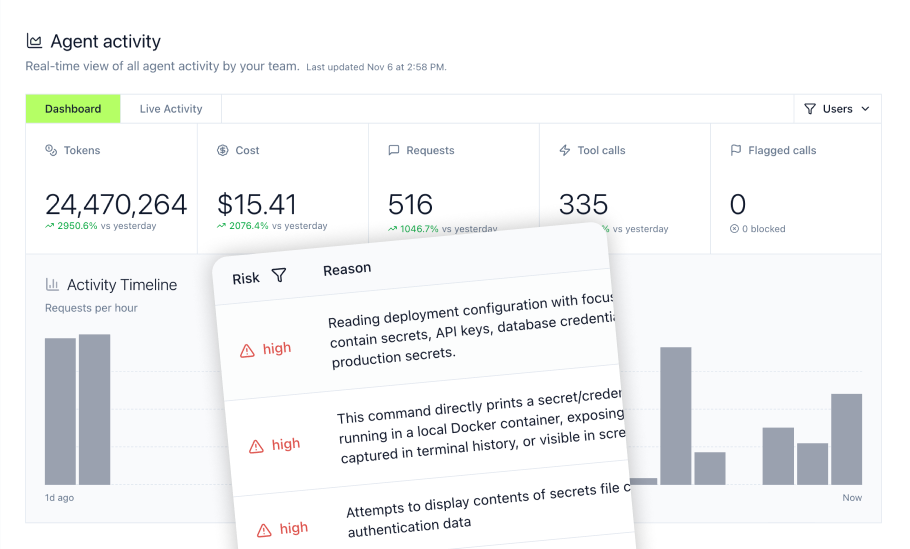
For comprehensive enterprise AI infrastructure monitoring, organizations need real-time dashboards tracking server health, usage patterns, and security alerts across all MCP connections.
Implementing Granular Access Controls and Centralized Authentication for OpenClaw Ecosystems
OpenClaw does not ship with authentication disabled by default; its safer default posture still gets undermined by misconfiguration, unsafe exposure, or weakened deployment settings. Enterprise deployment still requires layered controls beyond the base configuration.
Streamlining Authentication for AI Tools
Minimum authentication requirements:
- Gateway token: 256-bit random value set via
gateway.auth.token - Localhost binding: Configure
gateway.bind = "127.0.0.1"(never0.0.0.0) - VPN access: Deploy Tailscale or WireGuard for secure remote connections
- mDNS disabled: Prevent network reconnaissance via service discovery broadcasts
Deployment research provides detailed hardening configurations including Docker isolation with --cap-drop=ALL --read-only --user 1000:1000.
Defining Fine-Grained Permissions for AI Agent Actions
Tool whitelisting prevents agents from executing unauthorized operations:
- Explicitly allow: Only required tools (messaging, calendar, read-only file access)
- Deny by default: Shell execution, browser control, file deletion, web fetching
- Human approval: Require confirmation for irreversible actions (sending emails, deleting files, executing commands)
For organizations requiring centralized authentication with OAuth 2.0, SAML, and SSO integration across all MCP servers, MCP gateway architecture explains how enterprise infrastructure addresses these gaps.
Protecting Enterprise Data: Preventing Accidental Exposures via OpenClaw Integrations
The Moltbook database breach exposed the consequences of building AI infrastructure without security-first architecture. 404 Media investigation confirmed that disabled Supabase Row Level Security exposed 1.5 million API tokens and 35,000 email addresses—enabling full account takeover of any agent on the platform.
Safeguarding Databases and Internal APIs from AI Agents
Typical enterprise integration patterns create substantial blast radius:
- Slack connection: Access to all channels, private DMs, shared files
- Gmail OAuth: Entire email history, contacts, calendar, Drive files
- GitHub integration: All repositories (public and private), ability to commit code, read secrets
- Browser control: Inherits active sessions for AWS Console, internal dashboards, SaaS applications
A prompt injection attack through any input channel—malicious email, Slack message, or web page—can trigger data exfiltration across connected services. Palo Alto Networks discusses how agentic systems can introduce multi-step, persistent risk patterns that are harder to detect and contain than traditional single-step attacks.
The CISO's Roadmap: Building a Secure OpenClaw Strategy for 2026
Organizations face a choice: ban OpenClaw entirely (which employees will circumvent) or implement governance enabling safe adoption. The OWASP Top 10 for Agentic Applications provides a framework for risk assessment.
Developing an Enterprise-wide AI Governance Framework
Immediate actions (this week):
- Inventory: Scan networks for unauthorized OpenClaw instances
- Patch: Update all discovered instances to 2026.1.29+ minimum
- Rotate: Replace all credentials that compromised agents may have accessed
- Block: Disable ClawHub skill installation or require security review
Short-term governance (30 days):
- Establish AI acceptable use policy covering agent deployments
- Implement centralized monitoring for AI tool usage
- Deploy Docker isolation for any approved OpenClaw instances
- Configure SIEM alerting for suspicious agent behavior
Long-term infrastructure (90 days):
- Evaluate enterprise MCP gateway solutions for authentication and audit trails
- Integrate AI agent monitoring into existing security operations
- Establish vendor risk assessment process for AI tools
- Conduct quarterly red team assessments against agent infrastructure
Integrating OpenClaw Risk Management into Existing Cybersecurity Programs
Security teams should treat AI agents as privileged infrastructure requiring the same governance as production servers. The gap between OpenClaw's capabilities and its default security posture creates an urgent need for enterprise solutions that provide centralized authentication, compliance documentation, and credential management.
MintMCP: Enterprise-Grade Governance for AI Agent Infrastructure
The fundamental challenge with OpenClaw isn't the technology—it's the operational gap between powerful capabilities and absent guardrails. While hardening scripts, Docker isolation, and custom monitoring can improve security posture, they require continuous engineering effort and don't scale across distributed teams or heterogeneous MCP server deployments.
MintMCP addresses this infrastructure gap by providing a centralized control plane purpose-built for AI agent governance. Organizations can deploy both STDIO servers through MintMCP's managed service and integrate remote or self-hosted MCP servers under unified authentication and observability. This architecture enables security teams to enforce consistent access policies, monitor tool invocations in real-time, and maintain complete audit trails across every agent interaction—capabilities OpenClaw cannot deliver natively.
For enterprises pursuing regulatory compliance, MintMCP is SOC 2 Type II compliant, providing the independently audited controls, immutable logging, and segregation of duties that frameworks like SOC 2, GDPR, and financial regulations require. Rather than retrofitting compliance onto open-source infrastructure, teams gain a foundation designed for auditability from the start.
The choice isn't between innovation and security—it's between ungoverned shadow AI and observable, controlled deployment. Organizations that implement centralized MCP gateway infrastructure can provide developers and knowledge workers with the productivity benefits of autonomous agents while maintaining the visibility, authentication, and blast radius controls that CISOs require. Explore MintMCP Gateway to understand how enterprise teams are bridging the gap between OpenClaw's capabilities and enterprise security requirements.
Frequently Asked Questions
What immediate steps should security teams take if they discover unauthorized OpenClaw installations?
Treat discovery as a potential active incident. First, isolate the affected system from the network. Then verify the installed version—anything below 2026.1.29 requires emergency patching due to critical RCE vulnerabilities. Rotate all credentials the agent had access to, including Anthropic/OpenAI API keys, OAuth tokens for connected services (Gmail, Slack, GitHub), and any SSH keys on the filesystem. Audit installed skills against ClawHavoc indicators of compromise, particularly checking for communications with known C2 infrastructure at 91.92.242[.]30. Finally, preserve forensic evidence by archiving the ~/.openclaw/ directory before remediation.
How does prompt injection differ from traditional injection attacks, and why can't it be patched?
Traditional injection attacks exploit the boundary between code and data—SQL injection works because user input enters a SQL execution context. Prompt injection exploits the fact that in LLM systems, instructions and data occupy the same token stream. When an agent reads an email containing hidden instructions, the model cannot reliably distinguish between "data to process" and "commands to execute." This is architectural, not a bug to fix. Defensive strategies focus on blast radius reduction: limiting what actions the agent can take, requiring human approval for sensitive operations, and isolating agents from irreversible capabilities. The agent might still be tricked, but the damage is contained.
Can OpenClaw be safely deployed for enterprise use cases with proper hardening?
With extensive hardening, OpenClaw can achieve acceptable security posture for specific use cases—but not in default configuration. Required measures include: Docker isolation with dropped capabilities and read-only filesystem, localhost-only binding with VPN for remote access, explicit tool whitelisting denying shell and browser access by default, 256-bit gateway authentication tokens, human-in-the-loop approval for sensitive actions, comprehensive logging forwarded to enterprise SIEM, and complete disabling of ClawHub skill installation. Even with these controls, organizations in highly regulated industries (healthcare, finance, government) should evaluate purpose-built enterprise solutions rather than hardening open-source infrastructure.
How should organizations evaluate the tradeoff between banning OpenClaw versus governing its use?
Complete bans typically fail because employees deploy OpenClaw through a single command without requiring IT involvement—the 22% unauthorized installation rate demonstrates this reality. Effective governance acknowledges that employees seek productivity benefits and channels usage through approved, monitored channels. Organizations should provide sanctioned alternatives: enterprise AI agent platforms with built-in authentication, audit trails, and compliance controls. This transforms shadow AI into governed infrastructure while maintaining security visibility. The cost of implementing governance is substantially lower than the cost of discovering a breach after months of unmonitored agent access to corporate systems.