Enterprise AI agents are making autonomous decisions across your organization right now—querying databases, accessing customer records, and executing workflows. With 78% using generative AI according to Superblock and 80% report risky behaviors according to SailPoint Technologies research, enterprises require comprehensive frameworks to identify, assess, and mitigate risks across autonomous AI systems. The gap between AI adoption and AI governance creates substantial exposure—from data breaches to regulatory penalties that can reach up to €35M or 7% of global annual turnover under the EU AI Act
This guide provides a structured approach to enterprise AI agent risk management, covering governance frameworks, security controls, compliance requirements, and the practical tools needed for scalable AI deployments. Whether you're managing coding agents accessing production systems or customer service bots handling sensitive data, platforms like MCP Gateway provide the centralized governance, audit trails, and real-time monitoring essential for turning uncontrolled AI into sanctioned enterprise infrastructure.
Key takeaways
- 80% of organizations experience risky agent behaviors including unauthorized data access, hallucinations, and privilege escalation
- 90-day implementation timeline: Foundation (weeks 1-4), framework selection (weeks 5-8), tool deployment and pilots (weeks 9-12)
- 60% of organizations have shadow AI problems—employees using unsanctioned ChatGPT, Claude, or other tools without IT visibility
- Organizations with structured governance achieve 73% reduction in AI security incidents
- NIST AI RMF provides free voluntary guidance as a foundation; commercial platforms add automation for scale
- Cross-functional governance committees with executive sponsorship are essential—AI risk management fails when treated as an IT-only project
Understanding the foundation: What is AI risk management?
AI risk management encompasses the systematic identification, assessment, mitigation, and continuous monitoring of risks associated with AI systems. For enterprise AI agents—autonomous systems that perceive environments, make decisions, and take actions—this extends beyond traditional software governance to address unique challenges: model drift, prompt injection attacks, hallucinations, and the cascading effects of cross-agent task escalation.
Core risk categories for enterprise AI agents:
- Model risk: Performance degradation, bias amplification, and drift from training distributions
- Data privacy: Unauthorized access to sensitive information, data leakage through outputs, and consent violations
- Security threats: Prompt injection, jailbreaks, adversarial attacks, and privilege escalation
- Regulatory compliance: EU AI Act requirements, NIST RMF alignment, industry-specific mandates (HIPAA, SOC 2)
- Ethical concerns: Transparency gaps, accountability ambiguity, and bias in automated decisions
Without structured risk management, enterprises face substantial exposure. A single AI agent with database access can exfiltrate records for months before detection—as demonstrated by healthcare organizations experiencing $14M breach costs from customer service agents leaking patient data through prompt injection attacks.
Crafting your blueprint: Building an effective AI risk management framework
Effective AI risk management requires a structured framework that integrates with existing enterprise governance while addressing AI-specific challenges. The 90-day implementation approach balances thoroughness with practical timelines.
Key pillars of a robust framework
Phase 1: Foundation (Weeks 1-4)
- Form governance committee: Assemble cross-functional team with executive sponsor, including IT, Security, Compliance, Legal, and Business Units
- AI system discovery: Conduct enterprise-wide scan to identify all AI agents, including shadow AI deployments employees initiated without IT approval
- Risk taxonomy definition: Adapt standard categories (Operational, Security, Privacy, Ethical, Legal) to your business context with clear tolerance thresholds
Phase 2: Framework Selection and Policy Creation (Weeks 5-8)
Choose your primary framework based on regulatory requirements and operational context:
- NIST AI RMF: Free voluntary guidance with four core functions—Govern, Map, Measure, Manage—ideal for U.S.-based organizations
- ISO/IEC 23894: International process-driven standard providing structured risk assessment methodologies
- EU AI Act: Legally binding requirements for organizations operating in EU markets, with tiered obligations based on AI system risk classification
Phase 3: Tool Deployment and Integration (Weeks 9-12)
Deploy monitoring and governance platforms integrated with existing infrastructure: IAM systems, model registries, data catalogs, and SIEM tools. Configure automated controls including input validation, output filtering, and rate limiting.
Integrating frameworks with existing enterprise governance
AI governance shouldn't exist in isolation. Map AI risk controls to existing compliance programs—security policies, data governance frameworks, and audit procedures. This integration reduces overhead while ensuring complete audit trails that satisfy multiple regulatory requirements simultaneously.
From shadow to sanctioned: Implementing robust AI governance for enterprise agents
Shadow AI represents one of the largest governance blind spots. 60% of organizations have employees using unsanctioned AI tools—ChatGPT conversations containing proprietary code, Claude sessions processing customer data, or local LLM deployments accessing production databases without oversight.
Turning uncontrolled AI into governed assets
Discovery strategies:
- Deploy network monitoring to detect API calls to AI services
- Audit SaaS subscriptions for AI tool purchases
- Survey teams with amnesty programs encouraging self-reporting
- Monitor endpoint behavior for unauthorized model execution
Governance implementation:
- Establish centralized AI registries cataloging all approved tools with metadata: owner, purpose, data sources, risk tier
- Implement unified authentication wrapping OAuth and SSO around all MCP endpoints
- Configure tool access controls based on roles—enabling read-only operations while restricting write capabilities
- Create self-service request workflows allowing developers to obtain approved AI tools quickly, reducing shadow AI incentives
Establishing clear roles and responsibilities
Define RACI matrices for AI governance:
- AI Risk Committee: Strategic oversight, policy approval, risk appetite decisions
- Model Owners: Accountability for individual AI system performance and compliance
- Security Team: Runtime monitoring, incident response, vulnerability management
- Compliance Officers: Regulatory alignment, audit coordination, policy enforcement
- Business Units: Use case identification, acceptable use validation, outcome monitoring
The toolkit for control: Essential AI governance tools and technologies
Manual governance processes collapse under the scale of enterprise AI deployments. Organizations managing dozens or hundreds of AI agents require automated platforms handling discovery, risk scoring, policy enforcement, and compliance reporting.
Monitoring usage and performance
Core platform capabilities:
- Agent registry and inventory: Centralized catalog of all AI systems with version history, risk tiers, and ownership
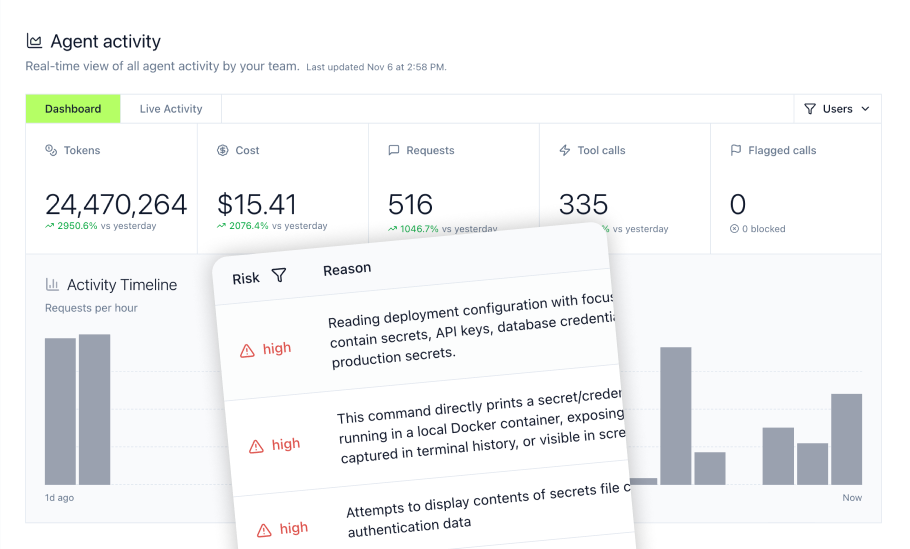
- Real-time dashboards: Usage patterns, error rates, policy violations, and security alerts
- Behavioral analytics: Baseline establishment and anomaly detection for identifying compromised or misbehaving agents
- Cost allocation: Tracking spending per team, project, and tool with detailed breakdowns
LLM Proxy provides essential visibility into coding agent behavior—monitoring every MCP tool invocation, bash command, and file operation while blocking dangerous commands in real-time. This transforms opaque agent activity into observable, controllable infrastructure.
Automating policy enforcement
Runtime guardrails:
- Input validation blocking sensitive data using regex patterns and NER models
- Output filtering for toxicity, PII, and hallucination detection
- Rate limiting preventing abuse and runaway agent loops
- Prompt injection prevention using semantic analysis rather than brittle pattern matching
Data protection controls:
- Prevent access to .env files, SSH keys, credentials, and configuration secrets
- Implement least-privilege access ensuring agents access only specific resources needed for their tasks
- Configure data loss prevention blocking PII/PHI in agent outputs
Ensuring trust: Achieving AI governance certification SOC2 HIPAA GDPR
Enterprise AI deployments increasingly require demonstrable compliance—not just internal policies, but third-party validated certifications that satisfy customers, partners, and regulators.
Meeting Industry-Specific regulatory requirements
EU AI Act (phased rollout with key 2025-2026 milestones):
- Risk classification system categorizing AI applications from minimal to unacceptable risk
- High-risk systems require risk management, data governance, technical documentation, and human oversight
- Penalties reaching €35M or 7% of global turnover for serious violations
NIST AI RMF Alignment:
- Govern function: Establish accountability structures and risk culture
- Map function: Document AI system contexts, capabilities, and limitations
- Measure function: Quantify and monitor AI risks through defined KRIs
- Manage function: Allocate resources, implement controls, and respond to incidents
Industry-specific requirements:
- Healthcare (HIPAA): Audit trails for PHI access, business associate agreements, encryption requirements
- Financial services: Model risk management (SR 11-7), fair lending compliance, explainability mandates
- Government (FedRAMP): Authorized cloud environments, continuous monitoring, incident reporting
Leveraging audit trails for certification
Complete, immutable logs of AI agent actions form the foundation of compliance evidence. Modern governance platforms maintain records of every tool call, data access, decision, and output—enabling auditors to trace any AI-driven outcome to its source.
MintMCP's SOC 2 Type II attestation and HIPAA compliance provide enterprises with pre-validated infrastructure, reducing the burden of building compliance capabilities from scratch. The platform's complete audit logs support compliance evidence by documenting tool calls and data access—helpful for SOC 2 audits, HIPAA, and GDPR accountability programs
Mastering the agent lifecycle: Effective agent management systems for enterprise AI
Managing AI agents requires systems addressing the complete lifecycle—from initial deployment through ongoing operation, version updates, and eventual retirement.
Deploying and managing AI agents at scale
Registry and inventory management:
- Maintain centralized catalogs with metadata including owner, purpose, data sources accessed, and risk classification
- Track version history with rollback capabilities for problematic updates
- Document dependencies between agents, tools, and data sources
Deployment automation:
- One-click deployment for STDIO-based MCP servers with built-in hosting
- Virtual servers enabling team-based access with role-specific permissions
- Automatic failover and high availability configurations for production workloads
Integration ecosystem:
Modern agent management requires seamless connections across AI platforms. MintMCP supports integration with Claude, ChatGPT, Cursor, Gemini, and other MCP-compatible clients, while connectors for Elasticsearch, Snowflake, and other enterprise data sources enable secure AI-to-data integration.
Monitoring and optimizing agent performance
Key performance indicators:
- Response latency and error rates by agent and tool
- Resource utilization (compute, memory, API calls)
- Policy violation frequency and severity
- User satisfaction and task completion rates
Continuous improvement:
- Quarterly risk assessments reviewing agent inventories and threat landscapes
- Monthly KRI dashboards tracking drift, bias, and performance degradation
- Weekly incident reports documenting violations, near-misses, and remediation actions
Securing your digital workforce: Mitigating AI agent security risks
AI agents operate with extensive system access—reading files, executing commands, and connecting to production databases. This capability makes them attractive attack vectors and sources of accidental data exposure.
Identifying and addressing Agent-Specific vulnerabilities
Common attack vectors:
- Prompt injection: Malicious inputs manipulating agent behavior to bypass controls or exfiltrate data
- Privilege escalation: Agents accumulating permissions beyond their intended scope through chained tool calls
- Data poisoning: Corrupted training data or retrieval sources leading to compromised outputs
- Supply chain attacks: Malicious dependencies in agent frameworks or MCP tools
Mitigation strategies:
- Implement zero-trust architectures requiring authentication and authorization for every agent action
- Deploy micro-segmentation confining agents to specific resources and data scopes
- Use task-scoped credentials rather than persistent access tokens
- Conduct regular red team exercises testing prompt injection, jailbreaks, and data exfiltration
Protecting sensitive data from agent access
LLM Proxy blocks access to .env files, SSH keys, and credentials while maintaining complete audit trails of all operations. This sensitive file protection prevents the most common accidental exposure scenarios while providing security teams visibility into attempted access.
Data governance integration:
- Tag sensitive data categories (PII, PHI, financial records) in data catalogs
- Configure agent access policies aligned with data classification
- Implement differential privacy for analytics workloads requiring aggregated insights without individual record exposure
Bridging the gap: Seamless AI implementation with Enterprise-Grade infrastructure
The gap between proof-of-concept AI projects and production-grade deployments often spans months of security hardening, compliance configuration, and infrastructure buildout. Modern platforms compress this timeline dramatically.
Accelerating AI deployment without compromising security
Rapid deployment capabilities:
- Deploy MCP servers in minutes with pre-configured policies rather than days of manual setup
- Transform local STDIO servers into production services with monitoring, logging, and compliance automatically applied
- Self-service access enabling developers to request and receive AI tool access instantly
Maintaining security velocity:
- OAuth protection wrapping SSO and enterprise authentication around any MCP server automatically
- Real-time monitoring detecting policy violations and security anomalies as they occur
- Centralized credential management eliminating scattered API keys and tokens
Integrating AI agents with your existing ecosystem
Enterprise AI infrastructure must integrate with existing tools rather than replacing them. MintMCP's approach works with current AI tool deployments—Claude, ChatGPT, Cursor, and others—without requiring changes to developer workflows.
Integration priorities:
- Identity systems: SAML and OIDC integration with existing identity providers
- Data platforms: Secure connections to databases, warehouses, and search infrastructure through managed connectors
- Security tools: Audit log integration with SIEM platforms for unified monitoring
- Workflow systems: Connecting AI agents to existing business process automation
Organizations managing enterprise AI agent deployments face a choice: build governance infrastructure from scratch—a 6-12 month effort requiring specialized expertise—or leverage platforms purpose-built for AI tool governance. The latter approach delivers faster time-to-value while ensuring compliance from day one.
Frequently asked questions
How do I calculate ROI for AI risk management investments?
The primary ROI drivers include breach prevention, reduced manual oversight (10-15 hours/week saved per ML engineer through automation), faster compliance audits (reduced remediation costs), and avoided regulatory fines. Organizations typically achieve break-even within 6-12 months through efficiency gains alone; preventing a single major incident provides immediate positive return. Calculate your organization's specific exposure by inventorying AI agents, assessing data access levels, and estimating incident probability based on current control gaps.
What skills does my team need to implement AI governance?
Effective implementation requires cross-functional expertise: AI/ML engineering for technical controls, security specialists for threat modeling and penetration testing, compliance professionals for regulatory alignment, and legal counsel for policy development. 57% lack confidence in the accuracy or explainability of their agentic AI outputs. Address gaps through targeted training, strategic hiring, or consulting partnerships—most enterprises benefit from 6-12 months of external support while building internal capabilities.
How do I handle AI governance across multiple cloud providers?
Multi-cloud AI deployments require governance platforms supporting consistent policy enforcement regardless of underlying infrastructure. Look for solutions offering unified dashboards across AWS, Azure, and GCP deployments; standardized authentication integrating with your central identity provider; consistent audit logging aggregating events from all environments; and policy templates applying equivalent controls across cloud boundaries. Avoid vendor-specific governance tools that create silos; prioritize platforms designed for cross-environment visibility.
What's the difference between AI governance for traditional ML models vs. Autonomous agents?
Traditional ML governance focuses on model validation, bias testing, and performance monitoring for systems producing predictions that humans act upon. Autonomous agents require additional controls addressing: real-time decision-making without human review, tool access enabling database queries, file operations, and API calls; multi-step reasoning chains where errors compound across steps; and agent-to-agent communication creating complex interaction patterns. Agent governance emphasizes runtime guardrails, dynamic access controls, and behavioral monitoring rather than primarily pre-deployment validation.
How frequently should we conduct AI risk assessments?
Establish a tiered assessment cadence based on risk classification. High-risk agents (customer-facing, accessing sensitive data, making consequential decisions) require monthly reviews and continuous monitoring. Medium-risk systems need quarterly assessments with automated drift detection. Low-risk internal tools warrant annual reviews with standard monitoring. Additionally, trigger reassessments whenever agents gain new tool access, training data changes, usage patterns shift significantly, or regulatory requirements update. Automated monitoring should supplement rather than replace periodic human reviews examining strategic alignment and emerging risks.