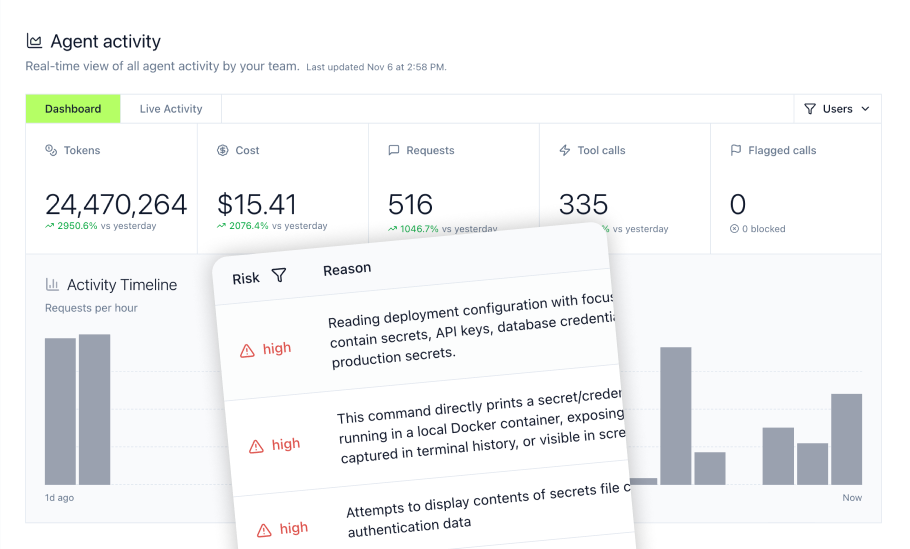
AI agents operating through the Model Context Protocol present a unique observability challenge: they make autonomous decisions, invoke external tools dynamically, and interact with enterprise data—all while remaining largely opaque to traditional monitoring. OpenTelemetry provides a vendor-neutral framework for implementing comprehensive observability across these workflows. When combined with an enterprise MCP Gateway, organizations gain deeper visibility into agent behavior, tool usage, token consumption, and audit trails that support governance and incident review.
This article outlines how to implement OpenTelemetry in MCP-based AI agent systems, covering core concepts, integration patterns, performance monitoring, compliance logging, and security governance to transform opaque agent operations into debuggable, cost-optimized workflows.
Key Takeaways
- Teams with stronger AI observability and evaluation practices report 2.2x better reliability than non-elite teams, according to Galileo's survey data
- Distributed tracing can materially reduce debugging time by exposing end-to-end MCP tool invocations, reasoning steps, and downstream failures in a single trace
- Token cost telemetry helps teams identify savings opportunities by surfacing redundant context, inefficient agent loops, and unnecessarily expensive model usage
- Auto-instrumentation libraries support 40+ AI frameworks including LangChain, LlamaIndex, CrewAI, and OpenAI Agents SDK
- Sampling strategies significantly reduce telemetry costs while maintaining debug coverage for production incidents
- GenAI semantic conventions standardize attributes for agent operations, enabling consistent monitoring across heterogeneous AI systems
Understanding Observability in AI Agent Workflows with OpenTelemetry
What is OpenTelemetry?
OpenTelemetry is an open-source observability framework that collects traces, metrics, and logs from distributed systems using standardized protocols. For AI agents, GenAI semantic conventions define specific attributes for capturing LLM calls, tool invocations, agent reasoning steps, token usage, and costs—then exporting this telemetry to any compatible backend.
Unlike traditional application performance monitoring, AI agent observability must capture:
- Agent decision-making: Why did the agent select a specific tool?
- Tool discovery and execution: Which MCP servers were queried, what parameters were available?
- Token economics: How many tokens consumed per operation, and at what cost?
- Multi-step reasoning: How did intermediate steps influence final outputs?
The Role of Observability in AI Agent Success
Traditional monitoring shows "everything working" while users report failures. AI agents operate as black boxes—HTTP 200 responses mask incorrect tool selections, hallucinated outputs, or inefficient token usage.
Research from Galileo demonstrates that teams with comprehensive observability and evaluation practices achieve significantly better reliability compared to those relying on basic logging. This gap widens as agent complexity increases: multi-agent orchestration systems without proper tracing become nearly impossible to debug.
Core Components of an Observability Stack
A complete AI agent observability implementation requires three signal types:
- Traces: End-to-end request flows showing parent-child relationships between agent invocations, LLM calls, and tool executions
- Metrics: Quantitative measurements including response times, error rates, token consumption, and cost per operation
- Logs: Structured event records for audit trails, compliance reporting, and detailed debugging
MintMCP's LLM Proxy provides foundational observability by tracking every MCP tool invocation, bash command, and file operation—capabilities that OpenTelemetry can extend through distributed tracing across the entire agent-to-backend interaction chain.
Integrating OpenTelemetry with MintMCP for Enhanced AI Agent Monitoring
Choosing Your Auto-Instrumentation Library
Three primary libraries provide automatic instrumentation for 40+ AI frameworks:
OpenLLMetry (traceloop-sdk):
- Best for LangChain, LangGraph, and multi-language deployments (Python, JS, Go, Ruby)
- Collects all three signals: traces, metrics, and logs
- Strong option for LangGraph tracing and broader multi-language deployments
OpenInference (Arize):
- Optimal for LlamaIndex and AutoGen workflows
- Strong Java support
- Tight integration with Phoenix evaluation platform
OpenLIT:
- Supports a broad set of AI frameworks and integrations, including newer options like AG2, Dynamiq, and Mem0
- Zero-code CLI instrumentation option
- TypeScript support
Implementing OpenTelemetry SDKs in Agent Code
Basic instrumentation requires minimal code:
# OpenLLMetry initialization

from traceloop.sdk import Traceloop

Traceloop.init(app_name="my-mcp-agent")

# OpenLIT initialization

import openlit

openlit.init(application_name="my-mcp-agent")
For MCP-specific workflows, add custom spans capturing tool discovery and execution:
with tracer.start_as_current_span("mcp.execute_tool") as span:
span.set_attribute("gen_ai.operation.name", "execute_tool")
span.set_attribute("gen_ai.tool.name", "read_file")
span.set_attribute("mcp.server.url", server_url)
result = await mcp_client.call_tool("read_file", arguments)
MintMCP's MCP Gateway provides real-time monitoring dashboards that complement OpenTelemetry's distributed tracing—enabling end-to-end visibility from agent request through MCP tool execution to backend response.
Configuring OpenTelemetry Collectors
The OpenTelemetry Collector acts as a central hub for receiving, processing, and exporting telemetry data. Deploy using Docker or Kubernetes Helm charts:
helm repo add open-telemetry https://open-telemetry.github.io/opentelemetry-helm-charts
helm install otel-collector open-telemetry/opentelemetry-collector
Configure exporters for your observability backend—OpenTelemetry supports exporting telemetry to multiple backends, including general observability platforms and AI-specific tracing tools like Langfuse.
Achieving Distributed Tracing Across AI Agent Microservices
Tracing MCP Tool Invocations End-to-End
MCP workflows involve multiple service boundaries: the agent runtime, MCP discovery, tool execution, and backend data sources. Standard tracing misses critical context—particularly the tool discovery phase where agents query available MCP servers.
A properly instrumented trace hierarchy reveals:
Agent Run (root span)
├── MCP Discovery (child span)
│ └── mcp.tools.count: 5
├── Agent Planning (child span)
│ └── Selected tool: read_file
└── MCP Tool Execution (child span)
├── gen_ai.operation.name: execute_tool
├── gen_ai.tool.name: read_file
└── Duration: 340ms
This structure can significantly speed root-cause analysis by preserving the full execution path across agent planning, tool calls, and downstream services—a critical capability when debugging production failures.
Correlating LLM Requests with Backend Operations
Context propagation ensures trace IDs flow through all service boundaries. When an agent invokes an MCP tool that queries a database, the resulting trace connects:
- Initial user request
- Agent reasoning steps
- MCP tool selection
- Database query execution
- Response aggregation
Multi-agent systems particularly benefit from this correlation—without it, debugging interactions between specialist agents becomes guesswork.
Monitoring AI Agent Performance and Costs with OpenTelemetry Metrics
Defining Key Performance Indicators for AI Agents
Effective monitoring tracks six essential metrics:
- Token Usage per Agent Run: Input and output tokens consumed per operation
- Tool Call Success Rate: Percentage of successful MCP tool invocations
- LLM Latency Distribution: Time from request to LLM response completion
- Agent Loop Iterations: ReAct cycles before task completion
- Context Window Utilization: Percentage of available context consumed
- End-to-End Agent Latency: Total time from user request to final response
Collecting Usage and Cost Metrics
OpenTelemetry's GenAI semantic conventions capture token usage automatically:
span.set_attribute("gen_ai.usage.input_tokens", 1500)
span.set_attribute("gen_ai.usage.output_tokens", 500)
span.set_attribute("gen_ai.usage.cost", 0.045)
Organizations implementing cost tracking commonly identify significant token reduction opportunities by analyzing redundant context in agent prompts and optimizing ReAct loop efficiency. Combining OpenTelemetry metrics with MintMCP's cost analytics provides granular breakdowns per team, project, and tool.
Logging and Auditing AI Agent Interactions for Compliance
Ensuring Compliance with OpenTelemetry Logs
Enterprise deployments often require complete audit trails of agent decisions—which data was accessed, which tools were invoked, and which policies were enforced—to support internal governance and regulated-environment reviews. OpenTelemetry structured logs can support auditability, incident response, and compliance evidence collection when paired with appropriate security, retention, and governance controls.
Critical attributes for compliance logging:
gen_ai.agent.id: Unique identifier for the agent instancegen_ai.tool.name: MCP tool invokedgen_ai.request.model: LLM model used- Input/output sizes (not content, to protect PII)
MintMCP's audit capabilities provide complete audit trails for every MCP interaction, access request, and configuration change—functionality that integrates with OpenTelemetry for centralized compliance reporting.
Correlating Audit Logs with Traces for Incident Response
When security incidents occur, correlating logs with distributed traces enables rapid reconstruction of agent behavior. A compliance reviewer can:
- Identify the specific agent session from audit logs
- Retrieve the complete trace showing all tool invocations
- Verify which data sources were accessed
- Confirm policy enforcement at each step
This correlation capability helps teams satisfy internal retention, audit, and incident-response requirements defined by their own compliance programs.
Best Practices for Deploying OpenTelemetry in Enterprise AI
Choosing the Right Collector Deployment Model
Two primary architectures serve different scale requirements:
Agent Mode: Collectors run alongside each application instance, providing immediate telemetry forwarding with minimal latency. Best for smaller deployments or when network egress costs matter.
Gateway Mode: A centralized collector tier receives telemetry from all agents, enabling sophisticated processing, sampling, policy enforcement, and multi-destination routing. It is typically preferred for larger or more complex deployments.
Strategies for Data Sampling and Retention
Production environments generate massive telemetry volumes. Intelligent sampling reduces costs while maintaining debug coverage:
from opentelemetry.sdk.trace.sampling import TraceIdRatioBased
sampling_config = TraceIdRatioBased(0.1) # 10% sampling rate
Probabilistic sampling at appropriate rates captures representative traffic while significantly reducing storage costs. Tail-based sampling alternatively keeps only slow or error traces—ideal for focusing on production issues.
Securing Telemetry Data in Production
Telemetry pipelines handle sensitive information. Essential security measures include:
- TLS 1.2+ encryption for all OTLP export connections
- PII redaction: Set
OTEL_INSTRUMENTATION_GENAI_CAPTURE_MESSAGE_CONTENT=falseto exclude prompt/response content - Access controls: Implement RBAC at the observability backend level
- Data residency: Configure collectors to route telemetry to region-specific storage
OpenTelemetry collectors can be configured to support region-specific routing and storage strategies, but MintMCP's data residency posture for multi-region compliance should be validated directly with the vendor during security review.
Leveraging OpenTelemetry for AI Agent Security and Governance
Detecting Anomalies with Trace and Log Data
OpenTelemetry data enables security monitoring beyond traditional approaches:
- Unusual tool invocation patterns: Agent suddenly accessing tools it hasn't used before
- Token consumption spikes: Potential prompt injection or data exfiltration attempts
- Error rate anomalies: Tool execution failures indicating compromised MCP servers
MintMCP's LLM Proxy guardrails block dangerous commands in real-time while OpenTelemetry provides the telemetry needed for post-incident forensics and pattern analysis.
Enhancing Granular Tool Access Control with Telemetry
Combining OpenTelemetry data with MintMCP's role-based controls creates defense-in-depth security:
- Policy enforcement logging: Every access control decision captured in traces
- Violation alerting: Real-time notifications when users attempt unauthorized tool access
- Usage pattern analysis: Identify over-provisioned permissions through actual usage data
The Future of AI Agent Observability: Advanced Analytics and Automation
AI-Powered Insights from Telemetry Data
The observability landscape is evolving toward automated analysis. Emerging capabilities include:
- Anomaly detection: Machine learning models identifying unusual patterns in agent behavior
- Predictive alerting: Forecasting failures before they impact users
- Automatic root cause analysis: AI-powered correlation across traces, metrics, and logs
The Evolution of OpenTelemetry Standards
GenAI semantic conventions remain experimental but are rapidly stabilizing. Organizations should:
- Use abstraction layers to insulate against attribute changes
- Stay on LTS versions of instrumentation libraries
- Monitor OpenTelemetry specification updates for breaking changes
As MCP adoption accelerates across major AI platforms, standardized observability becomes essential for managing the complexity of enterprise AI agent deployments.
MintMCP: Enterprise-Grade Observability for Production AI Agents
For organizations seeking production-ready AI agent observability, MintMCP provides a comprehensive platform that extends beyond generic OpenTelemetry implementations. MintMCP's Gateway and LLM Proxy deliver MCP-specific monitoring capabilities that complement OpenTelemetry's distributed tracing:
Unified visibility across the AI stack: MintMCP captures real-time metrics for every MCP tool invocation, including latency, success rates, and token consumption—correlated with your OpenTelemetry traces for complete end-to-end observability. Teams gain immediate insight into which agents are consuming resources, which tools are experiencing errors, and where optimization opportunities exist.
Security and governance at scale: With MintMCP's SOC 2 Type II attestation and role-based access controls, organizations can enforce least-privilege policies while maintaining complete audit trails. Every access decision, policy violation, and configuration change is logged and traceable—supporting HIPAA-compliant auditability workflows and GDPR-oriented governance requirements.
Production-ready deployment: Unlike standalone OpenTelemetry implementations that require custom integration work, MintMCP provides pre-built dashboards, alerting rules, and cost-tracking analytics specifically designed for MCP workflows. Teams deploying LangChain, LlamaIndex, or custom agent frameworks benefit from immediate visibility without extensive instrumentation engineering.
By combining OpenTelemetry's vendor-neutral telemetry framework with MintMCP's purpose-built MCP monitoring, enterprises achieve the comprehensive observability required for reliable, secure, and cost-optimized AI agent operations.
Frequently Asked Questions
What is the performance overhead of adding OpenTelemetry to AI agents?
OpenTelemetry adds overhead that varies based on workload, instrumentation depth, exporter configuration, and sampling settings. The auto-instrumentation libraries are designed for production workloads, and the collector can be scaled independently of your application. For latency-sensitive applications, use asynchronous exporters and batch span processors to minimize impact on request paths.
Can I use OpenTelemetry with multiple AI frameworks in the same application?
Yes, but choose a single instrumentation layer to avoid span duplication. If your application uses both LangChain and custom OpenAI calls, instrument at the agent level rather than individual LLM calls. Microsoft recommends this two-layer approach for richest telemetry without redundancy—LLM-level spans nested within agent-level spans provide complete context.
How do I handle sensitive data in AI agent traces without violating privacy policies?
Configure content redaction at the instrumentation level using environment variables: OTEL_INSTRUMENTATION_GENAI_CAPTURE_MESSAGE_CONTENT=false. This captures token counts and operation metadata without logging actual prompts or responses. For partial visibility, implement custom processors that truncate content to first 500 characters or hash sensitive fields while preserving debugging utility.
What observability backend should I choose for AI agent monitoring?
Your choice depends on existing infrastructure and specific needs. For cost-sensitive deployments, self-hosted Grafana solutions provide excellent value. For AI-specific features like prompt versioning and evaluations, purpose-built platforms like Langfuse or Arize Phoenix offer specialized capabilities. Enterprise teams with existing APM investments can extend Datadog or New Relic with GenAI semantic conventions.
How does OpenTelemetry complement MintMCP's native monitoring capabilities?
MintMCP provides real-time dashboards for server health, usage patterns, and security alerts at the MCP layer. OpenTelemetry extends this by capturing distributed traces across services beyond the gateway—including your application code, databases, and third-party APIs. The combination provides complete end-to-end visibility: MintMCP monitors MCP-specific operations while OpenTelemetry correlates these with broader system behavior.