Sales reps spend an average of 14 out of 51 working hours per week on non-selling activities—data entry, CRM updates, email drafts, and research. Claude Cowork changes this equation by executing complete workflows autonomously, but deploying AI agents at enterprise scale requires proper governance infrastructure. The Mintive (formerly MintMCP) new guides provide the blueprint for business users to implement Claude-powered automation while maintaining security and compliance through the MCP Gateway.
This article outlines how sales teams can leverage Claude Cowork for lead nurturing, pipeline management, and customer communication—with practical implementation steps from Mintive's Claude Cowork guide, skill customization strategies from the Skills Tips guide, and data protection frameworks from the Data Risk guide.
Key Takeaways
- Sales reps can save 5-10 hours per week by automating post-call CRM updates, email drafts, and account research with Claude Cowork
- Mintive's Claude Cowork guide provides a non-engineer path to connecting AI agents with CRM, email, and calendar tools
- The Data Risk framework identifies four risk categories—data-driven, supply chain, configuration, and operational—requiring governance controls
- Post-call workflows drop from 15 minutes to 2 minutes per call, enabling faster follow-ups and higher conversion rates
- AI-enabled sales teams report 6-10% average revenue increases compared to control groups
- Enterprise deployments often add Mintive Gateway for centralized audit logging and governance because Anthropic does not capture Cowork activity in native compliance tools
- The Skills Tips guide shows how to turn Claude into a sales specialist with validation checklists and custom instructions
Automating Lead Nurturing and Customer Communication with Claude and Mintive
Claude Cowork transforms sales communication from a manual process to an automated workflow. Rather than toggling between CRM, email client, and calendar, sales reps can execute complete lead nurturing sequences within a single interface.
How it works
The Gmail MCP Server enables Claude to search, draft, and reply to customer emails within approved workflows. Combined with CRM connectors, Claude can:
- Search inbox for prospect replies and extract key information
- Draft personalized follow-up emails based on call transcripts
- Prepare email drafts for review and sending
- Update CRM contact records with communication history
Practical implementation from guides
The Claude Cowork guide outlines connector setup for business users without engineering backgrounds. Global instructions codify your qualification framework (MEDDIC, BANT, SPICED), email tone preferences, and follow-up cadence rules—creating consistent outreach across your entire team.
For example, after connecting Gmail and your CRM through MCP connectors, a rep can paste call notes and run the /call-summary command. Claude generates structured notes, extracts action items, drafts a personalized follow-up email, and prepares CRM field updates for review before execution.
Streamlining Sales Operations with Claude-Powered Workflow Automation
Beyond communication, Claude Cowork handles operational workflows that consume significant rep time: pipeline updates, forecast preparation, deal progression tracking, and administrative data entry.
Key operational workflows
- Post-call CRM hygiene: Update opportunity stages, add call notes, set next steps
- Pipeline reviews: Automated weekly analysis flagging stale deals, missing qualification data, and at-risk opportunities
- Forecast generation: Pull pipeline data, apply weighted probability, generate revenue projections
- Account research: Compile company overviews, key stakeholders, recent news, and competitive intelligence
Setup through Mintive framework
The MCP Gateway provides the infrastructure layer for these automations. It handles OAuth authentication across multiple tools, manages credential lifecycle, and logs every operation for compliance review.
Scheduled tasks enable unattended execution. A sales manager can configure weekly pipeline reviews that run every Monday at 7 AM, analyzing all open opportunities and generating a prioritized action plan before the first team meeting—saving 2+ hours weekly.
Enhancing Sales Productivity Through Intelligent Data Access with Claude
Sales productivity depends on access to the right information at the right time. Claude Cowork connects to data warehouses and analytics platforms, enabling natural language queries against complex datasets.
Data access capabilities
The Snowflake MCP Server enables Claude to query sales data warehouses for insights. Product teams can enable AI-powered customer analytics, while finance teams can automate reporting and variance analysis—all through conversational queries rather than SQL expertise.
Use cases by role
- AEs: Query win/loss data to identify patterns, pull competitive intelligence, analyze deal velocity metrics
- SDRs: Research target accounts, identify buying signals, compile prospect briefings
- Managers: Generate performance dashboards, track quota attainment, identify coaching opportunities
- RevOps: Analyze pipeline health, forecast accuracy, and conversion rate trends
Ensuring Compliance and Security in Claude-Enhanced Sales Workflows
Enterprise deployment of AI agents introduces governance requirements that raw Claude Cowork installations cannot meet. The Data Risk guide provides a comprehensive framework for identifying and mitigating these risks.
Four risk categories
- Data-driven risks: Agents accessing sensitive data they shouldn't (PII, financial records, customer credit information)
- Supply chain risks: Malicious or compromised MCP servers introducing vulnerabilities
- Configuration risks: Misconfigured OAuth scopes or overly permissive API access
- Operational risks: Agents making unintended changes (mass updates, accidental deletions)
The inadvertent adversary concept
Most AI agent security incidents don't come from malicious actors—they come from well-intentioned employees using AI agents that execute unintended actions. A sales rep asking Claude to "clean up old opportunities" might trigger deletion of historical records rather than status updates.
Governance through Mintive
The MCP Gateway addresses these risks through:
- Centralized authentication: Single org-level OAuth replacing per-user token sprawl
- Audit logging: Complete trail of every MCP tool call, CRM change, and email action
- Policy enforcement: Real-time guardrails blocking dangerous operations before execution
- Role-based access control: SDRs access different tools than AEs or managers
This matters because Anthropic explicitly states that Cowork activity is not captured in Audit Logs, Compliance API, or Data Exports. Without an added governance layer like Mintive Gateway, Cowork lacks the centralized audit visibility many teams want for SOC 2 Type II evidence collection and GDPR accountability workflows.
Real-time Governance and Control for Claude-Enabled Sales Tools
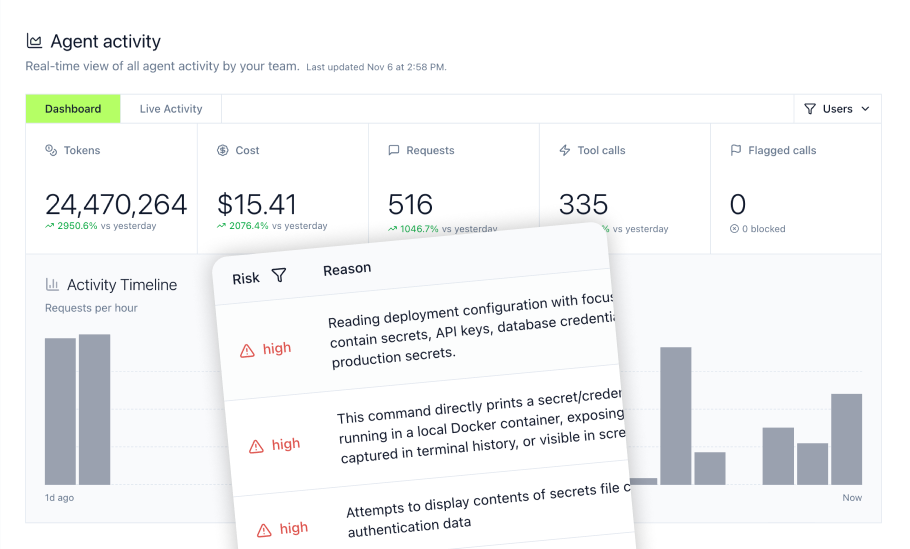
Visibility into AI-assisted workflows separates controlled enterprise deployment from shadow IT risk. For Cowork-connected sales workflows, Mintive's MCP Gateway provides the governance layer for authentication, access control, and auditability.
Governance capabilities
- Tool call tracking: Review MCP activity and governed tool usage across connected workflows
- MCP inventory: Visibility into approved MCP connectors, permissions, and usage patterns across teams
- Audit history: Centralized records of governed MCP activity for security and compliance review
- Usage analytics: Track adoption and activity patterns across teams and tools
Access and policy controls
Mintive can enforce governed access policies around connected tools, helping teams restrict sensitive operations and reduce the risk of unintended actions.
Implementation through guides
The Data Risk guide maps specific guardrails to each risk category. For sales teams, this means:
- Scoped CRM access (read contacts but don't export entire database)
- Email send limits (draft + review required, no bulk send)
- Calendar read-only for most reps (managers can create events)
- Data warehouse query limits (prevent resource-intensive operations)
Integrating Claude with Sales Knowledge Bases for Faster Support
Sales reps need instant access to product documentation, competitive battlecards, and case study libraries. The Elasticsearch MCP Server enables Claude to query internal knowledge bases and deliver contextually relevant information.
Knowledge base applications
- HR teams: Build AI-accessible knowledge bases from company documentation, policies, and training materials
- Product teams: Enable AI-powered customer-facing documentation search and contextual help
- Support teams: Search historical support tickets, resolution patterns, and help articles for faster customer issue resolution
Sales-specific use cases
- Pull relevant case studies matching prospect industry and company size
- Surface competitive intelligence when rep mentions competitor in call notes
- Retrieve pricing guidelines and discount approval thresholds
- Access product roadmap information for enterprise deal discussions
Deploying Claude-Powered Sales Automation in Minutes, Not Days
Traditional enterprise software deployments require months of integration work. Mintive's approach enables rapid deployment through pre-configured MCP connectors and one-click installation.
Deployment timeline
- Week 1-2: Set up connectors + test basic workflows (1-2 pilot reps)
- Week 3-4: Expand to 3-5 early adopters, gather feedback
- Week 5-8: Team-wide rollout with recorded training sessions
- Week 9-12: Optimize workflows based on usage patterns
Quick wins for immediate value
- Post-call workflow (Day 1): Connect CRM + Gmail + Calendar, run
/call-summaryafter first call - Daily briefing (Week 1): Scheduled task pulling pipeline data and generating prioritized action plans
- Account research (Week 2): Automated prospect briefs before outbound calls
Configuration from guides
The Claude Cowork guide provides step-by-step connector setup for non-engineers. Global instructions should include:
- ICP definition and qualification framework
- CRM field requirements and validation rules
- Email tone and template preferences
- Common objections and approved responses
Bridging Shadow AI to Sanctioned AI for Sales Teams with Claude
Shadow AI continues to expand as employees adopt consumer AI tools without IT approval. Mintive transforms this risk into governed capability through centralized controls and visibility.
The shadow AI challenge
Sales reps using personal ChatGPT or Claude accounts to draft emails, research prospects, and analyze deals create:
- Data leakage risk (customer information in uncontrolled systems)
- Compliance gaps (no audit trail for regulated industries)
- Inconsistent outputs (no organizational guidelines)
- Security vulnerabilities (unvetted tool connections)
Mintive's solution
Mintive provides usage visibility into MCP connector utilization and activity patterns across governed workflows. Combined with MCP Gateway, organizations can:
- See which AI tools teams are using and track usage patterns
- Meet compliance requirements with complete audit trails
- Enable AI tools safely with pre-configured policies
- Block risky operations while preserving productivity benefits
Team Collaboration Tools: Optimizing Sales Workflows with Claude and Mintive
Claude Cowork enables team-level collaboration patterns beyond individual productivity gains. Shared configurations, standardized workflows, and centralized monitoring create organizational capability.
Collaboration capabilities
- Virtual MCP servers: Create team-specific tool configurations with role-based access and permissions
- Shared global instructions: Standardize sales methodology, qualification frameworks, and output formats across all reps
- Plugin marketplace: Enterprise teams can deploy pre-approved plugins from private marketplaces
- Cross-functional integration: Connect sales workflows with marketing, customer success, and finance systems
Team deployment through Mintive
The MCP Gateway supports shared and per-user authentication—flexibility to configure service accounts at the admin level or enable individual OAuth flows. Granular tool access control configures tool access by role (e.g., enable read-only operations and exclude write tools for SDRs).
Scaling considerations
- Smaller teams: Start with a governed pilot and expand based on workflow fit
- Mid-sized deployments: Add SSO, role-based access, and centralized administration as usage expands
- Larger deployments: Plan for dedicated operational ownership of workflow maintenance, monitoring, and troubleshooting
Achieving Significant ROI with Claude for Sales Automation
The business case for Claude Cowork centers on time recovery and revenue impact. Quantified benefits enable clear ROI calculations for budget approval.
Time savings per rep per week
- Post-call CRM updates: 4.3 hours saved (15 min → 2 min per call × 4 calls/day)
- Account research: 3.3 hours saved (45 min → 5 min per account × 5 accounts/day)
- Pipeline/forecast prep: 2 hours saved
- Daily planning: 2.5 hours saved
Revenue impact
AI-enabled sales teams report 6-10% average revenue increases compared to control groups, demonstrating measurable business impact beyond time savings.
ROI calculation framework
For a 10-rep sales team:
- Time saved: 10 hours/week × 50 weeks × $50/hour burdened cost = $25,000/rep/year
- Total time value: $250,000/year across team
- Tool investment: Claude Team Premium ($150/user/month) + Mintive Gateway = ~$88,600/year
- Net benefit: $161,400 (182% ROI)
- Break-even: 4.3 months
Mintive: Enterprise-Grade Governance for Claude Cowork at Scale
Mintive solves the critical gap between Claude Cowork's powerful capabilities and enterprise governance requirements. While Claude Cowork excels at automating sales workflows, deploying it safely across teams requires infrastructure that Anthropic's native tools don't provide.
The MCP Gateway delivers centralized authentication, audit logging, and policy enforcement—turning individual productivity gains into governed organizational capability. Sales teams can deploy with confidence knowing that every CRM update, email draft, and data query is logged, controlled, and compliant with security policies.
Mintive's approach recognizes that governance shouldn't slow innovation. The platform enables rapid deployment through pre-configured connectors while maintaining the controls that compliance, security, and IT teams require. Service accounts replace per-user token sprawl. Real-time guardrails prevent risky operations before they execute. Complete audit trails support internal security reviews and SOC 2 Type II evidence collection workflows.
For sales leaders evaluating Claude Cowork, Mintive provides the production-ready foundation. The Claude Cowork guide walks non-technical users through connector setup in days, not months. The Data Risk guide helps teams identify and mitigate the four categories of AI agent risk. And the Skills Tips guide turns Claude into a sales specialist aligned with your methodology.
Organizations can start small—a pilot with 2-3 reps testing post-call workflows—and scale to hundreds of users with consistent governance. Mintive bridges the gap between shadow AI and sanctioned capability, giving teams the productivity benefits of AI agents with the controls enterprises demand.
Frequently Asked Questions
What happens if Claude makes an error in CRM data or sends an incorrect email?
Mintive's governance architecture includes approval workflows for high-risk actions. The Data Risk guide recommends configuring Claude to generate CRM payloads for review before execution—you see exactly what fields will change before clicking "Apply." For email, drafts save to your Drafts folder for review before sending. Mintive can enforce these approval gates at the organizational level, requiring human confirmation for destructive operations or external communications.
Can Claude Cowork integrate with our existing sales tech stack beyond Salesforce and HubSpot?
Yes. The MCP connector ecosystem covers common categories such as CRM systems, email providers, calendar tools, and internal data systems. Common integration categories include CRM systems, email providers, calendar tools, and internal data systems. For tools without existing MCP servers, teams can deploy custom MCP integrations through Mintive's hosted and governed setup patterns.
How does Claude Cowork handle multi-currency deals and international sales processes?
Claude can process data in any format your CRM stores—multi-currency fields, regional date formats, and localized text. The Skills Tips guide explains how to configure global instructions for international sales contexts: specifying currency conversion sources, regional compliance requirements (GDPR for EU prospects), and localized email templates.
What training does my sales team need before deploying Claude Cowork?
The Claude Cowork guide is designed for business users without technical backgrounds. Most teams achieve proficiency within 2-4 hours of initial setup. Best practice is piloting with 1-2 AI-curious reps for two weeks, documenting their workflows, then creating a 30-minute training video covering connector setup, global instructions, and the specific workflows (post-call summary, account research, pipeline review) your team will use.
How do we measure Claude Cowork adoption and impact across the sales organization?
Mintive provides usage visibility into MCP connector utilization and activity patterns across governed workflows. Track adoption by monitoring: percentage of reps using Cowork daily, average time-to-follow-up post-call, CRM field completion rates (MEDDIC/BANT data), and pipeline hygiene scores. Teams can also track adoption alongside their existing analytics workflows where supported by their broader tool stack.