The viral explosion of OpenClaw—accumulating nearly 300,000 GitHub stars—exposed a reality enterprise security teams can no longer ignore: AI agents are proliferating across organizations faster than governance frameworks can contain them. With 78% of AI users bringing their own tools to work and 60% of organizations lacking confidence in detecting unapproved AI deployments, the gap between AI adoption and AI governance has become a critical enterprise risk. This article examines how the MintMCP Gateway transforms unsanctioned AI agents into governed enterprise infrastructure—turning shadow AI into sanctioned AI without sacrificing the productivity gains that made these tools attractive in the first place.
Key Takeaways
- Shadow AI has reached critical mass: 76% of developers are using or planning to use AI tools in their development process while 60% of organizations lack confidence in detecting unapproved AI deployments—creating ungoverned attack surfaces across enterprise environments
- The "Lethal Trifecta" defines AI agent risk: Security researcher Simon Willison's framework identifies critical vulnerability when AI agents combine private data access, untrusted content exposure, and external communication capabilities
- Compliance gaps carry substantial penalties: Organizations with high levels of shadow AI observed an average of $670,000 in higher breach costs than those with low or no shadow AI, with GDPR and HIPAA violations adding regulatory fines
- Governance platforms enable rapid deployment: MintMCP's one-click deployment transforms local MCP servers into production-ready services with OAuth protection, SOC 2 Type II compliance, and complete audit trails
- Detection without governance creates alert fatigue: Organizations need both visibility into shadow AI deployments and infrastructure to provide approved alternatives that match developer productivity expectations
- The market is accelerating: 40% of enterprise applications will feature embedded AI agents by 2026, up from less than 5% in early 2025
Understanding the Shadow AI Agent Phenomenon
What Are Shadow AI Agents?
Shadow AI agents are AI-powered tools deployed by employees without formal IT approval, security review, or governance oversight. Unlike traditional shadow IT—unauthorized software installations or cloud services—shadow AI agents introduce unique risks because they can access sensitive data, execute autonomous actions, and learn from interactions across business systems.
OpenClaw exemplifies this phenomenon. The open-source "AI super agent" runs locally on employee machines, integrates with messaging platforms, executes code, manages files, and connects to external services through an extensible skills ecosystem. Security researchers have characterized it as a dangerous preview of agentic AI, demonstrating high utility with unacceptable cybersecurity risk.
The appeal is undeniable: developers solve problems faster, analysts automate repetitive tasks, and teams accomplish work that previously required specialized technical skills. But this productivity comes at a cost enterprises are only beginning to understand.
Why Employees Turn to Shadow AI
Three factors drive shadow AI proliferation across organizations:
- Productivity pressure: Employees facing tight deadlines adopt tools that help them work faster, regardless of approval status. When AI agents can automate hours of manual work, waiting for IT approval feels counterproductive.
- Accessibility: Unlike enterprise software requiring procurement cycles, tools like OpenClaw are free, open-source, and can be installed in minutes. The barrier to adoption is essentially zero.
- Policy gaps: 60% of leaders say their company lacks a vision and plan to implement AI, creating ambiguity that often pushes employees toward unapproved tools.
The result: 60% of organizations lack confidence in detecting unapproved AI deployments, and employee misuse of public AI tools has become a material data-handling risk, especially when organizations lack clear policies, monitoring, and approved alternatives. Shadow AI has evolved from isolated incidents to systemic enterprise risk.
The Hidden Dangers of Unsanctioned AI
Security researcher Simon Willison's "Lethal Trifecta" framework identifies when AI agents become critically dangerous: when they simultaneously have access to private data, exposure to untrusted content, and the ability to communicate externally. OpenClaw and similar agents frequently meet all three conditions.
Specific risks include:
- Data leakage: Proprietary code, customer information, and credentials exposed through AI prompts that retain training data or transmit to external services
- Prompt injection attacks: CrowdStrike researchers demonstrated how malicious content in Discord channels could exfiltrate private data through indirect prompt injection
- Compliance violations: Untracked AI processing of personal data can create GDPR privacy and accountability issues, HIPAA exposure risks for protected health information, and gaps in the auditability enterprises expect from SOC 2-aligned environments
- Supply chain vulnerabilities: AI-suggested code dependencies introduce unmaintained libraries and potential security flaws—95% of enterprises use open-source software where such risks compound
Published vulnerabilities affecting OpenClaw—including remote code execution flaws with high CVSS scores—illustrate how theoretical risks become concrete threats.
Bridging the Gap: Turning Shadow AI into Sanctioned AI
The Prohibition Paradox
Banning AI tools outright fails as a strategy. When organizations implement restrictive policies without providing alternatives, employees simply hide their AI usage more effectively. The tools go underground rather than away, making detection harder while risks persist.
The effective approach recognizes that employees adopt shadow AI because it genuinely improves their work. Rather than prohibition, governance frameworks should provide sanctioned alternatives that deliver equivalent productivity within appropriate security boundaries.
MintMCP's mission addresses this directly: "We believe AI tools should be accessible to everyone in an organization, not just engineers. MintMCP provides the security, governance, and ease-of-use that enterprises need to deploy MCP at scale."
From Local Experiments to Enterprise Infrastructure
The Model Context Protocol (MCP) has emerged as a widely adopted open standard for connecting AI assistants to enterprise data and tools, with support and ecosystem momentum from Anthropic, OpenAI, Google, and Microsoft. But MCP servers running on individual developer machines lack the authentication, logging, and access controls enterprises require.
MintMCP bridges this gap. The platform transforms local MCP servers into production-ready services with OAuth protection, enterprise SSO integration, and complete audit trails. What started as a developer's local experiment becomes governed infrastructure that security teams can monitor and compliance officers can audit.
MCP Gateway: Securing Your Enterprise AI Infrastructure
Enterprise-Grade Security for Every AI Agent
The MCP Gateway addresses the core challenge of shadow AI: useful tools deployed without appropriate controls. Key capabilities include:
- One-click deployment: Deploy STDIO-based MCP servers instantly with built-in hosting, eliminating the friction that drives developers toward unapproved alternatives
- OAuth and SSO enforcement: Automatic enterprise authentication wrapping for all MCP endpoints, integrating with existing identity providers through OAuth 2.0, SAML, and SSO
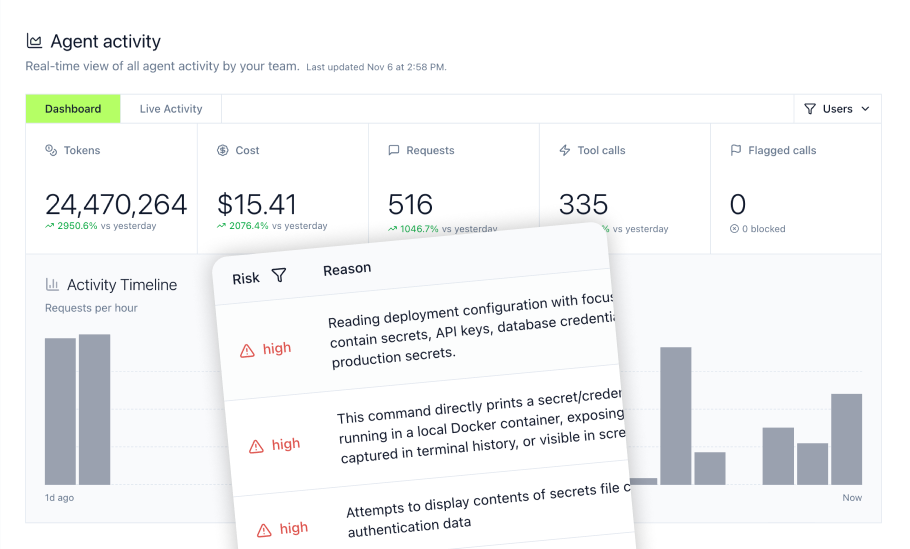
- Real-time monitoring: Live dashboards tracking server health, usage patterns, and security alerts across all AI agent connections
- Granular tool access control: Configure access by role—enable read-only operations while excluding write capabilities based on user permissions
The platform hosts STDIO servers on MintMCP infrastructure rather than individual machines. Containerized servers become accessible to authorized users without local installations, centralizing security controls while maintaining the flexibility developers expect.
Centralized Governance Without Friction
Organizations struggle with shadow AI partly because traditional security approaches create too much friction. Approval processes that take weeks while developers can install OpenClaw in minutes guarantee shadow deployments.
MintMCP's approach inverts this dynamic. Deploy in minutes, not days. Developers request and receive AI tool access through self-service workflows with pre-configured policies. Security teams gain visibility and control. Both constituencies get what they need.
The virtual MCP server architecture enables team-based access with role-based permissions. Organizations create governed environments where AI agents operate within defined boundaries while users experience the same responsive AI assistance that made shadow tools attractive.
Ensuring Compliance and Governance for AI Agents
Meeting Regulatory Requirements
Shadow AI incidents carry compliance penalties beyond direct breach costs. GDPR violations can reach 4% of global revenue. HIPAA penalties for unprotected health information exposure range from $100 to $50,000 per violation. SOC 2 audit failures can jeopardize enterprise contracts that require vendor security attestations and documented control maturity.
MintMCP provides the compliance infrastructure regulated industries demand:
- SOC 2 Type II compliant: Independently audited controls aligned with enterprise security expectations
- Healthcare-ready security controls: Access controls, logging, and policy enforcement that can support regulated healthcare environments
- Privacy and governance support: Audit trails, access controls, and operational visibility that help teams manage AI usage responsibly
- Deployment governance: Centralized access control, authentication, and logging to help teams manage AI infrastructure consistently across environments
Complete Audit Trails for Every Interaction
Audit observability transforms AI agent activity from a black box into documented, reviewable operations. The MCP Gateway logs every interaction, access request, and configuration change—creating the evidence trail compliance auditors require and security teams need for incident investigation.
When the question shifts from "was there a breach?" to "what exactly happened?", organizations with comprehensive logging can answer definitively. Those relying on shadow AI cannot.
Beyond Visibility: Monitoring and Control with LLM Proxy
Real-Time Monitoring of Coding Agents
Coding agents like Claude Code and Cursor operate with extensive system access—reading files, executing commands, accessing production systems through MCP tools. Without monitoring, organizations cannot see what agents access or control their actions.
The LLM Proxy addresses this gap specifically for coding environments:
- Tool call tracking: Monitor every MCP tool invocation, bash command, and file operation from all coding agents
- MCP inventory: Complete visibility into installed MCPs, their permissions, and usage patterns across development teams
- Security guardrails: Block dangerous commands, restrict file access, and control MCP permissions in real-time
- Command history: Complete audit trail of every bash command, file access, and tool call for security review
Protecting Sensitive Data from Agent Access
Development environments contain credentials, API keys, SSH keys, and configuration files that should never reach AI systems. The LLM Proxy prevents access to .env files, credentials, and sensitive configuration before exposure occurs—blocking risky tool calls like reading environment secrets or executing dangerous commands.
This protective layer operates between LLM clients and the models themselves, forwarding and monitoring requests while providing observability into how employees use AI tools and what those tools access.
Real-World Impact: Unleashing Sanctioned AI Across the Enterprise
With proper governance in place, AI agents transform from security liabilities into productivity multipliers across departments:
Data analysis teams let AI agents query databases, generate reports, and answer business questions using real-time data—all within governed access boundaries that ensure appropriate data classification.
Customer support organizations enable AI assistants to access CRM data, support tickets, and customer history through secured connections that maintain audit trails for every interaction.
Development teams connect AI coding assistants to repositories, issue trackers, and CI/CD systems securely—gaining productivity benefits without the compliance exposure of shadow deployments.
Executive teams generate real-time business intelligence dashboards and strategic insights from governed data warehouses through the Snowflake MCP Server without SQL expertise.
HR teams build AI-accessible knowledge bases from company documentation, policies, and training materials using the Elasticsearch integration for instant employee assistance.
The difference between shadow AI and sanctioned AI isn't capability—it's control. Both can query databases and generate reports. Only sanctioned AI does so with appropriate authentication, access logging, and compliance documentation.
Seamless Integration with Your Existing AI Tools and Data
MintMCP works with the AI clients organizations already use:
- Claude (Desktop and Web)
- ChatGPT (via Custom GPTs, GPT Actions, and app-based integrations)
- Microsoft Copilot
- Cursor
- Gemini, Goose, LibreChat, Open WebUI, Windsurf
- Custom MCP-compatible agents
Enterprise connectors extend AI capabilities to core business systems. The Gmail MCP Server enables AI assistants to search, draft, and send communications within approved workflows. Database connectors provide governed access to PostgreSQL, MySQL, MongoDB, and other data stores.
This compatibility matters because organizations don't need to abandon existing AI investments. MintMCP adds the governance layer that transforms ad-hoc usage into enterprise infrastructure.
Accelerating AI Adoption: Deploy in Minutes, Not Days
The ultimate answer to shadow AI isn't restriction—it's providing better alternatives faster. When approved tools deploy as quickly as unauthorized ones and deliver equivalent functionality, the incentive for shadow adoption disappears.
MintMCP's platform enables this velocity:
- Rapid deployment: Deploy MCP servers in minutes with pre-configured policies
- Self-service access: Developers request and receive AI tool access instantly through governed workflows
- Centralized credentials: Manage all AI tool API keys and tokens in one place
- User management: Centralized provisioning with team-based access controls
- Usage analytics: Monitor tool usage, performance, and cost allocation across the organization
Shadow AI grows rapidly when organizations can't match developer expectations for accessibility and speed. Meeting those expectations within governance frameworks is the only sustainable path forward.
Taking Action: Deploying MintMCP Gateway to Govern Shadow AI
Organizations facing shadow AI risk don't need months-long implementation projects to establish governance. The MintMCP Gateway is designed for rapid deployment that delivers immediate security value while enabling long-term scalability.
Start by identifying the MCP servers and AI tools your teams are already using—often scattered across individual developer machines or running in unsecured environments. The Gateway's one-click deployment centralizes these tools onto governed infrastructure in minutes, not weeks. Each server gains OAuth protection, enterprise SSO integration, and audit logging automatically, eliminating the manual configuration burden that typically delays security initiatives.
For development teams using coding agents like Claude Code or Cursor, the LLM Proxy provides immediate visibility and control. Deploy it alongside the Gateway to monitor tool calls, block risky commands, and maintain complete audit trails—all without disrupting developer workflows. Security teams gain the observability they need while developers retain the AI assistance that makes them productive.
As your governed AI infrastructure grows, MintMCP scales with you. The virtual MCP architecture supports team-based access controls, role-specific permissions, and centralized credential management across hundreds of users and dozens of AI tools. What starts as a solution to shadow AI becomes the foundation for enterprise-wide AI enablement—secure, compliant, and ready for whatever agents emerge next.
Frequently Asked Questions
What happens to existing shadow AI deployments when implementing MintMCP?
MintMCP enables a phased transition rather than abrupt cutover. Organizations first gain visibility through the LLM Proxy and gateway monitoring, identifying where shadow AI operates and what functions it serves. Security teams can then provision approved alternatives that replicate shadow tool capabilities within governed boundaries. Many organizations implement "amnesty periods" where employees can migrate to sanctioned tools without penalty, preserving productivity while eliminating ungoverned risk. The goal is replacement, not punishment—employees adopted shadow AI because it solved real problems, and sanctioned alternatives must solve those same problems.
How does MintMCP help organizations manage AI deployments in regulated environments?
MintMCP helps organizations centralize authentication, access control, and audit logging for AI tool access. That gives security and compliance teams better visibility into how AI agents connect to business systems, what actions they take, and which controls are applied across teams. For organizations operating under regional or industry-specific requirements, this governance layer can reduce operational risk and improve audit readiness.
Can MintMCP integrate with existing SIEM and security monitoring infrastructure?
Yes. The platform generates comprehensive logs designed for integration with enterprise security information and event management systems. Organizations route MCP Gateway and LLM Proxy telemetry to existing SIEM deployments, correlating AI agent activity with broader security monitoring. This integration enables security operations centers to include AI agent behavior in threat detection workflows, anomaly identification, and incident response procedures. Rather than requiring separate monitoring for AI-specific risks, MintMCP data becomes part of unified security operations.
What level of technical expertise is required to deploy and manage MintMCP?
MintMCP is designed for accessibility across technical skill levels. Initial deployment uses one-click installation for standard configurations, with administrative interfaces that don't require command-line expertise. Security teams configure policies through dashboard controls rather than code. That said, organizations with specific requirements can access deeper customization—API integrations, custom connector development, and advanced policy configurations are available for teams with engineering resources. The platform scales from "get started this afternoon" simplicity to enterprise-grade customization as needs evolve.
How does the cost of MintMCP governance compare to potential shadow AI breach exposure?
According to IBM research, organizations with high levels of shadow AI observed an average of $670,000 in higher breach costs than those with low or no shadow AI. A single GDPR violation can reach 4% of global annual revenue. Against these potential exposures, governance platform investments represent risk mitigation with quantifiable return. Organizations can calculate exposure by multiplying developer count by shadow AI usage rates by average data sensitivity by breach probability—a formula that typically shows governance platforms paying for themselves by preventing a single significant incident.