Connecting AI agents to your Snowflake data warehouse requires more than a standard API integration. MCP (Model Context Protocol) gateways create a governed translation layer between AI assistants like Claude, ChatGPT, and Cursor and your enterprise data, enabling natural language queries, semantic search, and multi-step workflows without custom coding. The MCP Gateway approach has emerged as a common way to bridge AI clients with internal data, giving teams a governed layer for authentication, access control, and observability.
With Snowflake's managed MCP server launch, organizations now have both native and gateway-based pathways to connect AI agents to Cortex Analyst, Cortex Search, and Cortex Agents. The right option depends on compliance requirements, deployment preferences, and governance needs.
Key Takeaways
- MCP gateways enable AI agents to query Snowflake data through natural language without SQL expertise
- SOC 2 Type II audited infrastructure matters for enterprises managing sensitive financial or customer data through AI agents
- Snowflake Managed MCP provides a low-friction native starting point for organizations already running Snowflake accounts
- One-click deployment options can reduce setup time from days to minutes for STDIO-based MCP servers
- OAuth 2.0 authentication is recommended for production deployments over Programmatic Access Tokens
- Semantic view development requires meaningful data-modeling work to map business concepts to database schemas
1. MintMCP Gateway: From Local MCP to Enterprise Deployment, Fast
MintMCP transforms local STDIO-based MCP servers into production-ready services with built-in OAuth protection, SSO and SCIM-driven RBAC, tool-level allowlisting, rule-based policy, credential management, centralized observability, and complete audit trails. For Snowflake integration, MintMCP provides a pre-built Snowflake connector that enables AI agents to perform natural language to SQL conversion, semantic search, and governed query execution.
What Makes MintMCP Different
MintMCP addresses the deployment bottleneck that often blocks enterprise MCP adoption: converting local or fragmented MCP setups into centrally hosted, authenticated, and observable services that teams can actually roll out across the organization. Most STDIO-based servers require local installations, scattered credentials, and manual configuration. MintMCP hosts these servers centrally, brokers OAuth for stdio and hosted MCP servers, and provides centralized governance across all AI-to-data connections.
A key MintMCP differentiator is Virtual MCP Bundles: administrators can publish curated, per-use-case endpoints with SCIM-driven membership for each team instead of exposing entire MCP servers, making least-privilege access practical for production AI deployments. MintMCP also supports Agent Bundles with M2M auth and an “act as agent” flow, so agent identities can receive scoped Snowflake tool access without relying on shared service-account keys.
MintMCP is SOC 2 Type II audited, compliant with HIPAA standards, penetration tested, and every agent action is audited. Enterprise SSO, complete audit trails, PII detection, and role-based access control are built into the platform, and security teams can review MintMCP’s full security posture in the Trust Center.
Snowflake Integration Capabilities
The MintMCP Snowflake MCP Server is positioned for governed access to Snowflake workflows such as Cortex Analyst, Cortex Search, and SQL-backed operations, with centralized authentication and observability.
Key capabilities include:
- Cortex Analyst workflows: Natural language questions over governed Snowflake business data
- Cortex Search workflows: Hybrid search across configured Snowflake search services
- SQL-backed workflows: Governed query execution where teams want direct database access patterns
- Semantic-view-based analytics: Structured business questions mapped to approved Snowflake views
- Administrative workflows: Configurable access to higher-privilege operations when organizations choose to expose them
Enterprise Use Cases
MintMCP enables specific team workflows across the organization:
- Product management teams: AI-driven product analytics and user behavior analysis directly from Snowflake data warehouses
- Finance teams: Automated financial reporting, variance analysis, and forecasting through AI agents accessing Snowflake data models
- Executive teams: Real-time business intelligence dashboards and strategic insights without SQL expertise
Deployment and Security
MintMCP supports granular tool access control, allowing teams to configure read-only operations for analysts while restricting write tools to administrators. The platform integrates with enterprise identity providers through OAuth 2.0, SAML, SSO, and SCIM-driven RBAC. Centralized dashboards monitor server health, usage patterns, audit logs, and AI tool activity across connected clients.
MintMCP's approach is especially useful when teams need MCP access in web-based AI clients such as ChatGPT, where local STDIO servers are not a practical deployment model. By hosting connectors centrally and wrapping them with enterprise auth, MintMCP turns local MCP tooling into production-ready services without additional infrastructure overhead.
AI Client Compatibility: Claude, ChatGPT, Cursor, Gemini, Copilot, and other MCP-compatible agents, with hosted deployment especially useful for web clients that cannot connect to local STDIO servers directly.
2. Snowflake Managed MCP
Snowflake Managed MCP is not a third-party MCP gateway, but it is an important native Snowflake MCP option for teams comparing how AI agents should connect to Cortex Analyst, Cortex Search, and Cortex Agents.
Snowflake's native MCP server provides direct integration between AI agents and Snowflake data without third-party infrastructure. Included with active Snowflake accounts, this option offers the fastest path to connecting AI clients like Claude Desktop to Cortex capabilities.
Where Snowflake Managed MCP Fits
Organizations already invested in Snowflake who need quick access to Cortex Analyst and Cortex Search without additional vendor relationships. The setup requires approximately 20 minutes for basic configuration through SQL commands.
Core Capabilities
Snowflake Managed MCP exposes several tool types:
- CORTEX_ANALYST_MESSAGE: Natural language queries against semantic views
- CORTEX_SEARCH_SERVICE_QUERY: Search against configured Cortex Search services
- CORTEX_AGENT_RUN: Multi-step workflows combining structured and unstructured data
- SYSTEM_EXECUTE_SQL: Direct SQL query execution
Authentication Options
The server supports OAuth 2.0 through Snowflake's built-in OAuth service (recommended for production) and Programmatic Access Tokens for development environments. PAT tokens require management overhead and create higher security risk at scale compared to OAuth flows.
Considerations
Snowflake Managed MCP requires appropriate Snowflake privileges to create and manage MCP server objects, and it depends on semantic view development to translate business questions into SQL. Semantic view development can require meaningful data-modeling work to map business concepts to database schemas, especially in complex or tightly governed environments.
Teams should also evaluate whether they need MCP gateway capabilities outside Snowflake, such as cross-client SSO, SCIM-driven RBAC, per-use-case tool bundles, agent identity governance, and one audit stream across Claude, Cursor, ChatGPT, Gemini, and Copilot.
Pricing: Included with Snowflake account (compute charges apply for query execution)
3. TrueFoundry MCP Gateway
TrueFoundry provides an MCP gateway designed for high-throughput AI workloads. The platform emphasizes low latency and scalability for organizations running intensive AI agent operations.
TrueFoundry's Primary Focus
TrueFoundry targets organizations requiring low-latency AI agent operations. TrueFoundry positions its gateway around low added latency, centralized auth, and broader AI platform integration, with first-party materials emphasizing performance and operational control.
Technical Architecture
The gateway supports OAuth 2.0 Identity Injection for enterprise authentication flows and integrates with broader AI platform capabilities including LLMOps, model serving, and tracing. This makes TrueFoundry suitable for organizations building comprehensive AI infrastructure beyond MCP gateway functionality.
Deployment Model
TrueFoundry offers hybrid deployment options across cloud and on-premises environments. Setup generally involves more configuration than lighter-weight hosted options, reflecting the platform’s broader infrastructure scope.
Considerations
Teams evaluating TrueFoundry for Snowflake should consider whether they want a broader ML platform footprint or a managed SaaS-first MCP governance layer. MintMCP focuses on IT, Security, and AI Operations needs such as SSO and SCIM-driven RBAC, Virtual MCP Bundles, Agent Bundles, hosted MCP connectors, credential management, and centralized auditability across AI clients.
Pricing: Contact-based
4. IBM ContextForge
IBM ContextForge provides an open-source MCP gateway option licensed under Apache 2.0. The platform focuses on federation capabilities for organizations managing multiple data sources alongside Snowflake.
ContextForge for Multi-Source Environments
Organizations with complex data architectures spanning multiple warehouses and systems may find ContextForge's federation approach valuable. The Apache 2.0 license allows modification and self-hosting without licensing fees.
Support Considerations
Organizations requiring vendor-backed assistance should verify available support options for their planned ContextForge deployment before committing to production implementation.
Implementation Considerations
As an open-source project, ContextForge requires more hands-on configuration compared to managed alternatives. Organizations should budget for internal engineering time to deploy and maintain the gateway infrastructure.
License: Apache 2.0
5. Bifrost
Bifrost focuses on minimal gateway overhead for organizations prioritizing raw performance. The gateway reports approximately 11µs overhead per request.
Bifrost for Performance-Critical Deployments
Development teams building latency-sensitive AI applications may benefit from Bifrost's lightweight architecture. The gateway adds minimal processing time to MCP requests.
Scope Considerations
Bifrost's focused approach means fewer built-in enterprise features compared to comprehensive platforms. Organizations may need to implement governance, audit logging, and authentication layers separately.
Teams should also evaluate whether they need managed SaaS-first deployment, hosted MCP connectors, SCIM-driven RBAC, Virtual MCP Bundles, Agent Bundles, and centralized agent governance across multiple AI clients.
6. DreamFactory
DreamFactory is not a native MCP gateway, but an adjacent API-first option for teams comparing Snowflake integration patterns, especially when REST API generation is already part of the organization’s architecture.
DreamFactory takes a REST API generation approach rather than native MCP protocol support. The platform auto-generates APIs for Snowflake and 250+ other databases.
DreamFactory for API-First Architectures
Organizations with existing REST API infrastructure or requirements for broad database connectivity beyond Snowflake may find DreamFactory's approach appropriate. The platform provides RBAC, OAuth 2.0, SAML, and LDAP authentication.
Architecture Difference
DreamFactory generates REST APIs rather than implementing MCP protocol directly. This creates a different integration pattern compared to native MCP gateways and may add latency compared to direct MCP connections. Teams that need MCP-specific primitives such as Virtual MCP Bundles, Agent Bundles, tool-update policy, hosted MCP connectors, or OAuth brokering for stdio and hosted MCP servers should evaluate whether a native MCP gateway is a better fit.
Choosing the Right Gateway for Your Snowflake Integration
Enterprise AI governance requires balancing speed, security, and compliance. The MCP gateway landscape offers options ranging from zero-cost native integrations to fully managed enterprise platforms.
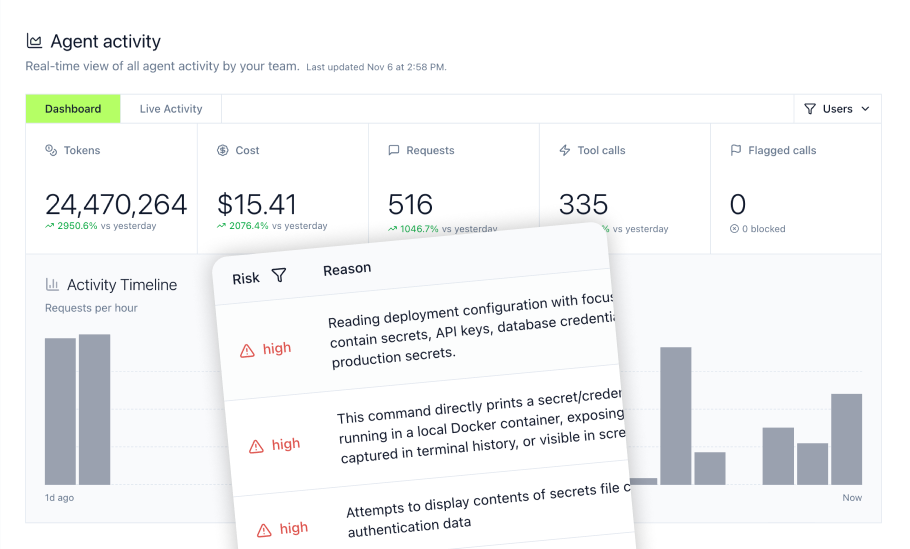
For organizations that need Snowflake access to work across web-based AI clients, centrally hosted MCP infrastructure, and team-specific governance, MintMCP provides one-click deployment, SOC 2 Type II audited infrastructure, and curated Snowflake access patterns designed for enterprise rollouts. The platform's Agent Monitor adds visibility into AI agent behavior, tracking tool calls, bash commands, and file access across Claude Code, Cursor, and other coding agents.
MintMCP's approach addresses the deployment bottleneck that often blocks enterprise MCP adoption: transforming local MCP servers into production services without infrastructure overhead. By hosting connectors centrally and wrapping them with enterprise auth, MintMCP turns local MCP tooling into production-ready services that teams can deploy across web and desktop AI clients. The platform's Virtual MCP Bundles let administrators expose curated tool sets per team rather than entire MCP servers, implementing least-privilege access for AI agents.
Organizations evaluating MCP gateways for Snowflake should consider semantic view development requirements, authentication requirements (OAuth 2.0 recommended over PAT), and compliance needs (SOC 2 Type II audited infrastructure, audit trail requirements). The MintMCP security documentation provides detailed guidance on authentication models and tool governance for enterprise deployments.
Ready to deploy enterprise MCP infrastructure for Snowflake? Book a demo to see MintMCP's one-click deployment and real-time monitoring in action.
Frequently Asked Questions
What is an MCP Gateway and why is it essential for Snowflake integration?
An MCP Gateway creates a governed translation layer between AI assistants (Claude, ChatGPT, Cursor) and your Snowflake data warehouse. Instead of building custom integrations for each AI tool, organizations deploy a single gateway that provides standardized access to Cortex Analyst, Cortex Search, and Cortex Agents with centralized authentication, audit logging, and access control.
How does MintMCP ensure data security when connecting AI to Snowflake?
MintMCP is SOC 2 Type II audited, compliant with HIPAA standards, and provides complete audit trails for every MCP interaction. The platform wraps MCP servers with OAuth 2.0 and SSO authentication, supports SCIM-driven RBAC, enforces tool-level access control, and offers granular tool permissions, enabling read-only operations for analysts while restricting write access. MintMCP adds centralized authentication, access control, credential management, and auditability around Snowflake-connected workflows so teams can govern how AI agents interact with enterprise data.
Can MintMCP integrate with existing AI clients like ChatGPT or Claude for Snowflake access?
Yes. MintMCP supports Claude (Desktop and Web), ChatGPT (via Custom GPTs and Actions), Microsoft Copilot, Cursor, Gemini, Goose, LibreChat, Open WebUI, Windsurf, and custom MCP-compatible agents. The platform's hosted MCP servers are accessible to web clients like ChatGPT that cannot connect to local STDIO servers directly.
What business problems does using an MCP Gateway for Snowflake solve?
MCP gateways eliminate the bottleneck where business teams wait for data engineers to run queries. Product managers can ask natural language questions about user engagement metrics, finance teams can generate revenue reports without SQL, and executives can access cross-functional KPIs instantly. MintMCP's Snowflake connector enables these workflows with governance appropriate for regulated industries.
What deployment options are available for MCP Gateways with Snowflake integration?
Options range from Snowflake's native managed MCP (included with accounts, approximately 20-minute setup) to fully managed enterprise platforms like MintMCP (one-click deployment, SOC 2 Type II audited infrastructure). MintMCP is managed SaaS-first, available in the US and EU, with VPC or self-hosted deployment on request.