OpenAI Agent Builder represented a significant shift toward no-code AI agent development when it launched in October 2025. The visual drag-and-drop platform promised rapid workflow creation without engineering overhead. Eight months later, OpenAI deprecated Agent Builder, with the product scheduled to shut down on November 30, 2026. The deprecation serves as a critical case study in platform-dependency risk for enterprises building on third-party AI infrastructure and reinforces the value of portable governance frameworks. Organizations running AI agents across Claude, Cursor, ChatGPT, Gemini, and Copilot now face a fundamental question: how do you build agent infrastructure that survives vendor deprecations?
This article examines what Agent Builder offered, what governance and portability risks its deprecation highlights, and what the deprecation teaches us about building resilient AI agent infrastructure.
Key Takeaways
- OpenAI Agent Builder lasted only 8 months from launch to deprecation, invalidating ROI calculations for businesses that invested in workflow optimization
- Agent Builder relied on OpenAI-hosted workflow infrastructure unless teams exported to the Agents SDK, creating deployment-control and portability tradeoffs for enterprises
- Agent Builder ran within OpenAI Platform identity and project controls, including SSO and role-based access control, while enterprises still needed to evaluate whether workflow-level permissions and audit coverage met their internal governance requirements
- Migration effort varies by workflow complexity and target platform because OpenAI's code export does not convert the workflow graph or guarantee identical behavior
- OpenAI cited Klarna's support agent as handling two-thirds of tickets in its broader agent ecosystem, but the source does not establish that Klarna built that system with Agent Builder
- Enterprises need abstraction layers that decouple agent logic from individual platform dependencies
- Per-agent identity and access management prevents credential sprawl and enables audit attribution at scale
Understanding OpenAI's AI Agents: What They Are and Their Potential
AI agents represent autonomous systems that can reason, plan, and execute multi-step tasks using large language models. Unlike simple chatbots that respond to single prompts, agents maintain context across interactions, use external tools, and make sequential decisions to accomplish complex objectives.
Defining Agentic AI: Beyond Simple Prompts
Agentic AI systems differ from basic LLM interactions in three ways. First, they execute multi-step workflows where each step builds on previous outputs. Second, they integrate external tools like web search, code execution, and API calls. Third, they maintain memory and context across interactions to work toward defined goals.
Agent Builder exemplified this pattern through its node-based architecture. Users connected agent nodes (containing model instructions), tool nodes (for actions like file search or web requests), and control flow nodes (for branching logic) on a visual canvas. The platform then executed these workflows as unified agent systems.
Real-World Examples of AI Agents in Action
Common enterprise agent deployments include:
- Customer support triage: Agents classify incoming tickets, retrieve relevant knowledge base content, and draft responses for specialist review
- Sales lead qualification: Agents enrich lead data through web search, score fit and intent, and generate personalized outreach
- Contract analysis: Agents extract key terms, check against compliance requirements, and flag deviations for legal review
- Development workflow automation: Agents connect to GitHub, Jira, and CI/CD pipelines to automate routine engineering tasks
These use cases require agents to access internal systems and sensitive data, making governance the central challenge for enterprise deployment.
Building and Deploying AI Agents: Tools and Platforms
Agent Builder offered a visual canvas where users assembled workflows through drag-and-drop nodes. The platform supported live preview runs showing data flowing through each step with visible agent reasoning, version control for published workflows, and dual deployment paths through either ChatKit embeds or Agents SDK code export.
No-Code and Low-Code Options for AI Agent Creation
The platform lowered the barrier to agent development significantly. Non-technical teams could build functional agents in hours rather than weeks. This accessibility came with tradeoffs: limited customization, dependency on a single vendor, and governance controls that required evaluation against enterprise governance requirements.
When Agent Builder deprecated, businesses faced stark choices:
- Agents SDK: Code-first migration path that requires teams to validate runtime configuration, tools, authentication, permissions, and deployment
- ChatGPT Workspace Agents: Natural-language migration path for team workflows, with some behavior requiring manual recreation and separate app and tool configuration
- Third-party platforms: Migration effort varies by platform and workflow complexity
Choosing the Right Platform for Your Agent Needs
The deprecation highlighted a critical oversight: most organizations selected Agent Builder based on ease of use without evaluating vendor stability, export capabilities, or governance requirements. Platform selection criteria should include:
- Export and portability: Can you extract all configuration, credentials, and optimization data?
- Vendor commitment: Is this the vendor's core product or a marketing experiment?
- Compliance alignment: Does the platform support your regulatory requirements?
- Abstraction potential: Can you add a governance layer that survives platform changes?
An MCP Gateway serves this abstraction function, providing governed connections to data and tools that remain consistent regardless of which AI platform initiates the request.
Integrating AI Agents with Internal Systems: The Last Mile Challenge
Connecting agents to enterprise systems creates the highest governance risk. Agent Builder worked with OpenAI's Connector Registry, which centralized approved data and tool connections across ChatGPT and the API. At launch, OpenAI specifically highlighted pre-built connectors including Dropbox, Google Drive, SharePoint, and Microsoft Teams, alongside third-party MCP servers.
Overcoming Integration Hurdles for Enterprise Adoption
Three integration challenges dominated Agent Builder deployments:
- Authentication complexity: OAuth scopes required manual configuration, and credentials did not export with workflows. Migration requires separate review of connected apps, authentication, publishing, and permission configuration, with effort varying by integration.
- Data type mismatches: Node connections failed when output types did not match input requirements. Teams spent significant time defining explicit output schemas in JSON for each node.
- Context flow limitations: Referencing data from previous nodes required bracket notation syntax. Complex branching logic became difficult to maintain as single workflows.
These integration challenges compound when agents lack centralized governance. Without a platform that normalizes authentication, manages credentials, and enforces consistent access policies, each agent deployment becomes a separate integration project.
Establishing AI Governance: Frameworks for Agent Builder Deployments
Agent Builder's deprecation exposed governance gaps that enterprises cannot afford to repeat. Building governance into agent infrastructure from the start prevents the operational disruption that businesses now face.
Key Pillars of a Robust AI Governance Framework
Vendor abstraction: Agent logic should not depend directly on any single platform. Governance layers that abstract away vendor-specific APIs and authentication mechanisms enable migration with configuration changes rather than full rebuilds.
Data sovereignty controls: Regulated industries require clear choices for where data is stored and processed. Agent Builder itself was an OpenAI-hosted visual workflow product, while eligible OpenAI API customers had regional data-residency options. Enterprises still needed to verify which workflow data and services were covered by their required residency and compliance scope.
Lifecycle management: Contractual commitments on platform longevity, deprecation notice periods (12-24 months minimum), and migration support should be prerequisites for critical business systems.
Compliance integration: Agent infrastructure must integrate with existing compliance frameworks. Agent Builder provided controls including PII redaction guardrails and human approval nodes, while enterprises still needed to verify whether OpenAI's retention, monitoring, and workflow controls met their specific regulatory requirements.
Ensuring Security and Compliance for AI Agents
Agent Builder workflows were not secured by workflow IDs alone. OpenAI Platform supported SSO and role-based access control, while ChatKit deployments required server-side user authentication and session credentials. Enterprises still had to design their own end-user authorization and connected-tool policies.
Protecting Against Prompt Injection and Credential Leakage
Enterprise agents face specific security threats that require dedicated controls:
Prompt injection: Malicious inputs designed to override agent instructions or extract sensitive information. Agent Builder included guardrail nodes for jailbreak detection and PII redaction, plus human-approval controls for sensitive tool actions, although OpenAI cautioned that guardrails alone were not foolproof.
Credential exposure: Agents with access to API keys, tokens, or OAuth credentials create exfiltration risk. Without per-agent credential scoping, compromise of one workflow could expose credentials used across the organization.
PII leakage: Agents processing customer data may inadvertently expose personally identifiable information in logs, responses, or to integrated systems.
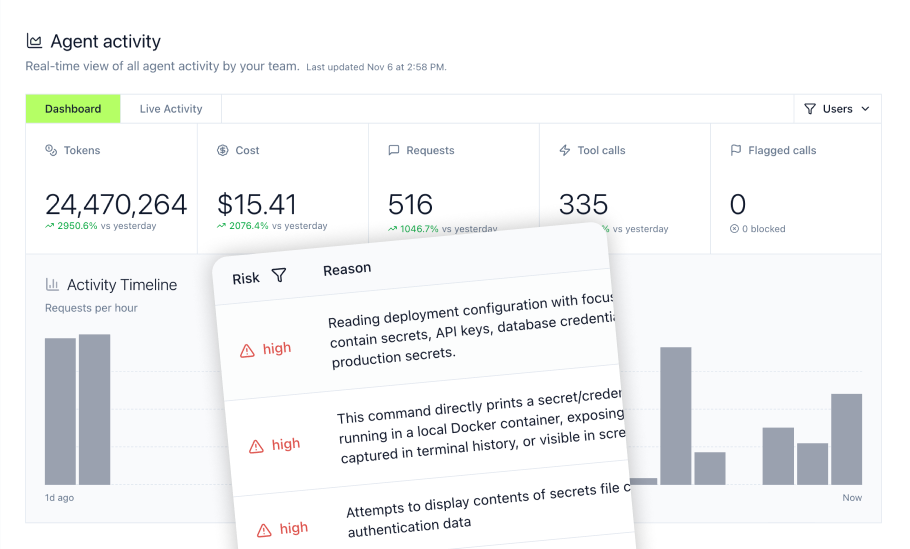
Agent Monitor extends visibility beyond gateway-controlled MCP traffic by capturing local non-MCP agent activity such as Bash commands, file reads and writes, and prompt submissions through supported Claude Code and Cursor hooks. Gateway middleware handles inline policy controls such as PII/DLP and jailbreak detection for traffic routed through the MCP Gateway.
Achieving Regulatory Compliance with AI Agents
Agent Builder held standard OpenAI infrastructure certifications but required careful scope verification:
- SOC 2: OpenAI's API Platform has a SOC 2 Type II attestation; organizations should verify the exact scope applicable to their deployment
- HIPAA: OpenAI offers BAAs for eligible API customers and HIPAA-eligible API configurations, subject to applicable service and retention requirements
- GDPR: OpenAI supports DPAs and data-residency options for eligible API customers, with availability depending on region and service scope
Organizations in regulated industries should verify the exact services covered by their BAA, DPA, residency configuration, retention settings, audit requirements, and existing compliance monitoring.
Monitoring and Observability: Tracking AI Agent Activity
Agent Builder provided workflow traces and evaluation tooling that let teams inspect end-to-end decisions, tool calls, and node behavior. Enterprises still needed to assess whether those native observability surfaces met their requirements for production alerting, SIEM integration, retention, and cross-platform monitoring.
Real-Time Visibility into Agent Actions
Enterprise agent governance requires visibility across multiple dimensions:
- Request and response logging: Complete capture of prompts, tool calls, responses, and context
- Per-user attribution: Which user or system initiated each agent action?
- Latency and error tracking: Performance monitoring for reliability and optimization
- Cross-platform coverage: Visibility into agent activity regardless of which AI platform executes it
Detecting Unauthorized Shadow AI Activities
Shadow AI represents one of the fastest-growing enterprise security concerns. Employees using AI tools outside approved channels create ungoverned access to corporate data. Agent Builder provided no visibility into off-platform activity.
Modern governance requires detection mechanisms for AI usage in tools like Cursor and Claude Code, even when that activity bypasses centralized gateways. Policy enforcement must extend to local agent activity through hooks and monitoring agents deployed to developer machines.
The Role of Identity and Access Management in Agentic AI
Agent Builder workflows were not secured by workflow IDs alone, but teams still needed to design their own end-user authorization and connected-tool policies.
Assigning Unique Identities to AI Agents
Agent identities should operate as first-class principals with their own credentials, permissions, and audit trails. This enables:
- Credential rotation: Rotate agent credentials independently of human user accounts
- Revocation: Disable compromised agent access without affecting other systems
- Attribution: Track which agent performed which action for compliance and debugging
- Least privilege: Scope each agent's access to exactly what it needs
Implementing Granular Access Controls for Agent Tools
Tool-level access control determines which capabilities each agent can use. An agent that needs to read from a database should not automatically have write access. An agent processing support tickets should not have access to financial systems.
Agent Builder supported human-approval nodes, OAuth-scoped connectors, and OpenAI Platform role-based access control. Enterprises still needed to design least-privilege permissions for connected tools and decide how workflow-level controls mapped to their existing identity and approval processes.
Enterprise deployment requires:
- SSO integration with existing identity providers (Okta, Azure AD)
- SCIM-driven group membership for role-based access
- Tool-level allowlisting per agent or team
- Approval workflows for expanding agent capabilities
Building for Scale: Infrastructure for Enterprise AI Agent Deployments
For customer-facing deployments, ChatKit required developers to authenticate each user and pass a unique end-user identifier. Teams still owned application-level tenancy, billing, and business-specific usage accounting around the Agent Builder workflow.
Designing Scalable Architectures for AI Agent Workloads
Enterprise agent infrastructure must support:
- Multi-tenant isolation: Serve multiple customers or business units from unified infrastructure with proper data isolation
- Horizontal scaling: Handle concurrent users without performance degradation
- Rate limiting: Prevent abuse and manage costs through per-user or per-team limits
- High availability: SLAs for production workloads with redundancy and failover
The Governance Lesson: Platform Risk Premiums
Agent Builder's 8-month lifespan demonstrates that total cost of ownership must include platform risk. The migration window of six months, while generous compared to some deprecations, still disrupted production systems and invalidated optimization investments.
Governance-first architecture addresses this through:
- Protocol standardization: Build on open standards like MCP rather than proprietary platform APIs
- Portable configuration: Store workflow logic, credentials, and policies in exportable formats
- Abstraction layers: Governance platforms that mediate between agent applications and AI providers
- Multi-provider support: Avoid single-vendor lock-in by supporting multiple AI backends
When agent applications continue to route governed tool access through MintMCP's MCP Gateway and use its Agent Gateway for identities, permissions, memory, and monitoring, core governance controls can remain consistent as the AI platform changes. Vendor-specific workflow logic may still require migration work, but the governance layer does not have to be rebuilt from scratch.
Building Resilient AI Agent Infrastructure with MintMCP
The Agent Builder deprecation delivers a clear lesson: enterprises cannot afford to build critical agent infrastructure on platforms that trap workflow logic, credentials, and governance policies inside proprietary systems. When a vendor deprecates a product after eight months, businesses can face unplanned migration work, credential reconfiguration, workflow validation, and prompt re-tuning.
MintMCP separates governance from execution. Its MCP Gateway provides governed data and tool connections for Claude, Cursor, ChatGPT, Gemini, and Copilot, helping teams keep core controls consistent across AI environments:
- Authentication and access control remain centralized across governed tool connections
- Tool-level permissions limit agents to the resources they need
- Gateway-side audit controls preserve visibility as AI platforms change
MintMCP's Agent Gateway builds on this foundation with:
- First-class agent identities with scoped credentials
- Independent credential rotation and revocation
- Governed memory and permissions
- Monitoring and attributable audit trails
This architecture reduces the governance work required when agent platforms change. If tool and data access continues through MintMCP's gateway layer, core access policies, agent identities, and gateway-side audit controls can remain consistent while teams migrate vendor-specific workflow logic separately.
The result is a more resilient governance layer that does not need to be rebuilt every time AI vendors change roadmaps, consolidate products, or deprecate platforms.
Frequently Asked Questions
What happened to workflows I built in OpenAI Agent Builder?
Agent Builder workflows stop functioning on November 30, 2026. OpenAI provides TypeScript and Python code export through the platform's Code section before shutdown. The export does not convert the workflow graph or guarantee identical behavior, while connected apps, authentication, publishing, and permission configuration require separate review during migration.
How do I calculate migration costs from Agent Builder to another platform?
Migration effort varies based on workflow complexity and target platform. OpenAI's official guidance does not publish universal dollar or hour estimates. It does warn that the exported code does not convert the workflow graph or guarantee that every behavior transfers unchanged, while connected apps, authentication, permissions, tools, and deployment may require separate review or recreation.
Can I use multiple AI providers in a single agent deployment?
MintMCP provides governed data and tool connections for Claude, Cursor, ChatGPT, Gemini, and Copilot through its MCP Gateway. The gateway can keep authentication, tool access, and audit controls consistent across those AI environments, while MintMCP's Agent Gateway adds agent identities, permissions, memory, and monitoring. Model selection, routing, and failover remain responsibilities of the agent or application stack.
How do I prevent another forced migration if my AI platform deprecates?
Three strategies reduce forced migration risk. First, build on open standards like the Model Context Protocol rather than proprietary platform APIs. Second, implement an abstraction layer that separates agent logic from platform-specific code. Third, maintain documentation of all credentials, configurations, and optimization decisions in systems you control. Organizations using governance platforms that abstract provider connections can migrate by updating configuration rather than rebuilding. The key principle: own your governance layer even if you rent your AI inference.
What compliance certifications should I require for enterprise AI agent platforms?
Minimum requirements depend on industry. Healthcare organizations should verify HIPAA-eligible service scope and BAA availability. Financial services should confirm SOC 2 Type II attestation, data residency options, and the controls relevant to their regulatory obligations. All enterprises should verify pen testing practices, encryption standards, and audit trail capabilities. Production agent infrastructure should have clear compliance documentation, not inherited assumptions from parent platform certifications. Request direct access to Trust Centers and security documentation before committing production workloads.