Open WebUI offers organizations a self-hosted AI platform that reduces dependence on a single model provider while providing a ChatGPT-like interface for local models, OpenAI-compatible APIs, Open Responses providers, and other supported integrations. When paired with local or private model endpoints, Open WebUI can keep sensitive data within organizational boundaries. Connecting cloud APIs such as OpenAI or Anthropic sends prompts and responses to those providers. However, scaling Open WebUI beyond personal use introduces governance challenges that require additional infrastructure, including MCP gateway solutions for managing agent tool access, authentication, and audit trails across enterprise deployments.
This article covers practical setup procedures, core features, and the governance requirements organizations face when deploying Open WebUI at enterprise scale.
Key Takeaways
- Open WebUI is free to self-host under the Open WebUI License, providing a unified interface for local and cloud AI models. Deployments covering 50 or more aggregate users must retain required branding unless they qualify for an exception or obtain enterprise licensing.
- The basic Docker setup can be completed in under five minutes, while production high-availability deployment time varies based on infrastructure, identity integration, storage, networking, and operational requirements.
- Default SQLite and local ChromaDB configurations are intended for single-process or small-team use and should be replaced before running multi-worker or multi-replica production deployments.
- Production costs vary significantly based on model hosting, GPU requirements, storage, availability targets, cloud usage, and staffing, so organizations should compare total cost of ownership rather than relying on a fixed infrastructure estimate.
- Security advisories such as CVE-2025-64496, a high-severity Direct Connections code-injection vulnerability affecting versions through 0.6.34 and patched in 0.6.35, demonstrate the need for active patch management.
- Open WebUI includes application-level authentication, RBAC, SCIM, audit logging, and native MCP support. External governance layers are most relevant when organizations need centralized policies across multiple AI clients, per-agent identities, hosted MCP operations, or a unified audit layer beyond one Open WebUI instance.
Understanding Open WebUI: Your Self-Hosted AI Chat Interface
What is Open WebUI and why self-host?
Open WebUI creates a unified control layer for managing multiple AI models, whether local through Ollama and vLLM or cloud-based through OpenAI, Anthropic, and Azure OpenAI. Organizations deploy it to increase control over the interface, data layer, and provider configuration while reducing dependence on any single model vendor.
The platform functions as a ChatGPT-like interface that organizations host on their own infrastructure. It connects to any OpenAI-compatible API or local model runtime, provides role-based access controls, and includes document RAG capabilities for querying uploaded files conversationally.
Key benefits of a personal AI chat interface
Self-hosting delivers three primary advantages over SaaS AI platforms:
- Data sovereignty: Sensitive documents and conversations can remain within your network when you use local or private model endpoints
- Cost control: Eliminate per-token API costs for non-critical tasks by running local models
- Vendor independence: Switch between AI providers without changing user workflows or losing conversation history
Open WebUI's role in the AI ecosystem
Open WebUI occupies the interface layer between users and AI models. It handles conversation management, document ingestion, and user authentication while delegating inference to underlying model providers. This separation allows organizations to upgrade models, add new providers, or adjust configurations without disrupting end-user experiences.
Getting Started: Open WebUI Docker Setup
Prerequisites for Docker deployment
Docker installation requires minimal infrastructure for initial testing:
- A supported Docker installation
- Sufficient memory for Open WebUI, document processing, and any locally hosted models
- Persistent storage sized for conversations, uploaded files, vector data, and local model files
Step-by-step Docker installation
The official getting-started path is designed to take under five minutes for a basic installation:
docker run -d -p 3000:8080 --add-host=host.docker.internal:host-gateway -v open-webui:/app/backend/data --name open-webui --restart always ghcr.io/open-webui/open-webui:main
This command:
- Maps port 3000 on the host to 8080 inside the container
- Creates a persistent volume for data storage
- Enables automatic container restart
Access the UI at http://localhost:3000 and create your first admin account. The first user registered automatically receives super admin privileges.
Troubleshooting common Docker issues
Several configuration mistakes cause most support requests:
- Data loss after restart: Always use the
-v open-webui:/app/backend/datavolume flag; containers without volumes lose all data when deleted - Ollama connection failures: Inside containers,
localhostdoes not reach host services; usehost.docker.internal:11434instead - Context length errors: Default Ollama context is 2048 tokens; increase to 8192+ in Advanced Parameters for RAG to function properly
- Session invalidation: Set a persistent
WEBUI_SECRET_KEYenvironment variable to prevent login issues after restarts
Exposing Your AI: Configuring Open WebUI Port Settings
Default port and how to change it
Open WebUI listens on port 8080 inside the container. The -p flag in Docker maps this to any host port. For production deployments, port 443 with HTTPS is standard practice.
Securing your Open WebUI port
Direct internet exposure of the application port creates security risks. Production deployments should:
- Place the application behind a reverse proxy (Nginx or Caddy)
- Terminate TLS at the proxy layer
- Implement rate limiting to prevent abuse
- Restrict access to corporate IP ranges or VPN users
Integrating with a reverse proxy for external access
Voice and video features require HTTPS. Deploy a reverse proxy with Let's Encrypt certificates for secure external access. Cloudflare tunnels provide an alternative for teams without certificate management expertise.
Core Features: Enhancing Your AI Chat Experience with Open WebUI
Key functionalities for individual users
Open WebUI delivers a comprehensive feature set:
- Multi-model chat: Switch between GPT-4, Claude, local Llama models, and others within a single interface
- Conversation history: Full persistence with search and organization capabilities
- Document RAG: Upload PDFs, Word documents, and other files for conversational querying
- Custom themes: Personalize the interface appearance
Customizing models and settings
Administrators configure model availability, system prompts, and default parameters through the Admin Panel. Task model configuration separates lightweight models for background tasks such as title generation and summarization from heavier reasoning models, which can reduce latency and model costs for routine operations.
Extending capabilities with plugins and integrations
The Python-based Pipelines framework enables custom integrations:
- Connect to internal APIs and databases
- Implement custom authentication flows
- Add specialized processing logic
- Integrate with home automation and IoT systems
Enterprise Adoption: Positioning Open WebUI as an Enterprise AI Tool
Benefits for teams and organizations
Enterprise deployments gain advantages unavailable in SaaS alternatives:
- Regulated deployment support: Self-hosted and air-gapped options can form part of an architecture operating under HIPAA requirements, but compliance responsibility remains with the deploying organization
- Custom model integration: Connect proprietary or fine-tuned models hosted within your infrastructure or through approved providers
- Air-gapped deployment: Run completely disconnected from public networks
- Cost control: Local inference can reduce external API spend, while cloud-model usage remains usage-based and self-hosting introduces infrastructure and operational costs
Challenges of deploying Open WebUI at scale
The default configuration does not scale beyond individual or small team use. Organizations report several technical barriers:
- Database limitations: SQLite becomes a bottleneck under multi-user and high-concurrency workloads, but Open WebUI does not specify a universal 50-user threshold
- Session management: Multi-replica deployments require a shared WEBUI_SECRET_KEY and Redis coordination to prevent session failures across instances
- Vector database scaling: ChromaDB local mode breaks with multi-instance deployments
Enterprise-grade requirements for internal AI tools
Production deployments require stateless architecture with:
- PostgreSQL for persistent data storage
- Redis for session management and WebSocket coordination
- Load balancer for horizontal scaling
- External vector database (PGVector, Milvus, or Qdrant) for RAG at scale
Beyond the Basics: AI Governance Framework for Open WebUI Deployments
Establishing clear AI usage policies
Open WebUI supports Admin and User roles, group-based permissions, SSO/OIDC, LDAP, SCIM, and per-resource access controls. Enterprises may still add cross-platform controls for agent identities, MCP tool policies, and centralized audit across multiple AI clients:
- Tool-level access control (which AI capabilities each role can access)
- Data classification policies (preventing sensitive data from reaching certain models)
- Usage quotas and rate limiting per user or team
Organizations deploying AI agents alongside Open WebUI need an AI governance framework that extends beyond what the platform provides natively.
Implementing robust access management
Open WebUI supports SSO integration through LDAP, Active Directory, and OIDC providers. Configuration requires:
- Identity provider registration (Okta, Azure Entra ID, Google Workspace)
- Redirect URI configuration
- Group mapping for role assignment
MintMCP Gateway provides centralized management for AI agents with OAuth 2.0 and SAML authentication, independently rotatable and revocable agent credentials, and granular tool-level access control, addressing the authentication gaps in standalone Open WebUI deployments.
Addressing data privacy and security concerns
Recent security advisories highlight ongoing risks:
- CVE-2025-64496: Direct Connections code injection through malicious SSE events, potentially enabling token theft, account takeover, and chained remote code execution; patched in v0.6.35
- CVE-2026-45672: Before v0.8.12, verified users could execute Python through the Jupyter endpoint even when ENABLE_CODE_EXECUTION was set to false; fixed in v0.8.12
- CVE-2025-64495: Stored DOM XSS when "Insert Prompt as Rich Text" was enabled; versions through 0.6.34 were affected and v0.6.35 contained the fix
Maintenance effort varies by deployment size and operating model. Use version pinning, tested backups, staging validation, monitoring, and a defined process for applying security updates.
Ensuring Compliance and Security with Robust AI Governance
Achieving industry-specific compliance (HIPAA, SOC 2)
Open WebUI provides technical controls that can form part of a compliant deployment, but the deploying organization owns the compliance responsibility:
- Audit logging: Configurable audit and structured logging can capture security-relevant activity and metadata, with coverage and content determined by deployment settings
- Data residency: Deploy in specific regions or on-premises
- Access controls: RBAC and SSO integration
- Encryption: TLS in transit, at-rest encryption via cloud provider
Organizations requiring formal compliance documentation should consider MintMCP, which is SOC 2 Type II audited with continuous Drata monitoring. Customers handling protected health information can request HIPAA documentation, and MintMCP signs BAAs.
Security measures for safeguarding enterprise data
Production deployments should implement:
- TLS termination at the reverse proxy
- At-rest encryption through cloud provider services (AWS EBS, Azure Storage encryption)
- Network segmentation isolating the AI platform
- Regular vulnerability scanning of the container image
The role of third-party certifications in AI governance
SOC 2 Type II is an attestation over an organization's defined system and controls, not a certification of a software binary. For a self-hosted Open WebUI deployment, the deploying organization remains responsible for the infrastructure, configuration, and operational controls within its audit scope. This places responsibility for the deployment's infrastructure, configuration, and operating controls on the organization under a shared-responsibility model. For organizations lacking dedicated compliance resources, managed platforms with existing attestations can reduce part of the audit burden.
Managing Risks: Shadow AI Detection and Prevention in Enterprise Settings
Identifying unauthorized AI usage (shadow AI)
Employees using unapproved AI tools create compliance and data leakage risks. Open WebUI deployments face a dual challenge: governing the platform itself while detecting shadow AI agents operating outside approved infrastructure.
Strategies for detecting and mitigating data risks
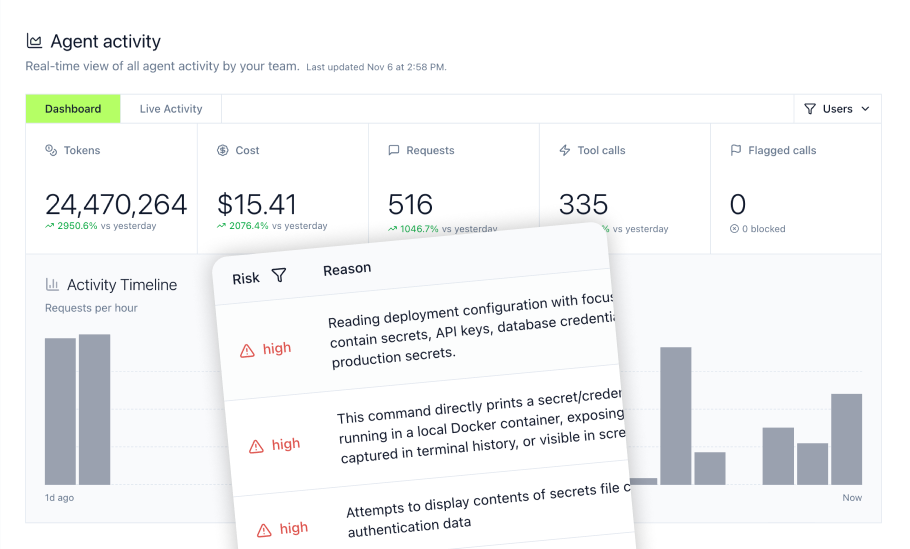
Gateway-only visibility misses AI activity occurring in developer tools like Cursor and Claude Code. MintMCP's Agent Monitor tracks agent activity in real-time across the organization, including MCP calls made outside the gateway through hooks in developer tools.
Detection capabilities include:
- PII exposure identification
- Credential leakage (API keys, tokens)
- Risky bash commands
- Prompt injection attempts
Enforcing consistent AI policies across the organization
MDM integration enables push of detect-only or enforce-mode configurations to managed developer machines. This supports consistent policy application across compatible coding agents such as Claude Code and Cursor, rather than every AI tool an employee may use.
Scalable Infrastructure: MintMCP's Role in Governing Open WebUI at Scale
Centralizing AI agent governance for enterprises
MintMCP provides enterprise-grade governance and infrastructure for AI agents using the Model Context Protocol. The platform addresses the "last mile problem" in enterprise AI by giving agents secure, governed access to internal systems without requiring extensive engineering overhead for each integration. MintMCP's MCP Gateway governs data and tool connections, while its Agent Gateway builds on that foundation with identities, permissions, memory, and monitoring for agents that work alongside users.
The Bundle architecture packages tool access, policy enforcement, and audit logging into single governance units per team or role. Each AI agent receives its own persistent identity with scoped credentials that can be rotated independently of human user credentials.
The 'last mile problem' in enterprise AI integration
Open WebUI handles the user interface layer, but connecting AI agents to enterprise data sources introduces complexity:
- Authentication against internal systems
- Authorization for specific operations (read vs. write)
- Audit trails meeting compliance requirements
- Credential management without shared service accounts
Leveraging MintMCP for secure and scalable AI deployments
MintMCP Gateway manages 50+ pre-configured connectors including Salesforce, GitHub, Slack, HubSpot, Notion, Linear, Gmail, and Stripe. Custom STDIO-based MCP servers from the community ecosystem can be hosted alongside these connectors with automatic OAuth wrapping.
Virtual MCPs (VMCPs) bundle multiple servers with role-based tool access, enabling administrators to create purpose-specific agent configurations without exposing unnecessary capabilities.
Practical Implementation: Integrating Open WebUI with Enterprise AI Workflows
Use cases for Open WebUI in different departments
Enterprise deployments typically serve:
- Legal and compliance: Query policy documents and case law without sending sensitive content externally
- Engineering: Search technical documentation, API specs, and architectural decisions
- Customer support: Access CRM data and ticket history through conversational interface
- Data analysis: Query databases and generate reports using natural language
Connecting Open WebUI to internal systems securely
MintMCP Gateway facilitates secure connections through:
- One-click activation of pre-configured connectors
- OAuth brokering for MCP servers with redirect URI limitations
- Custom policy code execution on every tool call for inline DLP integration
Integration with existing DLP investments supports Bedrock Guardrails, GCP DLP, Microsoft Purview, Nightfall, and Skyflow.
Real-world examples of enterprise AI integration
Johannes Gutenberg University deployed Open WebUI to serve more than 35,000 university members while maintaining institutional control over the deployment and data pipeline.
Tool-call, prompt-submission, gateway, and audit logging with SIEM export capabilities enables organizations to route supported AI activity to OTLP-compatible platforms or Splunk for centralized security monitoring alongside other enterprise systems.
MintMCP: Enterprise-Grade Governance for Open WebUI Deployments
Organizations that successfully deploy Open WebUI at scale quickly discover that the interface layer represents only one dimension of enterprise AI governance. While Open WebUI excels at providing users with a unified chat experience across multiple models, production deployments require a comprehensive governance framework that extends far beyond what any single interface can provide.
MintMCP fills this critical gap by delivering centralized governance infrastructure specifically designed for enterprise AI operations. The platform's dual-gateway architecture addresses both data connectivity and agent identity management. The MCP Gateway secures tool and data access with OAuth 2.0 brokering, granular permission controls, and real-time policy enforcement across 50+ pre-configured enterprise connectors. Meanwhile, the Agent Gateway provides agent identities, scoped permissions, memory, and audit trails. Agent Monitor adds hook-based activity monitoring for supported coding agents such as Claude Code, Cursor, and Codex, while Open WebUI activity is visible to MintMCP only when relevant MCP traffic passes through the gateway.
This separation of concerns allows security teams to apply consistent policies when activity passes through the MCP Gateway or a supported Agent Monitor integration. MintMCP's Agent Monitor tracks supported coding-agent activity through hooks, while the MCP Gateway records governed MCP traffic. Together, these controls can surface PII exposure, credential leakage, risky commands, and prompt injection attempts within their configured coverage. Organizations maintain their Open WebUI deployment while gaining the audit trails, compliance documentation, and centralized control that enterprise security frameworks demand.
For teams running Open WebUI in production, MintMCP transforms a powerful self-hosted interface into a complete enterprise AI platform with the governance, security, and operational controls that regulated industries require. The combination preserves Open WebUI's flexibility and cost advantages while meeting the authentication, authorization, audit, and compliance requirements that prevent most AI initiatives from reaching production scale.
Frequently Asked Questions
How does Open WebUI compare to ChatGPT Enterprise for organizations with strict data residency requirements?
Open WebUI can provide organization-controlled storage and inference when it is deployed with local or private model endpoints. When external model providers are connected, prompts and responses are sent to those providers. ChatGPT Enterprise also offers data residency and, for eligible customers in supported regions, inference residency. Air-gapped requirements generally call for self-hosted infrastructure, but Open WebUI is one of several possible self-hosted options.
What database migration path should organizations follow when scaling beyond the default SQLite configuration?
Start with PostgreSQL migration using the community migration tool before enabling multi-instance deployments. Configure the DATABASE_URL environment variable to point to your PostgreSQL instance, run the migration script during a maintenance window, and verify data integrity before switching traffic. Redis configuration (WEBSOCKET_MANAGER=redis and WEBSOCKET_REDIS_URL) should be completed simultaneously to avoid session management issues in load-balanced environments. Plan and test the migration within a maintenance window, with downtime determined by database size, backup and restoration procedures, and deployment architecture.
Can Open WebUI integrate with MCP servers for expanded tool access?
Open WebUI natively supports Streamable HTTP MCP servers starting in v0.6.31, while the MCPO adapter remains useful for stdio or SSE-based servers. An external gateway is optional when organizations need centralized cross-client governance, hosted connector operations, per-agent identities, or unified policy and audit controls beyond the Open WebUI instance. MintMCP hosts and operates MCP servers with auto-scaling and sandboxed execution per connector, eliminating the need for organizations to manage Kubernetes pods or container orchestration for the connector layer. The combination of Open WebUI as the user interface and MintMCP as the governance layer provides comprehensive enterprise AI infrastructure.
What ongoing maintenance burden should IT teams expect after deploying Open WebUI in production?
Maintenance effort varies by deployment size and operating model. Use version pinning, tested backups, staging validation, monitoring, and a defined process for applying security updates. Critical vulnerabilities may require rapid deployment processes once fixes are available. Enable OpenTelemetry and structured logging (LOG_FORMAT=json) before production launch to support troubleshooting. Organizations with limited DevOps capacity should consider managed alternatives or budget for additional SRE support during the first year of operation.
How do organizations handle model switching and provider redundancy in Open WebUI deployments?
The Connections settings in the Admin Panel support multiple simultaneous providers. Configure multiple cloud and local providers to give users alternative models during outages. Automatic failover requires a separately configured and tested routing or load-balancing strategy. Users can switch between available models within conversations without losing context. For enterprise resilience, maintain at least one local model capability that functions during internet outages and configure task-specific model routing to balance cost, latency, and capability requirements across different use cases.